
Picture this: Last Tuesday, I’m gridlocked on I-95. Again. My GPS keeps adding minutes like it’s playing some cruel game. Coffee’s gone cold. Spotify’s run out of songs I actually like. And I’m sitting there thinking—there’s gotta be something better than this, right?
Turns out, there is. And it sounds absolutely insane until you realize it’s actually happening right now.
While you’re reading this, there are pods being tested in Nevada that’ll zip people from LA to San Francisco in less time than it takes to watch a couple episodes of The Office. I’m not making this up. Welcome to hyperloop technology in 2026—where sci-fi meets reality and your morning commute might never be the same again.
Okay, so here’s the deal without all the complicated stuff. You know trains? Cool. Now imagine one that floats using magnetic levitation (Maglev). Got that image? Perfect. Now suck most of the air out of the tube it’s traveling in—creating these near-vacuum conditions—and boom. You’ve got something that can hit 760 mph without breaking a sweat.
That’s basically what hyperloop technology is.
The concept isn’t brand new—there was this white paper floating around since 2013—but what is hyperloop transportation technologies doing in 2026? They’re solving a problem we’ve all had: getting from city to city without wanting to pull our hair out. New York to DC in 30 minutes? Dallas to Houston in 20? That’s the kind of ultra-fast intercity transport that makes airports feel like they’re stuck in the Stone Age.
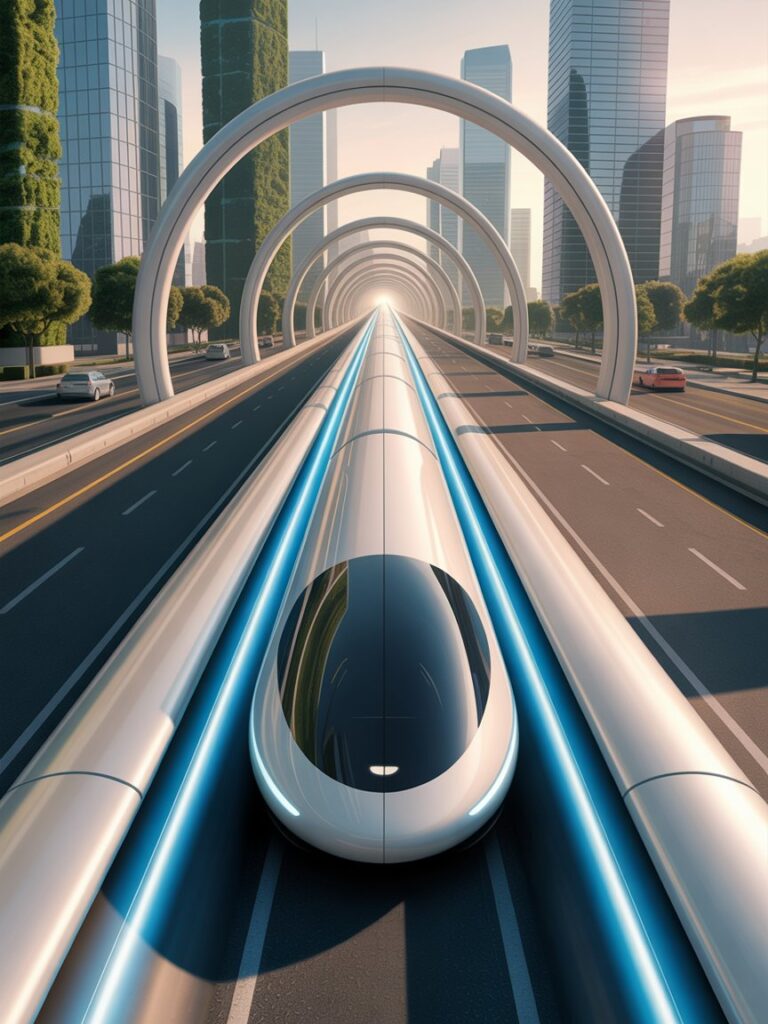
So how does hyperloop work, exactly? Alright, here’s the straightforward version without the engineering jargon: you’ve got passenger pods sitting inside these sealed tubes. Most of the air’s been pumped out. And without all that air pushing back, these things can go ridiculously fast using linear induction motors and magnetic levitation. The reduced pressure travel system basically means no friction—like that air hockey table at the arcade, except, you know, way more advanced and capable of carrying humans at insane speeds.
The tube propulsion systems work kind of like maglev trains, but hyperloop cranks it up to eleven by removing the biggest problem: air resistance. When you’re moving through a near-vacuum, all that aerodynamic drag that slows down planes and cars? Basically nonexistent. That’s how the hyperloop will travel at speeds that make regular high-speed trains look like they’re barely moving.
Let’s get real about where things actually are right now with hyperloop development and trends. In 2026, you can’t just hop online and buy a ticket yet—but we’re way past the “is this even possible?” stage. That ship has sailed.
Multiple companies are pushing this forward. Hyperloop Transportation Technologies (HTT) has test routes going in Europe and the Middle East. Virgin Hyperloop did their first passenger test back in 2020, and now they’re ramping up prototype testing progress at sites all over the United States—California, Texas, Nevada especially.
The hyperloop test projects happening right now? They’re split into two main tracks: passenger hyperloop systems for regular commuters and freight hyperloop solutions for moving cargo. And honestly, some experts think the cargo side might actually launch commercially first. Imagine shipping containers flying between ports at 600+ mph. That changes everything about logistics.
This is where it gets really interesting. Several states aren’t just talking about hyperloop infrastructure planning—they’re actually doing it:
California – The LA to San Francisco route is still the big one everyone’s watching. Hyperloop One news from earlier this year confirmed they’re actually buying land for a test segment near Bakersfield. If this works out, a trip that takes 6 hours driving or 1.5 hours flying (if you count all the airport nonsense) could drop to 35 minutes. Thirty-five minutes.
Texas – There’s a Dallas-Houston hyperloop route that’s got real funding behind it now. This 240-mile stretch that normally takes 4 hours of driving? Could be under 30 minutes. The Texas Department of Transportation is actually working with private companies on route optimization and getting regulatory approval sorted out.
Nevada – This state’s become the testing ground. There’s a 6-mile test track near Las Vegas where engineers are fine-tuning predictive maintenance systems and AI optimization for hyperloop operations. Nevada’s basically the hyperloop playground right now.
Florida – Miami to Orlando is another serious contender. Makes sense when you think about how much tourism drives traffic on that route. Early studies say this could be one of the first routes that actually makes money.
East Coast states like Virginia and North Carolina are also looking at EU hyperloop studies and regulation to see what they can learn from what Europe’s doing.
When people ask me “how fast will the hyperloop travel?”, the answer depends on which system and which route you’re talking about. Right now, the targets sit between 600 and 760 mph, though some engineers swear 800+ mph is doable on the longer, straighter routes.
Let me put that in perspective for you:
That’s not just faster. That’s a completely different ballgame. That’s revolutionary travel time reduction. New York to Chicago? Normally 19 hours driving or 2.5 hours flying with all the airport time. With hyperloop? 90 minutes, door to door.
Let me dig a little deeper here, because when you understand how hyperloop actually pulls this off, it makes the whole thing even more impressive.
The system’s built on several key pieces:
Magnetic Levitation (Maglev) – These pods literally float above the tube floor. Powerful electromagnets keep them hovering, which means zero friction. This Maglev and vacuum tube technology working together is what makes the crazy speeds possible in the first place.
Linear Induction Motors – These create electromagnetic fields that push the pod forward without anything actually touching. It’s like riding a wave of magnetic force.
Near-Vacuum Tubes – They pull about 99% of the air out of these tubes. With barely any air in there, drag becomes almost irrelevant. The reduced pressure travel system stays sealed and gets monitored constantly for safety reasons.
AI-Controlled Systems – The hyperloop technology in 2026 runs on artificial intelligence for pretty much everything—speed control, predictive maintenance, you name it. Sensors all over the place feed data to computers that optimize every single aspect of your trip.
Energy Efficiency – Here’s something that blew my mind when I first heard it: hyperloop systems can actually make more energy than they use. Solar panels sit on top of the tubes soaking up sun, and regenerative braking systems grab energy back when pods slow down. Makes it one of the most carbon-neutral high-speed transport options out there.
I know exactly what’s going through your head right now: “This sounds terrifying.” That was literally my first thought too. But when you actually look at the safety features, hyperloop technology might be safer than the car you drove this morning.
Here’s why: everything’s automated, so no human error (which causes most accidents anyway). The tubes are completely sealed, meaning weather can’t mess with operations—no snow delays, no fog problems, none of that. The low-pressure environment means fire can’t spread like it does in regular air. And since these pods never physically touch the tube walls, there’s zero chance of derailment like you get with regular trains.
That said, regulatory challenges are still huge obstacles. The Federal Railroad Administration and Department of Transportation are still writing the hyperloop safety and standards rulebook. They need solid answers on emergency evacuation, what happens if a tube loses pressure, and long-term structural stuff before this gets rolled out everywhere for commercial implementation.
Let’s talk dollars and cents. Because at the end of the day, that determines whether hyperloop becomes as normal as airplanes or stays some niche thing.
The hyperloop market forecast 2026 from analyst firms puts the industry at somewhere between $6-8 billion by 2030, with big hyperloop market growth continuing into the 2030s. Hyperloop investment and funding has picked up a lot, especially with public-private partnerships in hyperloop becoming more common.
Building this stuff costs serious money—estimates run from $20-60 million per mile, depending on what the terrain looks like and how dense the population is. But here’s the thing: operating costs are surprisingly cheap thanks to energy efficiency in hyperloop systems and the fact that you don’t need tons of staff.
Ticket prices should compete with flying, maybe 20-30% less on busy routes. That LA to San Francisco trip? You might pay $80-120 instead of the $150-200 you’d normally shell out for a flight.
The hyperloop high-speed travel concept works for both people and packages, though they approach it a bit differently.
Passenger Hyperloop is all about comfort and how often pods run. Think pods leaving every few minutes like a subway, except at 700 mph. Stations would be way smaller than airports—more like train stations—which makes the whole trip faster and easier.
Freight Hyperloop Solutions could completely transform shipping. Amazon, UPS, all the big shipping companies are paying close attention. Moving cargo at hyperloop speed means next-day delivery might become same-day or even same-hour for stuff within the region.
I’ve mostly been talking about US stuff, but hyperloop’s a worldwide thing. The Middle East has gone all-in, with Saudi Arabia and the UAE dropping serious cash on test tracks. China’s looking at hyperloop as part of their already crazy-impressive high-speed rail network. Multiple European countries are running studies for routes that cross borders.
The dream of a real global hyperloop network linking cities across continents? That’s still decades out. But regional networks covering big chunks of states or countries? Those could start running within 5-10 years. Picture a seamless sustainable transportation innovation network running from Seattle all the way down to San Diego, or Boston to Miami. That’s the endgame.
Here’s something people don’t talk about enough: hyperloop technology might be the greenest way to move people and stuff we’ve ever come up with.
Regular transportation wrecks the environment. Cars and trucks pump out tons of CO2. Planes are even worse when you look at emissions per mile. Even electric cars still need massive amounts of electricity, and most of that still comes from burning fossil fuels.
Hyperloop flips the script. Those solar panels on the tubes make more than enough power to run operations. The system creates literally zero emissions while it’s operating. And because it pulls demand away from highways and airports, it could make a real dent in decarbonization and green transport targets.
This carbon-neutral high-speed transport approach lines up perfectly with what tons of states and the federal infrastructure bill high-speed rail programs are shooting for. It’s not just about speed—it’s about being smarter and cleaner.
Speaking of funding, the federal infrastructure bill set aside big money for next-gen transit technologies. Most of it’s going to regular high-speed rail, but more people are realizing hyperloop deserves attention too.
Several states have put in for grants to study hyperloop infrastructure development as part of bigger transportation upgrades. The logic’s pretty simple: if we’re dropping billions on high-speed rail infrastructure anyway, shouldn’t we also explore tech that could be twice as fast and better for the environment?
Much as I love talking about hyperloop, I gotta be straight about what’s standing in the way. The biggest problem? Red tape.
The United States doesn’t have rules for hyperloop yet. The Federal Railroad Administration handles trains, but hyperloop’s not really a train. The FAA deals with air travel, but hyperloop doesn’t fly. The Department of Transportation is trying to create new categories, but government bureaucracy moves at a snail’s pace.
Insurance companies are still figuring out who’s liable if something goes wrong. Local governments are worried about zoning and property rights for building tubes through their areas. And there are real questions about maintaining this stuff long-term and how emergency response would work.
These regulatory challenges will probably determine the timeline more than the actual technology. The engineering’s basically solved—the paperwork’s still being sorted out.
Now you might be wondering what all this has to do with software development services and mobile app development. Here’s the thing: hyperloop technology in 2026 needs software just as much as it needs physics.
Every part of hyperloop operations requires serious software:
At Asapp Studio, we build exactly these kinds of robust, scalable, intelligent software systems that power next-generation transportation. Whether it’s artificial intelligence for route optimization or custom ERP systems managing operations, the expertise we’ve developed in mobile app development and web development applies directly to transport innovation ecosystems.
So here we are in 2026, standing on the edge of what could be the biggest change in transportation since someone invented the airplane. Hyperloop technology isn’t fantasy anymore—it’s engineering in progress.
Will you ride a hyperloop next year? Probably not. Five years from now? Maybe. Ten years? Pretty likely, assuming you live somewhere near one of these planned routes.
The super fast train USA projects we’re watching right now represent more than just getting somewhere faster. They represent completely rethinking how we move people and products across distances. They show what becomes possible when you combine sustainable mobility technology with cutting-edge engineering and smart software.
And honestly? I’m pumped. Because next time I’m stuck on I-95 watching my coffee go cold, I’ll know that somewhere in Nevada or California, engineers are perfecting the system that’ll make that traffic jam a thing of the past.
The future of transportation is coming. And it’s coming fast—like, 760 mph fast.
What is Hyperloop technology and how does it work?
Hyperloop is a high-speed transportation system where passenger pods travel through near-vacuum tubes using magnetic levitation at speeds up to 760 mph, eliminating air resistance for ultra-fast travel.
How fast will the Hyperloop travel in 2026?
Current Hyperloop systems target speeds between 600-760 mph, with some engineering studies suggesting 800+ mph is achievable on longer routes, making it faster than most commercial aircraft cruise speeds.
Is Hyperloop safe for passengers?
Yes, Hyperloop is designed with multiple safety features including automated systems eliminating human error, sealed tubes protecting from weather, and magnetic levitation preventing derailment risks.
When will commercial Hyperloop systems be available?
First commercial Hyperloop routes could launch between 2028-2030 in states like California, Texas, and Nevada, pending regulatory approval and completion of current test projects.
How much will Hyperloop tickets cost?
Projected ticket prices will be competitive with air travel, estimated 20-30% cheaper. A Los Angeles to San Francisco trip might cost $80-120 compared to $150-200 for flights.
Ready to innovate transportation with cutting-edge software? Contact Asapp Studio today and let’s discuss how our software development services, AI solutions, and IoT development can power the next generation of transportation technology.