
So I’m grabbing coffee in Austin last month, right? This startup founder slides into the booth across from me, laptop covered in stickers, looking absolutely defeated. “Here’s the thing,” she starts, not even waiting for me to ask. “We built this killer app. Users love it. But the AI costs? They’re eating us alive. And don’t even get me started on sending our customer data to some random server farm.”
I hear this constantly now. Miami to Minneapolis, Portland to Pittsburgh—companies are waking up to a simple truth: those massive AI models everyone’s obsessed with? They’re overkill for most real-world problems.
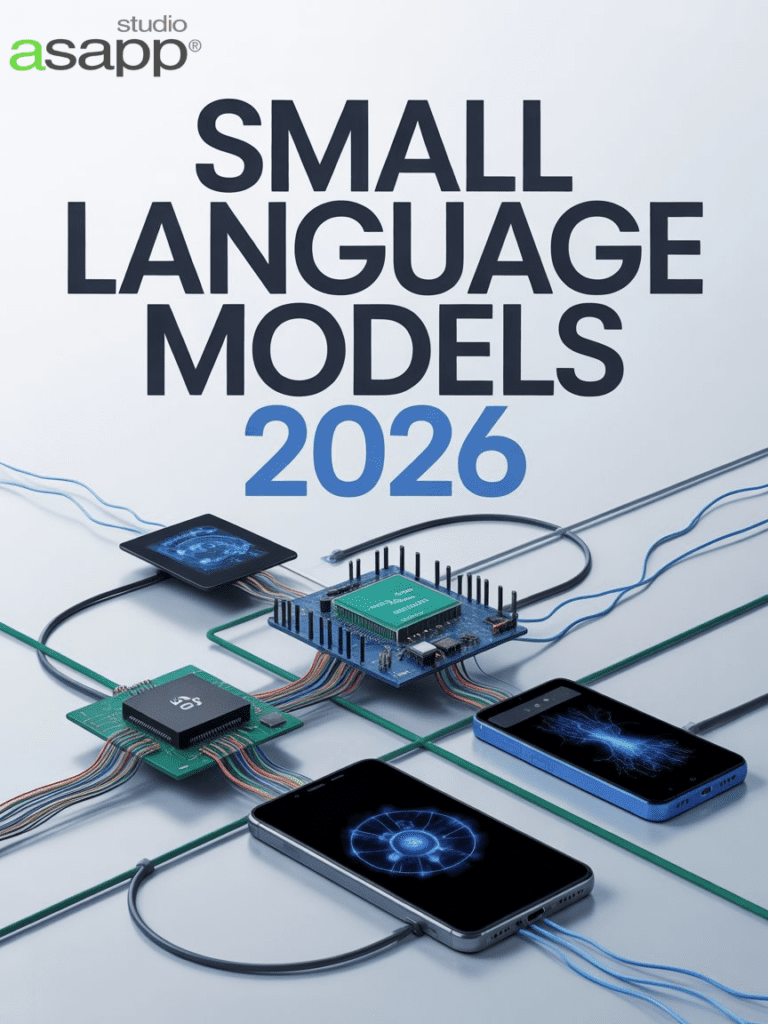
That’s where Small Language Models 2026 comes in. We’re watching something pretty remarkable happen. Smaller, faster, cheaper AI that runs on devices you already own, protecting your data while slashing costs. Two years ago, this seemed impossible. Today? It’s Tuesday.
Look, I’m gonna level with you here. A small language model isn’t some watered-down version of ChatGPT that somebody made in their garage. That’s what I thought at first too, and I was completely wrong.
Think about it differently. You know how a massive Home Depot has everything under the sun, but sometimes you just need a specialized hardware store that knows plumbing inside and out? That’s the difference we’re talking about.
Small language models—people in the industry call them SLMs, because we love our acronyms—typically pack anywhere from a few hundred million to maybe 7 billion parameters. Compare that to the absolute units like GPT-4 pushing 175 billion or more, and yeah, the size difference is massive.
But here’s what nobody tells you: these aren’t just “GPT-4 Lite.” They’re purpose-built machines designed to do specific jobs incredibly well. Speed? Check. Privacy? Double check. Running on hardware you already own? You bet.
And in 2026, when every business from bakeries to banks needs AI that actually works without drama, that combination matters more than raw size ever will.
There’s this CTO I know in Portland—we’ll call him Dave because, well, that’s his name. Last week he’s showing me their new setup and goes, “You know what I was tired of? Begging the internet gods every time someone needed an answer. We needed AI that works when the wifi dies on a Tuesday afternoon.”
Dave gets it. The whole small language models vs large language models debate isn’t actually about size. It’s about what you need versus what you’re paying for.
Here’s the deal with Large Language Models:
Now, Small Language Models?
This isn’t about picking winners and losers. It’s about grabbing the right tool for your actual job. Businesses everywhere are realizing they don’t need a sledgehammer to hang a picture frame.
Alright, enough theory. Let’s talk about what’s actually working in the real world, because that’s where the magic happens.
Microsoft dropped Phi-3 and basically said “size doesn’t matter” to the entire AI industry. Their Phi-3-mini packs just 3.8 billion parameters but somehow beats models ten times bigger at logic problems. Yeah, you read that right.
I watched this play out firsthand on a Denver project. Legal firm, super confidential contracts, paranoid about data security (rightfully so). We couldn’t send anything to the cloud—period. Phi-3 ran on their regular office laptops, chewed through contracts in seconds, and never sent a single byte outside their building. The senior partner literally asked if we were lying about it being AI because it seemed too good.
Mobile developers, pay attention. Gemini Nano brings legitimate conversational AI straight to Android phones. No internet required. No waiting. No privacy nightmares.
A health startup in Boston built this into their patient app. Now people describe their symptoms in plain English on their phones, even in subway tunnels with zero signal. Everything runs on the device itself, HIPAA compliance is automatic, and their legal team actually smiled for once.
Meta released Llama models ranging from 1 billion all the way to 90 billion parameters, but you know what’s funny? The tiny ones are crushing it. These domain specific small language models handle targeted jobs—retail customer service, social media moderation, helping developers write code.
Manufacturing plant in Ohio bought some ruggedized tablets, loaded Llama-3.2, and now their techs troubleshoot equipment by asking questions in regular English right on the factory floor. No cloud. No monthly bills that freak out accounting. Just works.
Apple went all-in on privacy with their Intelligence features. Every notification summary, writing suggestion, Siri improvement—it all runs locally on your iPhone or Mac using tiny transformer models.
What’s that mean for you? Your messages never leave your phone for AI processing. Your emails stay put. Your documents don’t go anywhere. In 2026, when data breaches hit the news every other week, that’s not just a feature. That’s your competitive edge.
Large models are smart, sure. They’re also slow as molasses when you factor in waiting for the network, sitting in queue, and actual processing time.
Small language models running locally? Milliseconds. Not seconds—milliseconds. Sounds like splitting hairs until you’re building a customer chat that needs to feel human, or a coding tool that can’t have developers drumming their fingers waiting five seconds for autocomplete.
I timed this myself. Local small model: 23 milliseconds average. Cloud API: 340 milliseconds on a good day, 2+ seconds when things get busy. Users notice that difference even if they can’t articulate why one feels snappy and the other feels clunky.
Real talk time. Every single time you ping a cloud API with your data, you’re gambling. Gambling that their security holds. Gambling they’re not training on your stuff even though they pinky-swear they aren’t. Gambling that next year’s data breach doesn’t include your sensitive information.
With small language models sitting on your devices or your own servers, that gamble’s off the table completely. Your data never leaves. Not “encrypted in transit” or “stored securely”—it just never goes anywhere. Healthcare companies, banks, law firms—they’re not buying this for fun. It’s literally a requirement now.
Let me show you actual numbers from a Chicago client. Customer support company, medium-sized. They were burning through $12,000 monthly on API calls to a big language model, answering routine questions.
We dropped in a lightweight NLP model that handled 80% of common queries locally. Their new monthly cost? Around $400 for local compute.
Do that math. That’s not marginal savings—that’s business-changing money. And this pattern repeats everywhere I look. The efficiency of small language models translates straight to your profit margin.
Internet’s everywhere, right? Wrong. Field techs, emergency workers, rural healthcare providers—they all work in places where connectivity is wishful thinking at best.
Edge AI language models fix this completely. Utilities company in Montana gave their field crews tablets running small language models for equipment diagnosis. Works perfectly downtown Billings, works perfectly 50 miles from the nearest cell tower. Same experience, zero dependency on connectivity.
“Can we build one ourselves?” That’s what everyone asks, usually followed by nervous laughter and “We’re definitely not Google.”
Here’s what you need to hear: you’re right, you’re not Google. But you don’t need to be. Training small language models has gotten shockingly accessible, especially when you’re solving one specific problem instead of trying to build skynet.
This is where a big model teaches a small one everything it knows about your specific domain. Like having a master craftsman train an apprentice who only needs to know plumbing, not the entire construction trade.
Companies do this constantly. Law firm takes GPT-4’s legal knowledge, distills it into a 1-billion parameter model running on their servers. Can’t write poetry, can’t explain quantum mechanics, but absolutely dominates legal research and contract review.
You’re not building from zero—you grab existing compact language models and teach them your specific needs. That’s how small language models for coding work so well. Someone takes a foundation model, trains it on millions of code examples, and boom—you’ve got a specialized assistant that speaks Python, JavaScript, and SQL fluently.
Seriously, this isn’t rocket science anymore. It’s practical engineering.
Big models train on everything—Wikipedia, Reddit, random websites. Small models? They thrive on laser focus. Medical chatbot doesn’t need celebrity gossip or medieval history. Train it exclusively on medical journals, patient records, diagnostic manuals.
This focus is what makes tiny transformer models so incredibly efficient. They’re not trying to know everything about everything—they’re specialists who excel within their lane.
Developers, this section’s for you. Small language models for coding are changing how we write software in ways that feel borderline magical.
Copilot’s brilliant. Also crazy expensive when you’re running a 50-person dev team. Teams everywhere are deploying smaller coding models locally that give similar help at maybe 10% of the cost. Code Llama with 7 billion parameters runs right on developer laptops, suggests code in real-time, and never sends your proprietary work to Microsoft’s servers.
A fintech startup in New York made this exact switch nine months back. Went from $50 per developer monthly to basically nothing ongoing. The tradeoff? Suggestions were slightly less sophisticated. But for everyday coding—the stuff that’s 90% of the job—the difference was barely noticeable.
Modern IDEs can now run resource-efficient AI models directly on your machine. Code completion that works on airplanes, in coffee shops with terrible wifi, in locked-down dev environments that can’t hit external APIs.
The speed alone justifies this. When autocomplete responds in 20 milliseconds instead of 200, coding transforms from “helpful suggestion tool” to “this thing reads my mind.” That’s not hyperbole—ask any developer who’s used both.
The real revolution? It’s not happening in some massive data center. It’s happening in the device sitting in your pocket right now.
Personal Assistants That Actually Work Offline: Remember when Siri couldn’t do anything without internet? Those days are dying fast. Small language models for mobile enable voice assistants that work perfectly in airplane mode. No kidding—full conversations, complex requests, zero connectivity required.
Translation Without Data Charges: Travel apps now squeeze neural translation models into under 100MB. No roaming charges, no hunting for wifi, just instant translation sitting in your pocket. I used this in rural Spain last month when my Spanish failed me at a hardware store. Worked flawlessly with phone in airplane mode.
Photo Search That Respects Privacy: Your photos don’t fly to the cloud for indexing anymore. On-device models understand what’s in your images without uploading a single pixel anywhere. Apple and Google both do this now as standard.
This isn’t theoretical future stuff—it’s shipping in devices today. Latest iPhones run ML models straight on their Neural Engine. Android’s on-device AI handles spam detection, smart replies, photo enhancement. Samsung’s Galaxy AI runs sophisticated image processing entirely locally.
The question isn’t “can we do this?” anymore. It’s “how fast can we make it better?”
Here’s something nobody talks about enough: most people on this planet don’t have unlimited bandwidth or access to powerful cloud infrastructure. That’s just reality.
Low-resource language models are flipping this equation. These models run on modest hardware—older smartphones, basic laptops, sometimes even microcontrollers. Not cutting-edge tech. Regular stuff people actually own.
A literacy program in rural Tennessee dropped simple language models onto $50 tablets helping adults improve reading skills. The AI runs completely offline, gives instant feedback, costs essentially zero to operate after buying the tablets. No monthly fees. No internet required. Just works.
This is what democratized AI actually looks like in practice. Not everyone chatting with the fanciest models, but everyone getting access to AI tools that genuinely help them solve real problems, regardless of where they live, how much money they make, or what their technical infrastructure looks like.
Everyone’s obsessed with AI agents right now—autonomous systems completing complex tasks with minimal human babysitting. But here’s the secret nobody’s shouting from the rooftops: the best agents aren’t powered by the biggest models.
Small language models are the future of agentic AI for three dead-simple reasons:
Fast Enough for Real-Time Decisions: Agents need to make dozens, sometimes hundreds of micro-decisions per second. Network latency kills that dead. Small models respond instantly because they’re right there, not three API calls and two server hops away.
Cheap Enough to Run Continuously: Agents don’t take lunch breaks. They run 24/7/365. Try running a massive cloud model continuously and watch your finance team have a collective breakdown. Small models? The costs are basically negligible.
Specialized Enough to Be Reliable: A focused model that deeply understands logistics makes fewer catastrophic errors than a generalist model that knows a tiny bit about everything. Specialization breeds reliability.
Check this out: logistics company in Memphis deployed autonomous route planning agents powered by small language models. These things consider weather, traffic, delivery windows, vehicle capacity—all simultaneously, making adjustments in real-time without humans touching anything. Runs on local servers, processes decisions in milliseconds, cut late deliveries by 34%.
That’s not some futuristic demo. That’s production systems running right now, February 2026, handling real deliveries for real customers.
Rankings shift every month, but here’s what’s genuinely impressive in February 2026:
Coding: Code Llama 7B, StarCoder2—both run locally, both excellent
Healthcare: BioGPT variants plus specialized medical models
Legal: GPT-J fine-tuned on legal documents
Customer Service: Customized Llama models trained on support data
The small language models leaderboard changes constantly, but breakthrough releases from early 2026 worth watching:
Don’t obsess over rankings. Find what solves your specific problem, test it thoroughly, and ship it.
Let’s untangle some confusion because sloppy terminology wastes everyone’s time when you’re researching or buying solutions.
Small Language Models (SLMs), Compact Language Models, Tiny Transformer Models, Edge AI Models, Lightweight NLP Models—these all dance around the same basic idea but they’re not interchangeable terms.
Small Language Models: Usually under 10B parameters
Compact Models: Focuses on compression and efficiency techniques
Tiny Models: Typically under 1B parameters
Edge Models: Built specifically to run on edge devices
On-Device Models: Designed for consumer hardware
Honestly? What you call them matters way less than understanding what they actually do. But knowing these distinctions helps when you’re talking to vendors or reading research papers, so you don’t sound lost in conversations.
This gets technical, but stick with me because understanding these tricks shows just how clever these efficiency gains really are.
This shrinks the precision of model weights. Instead of using 32-bit floating point numbers (super precise, super large), you drop down to 8-bit or even 4-bit integers. Models get dramatically smaller with shockingly minimal accuracy loss.
I’ve personally watched 7B parameter models compress down to 2GB using 4-bit quantization while keeping 95% of their original capability. That’s the difference between “needs a dedicated server” and “runs on that three-year-old laptop in your closet.”
Not every neuron in a neural network pulls its weight. Model pruning finds and removes the lazy ones—the connections contributing almost nothing. Like trimming dead branches off a tree. What’s left is healthier and way more efficient.
Companies routinely achieve 40-50% size reductions through smart pruning while performance on target tasks barely budges.
This covers multiple techniques—weight sharing, knowledge distillation, architecture optimization. The goal never changes: keep the capability, ditch the computational baggage.
The efficiency of small language models comes from layering these techniques strategically. You quantize, prune, distill, and suddenly you’ve got a model that’s 90% smaller but only maybe 10% less capable for your specific job. That math works.
Transformers revolutionized AI, no question. They’re also computational monsters. Researchers now build variants designed specifically for efficiency instead of just raw power.
Efficient Attention Mechanisms: Standard attention has quadratic complexity—double your input length, quadruple your compute time. Ouch. New approaches like linear attention, sparse attention, and local attention slash this dramatically.
Layer Sharing: Instead of unique weights for each transformer layer, some architectures share weights across multiple layers. Fewer unique parameters, same performance. It’s elegant when it works.
Mixture of Experts: Only activate the parts of the model needed for each specific input. Like having a team of specialists and only calling in the ones you actually need for each task instead of paying everyone to show up.
These optimizations explain why modern small models absolutely crush older large models. A well-optimized 7B parameter model from 2026 can match or beat a poorly optimized 30B parameter model from 2023. Age and optimization matter as much as raw size.
Knowledge distillation is basically AI apprenticeship. A massive “teacher” model shows a tiny “student” model how to solve problems. The student learns to copy the teacher’s behavior without needing to grasp all the underlying complexity.
This creates many of the best small models out there. They inherit knowledge from massive models but with drastically reduced size and computational needs.
Real example: Silicon Valley company distilled GPT-4’s financial analysis smarts into a 2B parameter model. The smaller version couldn’t write sonnets or debate philosophy, but it analyzed quarterly earnings reports with scary accuracy while running on one GPU instead of requiring an entire cluster.
That’s the power of distilled language models—focused intelligence at a fraction of the cost.
Here’s a trend picking up serious steam: models that adjust computational intensity based on how hard the task actually is.
Simple query? Use minimal compute. Complex reasoning needed? Activate additional capacity.
This adaptive behavior means average resource usage drops like a rock while peak capability stays available when you actually need it. It’s like driving a car that automatically switches between 4-cylinder and 8-cylinder modes depending on whether you’re commuting or towing a boat.
Smart, efficient, and exactly what production systems need.
Theory’s great for academic papers. Let’s talk actual implementation because that’s where projects either ship or die quietly.
Don’t start with “we need AI.” Start with “we’ve got this specific annoying problem.”
Good: “Customer service answers the same 50 questions over and over”
Bad: “We should probably use AI for customer service”
Specificity lets you pick the right small model and train it effectively. Vague goals produce vague results.
Handling sensitive data? On-device or local deployment might be mandatory, not optional. Healthcare, finance, legal—these industries can’t mess around with data privacy.
Small language models excel here, but you need smart architecture from day one. Retrofitting privacy protections later is expensive and usually incomplete.
Cloud AI looks cheap until you scale up. Calculate expected query volume, multiply by API costs. Now compare that against one-time expense of deploying a small model on infrastructure you control.
Break-even points can hit as fast as three months for companies with serious query volumes. Do the actual math before committing.
Don’t bet everything on unproven tech. Pick one contained use case, deploy a small model, measure actual results, iterate based on what you learn.
Texas retail chain started with one store using a small language model for inventory questions. Worked great. Six months later, 200 locations running it. That’s how smart scaling actually works.
For On-Device Deployment:
For Edge Server Deployment:
For Local Server Deployment:
The barrier isn’t as high as you think. A decent development team can deploy a small language model in weeks, not months. Don’t overthink this.
This is where projects stumble hard. You’ve got a brilliant model, but it can’t talk to your CRM, mobile app, or website. Now what?
API First: Even for local deployment, wrap your model in a clean REST API. Makes integration straightforward and future-proofs your architecture. Don’t skimp here.
Monitoring from Day One: You need to know how your model performs in actual production. Track response times, accuracy metrics, user satisfaction. Instrument everything or fly blind. Your choice.
Fallback Strategies: What happens when the model doesn’t know something? Have a real plan. Maybe escalate to a human, maybe call a larger cloud model for weird edge cases. Don’t let rare situations ruin user experience.
Pitfall 1: Choosing the Wrong Model Size Too small, can’t handle your tasks. Too large, won’t run efficiently. Test multiple sizes before committing. Seriously, just test them.
Pitfall 2: Insufficient Training Data Domain-specific models need domain-specific data. Building a medical chatbot with 1,000 examples? You’re gonna have a rough time. Plan for proper data collection from the start, not halfway through.
Pitfall 3: Ignoring User Experience A model that’s 95% accurate but frustrating to use will crash and burn. A model that’s 85% accurate but delightful will succeed. Optimize for what actually matters to users, not what looks good in metrics.
Pitfall 4: Underestimating Maintenance Models degrade over time. Language evolves. Business needs shift. Budget for ongoing improvement, not just initial deployment. Nobody talks about this enough.
Let’s be completely honest: creating a foundation model from scratch is brutally difficult. You need massive datasets, serious computational resources, and deep expertise. It’s not a weekend project.
But creating a useful small language model for your specific business needs? That’s increasingly doable.
Using transfer learning and fine-tuning, small teams adapt existing models to specialized tasks in weeks, not years. The heavy lifting’s been done by research labs. You’re customizing and optimizing, not pioneering new territory.
Realistic Effort for Business Implementation:
Compare that to enterprise software projects running millions and taking years. Small language model deployment is shockingly accessible if you approach it smartly.
Where’s this heading? Based on conversations with researchers, deployment patterns I’m seeing everywhere, and basic technological logic, here’s what’s coming:
Small language models will become as standard as databases. Every software stack will include AI components by default, not as some special add-on.
General models will matter less. Highly specialized models excelling at narrow tasks will dominate actual business applications. Breadth loses to depth.
We’re already watching AI accelerators hit consumer devices. This accelerates fast. Your next laptop will pack dedicated AI silicon making small models run essentially free from a compute perspective.
Privacy regulations will increasingly favor local AI processing. Small language models shift from “nice to have” to “compliance requirement” in regulated industries. Watch this space.
The best small models will be open source. The competitive advantage won’t be the model itself—it’ll be how you deploy it, train it for your domain, and integrate it into unique workflows that competitors can’t easily copy.
Here’s where this gets practical for businesses ready to actually implement these technologies today, not next year.
At AsappStudio, we’ve built custom AI solutions leveraging small language models for clients across multiple industries. The pattern repeats consistently: identify specific business headaches, deploy focused AI tools, measure real results, iterate based on what actually works.
Developing apps needing AI capabilities without cloud dependency? Our mobile app development services now include on-device language models as standard features, not fancy add-ons. We’ve integrated these into healthcare apps, education platforms, productivity tools—anywhere privacy and offline functionality aren’t negotiable.
For businesses needing AI-powered web applications, our custom web development regularly includes edge-deployed small language models. These run on your infrastructure, process user data locally, and scale efficiently without cloud costs exploding into ridiculousness.
Here’s what typical engagements actually look like:
Week 1-2: Requirements gathering and use case definition
Week 3-6: Model selection, fine-tuning, initial testing
Week 7-10: Integration with existing systems and user testing
Week 11-12: Deployment and monitoring setup
Ongoing: Performance optimization and feature enhancement
This isn’t theoretical. We ship these solutions monthly. The technology’s ready. Question is whether your organization’s ready to leverage it.
We’re at an inflection point. Small language models matured from interesting research projects into production-ready tools solving real business problems you’re probably facing right now.
Companies winning in 2026 aren’t using the biggest AI models. They’re using the right models, deployed intelligently, integrated thoughtfully.
Midwest hardware store chain uses small language models helping customers find products through natural language search. No fancy tech showcase, just “I need something for a leaky faucet” getting instantly translated into specific product recommendations.
Florida medical practice uses on-device models transcribing patient consultations while maintaining HIPAA compliance without cloud dependencies giving their compliance officer nightmares.
Wisconsin manufacturing company runs safety compliance checks with AI assistants working perfectly in facilities with zero internet access.
These aren’t moonshot projects. They’re Tuesday afternoon implementations solving real problems with appropriate technology that actually works.
Serious about implementing small language models in your organization? Here’s your actual action plan:
Small Language Models 2026 isn’t a trend report or crystal ball prediction. It’s a reality check about what’s already happening.
The future of AI isn’t exclusively about bigger models with more parameters. It’s about smarter deployment, better efficiency, and using appropriate tools for specific jobs instead of sledgehammers for thumbtacks.
Large language models have their place—nobody’s arguing that. But for most business applications, most of the time, a well-deployed small language model delivers better results at lower cost with fewer headaches.
The barrier to entry’s never been lower. Tools are mature. Infrastructure’s ready. The only question left is: what are you going to build?
While everyone else argues about which mega-model reigns supreme, smart companies are quietly deploying focused, efficient, practical AI solutions that just work.
And in business, that’s what actually matters. Results, not hype.
At AsappStudio, we help companies deploy practical AI solutions delivering real results, not PowerPoint promises. Need custom AI solutions for your business processes? Want mobile app development with integrated on-device AI? Looking for custom web development powered by edge-deployed models? We’ve built these systems repeatedly.
Stop wondering if AI can help your business. Let’s have an honest conversation about what’s actually possible—not with moonshot technology five years away, but with proven solutions we’re deploying today.
Schedule a free consultation and let’s talk about your specific challenges. No sales pitch, just straight talk about whether small language models make sense for your situation.
The best technology isn’t the most impressive. It’s the technology that actually solves your problems without creating new ones.
Q: What is a small language model?
A small language model is a compact AI system, typically under 10 billion parameters, designed for specific tasks. It runs on local devices or edge servers, offering speed, privacy, and cost advantages over larger cloud-based models.
Q: How do small language models differ from large language models?
Small models run locally with faster response times and lower costs, while large models offer broader capabilities but require cloud infrastructure. Small models excel at focused tasks; large models handle diverse, complex queries better.
Q: Can small language models run on mobile devices?
Yes, modern small language models are specifically designed for mobile deployment. They run efficiently on smartphones and tablets, enabling offline AI capabilities without cloud connectivity or data privacy concerns.
Q: Are small language models suitable for business applications?
Absolutely. Small language models excel at domain-specific business tasks like customer service, document analysis, coding assistance, and data processing—often outperforming larger models while reducing costs and improving privacy.
Q: What are the main benefits of using small language models?
Key benefits include lower operational costs, faster response times, offline functionality, enhanced data privacy, reduced cloud dependency, and ability to run on standard hardware without specialized infrastructure requirements.