
My neighbor runs a small insurance brokerage out of Temecula, California. Sharp guy. Knows his industry cold. For about two years he had a website that looked decent enough — honestly it looked like every other insurance brokerage site on the internet, because it was built on the same $59 theme half of them use. He was running Google Ads, getting traffic, watching people leave. Nothing was converting.
He finally sat down with an actual developer — not a theme tweaker, a developer — and said, look, just show me what you’d build if this were your business. Three months later he had a custom quote request tool, a client login portal, a back-end that talked to his CRM, and a site that loaded in under a second on mobile. His contact form submissions tripled in the first month.
That’s the cleanest explanation I know for what custom web development services actually do. It’s not magic. It’s just building something that fits your business rather than bending your business to fit what a template can do.
In 2026, that gap — between a purpose-built platform and an off-the-shelf website — is wider than it’s ever been. And yet plenty of businesses haven’t crossed it yet. This post is about why that needs to change, what Custom Web Development Services 2026 actually cover, and how to tell a real custom web development company from one that just uses the word.
People use the phrase custom web development to mean a lot of different things, and that’s a problem. Sometimes they mean “we changed the fonts and added a contact form.” That’s not it.
Real custom development means the code was written for your use case. The database structure was designed around your actual data. The workflows were built around how your customers behave, not how a theme designer imagined some generic visitor would. The integrations talk to your real tools — your CRM, your inventory system, your scheduling software.
A plumbing company in Nashville needs something completely different from a SaaS startup in Seattle. The Nashville business needs a booking tool that checks technician availability live, sends confirmation texts, and logs the appointment in their dispatch system. The Seattle startup needs a gated resource library, a demo request workflow, and a customer dashboard where accounts can track their usage. Neither of those works in a stock theme. Not well, anyway.
This is true whether you’re talking about custom web application development services, custom web portal development services for a multi-vendor platform, or custom php web development services handling high transaction volumes on the back-end. The principle doesn’t change: technology shaped around the business, not the business squeezed into technology.
When someone tells you they offer customized website development, press them on it. Ask what they built for their last client who had requirements that no plugin could handle. The answer tells you everything.
Things have shifted. Not in a dramatic announcement kind of way — just quietly, over the past couple years, the calculus on custom vs. template has moved decisively.
Google’s performance standards have tightened. Core Web Vitals — the metrics that affect where your site ranks — have stricter thresholds than they did two or three years ago. Theme-based sites built on top of page builders are structurally bad at this. Too many scripts loading, too much CSS that applies to nothing on your page, too many third-party elements you didn’t ask for. A properly built custom site is lean. It loads what needs to load and nothing else.
User patience has shortened along with it. The data on mobile abandonment is not ambiguous. Someone in Phoenix checking a contractor on their phone while standing in a parking lot is not waiting four seconds for your page to render. They’re gone. A slow site isn’t just a bad experience — it’s an active revenue drain.
AI-powered web development is the other big shift. In 2026 this isn’t a feature on a roadmap — businesses are actually deploying it. Smart product recommendations, semantic search that understands what people are actually looking for, behavioral automation that triggers based on what a user did or didn’t do, personalized content. None of this happens inside a standard theme. You need a custom web app development service built specifically for what you’re trying to automate.
And then there’s the plain competitive reality. The businesses winning in Chicago’s B2B market or New York’s financial services space or Los Angeles’s tech sector are not on the same Elementor theme as their competitors. They built something. It shows in their speed, their conversion rates, and their user retention. Every month they’re on that custom platform they’re pulling further ahead.
Here’s something that gets skipped in most blog posts about this: custom web development services USA aren’t a monolithic thing. The specific needs vary pretty significantly by region, and that has a real impact on what you should look for in a custom web development services company.
New York is where trust signals matter most. Finance, law, fashion, media, healthcare — these industries live and die on credibility. When a Manhattan investment firm or a Brooklyn law firm goes searching for the top web design company in New York, they’re not primarily comparing prices. They need something that feels authoritative the second someone lands on it. Fast, structured, unforgettable in the right way. Template sites feel like templates. People in those industries notice.
Chicago is heavy B2B — manufacturing, logistics, professional services, mid-market companies with real operational complexity. When a Chicago company hunts for a web design agency Chicago, what they often actually need is custom web design and development services that integrate with legacy systems. Old ERP platforms. Inventory tools that weren’t built to talk to anything modern. Order management systems from fifteen years ago. The development partner who can bridge those gaps is worth a lot more than one who just builds nice-looking pages.
Texas — Dallas, Houston, Austin — has grown fast and attracted a mix of relocated tech companies and ambitious local businesses that survived the economic shifts of the last few years. A web development agency in that market needs range. Scrappy startup builds on Monday, enterprise platform architecture on Wednesday. Both at a high level.
California — Bay Area, LA, San Diego — is the most demanding. Startups there have often seen real competition and know what good looks like. They want scalable web solutions from sprint one, not a promise to handle it later. API integration needs to be clean because they know there will be ten more integrations within a year. They want UI/UX Services that come from actual user research, not aesthetic preference. AsappStudio’s web development services are built around this kind of demanding standard.
Florida, Georgia, Washington, Colorado — all growing, all watching local competitors build up real digital infrastructure. The website design companies in USA serving these markets are doing their best work right now.
Not everyone who uses the phrase custom web development services is offering the same thing. Here’s what serious work in this space actually covers.
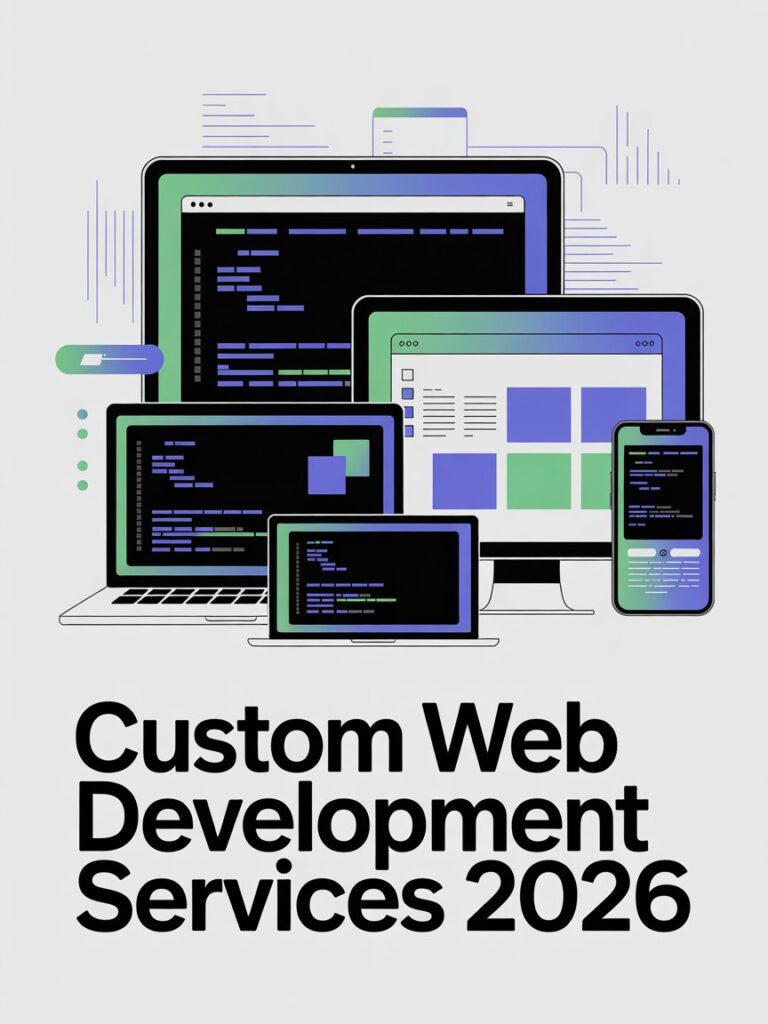
Front-end development is what your visitors interact with — layout, navigation, buttons, animations, how a page feels on a phone versus a 27-inch monitor. In 2026, good front-end work means fast, accessible, consistent across devices. Responsive web design is not optional, but “responsive” doesn’t mean “desktop layout shrunk down.” It means rethinking what information a user on a phone in Denver actually needs to do, and designing the experience around that from the ground up.
User experience (UX) / user interface (UI) is the discipline living inside this layer. It asks “what would make someone leave this page without doing what we want?” and then solves for it. Good UI/UX Services are about reducing the friction between a user’s intent and their action — not about winning design awards.
Back-end development is what most clients never see and consistently underestimate. Authentication, data processing, business logic, security enforcement, third-party communication — all of it runs in the back-end. Custom php web development services are a big part of this, building the transactional and relational logic that makes a web application actually work under real conditions.
When a single form submission needs to write to a database, send a confirmation email, update a CRM record, and fire a webhook to a third-party tool — that’s back-end work. When it works, nobody notices. When it doesn’t, the front-end looks fine and nothing actually happens.
Full-stack development handles both. One team owns the full stack — from database structure to browser interaction. For most businesses working with a serious agency like AsappStudio’s software development team, this is the cleanest setup. No translation layer between the people who designed the data model and the people building the interface. Fewer places for things to fall through gaps.
Custom web application development services are for when a website isn’t enough. You need something that does things — processes information, changes state, responds to user input in ways that require real logic, connects with systems outside itself. A patient intake form for a healthcare clinic in Phoenix. A quote builder for a commercial insurance broker in Charlotte. A driver dispatch system for a logistics company in Atlanta.
A serious custom web application development services company in USA spends serious time before writing any code — mapping user roles, data dependencies, error states, edge cases. That work is not overhead. It’s what keeps a six-month build from turning into a two-year rebuild.
Custom web portal development services are their own discipline. When you have different user types — customers, vendors, employees, administrators — who all need to interact with the same underlying data but through completely different interfaces and with completely different permissions, that’s a portal problem.
A wholesale distributor in Ohio where retailers can check inventory, place orders, and track shipments — while the internal team manages pricing, fulfillment, and relationships from a different view. A franchise network in Texas where individual franchise owners see their location data and regional managers see rollup reports. A healthcare platform in Florida where patients, nurses, and billing staff each see exactly what they need and nothing they shouldn’t. These require careful architecture, role-based access that actually works, and a database design built for concurrent users and complex queries.
Ecommerce web development services in 2026 are a different conversation than they were in 2020. Headless CMS development has become a real option for brands that want to push the same product data to a website, a mobile app, and a point-of-sale display without running three separate systems. Speed is the dominant variable in ecommerce — Asapp Studio’s ecommerce development services are built performance-first, because slow checkout is a revenue leak at every price point.
If you’re building software other businesses will pay to use, the requirements go up another level. Custom web app development service for a SaaS product means multi-tenant architecture, clean API integration from the start, database design that can scale across thousands of accounts, and code quality that doesn’t create a wall of technical debt before you hit your first hundred customers. Getting the foundation wrong here is expensive. Getting it right is a real asset.
A mistake businesses make regularly: treating design and development as separate phases. Hire a designer for mockups, hand them to a developer, developer builds it.
This almost always creates problems. A designer working without a developer’s input will design things that are either impractical to build or slow when they are built. A developer working from static mockups without understanding design intent will make a hundred small judgment calls that add up to an experience that feels assembled from parts.
Custom web design and development services work because both disciplines are in the room at the same time. UI/UX teams and development teams at AsappStudio work in parallel — design decisions are tested against technical constraints, performance requirements shape the visual approach, and responsive web design choices are made together rather than retrofitted.
Custom website design services done this way also produce brand coherence. Your website is the first impression a potential customer in Seattle or Charlotte or Philadelphia gets of your business. It should communicate clearly and immediately who you are and what you do. That doesn’t happen when design and development operate independently and then get stitched together at the end.
The market is full of options and the quality difference between them is enormous. Here is how to actually tell them apart.
Look at real projects, not portfolio screenshots. Any agency can have a beautiful website. Click through to the actual work. Read the case studies. Does what they built look like something a real team uses every day to run a real business, or does it look like a comp created for a portfolio?
See if they push back. A great custom web development company will look at your situation and tell you things you didn’t ask to hear — what’s slow, what’s confusing, what you’re missing, what you’re overbuilding. An agency that agrees with everything you say and starts quoting immediately is not going to build you anything meaningfully better than what you have.
Ask directly about after launch. Website maintenance and support is the part where agency relationships either prove themselves or fall apart. Find out specifically what’s covered, how bugs are prioritized, what the SLA looks like, and whether you’ll be talking to the team that built it or a generic support inbox.
SEO architecture should come up without you asking. SEO-friendly web development isn’t an add-on feature. It’s semantic HTML, clean URL structure, properly compressed images, mobile-first indexing, structured data where it helps, and page speed that doesn’t crater your Core Web Vitals. If an agency positions SEO as something they can layer in later, that’s a red flag about their fundamentals.
Read third-party reviews. Clutch, GoodFirms, AppFutura — real clients leave reviews there that agencies can’t edit or remove. AsappStudio is listed and reviewed across all three.
Progressive web apps (PWAs) have settled into a genuine first choice for businesses that want mobile app experiences without the cost and complexity of maintaining a separate iOS and Android codebase. Offline functionality, push notifications, fast loading on patchy connections — these work in a browser now. For service businesses in mid-size US markets where app store downloads are low, a PWA often outperforms a native app at a fraction of the cost.
Headless CMS development is mainstream. The front-end is decoupled from the content management system, so content editors keep a familiar interface while developers build a presentation layer that’s fast, flexible, and not constrained by the CMS’s limitations. Brands running headless see load time improvements that directly hit their bounce rates.
AI-powered web development is where competitive advantages are being built right now. Product recommendations that actually know what a user might want. Search that understands intent, not just exact keywords. Chatbots that resolve questions instead of looping indefinitely. Content personalization that changes what someone sees based on what they’ve done before. AsappStudio’s AI development services help businesses implement these capabilities without needing a dedicated machine learning team.
Cloud-based web solutions have made serious infrastructure accessible to businesses that aren’t Fortune 500s. Autoscaling, global CDN delivery, serverless functions — when you get a spike of traffic from a piece of press coverage or a viral post, a properly architected cloud deployment handles it. A shared hosting environment does not. Digital transformation services for most businesses now start here.
Yes. Custom builds cost more upfront. A template might cost $2,000. A custom site might cost $12,000. A custom web application might cost $50,000. That’s real money and it’s a real comparison.
But the comparison isn’t complete if it stops there.
A template site that doesn’t convert is costing you money every single month. If you’re spending $4,000 a month on paid search and your site converts at 0.6% instead of 2.5%, the annual revenue difference is not a rounding error. You’re not saving money on the template. You’re paying less to get worse results.
Then there’s website redesign services — the project of tearing down what you built and doing it properly. Businesses in Houston, Miami, Atlanta, and Portland who’ve been through this know: rebuilding from a bad foundation almost always costs more than starting right would have. Technical debt accumulates. Code written around theme limitations becomes code that’s slow to extend, slow to load, and frustrating to maintain. The “cheap” site ends up being the expensive one over any meaningful time horizon.
Web development consulting before a single line of code is written is one of the most underspent investments in this whole space. Two hours with someone who’s built what you’re trying to build can save you from six months of building the wrong thing. AsappStudio offers exactly that conversation — before any commitment.
AsappStudio is headquartered at 43620 Ridge Park Dr., Temecula, California. Real office. Their development team works from Lahore, Pakistan, which gives clients the communication quality and accountability of a US-facing agency alongside the technical depth and efficiency of a mature distributed team.
The company has shipped real products across real industries — healthcare, logistics, fintech, retail, education, real estate. The project portfolio includes a fleet management platform, a women’s healthcare communication system, an NFT marketplace, a job auction portal, and a school management application. Not design mockups. Working software that clients use.
The services span the full range of what custom web development services company should cover:
Cross-platform compatibility is tested on every build — multiple browsers, screen sizes, operating systems. SEO-friendly web development is built into the architecture from line one, not added on at the end. The process — research, planning, development, launch — keeps clients in the loop at every stage. And ongoing website maintenance and support means the relationship doesn’t end when the project goes live.
AI integration inside web products is going from differentiator to expectation. Businesses building personalized experiences, intelligent search, and automated workflows into their platforms right now are creating advantages that are genuinely hard to close later. AI-powered web development is not a luxury feature for the next two years. It’s a competitive baseline.
Performance standards will keep getting stricter. What passes for fast in 2023 is average in 2026. High-performance web development — lean code, optimized assets, fast server response — is an ongoing discipline, not a one-time achievement. Future-proof websites are the ones built on architectures that can be tuned and improved continuously, not ones that require a full rebuild every three years.
Security keeps expanding in scope. Secure web development — proper authentication, encrypted data handling, dependency auditing, regular testing — is table stakes. The threat surface for web applications keeps growing as they handle more sensitive data and connect with more external services.
Headless and composable architectures will replace monolithic CMS setups for any serious content or commerce operation. The performance benefits and flexibility advantages are too consistent to ignore.
Custom software development that pulls together web, mobile, and AI into a single coherent product is where durable competitive advantages are being built. Not just for enterprise companies. For businesses of every size that decide to stop renting someone else’s infrastructure and start building their own.
A template is someone else’s best guess at what a generic business in a generic industry might need. It works fine until it doesn’t — until you want to do something the plugin wasn’t designed for, until a WordPress update breaks three things at once, until a competitor builds something better and you’re stuck wondering whether to patch what you have or start over.
Custom web development services 2026 is the decision to stop working around limitations and start building around your actual business. It’s a commitment to owning something that fits — your customers, your workflows, your growth path — instead of fitting yourself into something that was designed for everyone.
Whether you’re a startup in San Francisco, a healthcare company in Houston, a retailer in New York, a logistics operation in Chicago, or a service business anywhere in between — the question is the same: are you building something that belongs to you, or borrowing something that belongs to a theme developer in another country?
Let’s talk about what a custom build looks like for your business.
Q1: What are custom web development services and how do they differ from templates?
Custom web development services build your site or app specifically for your workflows and goals. Templates are generic layouts not designed for your actual business needs or processes.
Q2: How much do custom web development services cost in the USA in 2026?
Custom websites typically start at $5,000–$15,000. Full web applications with integrations and custom features range from $20,000 to $100,000+, based on scope.
Q3: How long does building a custom website or web application take?
Most custom websites take 4–10 weeks. Complex web apps with multiple roles and integrations usually take 3–6 months from discovery through launch.
Q4: Does AsappStudio handle both design and development for custom web projects?
Yes. AsappStudio delivers end-to-end custom web design and development — UI/UX, front-end, back-end, API integration, QA testing, and ongoing post-launch support.
Q5: Do custom web development companies in the USA offer support after the site goes live?
Reliable companies like AsappStudio offer post-launch website maintenance and support plans covering updates, security patches, bug fixes, and feature additions.