
Here’s something most blockchain articles won’t say upfront: a lot of blockchain projects from 2019 to 2022 failed. Not because the technology was broken, but because companies rushed in without a clear problem to solve. They hired blockchain development companies, built something, and then realized they’d essentially rebuilt a database with extra steps.
That era is over.
By 2026, the businesses investing in blockchain development in USA aren’t experimenting anymore. They’ve watched peers succeed, studied what worked, and come to firms like Asapp Studio with specific, tangible problems they need solved — not a vague desire to “get on the blockchain.”
A freight company in Ohio wants to stop losing $200,000 a year to disputed delivery documentation. A healthcare group in Minnesota needs patients to control their own records without a centralized server that could get breached. A real estate firm in Arizona wants to let smaller investors buy fractional stakes in properties that used to require $500,000 minimum. These are real conversations happening right now.
This guide covers blockchain development services in USA 2026 the way they actually work — not the conference talk version, but what you’d hear sitting across from someone who has been building this stuff for years.
You have probably read fifteen explanations of what is blockchain technology and come away feeling vaguely educated but not much clearer. So let’s try a different angle.
Picture a spreadsheet that lives on ten thousand computers simultaneously. Every time someone adds a row — records a transaction, logs an event, transfers ownership of something — all ten thousand copies update at the same time. Nobody owns the spreadsheet. Nobody can go in and quietly edit last Tuesday’s entries. The history is permanent.
That is the core of it. Distributed ledger technology means the record does not live in one place that can be hacked, corrupted, or manipulated. The data is spread across nodes, and each new block of entries gets cryptographically linked to the block before it — which is literally where the name “blockchain” comes from.
Now here’s what matters for businesses in 2026: the interesting part is not the storage mechanism. It’s what you can build on top of it.
Smart contracts are probably the biggest piece. A smart contract is a piece of code that lives on the blockchain and executes automatically when conditions are met. No middleman. No delay. No invoice sitting in someone’s inbox for three weeks. The contract runs itself.
Decentralized applications — dApps — are software products built on blockchain infrastructure instead of centralized servers. Crypto wallet development lets people hold and move digital assets without a bank holding the keys. NFT marketplace development lets creators sell digital ownership in things that used to be infinitely copyable. DeFi platforms let people lend, borrow, and trade without going through a financial institution.
All of that is built on blockchain technology. The ledger is just the foundation.
It is a fair question. Why blockchain is good does not have a single universal answer — it depends entirely on what problem you are trying to fix.
The honest answer: blockchain is good when you have multiple parties who need to share data but do not fully trust each other, and where that shared data needs to be permanent and independently verifiable.
Think about how many business situations fit that description.
A manufacturer and its twelve suppliers all need visibility into the same shipment data — but the manufacturer does not want to hand the suppliers access to its internal ERP. A patient transferring between three hospitals needs her complete medical history to follow her — but no single hospital should own that data. Two companies completing a large transaction need to know the payment released the moment delivery was confirmed — without waiting for a bank to manually process it three days later.
In all of these cases, blockchain is good because it creates a neutral, shared source of truth that nobody controls but everybody can trust.
The confusion comes when people try to apply blockchain to situations where a regular database would do the job better. If you have one company, one database, and no external parties who need to verify anything — you probably do not need blockchain. A good blockchain consulting team will tell you that honestly, too.
But where the use case fits? The advantages are real and measurable:
Transactions that used to take days happen in minutes. Records that used to require three departments and a lawyer to verify are instantly auditable by anyone with permission. Agreements that used to require escrow accounts and brokers execute automatically through smart contract development. Fraud that used to cost companies millions becomes extremely difficult when the ledger cannot be retroactively altered.
That is why blockchain is good. Not because it is impressive technology — because it solves specific, expensive, real-world problems better than what came before it.
The narrative around blockchain in USA shifted somewhere around 2024. The speculative crypto conversations faded — or at least moved to a different corner of the internet — and the enterprise conversations got louder and more concrete.
Federal agencies are using blockchain for document verification. Major banks are settling interbank transactions on private distributed ledger technology networks. Healthcare systems are piloting patient data portability on permissioned blockchain infrastructure. The Department of Homeland Security has explored blockchain for border control documentation. None of this is hypothetical. These are operational systems.
At the same time, the regulatory picture has gotten clearer. After years of uncertainty, there is more guidance now around cryptocurrency development, tokenization services, and what constitutes a security token versus a utility token. That clarity matters because regulatory ambiguity was the single biggest thing holding serious corporate investment back for years.
Blockchain development companies in USA are operating in a market that is both more competitive and more legitimate than it was three years ago. The shakeout happened. The companies riding hype without technical depth are mostly gone. What is left is a smaller set of firms with real engineering capability and actual deployments behind them — and a much more demanding buyer.
The demand for blockchain app development services in USA has expanded in a direction that surprised a lot of people: mid-market companies. The Fortune 500 pilots from 2019 are now production systems. But in 2026, the growth is coming from the $20M to $500M revenue companies — regional distributors, mid-size healthcare networks, community banks, logistics firms — who watched the big players deploy and decided it was time to follow.
That is where some of the most interesting blockchain project development is happening right now.
Before going deeper on individual services, here is the top 10 blockchain development services in USA 2026 that any serious blockchain development company should be able to deliver:
And beyond the top ten, the best blockchain development services in USA 2026 also include:
That is the list of blockchain development services in USA 2026 in full. Not every business needs all of it. Most businesses need three to five of these done exceptionally well, with the right platform choice underneath and genuine security discipline throughout.
The term gets thrown around loosely. Custom blockchain applications means the architecture is designed from scratch around your specific data model, your users, your governance rules, and your compliance requirements. You are not plugging into a template.
A good custom blockchain development USA engagement starts with a lot of questions before anyone writes a single line of code. At Asapp Studio, we start every blockchain engagement with a discovery process — sometimes two or three weeks — before proposing an architecture. Clients who have worked with other blockchain development firms and skipped this step tend to arrive carrying expensive technical debt they need us to fix.
Smart contract development is one of the more misunderstood services. A smart contract is not just “code that runs automatically.” The logic inside it needs to be airtight, because once deployed to a public blockchain, changes are difficult or impossible — and if there is a bug, people who want to exploit it will find it.
The best smart contract development company USA approach involves writing the contract, then auditing it independently, then testing it against attack scenarios before anything touches a live network. This takes longer and costs more upfront than skipping the audit. Every team that skipped the audit and got exploited will tell you the same thing afterward.
A dApp is a full application — frontend, backend, smart contract layer — built to run on blockchain infrastructure. The user experience does not have to feel technical at all. Some of the best dApps today look like completely normal web or mobile apps. The blockchain is running underneath, invisible to the user, doing the trust and verification work in the background.
Our mobile app development and web development teams work alongside our blockchain team on dApp projects, which is one of the real advantages of working with a full-service firm rather than a pure-play blockchain shop.
DeFi development is one of the higher-complexity categories. Building DeFi platforms that handle real money — lending pools, liquidity protocols, yield strategies — requires deep expertise in both the finance mechanics and the smart contract security implications. A bug in a DeFi protocol can drain millions in minutes, as history has shown too many times.
The best DeFi work happening in 2026 is built on formally audited code with multiple security layers and circuit breakers built in from the architecture stage, not bolted on later.
The NFT space looks very different in 2026 than it did in 2021. The speculative art bubble deflated, and what replaced it is actually more commercially interesting: NFT marketplace development for real-world use cases. Event ticketing with NFT-based access eliminates scalper fraud. Real estate title transfers using NFT ownership records cut through title insurance complexity. Brand loyalty programs using NFTs give customers something genuinely valuable instead of expiring points nobody uses.
Your blockchain product is only as trustworthy as the wallet your users interact with. Custom crypto wallet development — mobile wallet, browser extension, hardware wallet integration — needs to handle key management, transaction signing, multi-chain support, and recovery flows without exposing users to unnecessary risk. The UX of a crypto wallet is a security surface as much as it is a design problem.
Tokenization means converting real-world assets into digital tokens on a blockchain. The tokenized asset becomes fractionally ownable, tradeable around the clock, and verifiably authentic. Real estate, private equity, commodities, intellectual property, carbon credits — all of these are being tokenized by businesses that want access to new investor pools and faster settlement cycles. Tokenization services are one of the fastest-growing sub-sectors in this space right now.
Blockchain consulting is where most good engagements start. Before spending anything on development, you need someone who can tell you honestly: does blockchain actually solve your problem better than a conventional approach? If yes — which type? Public, private, permissioned? Which platform? What does governance look like? What are the regulatory considerations specific to your industry and your state?
At Asapp Studio, our blockchain consulting process is structured to answer these questions in weeks, not months — and we are not trying to create dependency on the consulting engagement. We want you to make a good decision, even if that decision is to wait.
Enterprise blockchain solutions are purpose-built for organizations where scale, compliance, and integration with existing systems are non-negotiable. Hyperledger-based deployments, private blockchain networks with role-based access controls, integration with SAP, Oracle, or Salesforce — this is complex work that requires both blockchain expertise and traditional enterprise software experience. Most pure-play blockchain firms lack the second half of that.
Most companies already have software running their operations. Blockchain integration services connect those existing systems — ERPs, CRMs, supply chain management platforms, financial systems — to blockchain networks without requiring a full replacement. The data flows between your legacy infrastructure and the blockchain layer, giving you the transparency benefits without burning down what already works.
This deserves emphasis separately: blockchain security and auditing is not optional. Every smart contract and every on-chain application should go through a formal security review before going live. This includes code review, vulnerability testing, access control verification, and economic attack modeling for anything touching DeFi mechanics. Our quality assurance team works in coordination with blockchain auditors on every production deployment we do.
One of the things that gets lost in general articles about blockchain development services in USA is how differently the technology plays out depending on where you are. The dominant industries in each state shape the use cases. The regulatory climate shapes what’s feasible. The local talent pool shapes who’s actually building it. Here’s the ground-level picture.
Silicon Valley and Los Angeles have the highest concentration of Web3 development activity in the country, and that has not changed in 2026. The Bay Area drives DeFi platforms, protocol development, and the more experimental edges of blockchain application. LA brings media and entertainment companies with real interest in NFT marketplace development, rights management, and creator monetization on-chain.
Asapp Studio is headquartered in Temecula, California — 43620 Ridge Park Dr. STE 310 — in the Southern California tech corridor, serving clients from San Diego through LA and across the state. The blockchain integration work we do for supply chain operations connected to LA’s port complex is some of the most practically impactful work we handle.
New York’s blockchain story is almost entirely driven by finance. Wall Street firms have been running distributed ledger technology pilots for settlement and trade confirmation since before most people were paying attention — and in 2026, those pilots are production systems handling real daily volume.
The New York Department of Financial Services has one of the more developed crypto licensing frameworks in the country. That regulatory clarity is what pushed a lot of previously hesitant institutional money into enterprise blockchain solutions for custody, compliance, and capital markets infrastructure.
Texas has built a blockchain ecosystem almost as significant as California’s, for completely different reasons. The energy sector — oil, gas, and a growing renewable energy industry — has adopted blockchain for energy credit tracking, grid management, and carbon offset tokenization. The Dallas-Fort Worth corridor produces serious blockchain development companies in USA focused on supply chain and logistics, which fits naturally with the state’s freight infrastructure.
Austin’s startup scene adds a consumer and Web3 development layer on top of that enterprise foundation. The combination makes Texas one of the more complete blockchain markets in the country.
Miami made a deliberate push to become a crypto hub several years back, and while the loudest hype of that moment has settled, what remains is a genuine cluster of blockchain businesses and talent. In 2026, Florida’s activity concentrates around crypto wallet development, DeFi platforms, and real estate — where the sector has moved faster than most industries nationally on tokenization services for property transactions.
Wyoming has passed more blockchain-specific legislation than any other US state. It was the first to legally recognize decentralized autonomous organizations, clarify digital asset custody rules, and create a regulatory pathway for special purpose depository institutions serving crypto businesses. For blockchain project development companies that need regulatory certainty, Wyoming is where you incorporate — even if your developers work remotely from anywhere in the country.
Chicago’s trading history makes it a natural home for smart contract development in financial contexts — derivatives, structured products, and insurance automation. The supply chain activity in and around Chicago’s logistics infrastructure is another major driver. Illinois healthcare systems have also been among the more progressive in exploring blockchain for patient data management and interoperability.
Seattle’s tech giants and the enormous cloud infrastructure industry they anchor have made blockchain integration services a significant business in Washington State. The dominant use case here is less about building new blockchains and more about connecting existing cloud infrastructure to blockchain networks securely and without disrupting operations.
Atlanta has quietly become one of the most important cities in the US for payment technology. More Fortune 500 payment companies are headquartered there than almost anywhere else. That background makes Atlanta’s blockchain development scene heavily focused on transaction processing, smart contract development for payment automation, and blockchain integration for financial operations.
Manufacturing and logistics define Ohio’s blockchain activity. Companies tracking parts through complex supplier networks, managing recall traceability, and automating purchase order confirmations are the core buyers of blockchain app development service in USA coming from this state. Columbus and Cleveland both have growing tech communities, and the use cases there are operational and enterprise-focused rather than consumer-facing.
Boston’s research institutions — MIT, Harvard, and the biotech cluster around the Longwood Medical Area — have made Massachusetts a leader in blockchain for healthcare. Clinical trial data integrity, drug supply chain authentication, and patient consent management are the primary applications. The academic influence means the blockchain work coming out of Boston tends to be technically rigorous in ways that stand out even against national competition.
Las Vegas’s entertainment economy has produced an interesting blockchain market. In 2026, the most active applications are NFT marketplace development for event ticketing and entertainment IP, and loyalty program tokenization for the hospitality sector. Nevada’s incorporation-friendly legal environment also makes it a common domicile for blockchain technology companies that want structural flexibility.
Arizona was one of the first states to legally recognize smart contracts and blockchain-based records, and the state has continued developing blockchain-friendly regulations. Real estate title companies in Phoenix and Tucson are actively exploring tokenization services for property transactions. The combination of regulatory clarity and a growing tech talent base is making Arizona one of the more interesting markets for scalable blockchain solutions in 2026.
Denver’s state government has been exploring blockchain for public records — land titles, business registrations, professional licenses. The outdoor economy has also produced applications around carbon credit tokenization, connecting blockchain infrastructure to the state’s environmental commitments.
Healthcare is Minnesota’s biggest blockchain story. The Mayo Clinic’s influence ripples through the entire state’s health sector, and blockchain for healthcare — patient-controlled records, insurance claim automation, prescription drug tracking — has more real traction in Minnesota than in most states.
Proximity to New York’s financial district defines New Jersey’s blockchain activity. Financial compliance, trade processing, insurance claim management — the use cases mirror what is happening across the Hudson River, scaled to fit the large insurance and pharmaceutical companies headquartered in the state.
| State | Dominant Use Cases | Primary Industries |
| California | Web3 development, DeFi, NFT marketplace development | Tech, Media, Finance |
| New York | Enterprise blockchain solutions, Settlement, Compliance | Finance, Legal, Insurance |
| Texas | Tokenization services, Energy, Supply chain | Energy, Logistics, Real Estate |
| Florida | Crypto wallet development, DeFi platforms, Real estate | Finance, Real Estate, Tourism |
| Wyoming | Regulatory compliant blockchain, DAO formation | Legal, Finance, Startups |
| Illinois | Supply chain, Healthcare blockchain, Smart contracts | Healthcare, Logistics, Finance |
| Washington | Blockchain integration services, Cloud | Tech, Healthcare, Retail |
| Georgia | Payment blockchain, Smart contract development | Fintech, Payments, Logistics |
| Ohio | Supply chain traceability, Manufacturing blockchain | Manufacturing, Logistics |
| Massachusetts | Healthcare blockchain, Digital identity, Biotech | Healthcare, Research, Biotech |
| Nevada | NFT marketplace development, Loyalty tokenization | Entertainment, Hospitality |
| Arizona | Smart contracts, Real estate tokenization | Real Estate, Finance, Legal |
| Colorado | Government blockchain, Carbon credit tokenization | Government, Energy |
| Minnesota | Patient data, Clinical trial integrity | Healthcare, Insurance |
| New Jersey | Financial compliance, Insurance blockchain | Finance, Insurance, Pharma |
The four industries where blockchain is delivering the clearest ROI in the United States right now are supply chain, healthcare, finance, and logistics. Here is what is actually being built.
Counterfeiting and supply chain fraud cost American businesses hundreds of billions annually across sectors. In food, a contamination event that takes two weeks to trace through conventional paper records takes seconds on a blockchain where every handoff was logged immutably at the time it happened.
Walmart’s implementation of blockchain for food traceability changed the conversation for the grocery sector years ago, and the ripple effect is still expanding. In 2026, mid-market food distributors, pharmaceutical companies managing drug supply chains, and electronics manufacturers tracking component provenance are all implementing scalable blockchain solutions to solve supply chain integrity problems their conventional software was never designed to handle.
Patient data portability is one of healthcare’s hardest persistent problems. A patient who sees five different specialists may have five different medical records in five different systems, with no reliable way to give any of them the full picture without faxing documents back and forth.
Permissioned blockchain networks — where the patient controls access and providers request it — are starting to change this fundamentally. The patient holds the cryptographic key. They grant access to provider A and revoke it from provider B. The record is complete, accurate, and theirs.
Beyond records, blockchain for healthcare is being applied to clinical trial data integrity, prescription drug authentication, and insurance claim processing through smart contract automation. These are not pilots anymore in most cases — they are production deployments.
Cross-border payments remain one of the clearest blockchain wins in finance. A traditional international wire transfer involves correspondent banks, reconciliation across multiple systems, and fees that stack up at each intermediary. The settlement can take two to five business days. A blockchain-based transfer settles in minutes with a fraction of the cost.
For DeFi platforms, the value proposition is access. Small businesses that cannot get bank loans can access lending pools. Individual investors who do not meet accredited investor thresholds can participate in asset classes previously reserved for institutions.
Logistics documentation — bills of lading, customs forms, proof of delivery — is still largely paper-based or PDF-based in many operations, which means disputes are common and expensive to resolve. Smart contracts that automatically release payment when GPS confirms delivery, or when a port authority signs off on receipt, eliminate those disputes before they start.
The smart contract development work in logistics is some of the most straightforward in the industry, which makes it one of the better starting points for companies that want to pilot blockchain before committing to a full enterprise deployment.
A question we hear constantly from clients: which blockchain should we build on? The honest answer is it depends on four things — how many transactions you need to process, how much those transactions can cost per unit, who needs access to the network, and what compliance requirements govern your industry.
Ethereum is the most mature smart contract platform in the world. The developer tooling is excellent, the security track record at the protocol level is solid, and the ecosystem of wallets, oracles, and integrations is enormous. If you are building anything that needs to connect to the broader DeFi ecosystem or interact with existing protocols, Ethereum is usually the default starting point. Gas fees on mainnet can be high for high-volume applications, which is why most serious applications now run on Layer 2 networks built on top of Ethereum’s base layer.
Solana is what you reach for when you need speed and volume at low cost. Solana handles tens of thousands of transactions per second. For gaming platforms, high-frequency applications, and NFT marketplace development at scale, Solana’s throughput profile makes it genuinely attractive. The network had reliability issues in earlier years; the infrastructure has matured considerably since then.
Hyperledger Fabric is the enterprise standard. It is a permissioned blockchain — meaning only approved participants can join the network and only authorized parties see specific data. This makes it the right choice for supply chain networks, healthcare data systems, and financial infrastructure where public visibility is completely unacceptable and regulatory compliance is non-negotiable. The majority of serious enterprise blockchain solutions USA are built on Hyperledger.
Polygon sits between Ethereum and the alternatives — Ethereum-compatible, much lower transaction costs, and broad ecosystem support. It has become the go-to choice for consumer-facing applications that need Ethereum’s security without the gas fees that would make small everyday transactions uneconomical.
Our blockchain technology experts at Asapp Studio assess the full picture before recommending a platform. We have seen too many projects locked into the wrong chain because someone defaulted to what was most familiar rather than what was most appropriate for the specific requirements.
Where will blockchain technology be in 5 years is a question worth taking seriously, because the answer shapes decisions you are making right now about which firms to partner with and which use cases to prioritize.
The short version: blockchain in 2031 will be invisible infrastructure. Most people interacting with blockchain-based systems will not know they are using it — the same way most people who browse the web have no idea what TCP/IP is. The technology becomes foundational precisely when it stops being interesting to talk about.
What gets us there:
Tokenization of real-world assets goes mainstream. Tokenized Treasury bills already exist. Tokenized real estate funds are live and trading. By 2031, a meaningful portion of private equity, real estate, and commodity markets will settle on blockchain rails. The tokenization services market is already measured in the billions. In five years the figure will look different in a significant way.
Regulatory compliant blockchain becomes the standard operating expectation. The regulatory frameworks being built right now — by the SEC, CFTC, OCC, and state-level regulators — will be mature and settled by 2031. Companies building with compliance in mind today will have infrastructure that works within those frameworks without expensive retrofits.
AI + blockchain integration matures into verifiable AI systems. This is the combination that will matter most across industries. AI makes decisions; blockchain creates auditable, immutable records of how those decisions were made and what data drove them. In healthcare, finance, and legal services especially, this combination becomes the standard for any AI application that needs to be trusted and independently audited.
Cross-chain interoperability solves fragmentation. Today, moving assets between Ethereum and Solana requires bridging protocols that introduce risk and friction. By 2031, interoperability standards will allow assets and data to move across networks as freely as data moves across the internet today.
Private blockchain and permissioned blockchain dominate enterprise. Public chains for consumer-facing applications; permissioned chains for enterprise operations. This division is already emerging clearly in blockchain adoption trends 2026 and will sharpen further over the next five years.
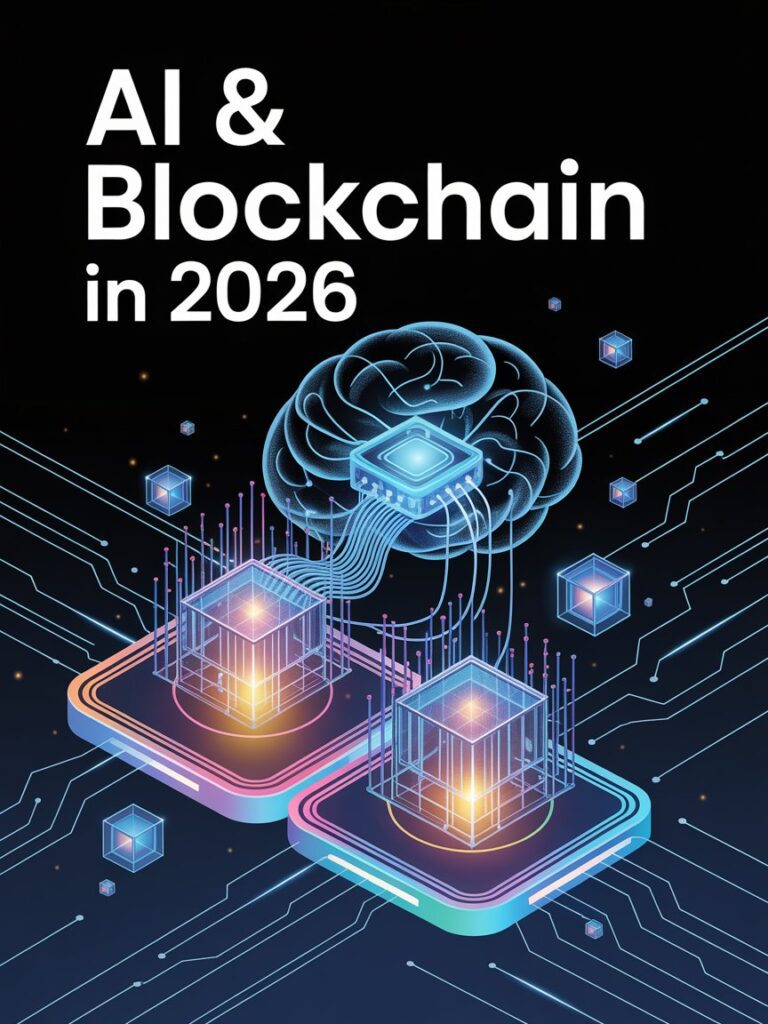
The combination of AI + blockchain integration is drawing more attention from serious enterprise clients in 2026 than almost any other single development in blockchain development 2026, and the reasons are concrete.
AI is getting very good at making decisions. The problem is that AI decisions can be opaque, biased, or wrong — and in regulated industries, “the algorithm decided” is not an acceptable audit trail for a regulator or a court. Blockchain creates the infrastructure for verifiable AI: every data input, every model version, every decision output is logged immutably on a chain that can be reviewed by anyone with appropriate authorization.
A few specific examples of where this is being built today:
An insurance company using AI to approve or deny claims needs to prove its model does not discriminate based on protected characteristics. If the decision process is logged on a blockchain, the compliance audit is straightforward — the record is there, unchanged, whenever it is needed.
A pharmaceutical company using AI to manage drug supply chain routing needs to prove that rerouting decisions were based on legitimate factors. Blockchain provides that proof automatically, because the system’s decisions were recorded in real time on a ledger nobody can edit.
A financial institution using AI for credit decisions needs to demonstrate compliance with fair lending regulations. Immutable AI decision logs make that demonstration clean and defensible.
At Asapp Studio, our AI development practice and our blockchain development practice collaborate on integrated systems where AI handles the intelligence layer and blockchain handles the trust and verification layer. It is not a simple integration, but when it is done well, the combined system does things that neither technology can deliver on its own.
There are a lot of blockchain development companies in USA in 2026. Hundreds of firms say the right things on their websites. So here is what actually sets us apart in practice.
We are a full-service technology company — mobile app development, software development, web development, AI development, e-commerce development, and blockchain development services — under one roof, with one team that communicates across disciplines. When your blockchain product needs a mobile frontend, we do not hand you off to a third party who does not know your system. The same company that built your smart contracts builds your application.
We have real case studies and a portfolio of actually delivered work. HealthCoin came to us with a specific problem; we built a working solution. B Minted needed an NFT marketplace; we built one. These are real projects with real clients, not pitch deck screenshots.
We are US-based. Our office is at 43620 Ridge Park Dr. STE 310, Temecula, CA 92590. When you need to talk through a regulatory question or a timeline concern with someone who operates in the same environment you do, that person is available.
We tell clients what they do not want to hear when it is necessary. If your blockchain idea is not suited to blockchain, we will say so and recommend a better approach. Our blockchain consulting process is specifically designed to surface that kind of misfit before you spend real money.
Here is what the actual engagement process looks like:
Weeks one and two — discovery: We ask a lot of questions. What problem are you solving? Who are the parties involved? What data needs to be shared? What systems does it need to connect to? What does your regulatory environment look like? What does success look like in six months and in three years?
Weeks three and four — architecture: Based on discovery, we propose a technical architecture. Which platform. What smart contract structure. How data flows between components. How governance works. How the system scales as volume grows. We present alternatives and trade-offs, not just a single recommendation we are pushing because it is what we know best.
Development phase: Clean, documented code with built-in testability. We build blockchain development projects the way we would want a firm to build something we had to maintain for the next five years.
Security audit: Before production deployment, everything goes through formal blockchain security and auditing. This is not negotiable.
Launch and ongoing support: We deploy, monitor, and stay involved. Blockchain networks upgrade. Regulations change. Business requirements evolve. We are not the kind of firm that ships a project and disappears.
If you want to understand what a specific blockchain engagement might look like for your business, reach out to our team directly. The first conversation is a consultation, not a sales call.
You can also explore our services page to get a broader sense of what we build, or read the about us page to understand who we are and how we operate.
Q1: What are blockchain development services in USA 2026?
Services covering smart contracts, dApps, DeFi, NFT marketplaces, wallets, tokenization, consulting, and enterprise blockchain built specifically for US business needs.
Q2: Why is blockchain good for American businesses in 2026?
It removes costly middlemen, creates tamper-proof records, automates agreements via smart contracts, and enables faster, cheaper cross-border transactions.
Q3: Which is the top blockchain development company USA?
Asapp Studio delivers full-cycle blockchain — consulting through deployment — on Ethereum, Solana, Hyperledger, and Polygon for businesses across all US states.
Q4: Where will blockchain technology be in 5 years?
Mainstream tokenized assets, verifiable AI systems, cross-chain interoperability, and invisible blockchain infrastructure powering finance, healthcare, and logistics.
Q5: How do I choose the right blockchain development service in USA?
Look for firms with real case studies, full-service capability, US presence, security auditing practices, and consulting that questions your assumptions before building.