
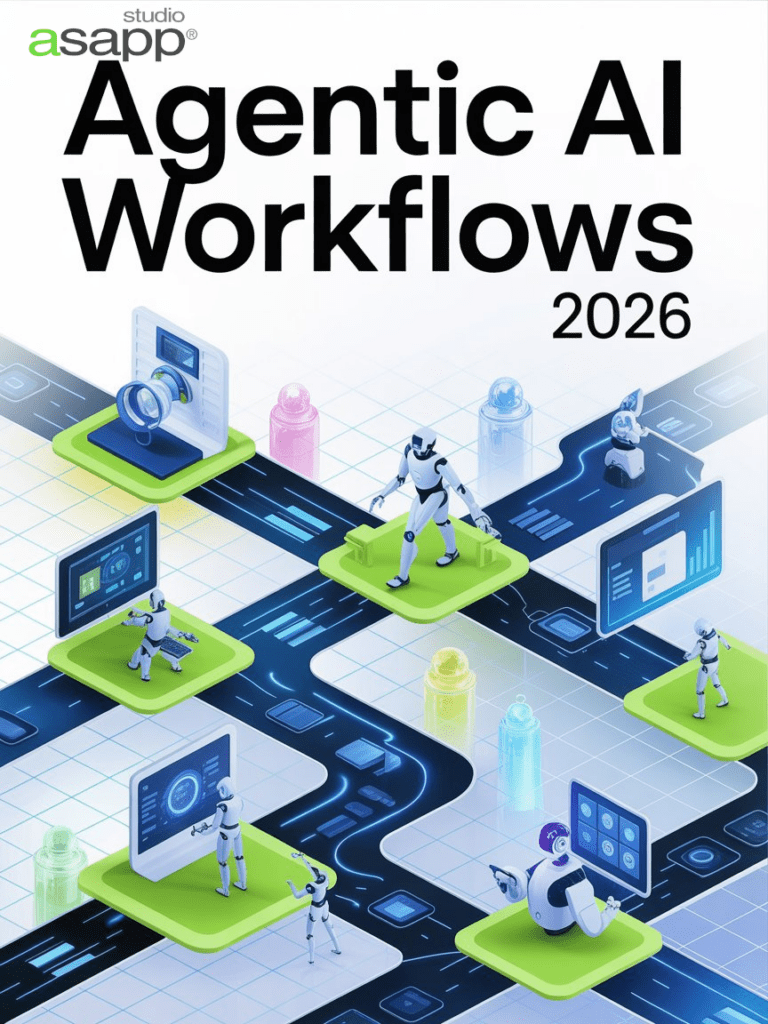
It’s February 2026, and if your operations team is still manually routing approvals or reconciling spreadsheets, the gap between you and top performers is widening daily. Agentic AI Workflows 2026 aren’t futuristic hype anymore — they’re live in production across California SaaS startups, Texas energy firms, New York finance houses, and Midwest manufacturers.
I’ve built and deployed these systems hands-on for the past 18 months. The leap from 2025 experiments to 2026 scaled wins is massive. Here’s the no-BS view of what’s actually working right now, why your US-based business can’t afford to wait, and how to start without burning six figures.
Agentic AI goes way beyond chat. It’s autonomous intelligence that:
Unlike scripted RPA or basic copilots, agentic workflows adapt in real time. That’s why people now talk about agentic ai workflow automation, ai agents workflow automation, and multi-agent ai coding workflows as the default for serious teams.
These aren’t toys. They’re running 24/7 with audit logs for compliance.
Early 2026 reports (UiPath, Anthropic, Gartner) show 35–55% gains in targeted processes when agentic workflows scale. The winners treat agents like digital employees, not tools.
We skip the buzzword salad. Process:
Need this custom-built?
What is agentic AI exactly?
Agentic AI is goal-driven, autonomous intelligence that plans multi-step actions, uses tools, self-corrects, and executes with minimal supervision — unlike traditional AI that only responds.
How are agentic workflows different from regular automation?
Regular automation uses fixed if-then rules. Agentic workflows reason dynamically, handle unknowns, iterate on failures, and adapt — making them far more flexible for real business complexity.
What will AI look like by 2030 based on 2026 trends?
By 2030, networks of specialized agents will orchestrate most repeatable knowledge work. Humans set strategy and handle nuance; agents own execution at massive scale.
How reliable are agentic AI systems today — how often is AI wrong?
With reflection loops, tool validation, and exception routing, production error rates sit at 2–6% on complex tasks. Graceful failure design + human oversight keeps risks low.
Where is agentic automation succeeding most right now in the US?
It’s dominating sales ops, finance back-office, software dev pipelines, supply-chain exceptions, and customer support tier-2 — anywhere decisions repeat but vary slightly.
Ready to turn agentic workflows into your unfair advantage in 2026?
Book a quick 30-min call — we’ll map one high-ROI process and show you a working prototype path.
Get your free strategy session →
Let’s make 2026 the year your team stops doing grunt work.
Asapp Studio – Building Agentic AI, Web & Mobile That Actually Delivers