
My friend Tony owns a tire shop in Akron, Ohio. Four bays, six guys, been running the place since 2011. Last spring he called me out of nowhere — not to talk about tires, but to tell me his nephew had set up something called an AI chatbot on his website over a single weekend.
Tony was genuinely annoyed at first. “I don’t need a robot talking to my customers,” he told me.
Three months later, he called again. Different tone entirely.
That chatbot had booked 34 appointments without anyone at the shop lifting a finger. It answered questions at midnight. It followed up with people who filled out a form and never called back. And it did all of this while Tony’s team was focused on the actual work in the bays.
Tony’s not a tech guy. He still doesn’t fully understand how it works. But he understands that his appointment book is fuller than it’s ever been.
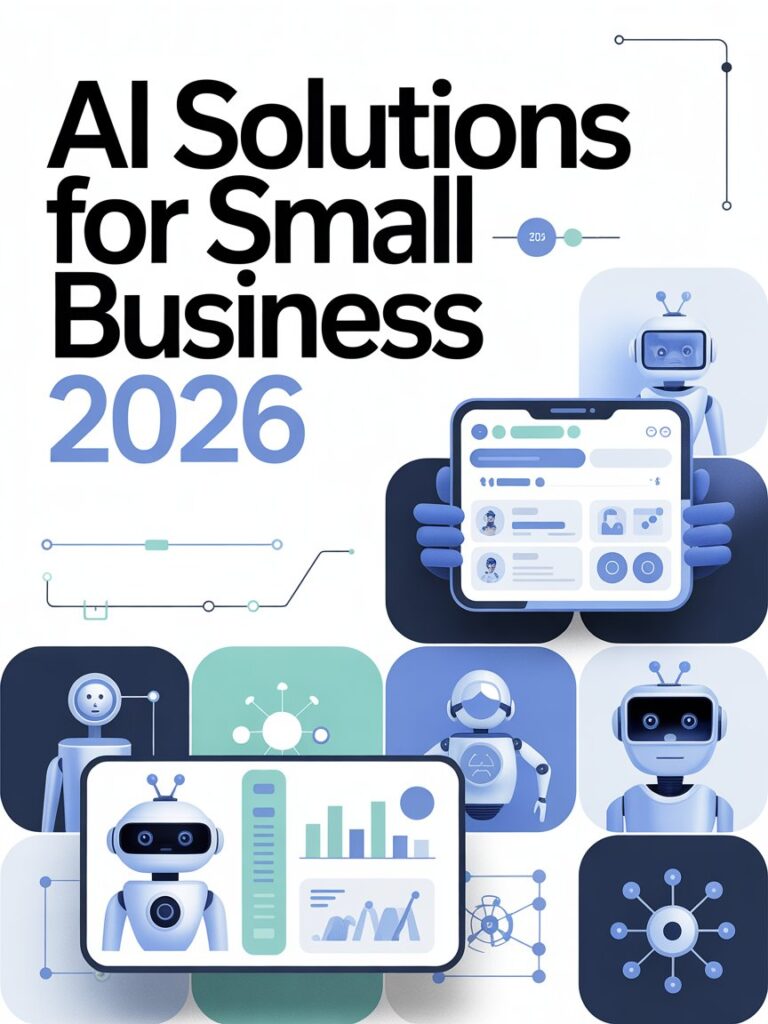
That’s the real story of AI solutions for small business 2026. It’s not about Silicon Valley. It’s not about billion-dollar companies. It’s about tire shops in Akron, flower shops in Nashville, and law offices in Phoenix figuring out that some of these tools actually work — and aren’t nearly as complicated or expensive as they assumed.
This guide is written for those business owners. Not the tech crowd. The people running real operations with real problems, trying to figure out whether any of this AI stuff is actually worth their time.
Short answer: yes. But only if you go in with clear eyes.
There’s a window open right now that won’t stay open forever.
The businesses that figured out Google search in 2008 had a massive head start. The ones that jumped on Facebook ads in 2013 built audiences for pennies that would later cost dollars. Every few years there’s a moment where a new tool levels the playing field — where a small outfit can compete with a big one if they move fast enough.
AI for small business is that moment. And 2026 is still early enough to matter.
Here’s what changed between 2022 and now. Three years ago, meaningful AI tools cost five to six figures to build or license. You needed a data scientist to configure them and a developer to maintain them. The barrier was real.
Today, an independent accountant in Denver can set up an AI-powered client intake system in an afternoon. A food truck operator in Austin can use AI automation for small business 2026 to handle catering inquiry responses while they’re prepping food. A therapist in Atlanta can use AI to draft intake paperwork, session summaries, and billing follow-ups — without hiring anyone new.
None of these people needed a technical background. None of them wrote code. They just found the right tools and gave them a serious try.
The U.S. Small Business Administration tracks more than 33 million small businesses operating in this country. The ones moving on AI business solutions right now aren’t the big sophisticated ones — they’re often the scrappiest. The solo operators. The family-run shops. The bootstrapped service companies. Because those are the businesses that feel the pain of being understaffed most sharply, and they’re the ones with the most to gain from tools that multiply their capacity.
The best AI tools for small business 2026 aren’t theoretical. They’re running right now inside businesses in your industry, in your market, competing for the same customers you are. The question is whether you’re going to let them build a lead while you wait.
When people ask how many AI companies are there, the number is genuinely staggering. Estimates in 2026 put it somewhere between 70,000 and 90,000 companies globally — with thousands of them based right here in the United States.
That figure is both exciting and exhausting if you’re a small business owner trying to make a practical decision.
Here’s a more useful way to think about it: you don’t need to know about all of them. You need to know about the five or ten tools directly relevant to your specific problem. The market being crowded is actually good for you — prices are competitive and options are plentiful.
Artificial intelligence companies in the small business space generally fall into a few categories.
The horizontal platforms — tools like HubSpot, Salesforce, and Zoho — that have been layering AI features on top of existing CRM and marketing infrastructure. These are solid if you’re already embedded in their ecosystem and comfortable with their pricing.
The vertical specialists — AI solutions companies built specifically for one industry. There’s AI software built specifically for restaurants, for law firms, for real estate agents, for e-commerce retailers. These tend to deliver better results because they’re not trying to be everything to everyone.
The custom builders — companies like Asapp Studio that design and build AI-powered tools from scratch around what a specific business actually needs. This costs more upfront but produces something that fits your operation precisely, rather than requiring you to adapt your workflow to the tool’s limitations.
When evaluating AI software for your business, the questions that actually matter are: Does this solve a specific problem I have right now? Can I get it set up without three months of onboarding? Can I measure whether it’s working? And is the pricing straightforward?
If the answer to all four is yes, it’s worth a real try.
Let me tell you the most common way small businesses lose customers without ever knowing it.
Someone finds you online at 8:47 PM. They’re ready to buy, or at least seriously interested. They visit your site, look around for a minute, and then — because they have a question they can’t find the answer to — they leave. They don’t call. They don’t fill out a form. They just go find someone else who made it easier.
AI customer service solutions for small business plug that hole directly.
The most practical starting point for most small businesses is an AI chatbot for small business on your website. Not a glorified FAQ button — an actual conversational interface that can answer questions, collect contact details, and route people to the right place.
A hair salon in Miami Beach set up a simple AI chat tool to handle all after-hours booking inquiries. The system asks a few questions — what service, preferred day, new or returning client — and either books directly into the calendar or flags the inquiry for a morning callback. The owner, who used to spend her first hour every morning returning messages, now uses that time to prepare for her actual clients.
AI customer service automation goes further than chatbots alone:
Automated review request texts sent after every completed service. Businesses that implement this consistently report that their Google review volume doubles or triples within 90 days — which directly moves local search rankings.
Smart email routing that reads incoming customer messages and gets them to the right team member without a human manually sorting the inbox every morning.
Voice AI for inbound calls — particularly valuable for trades like plumbing, electrical, and HVAC where after-hours emergency calls are both common and high-value.
For businesses handling significant call volumes, combining AI tools with your call center operations produces measurable improvements in response time and consistency without proportionally growing your team.
The bar here isn’t high. Most of your competitors are still relying on someone checking their phone when they get a free minute. Responding fast and consistently is itself a competitive advantage — and ai customer service solutions for small business make that achievable without adding staff.
CRM used to be a dirty word in small business circles. It meant expensive software that your sales team ignored, a bunch of contacts nobody kept updated, and a monthly subscription quietly draining your account.
AI CRM for small business in 2026 is different in ways that actually matter.
The core shift is that AI-powered CRM doesn’t just store information — it acts on it. It notices a lead went quiet after your second follow-up and suggests a different approach. It flags a customer who hasn’t bought in six months and prompts a re-engagement offer. It tells your salesperson which deals to prioritize today based on probability of closing — not just based on whoever asked first.
For a small business with a lean team, that kind of intelligence used to require a seasoned sales manager with sharp instincts and years of experience. Now a significant portion of that judgment is automated.
The AsappStudio CRM is worth evaluating if you’re considering options — it’s built for businesses that want AI-driven insights without the complexity and cost of enterprise platforms.
Whatever platform you choose, look for these things in an AI CRM for small business: lead scoring that updates automatically based on real behavior; follow-up automation that actually sends messages rather than just reminding you to send them; pipeline visibility without your team manually updating every record; and a mobile interface that works properly, because small business owners are rarely at a desk.
A mortgage broker in Phoenix I know used to lose track of leads regularly — not from lack of effort, but because she was managing 60 to 80 active conversations at once. After implementing an AI-powered CRM, she closed three deals within 60 days that she’s certain she would have lost to follow-up gaps before. That’s not a feature demo. That’s real money.
Marketing is where most small business owners feel the most scattered.
You know you should be posting on Instagram. You know you should be sending emails. You know you should be running Google ads, keeping your Google Business Profile updated, writing blog posts, and doing a dozen other things — all of which require time you genuinely don’t have.
AI marketing tools for small business don’t make all of that disappear. But they make it dramatically more manageable.
A landscaping company in suburban Chicago is using AI to generate a full month of social media content — captions, image prompts, hashtag sets — in about two hours at the start of each month. One person. Two hours. Thirty days of consistent posting across three platforms.
A boutique clothing retailer in Scottsdale is using AI to write promotional email campaigns. She gives the AI a brief — “fall collection launch, 20% off first order, target women 30-50 who care about sustainable fashion” — and gets five draft emails back in under two minutes. She picks the strongest one, adjusts the tone to match her voice, and sends it.
A contractor in Charlotte is using AI to write personalized follow-up messages after every estimate. The AI pulls details from the project notes and generates a message that references specifics from that particular job. His clients think he wrote each one by hand.
AI content creation for small business and broader AI marketing automation aren’t about replacing authentic communication. They’re about removing the friction that prevents consistent communication from happening in the first place.
Combined with a well-built web development foundation, AI marketing tools give you both the traffic generation and the destination to send it to.
Search engine optimization is one of those things every small business owner knows they should be doing better and almost none of them feel like they’re doing well enough.
AI SEO solutions for small businesses have made meaningful progress on this problem — not by making SEO simple, but by making its most time-consuming parts fast.
A tax preparer in Houston used an AI SEO tool to find 40 low-competition search terms related to small business tax preparation in Texas. She created pages targeting those terms over four months. Her organic traffic climbed substantially without a single paid ad.
An auto repair shop in Portland used AI to audit their existing website content and identify quick wins — pages with thin content, missing meta descriptions, heading structure issues, broken internal links. The audit took minutes. A manual audit would have taken days.
AI seo solutions for small businesses in 2026 are handling things like competitor content gap analysis, content brief generation, rank tracking, and local listing optimization — tasks that used to require either an agency retainer or a significant time investment from a knowledgeable in-house person.
One honest caveat: these tools are excellent at identifying what needs to change. Actually making those changes on a technical level — site speed, structured data, crawlability — often requires professional hands-on work. That’s where a team with real software development experience earns its keep.
The businesses winning at local SEO in 2026 combined consistent content production with a clean technical foundation. AI accelerates the content side. The technical side still needs real attention — and it’s worth getting it right.
Here’s a simple exercise worth doing this week.
For five days, keep a running list of every task you do that follows the exact same steps every time. Not the creative work. Not the judgment calls. The mechanical repetition — the same email sent in response to the same inquiry type, the same data moved from one system to another, the same report compiled from the same sources every Friday morning.
At the end of five days, look at your list.
Most small business owners are genuinely surprised by how much of their day goes to work that’s completely predictable and pattern-based. That’s the work AI workflow automation is designed to absorb.
Business process automation with AI in 2026 covers things like:
Customer onboarding sequences that trigger automatically when a new contact enters your system. Every new client gets the welcome email, the intake form link, and the appointment scheduling prompt — without anyone on your team doing it manually each time.
Invoice generation triggered by job completion. When a job is marked done in your system, an invoice goes out within minutes. No one has to remember. No invoice sits in a draft folder for three days.
Appointment reminders that cut no-show rates. Automated messages sent 24 hours and two hours before a scheduled appointment consistently reduce no-shows by 30 to 50 percent for service businesses.
Weekly report generation. Instead of someone pulling numbers from three different platforms every Monday morning, the AI compiles and distributes the summary automatically.
AI productivity tools for business compound in a way that’s hard to see until you look back at six months of data. The first workflow you automate saves a couple hours per week. The fourth and fifth start to add up to what amounts to a full employee’s worth of output — without the overhead, management time, or HR complexity.
For businesses with more complex internal operations, combining workflow automation with custom ERP development creates a system where every part of the business communicates with every other part, and the manual handoffs that cause delays and errors disappear.
Getting new customers is the most important and most expensive thing most small businesses do. AI lead generation tools don’t make it free — but they make it significantly more efficient.
For B2B businesses, AI prospecting tools build highly targeted prospect lists based on industry, company size, location, and dozens of other criteria. A commercial cleaning company in Dallas can identify every office building, medical facility, and restaurant in a 25-mile radius, pull contact information, and have a prioritized outreach list ready before lunch — work that used to take a full week.
For local consumer businesses, AI tools analyze website visitor behavior and use that data to fuel smarter retargeting. Instead of showing your ads to everyone in a zip code, you’re reaching people who’ve already demonstrated real interest in what you offer.
For everyone: AI-powered lead scoring means your team stops wasting time on the people least likely to buy. The lead who opened your last four emails, visited your pricing page twice, and clicked your contact link is automatically ranked above the person who clicked one ad six weeks ago and hasn’t engaged since.
AI sales automation works directly alongside lead generation. Capturing a lead is only half the job. Following up fast, consistently, and with some degree of personalization is what actually converts them — and AI handles that follow-up sequence without your team tracking it manually through a spreadsheet.
For businesses selling online, pairing strong ai lead generation tools with a high-converting e-commerce platform means leads that arrive find a storefront built to close them.
Let me be honest about something.
The business writing most small business owners produce is fine. It covers the basics. It’s accurate. It’s not embarrassing. But it rarely makes someone stop scrolling and actually read. It rarely ranks well on Google. It rarely gets shared.
That’s not a criticism — it’s just what happens when you’re writing blog posts at 11 PM after a full day of running your business.
AI content creation for small business doesn’t fix the 11 PM problem entirely. But it changes what’s possible in the time you actually have.
The printing company in Minneapolis I mentioned earlier went from publishing one blog post per month to eight to ten per month after adopting AI content tools. Not fully AI-written posts — a human still reviews everything, adds real examples, and adjusts the voice. But the first draft happens in minutes instead of hours, and that changes the math completely.
Their organic traffic grew meaningfully in the six months following that shift. Not because AI content is inherently better, but because consistency compounds in search — and AI made consistency achievable for the first time.
AI content creation for small business is currently being used for blog posts targeting local and industry-specific search terms, product descriptions for e-commerce catalogs, email newsletters on a regular schedule, social media content planned in advance rather than improvised daily, and video scripts for YouTube and short-form platforms.
The businesses getting the best results from these tools share one understanding: AI gives you a draft. Your real-world experience, specific examples, and genuine personality are what you add. The combination — AI speed plus human authenticity — is what actually works in 2026.
AI inventory management is one of the most underappreciated applications of AI in small business — particularly for product-based businesses.
Inventory problems come in two flavors, both painful. Too much of something that didn’t sell as expected, tying up capital and shelf space. Too little of something that moved fast, leaving you with stockouts and disappointed customers.
Traditional inventory management runs on gut feel, experience, and spreadsheets. AI-powered systems do something different: they analyze historical sales velocity, seasonal patterns, current supplier lead times, upcoming promotions, and other variables simultaneously — producing reorder recommendations that are far more accurate than anything a human calculates manually.
A hardware store in Memphis implemented AI inventory management and reduced carrying costs meaningfully in the first year. More importantly, stockouts on their fastest-moving products dropped sharply. Customers stopped hearing “we need to order that” and started leaving with what they came for.
AI sales automation works at the other end of the pipeline. Once you have a lead, AI handles the mechanical parts of moving them toward a close:
Automated quote follow-ups when a prospect hasn’t responded in 48 hours. Proposal reminders. Sequences for leads that went quiet. Post-sale check-ins that create upsell and referral opportunities. Renewal reminders for businesses with recurring service relationships.
None of this is complicated to set up. None of it requires a sophisticated sales team to run. It just requires the right configuration — which is where working with a partner who understands both the business side and the technical side makes a real difference.
Three years ago, getting a polished video presenter for your business’s website or marketing meant a camera, a real person, lighting, audio equipment, editing software, and either a lot of your own time or a production company budget.
Affordable AI avatar solutions for small businesses have genuinely disrupted that equation.
An AI avatar is a realistic, AI-generated digital presenter that can deliver scripted content in video format — explaining your services, walking through a product, answering common questions. You provide the script. The AI generates the video. No studio. No talent fees. No reshoot when something changes.
The quality in 2026 is not perfect. Anyone paying close attention can often tell. But for business applications — website explainers, training materials, social content, multilingual customer communication — it’s more than sufficient, and the cost difference compared to traditional production is dramatic.
A real estate firm in Las Vegas used affordable ai avatar solutions for small businesses to create narrated property tour videos for every listing. A job that previously required scheduling a videographer and hours of post-production now takes under an hour per property. Their listings immediately looked more professional than most of their direct competitors.
For businesses interested in pairing AI avatar capabilities with broader artificial intelligence development, the range of creative and operational applications in this space continues to expand.
Generative AI for small business is the category sitting behind most of the tools we’ve discussed throughout this guide. It refers to AI that creates new content — text, images, video, audio, code — rather than simply analyzing existing data or following rigid rules.
It’s what makes a chatbot sound like a person instead of a phone tree. It’s what writes the first draft of your blog post. It’s what generates five headline variations for your ad campaign and lets you test which performs.
The practical reality of generative AI for small business in 2026: you’re probably already using it whether you’ve labeled it that way or not. If you’ve used an AI writing tool, a conversational chatbot, or an image generation platform for anything business-related, you’ve been using generative AI.
The businesses getting the most from it treat it like a capable junior person who’s fast and tireless but needs clear direction and quality review. Give it vague instructions and you get mediocre output. Give it specific, detailed direction and you get something genuinely useful that saves you real time.
Using AI for small business in this way requires developing one skill that didn’t exist five years ago: writing good prompts. Knowing how to communicate clearly with AI tools to get what you actually want. It’s not difficult to learn — most people get reasonably proficient within a few weeks of regular use.
The businesses investing time in developing that skill right now are building an advantage that compounds as the tools improve. The ones waiting until it’s completely mainstream will spend the next three years catching up.
Not every small business needs custom AI development. A large portion of what small businesses need in 2026 can be configured using no-code AI tools for business — platforms that let you build AI-powered workflows through visual interfaces and simple logic without touching code.
No-code AI tools for business make business process automation with AI accessible to owners who’ve never written a line of code. Through drag-and-drop builders and template libraries, you can configure an AI chatbot trained on your specific service catalog, a lead routing workflow that sorts inquiries and assigns them automatically, an automated client onboarding sequence, or a social media content workflow that generates drafts and queues them for approval.
Low-cost AI tools for SMEs in the no-code category often start at $20 to $50 per month. For the problems they address, that’s an exceptional return if you use them properly and consistently.
The honest caveat: no-code tools have real limits. When your needs outgrow what template-based platforms can handle — custom integrations, proprietary data handling, complex multi-step logic — you need professional development support. Working with a team offering software development services lets you start with accessible no-code tools and graduate to custom builds when the business justifies the investment.
Starting with no-code is a sensible approach for most small businesses. It lets you figure out exactly what you need before spending money on custom development.
The conversation around AI agents for small business has gotten louder in 2026 — and for good reason.
There’s an important distinction between AI tools and AI agents. A tool responds when you use it. An agent operates with genuine autonomy. You give it a goal, and it figures out the steps to reach that goal without requiring your input at each stage.
A chatbot waits for someone to start a conversation and responds. An AI agent for small business might actively monitor your inquiry inbox, identify leads matching a specific profile, draft personalized outreach, send it on a schedule, follow up automatically if there’s no response, and book a call when someone replies positively — all without you touching it once it’s been set up.
For small businesses running lean teams, ai agents for small business represent the closest practical thing to multiplying yourself. Not perfectly. Not without oversight and occasional correction. But with a level of autonomous task completion that frees your attention for the decisions only you can make.
Low-cost AI tools for SMEs in the agent category are still developing, and some of the most effective implementations in 2026 are custom-built around specific business workflows rather than off-the-shelf products. But prices are dropping and the category is moving fast.
The businesses experimenting with AI agents now — figuring out which tasks can genuinely be delegated to autonomous AI — are going to have a meaningful operational edge in 24 months. That gap will widen, not close.
What will AI look like in 2030? Anyone who claims to know exactly is guessing. But based on the trajectory of the last four years, some things seem reasonably clear.
AI won’t be a separate tool you log into for help. It will be built into every piece of software you already use — your accounting platform, your scheduling software, your email client, your POS system. The distinction between “using AI” and “running your business” will largely disappear. It’ll just be how business software works.
The regulatory environment will mature. Several U.S. states are already developing legislation around AI transparency, particularly in employment and customer-facing applications. By 2030, there will be clearer federal guidelines. Businesses building responsible, transparent AI practices now will navigate that environment more comfortably than those scrambling to comply after rules are in place.
Pricing will keep falling. The ai business solution that costs $300 per month today will likely be available for $30 in four years, while being meaningfully more capable. The businesses that build operational fluency with AI now will be positioned to benefit from those improvements as they arrive.
AI small business applications in 2030 won’t look revolutionary compared to what exists in 2026. They’ll look inevitable in hindsight. The thing about being inside a fundamental shift is that it rarely feels dramatic while it’s happening. It just feels like things getting slightly more efficient, month after month, until you look back and realize how much changed.
The revolution is happening right now. And it’s quieter and more practical than the headlines make it sound.
Using AI for small business looks different depending on where you are, what industry you’re in, and what problem you’re solving. Here’s how it’s showing up across the country.
California — The tech proximity effect is real. Small businesses in LA and the Bay Area have been experimenting longer and tend to run more sophisticated setups. E-commerce companies, creative agencies, and professional services firms use ai seo solutions for small businesses, AI content generation, and workflow automation in combination. The competitive digital environment makes adoption feel less optional.
Texas — Dallas, Houston, and Austin are seeing strong adoption in real estate, healthcare services, and food service. AI sales automation and AI CRM for small business are particularly common in B2B service companies competing for commercial contracts. The geographic scale of the state makes AI tools that reduce required in-person touchpoints especially practical.
Florida — Tourism and hospitality businesses in Miami, Orlando, and Tampa are heavy users of AI chatbots for small business and AI customer service automation. Managing high inquiry volume during peak seasons without proportionally expanding staff is a real operational problem these tools address directly.
New York — NYC’s professional services sector — legal, financial, consulting, creative — is investing in AI productivity tools for business and workflow automation. The cost of labor in the city makes AI tools that eliminate manual hours particularly compelling from an ROI standpoint.
Illinois — Chicago’s small business ecosystem, particularly in professional services and distribution, is adopting AI inventory management and AI lead generation tools at a growing rate. Manufacturing-adjacent businesses are using AI to tighten supply chain processes.
Washington — Seattle’s closeness to the tech industry creates a higher baseline of AI familiarity among small business owners. Generative AI for small business adoption is strong, particularly in companies with digital products or content-heavy marketing.
Georgia — Atlanta’s fast-growing small business community is using AI marketing tools for small business and AI content creation for small business to compete with larger regional players who have dedicated marketing teams. The leveling effect is real.
Colorado — Denver-based service businesses in real estate, home services, and professional services are adopting no-code AI tools for business faster than most comparable markets. The entrepreneurial culture there tends toward early experimentation.
North Carolina — Charlotte and the Research Triangle are seeing AI adoption in financial services, health services, and technology-adjacent small businesses. AI customer service solutions for small business are particularly common given the density of consumer-facing service businesses in those markets.
Ohio — Columbus, Cleveland, and Cincinnati have strong manufacturing and logistics sectors. AI inventory management, AI workflow automation, and business process automation with AI are the primary entry points in these markets, where operational efficiency translates directly to margin.
The pattern across all these states is consistent. The ai solutions for small businesses delivering real results aren’t deployed by the most technically sophisticated business owners. They’re deployed by the ones who identified a specific, painful problem and found a tool that addresses it without requiring six months of implementation work.
This is the part most guides skip because it’s less exciting than listing tools. But it’s the part that actually determines whether AI ends up working for your business or becomes another subscription you cancel after three months.
Pick one problem. Just one.
Not “I want to use AI to grow my business” — that’s too vague to act on. Instead: “I want to stop losing leads because nobody responds to website inquiries after 5 PM.” Or: “I want to stop spending four hours every Friday building our weekly sales report manually.” Or: “I want more Google reviews without having to personally ask every single customer.”
One problem. One tool. Four to six weeks of real, consistent use.
Establish a baseline before you start.
You need a before number to assess whether anything is working. How many after-hours leads are you missing right now? How long does that weekly report currently take? How many reviews do you get per month without prompting? Without that baseline, you’re flying blind on results.
Don’t quit in week two.
AI tools — especially chatbots and automation workflows — get better as you refine them based on real-world feedback. The first version will have gaps. That’s completely normal. The businesses that stop after the first imperfect month miss the compounding benefits that come with iteration and improvement over time.
Then expand systematically.
Once one tool is working and you have the numbers to prove it, add the next one. Over 12 to 18 months, you build an interconnected set of tools — your AI CRM for small business feeding your AI lead generation tools, your AI marketing tools for small business driving traffic to your site, your AI workflow automation handling the routine work across all of them.
That’s when ai solutions for small business stop feeling like individual tools and start functioning as a genuine operational advantage.
The team at Asapp Studio works with small and mid-sized businesses across the U.S. on exactly this kind of buildout — from initial strategy through development and deployment of AI-powered software, custom CRM systems, mobile applications, and integrated workflow automation. Our case studies show what this looks like in practice across different industries. The full picture of what we build is on our services page.
If you want a straight conversation about what would actually make sense for your situation, the contact page is the place to start. No pressure, no jargon — just a real discussion about your actual operation.
Back to Tony, the tire shop owner in Akron.
I asked him recently what he’d tell another small business owner who was skeptical about all this AI stuff.
He thought about it for a second and said: “I’d tell them I was skeptical too. I didn’t want to mess with it. But my nephew set it up in a weekend and now it’s just part of how the shop runs. I don’t think about it being AI anymore. I just think about it being the thing that books appointments when I’m too busy to pick up the phone.”
That’s probably the most honest description of where AI solutions for small business 2026 have landed. Not robots. Not science fiction. Just practical tools that handle specific jobs — and when they handle those jobs well, you stop noticing the tool and start noticing the results.
The businesses that will be in the strongest position in 2028 and 2030 are the ones building that operational fluency right now. Starting small, learning what actually works, and building from there.
The window is open. The only real question is whether you’re going to walk through it.
Q1: What are the best AI tools for small business 2026?
Top picks are AI chatbots, AI CRM platforms, AI marketing tools, workflow automation, and AI content creation software. Start with the tool that addresses your single biggest daily operational pain first.
Q2: Are AI solutions for small businesses actually affordable?
Yes. Most small business AI software starts between $29–$99/month. Custom-built solutions cost more upfront but deliver better long-term ROI for businesses with specific or complex needs.
Q3: Can I use AI for small business without any technical background?
Absolutely. No-code AI tools for business let non-technical owners configure chatbots, automations, and workflows through visual drag-and-drop interfaces — no coding required at any step.
Q4: What is the real difference between an AI agent and an AI chatbot?
A chatbot responds when someone initiates a conversation. An AI agent operates proactively — it pursues goals, takes steps independently, and completes multi-stage tasks without waiting for input each time.
Q5: What will AI look like in 2030 for small businesses?
AI will be embedded inside all standard business software, nearly invisible in daily use. Pricing will drop sharply while capability grows. Small businesses will access tools matching today’s enterprise-level AI at a fraction of current costs.