
My friend’s startup launched a delivery app last spring. It worked perfectly on the backend — fast APIs, solid database, zero crashes in testing. But within the first three weeks, their 1-star reviews kept saying the same thing: “Confusing layout.” “Can’t find the checkout button.” “Looks outdated.”
Not a single complaint about speed or bugs. Every single complaint was about the UI.
That’s the reality of building Android apps in 2026. Your logic can be flawless, your performance bulletproof — but if the interface doesn’t feel natural, people bounce. And with roughly 150 million Android users in the United States alone, you’re competing in one of the most design-conscious markets in the world.
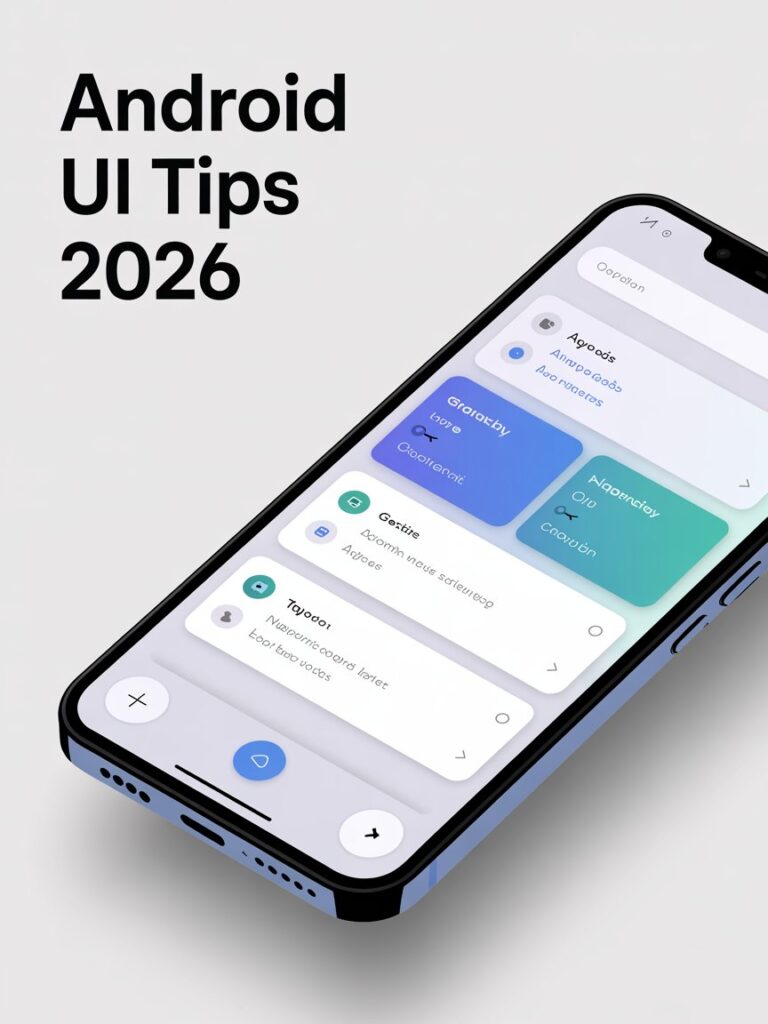
This guide covers the Android UI Tips 2026 that actually matter — not the theoretical stuff you read on forums, but the practical changes and modern android UI design principles that real developers are applying right now.
Before jumping into the tips, let’s talk context. The android ui change happening this year isn’t just cosmetic. A few things drove it:
Android UI 5.1 and the new UI update android pushed in early 2026 refined adaptive theming in ways that didn’t exist two years ago. The android update february 2026 specifically introduced refinements to dynamic color engine behavior, making it more predictable for third-party app developers.
Then there’s the user side. People in states like California, New York, and Texas — three of the highest Android-adoption states — use their phones in wildly different lighting environments, accessibility needs, and screen sizes. A ui design that works on a Galaxy S24 sitting on a desk in a Manhattan office should also work in direct sunlight on a job site in Houston.
The market has also pushed app design trends toward authenticity. Users in 2026 can smell a cookie-cutter template from a mile away. The best app design 2026 feels intentional, purposeful, and human — not generated.
Here’s a number that should grab your attention: Android holds around 44% of the US mobile market as of early 2026. That’s tens of millions of people across all 50 states interacting with Android interfaces every single day.
Cities like Seattle, Austin, Chicago, and Miami have booming tech ecosystems where Android developers are in constant demand. UX designer jobs in these markets consistently list Android UI expertise as a top requirement. Whether you’re freelancing out of Atlanta or working at a firm in San Francisco, knowing current android ui development tips directly affects your job value.
The question of which android ui is best comes up constantly in developer communities. And the honest answer? The one that serves your specific user base — but there are universal principles that apply everywhere.
Let’s get into them.
Material Design 3 (Material You) is the foundation of modern android ui design. If you’re building professional Android apps in 2026 and you haven’t gone deep on M3 components, that’s your first stop before anything else.
The android material design tips for 2026 come down to a few non-negotiable habits:
Use dynamic color correctly. Android 12+ devices extract a color palette from the user’s wallpaper. Your app should honor this. That means using colorPrimary, colorSecondary, and their variants from the theme system rather than hardcoding hex values into your layouts. When you do this right, your app looks like it belongs on the device.
Don’t fake adaptive layouts. There’s a difference between making your app scale and making it truly adaptive. Android UI components guide from Google now gives you clear guidance on WindowSizeClass breakpoints. Use them. A tablet user in Portland who opens your app shouldn’t get a stretched phone layout — they should get a proper two-pane experience.
Embrace the Surface system. M3’s tonal elevation system replaces shadow-heavy designs with subtle color shifts that feel cleaner and more modern. This is one of the bigger android ui improvements 2026 that separates apps built last year from apps built this year.
The team at Asapp Studio’s UI/UX Services works with Material Design 3 principles daily when building Android applications, and the difference in user response to M3-native layouts compared to legacy Material implementations is noticeable from day one.
This one surprises a lot of newer developers. When people talk about android simple ui design tips, they often jump straight to color palettes and icons. But professional designers know that typography and spacing carry 70% of perceived quality in any mobile interface.
For android ui design tips 2026, here’s what to focus on:
Stick to the Material Type Scale. M3 defines clear roles — Display, Headline, Title, Body, Label. Each has a purpose. When developers start mixing sizes arbitrarily, layouts feel amateur. Use the scale intentionally: Display for splash screens, Headline for section titles, Body for reading content.
Minimum 16sp for body text. This matters especially for users over 40 — a massive segment of Android users in states like Florida and Arizona. Accessibility isn’t just kindness; it’s user retention.
Line height matters more than you think. Default line heights in Android often feel cramped. For body content, a line height of 1.5x the font size dramatically improves readability without changing anything else.
Padding consistency builds trust. Define your spacing system early — 4dp, 8dp, 16dp, 24dp, 32dp. Stick to it everywhere. Users can’t articulate why a layout feels “off” when spacing is inconsistent, but they absolutely feel it.
A common mistake in android ui tips discussions: treating performance and design as separate concerns. In 2026, they’re having the same conversation.
Android UI responsiveness is part of the design experience. If your beautiful animations stutter at 20fps, the visual polish means nothing. Here’s where android ui coding practices matter:
Avoid overdraw. Use the GPU overdraw tool in Developer Options to find spots where your UI is painting pixels multiple times unnecessarily. Every layer of overdraw adds latency.
Use ConstraintLayout by default. Nested LinearLayouts and RelativeLayouts were fine five years ago. Today, deep view hierarchies hurt performance on mid-range devices — which is exactly where a huge portion of US Android users live. Families in the Midwest running Galaxy A-series devices shouldn’t experience a worse app than users with flagship phones.
Defer heavy work off the main thread. This is android UI development tips 101, but it still gets violated constantly. Network calls, image decoding, database queries — none of this belongs on the UI thread. Coroutines with Dispatchers.IO or WorkManager for background tasks keeps your interface buttery smooth.
Use Jetpack Compose for new screens. Compose’s declarative model makes it far easier to write performant UI code compared to the old XML view system. It also produces cleaner, more readable android UI coding practices and integrates naturally with modern architecture patterns.
Ask any UX designer about the most violated android ui design principles, and navigation will come up within the first 30 seconds.
Bottom navigation bars are the standard for a reason. Thumbs rest at the bottom of the screen. Putting primary navigation at the top forces unnatural reach patterns — particularly annoying on larger phones, which are increasingly common. The average screen size of US Android devices has been growing every year.
Back stack behavior needs explicit thought. One of the most common 1-star review triggers is an unpredictable back button. Users in frustration-prone moments (commuting in Chicago, waiting in line in Dallas) will absolutely uninstall your app if pressing back three times doesn’t take them where they expect.
Deep link handling is now table stakes. If your app supports sharing or external links and deep links break the navigation flow, you’re behind. This is especially relevant for apps with content that gets shared on social media — an increasingly common use case across all demographics.
Predictable transitions build confidence. When a user taps a card and it slides in from the right, and then the back button slides it out to the right — that consistency is the UX equivalent of a firm handshake. It communicates reliability.
For mobile app development teams working across multiple projects, establishing a navigation pattern library early saves enormous time and keeps UX consistent.
Android UI kits have become a critical part of the modern development workflow. Figma libraries, Compose component kits, and Material Design reference implementations give teams a shared language between designers and developers.
The risk is over-reliance. A kit gets you 70% of the way there. The remaining 30% — the micro-interactions, the empty states, the error messages, the loading skeletons — that’s where good android app interface design tips actually live.
Here’s how experienced teams use kits in 2026:
Start with the official M3 Kit as a base. It includes every component with proper theming, dark mode variants, and accessibility annotations baked in. Don’t reinvent this work.
Customize systematically, not surgically. If you’re going to deviate from the kit — and you probably should, to give your app its own identity — do it through the theme system. Change typography, colors, shape tokens. Don’t manually override component styling in one-off places.
Build your own component additions. Any UI element your app uses repeatedly that isn’t in the base kit should become its own documented component. This is what separates scrappy apps from polished ones, and it’s non-negotiable for teams doing Android app development at scale.
Not every design trend deserves your time. Here are the mobile ui design trends 2026 that have real legs — and are already showing up in the best app design 2026 releases:
Bolder, more expressive typography. Thin typefaces felt modern in 2018. In 2026, the pendulum has swung toward confidence. Heavier weights, generous display sizes, and expressive use of type as a visual element (not just information delivery) define leading apps.
Minimalist Android UI design with intentional personality. This sounds contradictory but it isn’t. Clean Android UI layouts with generous white space — but with one or two deliberate moments of brand character, whether it’s an illustration, a micro-animation, or a distinct color accent.
Contextual surfaces over flat screens. Rather than one flat color background, apps in 2026 use subtle surface layers to create visual depth without relying on harsh shadows. This is a natural evolution of the M3 tonal elevation system.
Nearby interactions and contextual UI. The nearby interactions API has matured significantly. Apps that adapt their interface based on context — what’s physically near the user — are creating experiences that feel almost magical. A retail app in a US store that changes its home screen when you walk near a specific department is doing contextual UI right.
Skeleton screens over spinners. Across app design trends, the spinner is dying. Content skeleton loading states (greyed-out placeholder shapes that match your real content layout) feel faster even when load time is identical, because they communicate structure rather than uncertainty.
Dark mode done properly. Not just inverted colors. True dark mode uses #121212 surfaces with elevated surface overlays for depth, not #000000 which causes accessibility problems and looks harsh. If your dark mode looks like a photo negative, it’s not done right.
Android UI customization is where apps develop personality — but it’s also where a lot of developers accidentally break accessibility, especially for users with visual impairments.
Here are the android ui design tips and tricks that let you customize boldly while staying inclusive:
Never rely on color alone to communicate state. A red text field with an error doesn’t work for colorblind users (roughly 8% of men in the US). Pair color changes with icons, text labels, or shape changes.
Test with TalkBack on every major flow. Screen reader testing isn’t a nice-to-have in 2026. It’s increasingly expected, especially for apps targeting education, healthcare, or government sectors — all significant markets in states like New York, Massachusetts, and Virginia.
Maintain 4.5:1 contrast ratio for all body text. Use tools like the Material Color Contrast Calculator to verify every combination. This is both an accessibility requirement and a usability improvement for outdoor use in bright states like Arizona and California.
Support text scaling. Your layouts need to survive up to 200% font scale without breaking. Use sp units for text (never dp) and avoid fixed-height containers that cut off scaled text.
The UI/UX Services team at Asapp Studio conducts accessibility audits as part of standard Android app development delivery — because retrofitting accessibility after launch costs significantly more than building it in from the start.
The android ui tuner in developer settings is one of the most underutilized tools for Android UI design testing. While it’s primarily aimed at power users, developers can use it to:
Beyond the built-in tuner, here are the android studio ui tips and android studio ui design tips that actually speed up your workflow:
Use Layout Inspector actively. Not just for debugging — use it to verify your actual view tree during development. Unexpected extra views, unintended overlaps, and clipping issues show up in Layout Inspector before users ever see them.
Layout Validation is your multi-device preview. This Android Studio feature shows your layout simultaneously across multiple screen sizes, font scales, and orientations. Use it for every new screen before you call it done.
Lint warnings for UI deserve attention. Android Lint flags a lot of UI issues that are easy to dismiss — missing content descriptions, hardcoded strings, missing size attributes. Address them. Most have real accessibility and maintainability consequences.
Security and UX have a complicated relationship. Every friction point you add for security reasons potentially costs you a user. Here’s how to know how to secure mobile apps without destroying the experience:
Use biometric authentication as the default. Fingerprint and face unlock are now second nature to US Android users. Apps that force password entry when biometrics are available feel dated. BiometricPrompt API is straightforward to implement and makes your app instantly more trustworthy.
Don’t punish legitimate users for security theatre. Session timeouts that boot users out after 5 minutes are overkill for most consumer apps. Think carefully about what your app actually needs to protect and calibrate accordingly.
Secure data storage without user-visible consequences. EncryptedSharedPreferences and Android Keystore handle encryption transparently. Your users never need to know — but your security posture is dramatically better. This is also directly relevant to how to secure mobile apps during quality assurance review.
Clearly communicate when permissions are needed. The android ui design guidelines from Google are explicit about this: ask for permissions in context, explain why at the moment of asking, and gracefully handle denial. Permission dialogs that appear with no explanation are one of the top reasons US users deny permissions — and many never grant them again.
Here’s the android app design optimization material that rarely makes it into beginner resources:
Design for interruption. US users get an average of 80+ phone notifications per day. Your app will be interrupted constantly. Make sure your UI state survives backgrounding and resumption gracefully. Use ViewModel and SavedStateHandle to preserve UI state across configuration changes and process death.
Error states deserve as much design attention as happy paths. Empty states, no-connection screens, failed API responses — design each one. The best apps handle errors with helpful guidance and visual consistency. The worst apps show a generic error toast and leave users confused.
Loading states should feel alive. Shimmering skeleton loaders, progress indicators that feel responsive, micro-animations that reassure users something is happening — these details keep engagement up during unavoidable wait times.
Onboarding is your first impression and your highest-risk moment. Data consistently shows that apps lose the majority of their users within the first session if onboarding is confusing. Keep it under three steps. Show value before asking for anything. Skip the permission gauntlet at launch — ask for each permission when it becomes contextually relevant.
If you’re serious about mobile app design that converts and retains users, the Android app development team at Asapp Studio specializes in exactly this kind of detail-oriented, user-first build approach.
The broader UX design trends 2026 affecting Android development are worth understanding, because they shape user expectations across every app category.
Personalization without creepiness. US users are more privacy-conscious than ever following years of data breach headlines. Apps that personalize the experience through on-device data (usage patterns, preferences, location context) rather than server-side profiling feel helpful rather than invasive.
Conversational interfaces as a UI layer. Not replacing traditional UI — but many top apps in 2026 include a conversational layer powered by on-device AI for complex tasks. Think of it as a shortcut layer for power users. This ties into the broader design trend 2026 toward ambient computing.
Haptic feedback as a design medium. Tactile response is an underused dimension of Android UI. Well-timed haptic patterns during interactions — a subtle pulse when a toggle turns on, a distinct bump when a boundary is reached — communicate state in ways that visual design alone can’t.
Voice-first fallback patterns. Not voice as the primary interface, but designing Android UX so that voice input works seamlessly as an alternative for any text input. For users who commute (significant populations in New York, LA, Chicago), this is genuine quality of life improvement.
These are the Android UI patterns that experienced developers reach for consistently, and that newer developers often reinvent poorly from scratch:
Pull-to-refresh — Standard SwipeRefreshLayout implementation, but customize the progress indicator to match your brand color. The default grey is forgettable.
Infinite scroll with smart pagination — Load content in chunks of 20-30 items. Show a skeleton loader at the bottom of the list during loading, not a spinner that jumps the layout.
Swipe-to-dismiss with undo — Any destructive action in a list should be undoable within 3-5 seconds via a Snackbar action. This single pattern has been shown repeatedly to reduce support tickets related to accidental deletions.
Contextual bottom sheets — Instead of full-screen dialogs for secondary actions, use modal bottom sheets. They feel native to Android and keep users oriented in the app’s context.
Collapsing toolbar with sticky content — For content-heavy apps, a collapsing toolbar that transitions to a compact sticky header as the user scrolls down gives both rich visual context at the top and efficient use of screen space while reading.
Understanding how many android users in the US there are isn’t just trivia — it shapes how you prioritize. With roughly 150 million active Android users in America and significantly more Android devices than that in active circulation, you’re dealing with enormous device diversity.
How often does android update matters for developer decisions. Google pushes monthly security updates and roughly annual major version updates. But actual device adoption of those updates varies dramatically. This is why how many android security updates are there is a more complicated question than it sounds — and why you should test on both recent and slightly older API levels.
Why android updates take so long to reach all devices comes down to the fragmentation of the Android ecosystem. Google releases the update, manufacturers customize it, carriers certify it, and then it rolls out. For a developer targeting broad US audiences, supporting API levels 24 and above still reaches the overwhelming majority of active devices.
This diversity of the Android ecosystem — across screen sizes, Android versions, manufacturer customizations, and hardware capabilities — is exactly why android ui tips in 2026 are more nuanced than they were even three years ago.
Let’s bring it all together. Mobile app best practices for Android UI in 2026 come down to a philosophy rather than a checklist:
Design for the real world, not the ideal demo. Your app will be used in bad lighting, with one hand, with interruptions, on a cracked screen, by someone who’s in a hurry. Design for that person.
Measure what matters. Use Firebase Analytics or a comparable tool to track where users drop off, which screens get the most time, and where rage taps occur. Let real user behavior guide your android UI improvements 2026 roadmap.
Iterate based on real feedback, not opinion. The best android ui design tips and tricks aren’t rules — they’re starting points. A/B test your major UI decisions whenever possible. What works for a fitness app in Denver might not work for a fintech app in New York.
Work with specialists when the stakes are high. If your app is your business, the UI and UX directly affects your revenue. The Android app development company expertise at Asapp Studio — based in Temecula, CA and serving clients across the US — exists specifically for situations where getting the UI right is too important to leave to guesswork.
One question comes up constantly from newer developers: what is the best user interface design software for apps?
The honest answer depends on your workflow, but here’s what the majority of professional Android UI designers use in 2026:
Figma remains the industry standard for collaborative design. Its Android UI kit support, interactive prototyping, and developer handoff tools are unmatched. If your team has more than one person, Figma is the answer.
Android Studio’s Layout Editor for implementation. This is your ground truth — what you design in Figma gets built here. Use Jetpack Compose’s live preview feature extensively.
Principle or ProtoPie for complex animation prototyping. When you need to communicate a multi-step micro-interaction to a stakeholder or hand it off to a developer precisely, these tools bridge the gap.
Material Theme Builder for systematic theming. This Google-maintained tool lets you build a complete M3 color scheme from a single brand color and export it directly to code. Use it.
After working with development teams across various mobile app projects, the same mistakes show up again and again. Here’s what actually kills well-intentioned Android apps:
Designing for pixel-perfect screenshots, not real use. Screenshots look great when nothing is selected, all content is placeholder-perfect, and there are no edge cases. Real usage has empty states, long names, truncated text, and unexpected content lengths. Design for those.
Ignoring the fold on foldable devices. Foldables are a growing segment in the US market. If your app breaks when a Galaxy Z Fold is opened, you’re behind. Window size classes handle this — use them.
Treating android 11 tips as outdated. Not everyone is on the latest version. Some of the most reliable, well-designed apps still see 15-20% of their traffic from Android 11 devices. Regression testing isn’t glamorous but it’s essential.
Not testing with real users before launch. Closed beta testing with even 20 real users in your target demographic will surface more real UI problems in 48 hours than months of internal review. Tools like Firebase App Distribution make this cheap and easy.
Whether you’re building a new Android app from scratch or looking to modernize an existing interface, the practical android ui design tips 2026 discussed in this guide represent years of real-world development experience across hundreds of apps.
The mobile app development team at Asapp Studio brings together Android UI specialists, UX designers, and quality assurance professionals who work specifically with the US market in mind. From the Android app development side to UI/UX design services, to cross-platform solutions when your project demands them — the full capability is there.
If you’re ready to build something that doesn’t just function well but genuinely earns its users, contact the team at Asapp Studio for a free consultation.
Android UI design in 2026 is more demanding, more nuanced, and more rewarding than it’s ever been. The bar for what users accept is higher, but the tools and frameworks available to meet that bar are better than ever.
The developers and designers who win in this environment are the ones who treat UI not as a coat of paint applied after the “real” work is done — but as the work itself. Because from the user’s perspective, the UI is the app.
Start with solid Material Design 3 foundations. Take performance seriously as a UX concern. Design for accessibility from day one. Follow mobile ui design trends 2026 thoughtfully rather than chasing every new thing. And test, iterate, and listen to your users relentlessly.
The Android UI Tips 2026 laid out in this guide aren’t a one-time checklist. They’re a discipline. The apps that earn loyalty — the ones with 4.8 stars and millions of daily active users — got there because their teams treated every layout decision, every animation timing, every error message as an opportunity to build trust with a real human being.
That’s what great android ui design looks like in 2026. Go build it.
Q1: What are the most important Android UI Tips 2026 for beginners?
Start with Material Design 3, use ConstraintLayout, ensure accessibility compliance, test on multiple screen sizes, and prioritize consistent spacing and typography throughout your app.
Q2: How many Android users are in the US in 2026?
There are approximately 150 million active Android users in the United States, making it one of the largest and most competitive Android markets globally for app developers.
Q3: Which Android UI is best for modern app development in 2026?
Material Design 3 (Material You) is the best Android UI framework in 2026. It supports dynamic theming, accessibility, and adaptive layouts across all modern Android device categories.
Q4: How often does Android update and how does it affect UI development?
Android releases major updates annually and security patches monthly. Developers should support API levels 24+ to cover most US users while testing against the latest Android UI changes.
Q5: What is the best UI design software for Android apps in 2026?
Figma is the top choice for design collaboration, paired with Android Studio for implementation. Material Theme Builder and ProtoPie complement the workflow for theming and animation prototyping.