
Most startups don’t die because the founder was lazy or the idea was dumb.
They die because the founder built a full product when they should’ve built a test. Or they tested the wrong thing. Or they validated assumptions that never actually mattered to the customer.
I’ve watched this happen more times than I care to count — brilliant people in Dallas, Denver, and Detroit spending 14 months and $200,000 to build something nobody wanted. Not because they were careless. Because they skipped the hard, unsexy, slow work of figuring out why people would actually use what they were building.
2026 is a strange and genuinely exciting time to launch a startup. AI for startups in 2026 has handed founders capabilities that were reserved for companies with 20-person engineering teams just four years ago. You can move fast. You can automate a staggering amount. You can build things that feel like magic on a budget that would’ve gotten you laughed out of a 2018 pitch meeting.
But those same tools can also make it dangerously easy to look like you’re building something while you’re actually just spinning.
This guide covers the top 5 MVP strategies that real US founders are using right now to make AI for startups actually work — not as a buzzword, but as something that generates traction, revenue, and real business outcomes. No theory. No buzzword salad. Just the approaches that are working and the thinking behind why each one works.

Before jumping into strategy, let’s be honest about something.
The phrase AI for startups in 2026 gets thrown around in every pitch deck, every accelerator newsletter, every LinkedIn post from someone who just attended a conference. Most of the time it means almost nothing — a vague gesture toward “we use AI somehow” without any real clarity on what that means for the business, the product, or the customer.
Real AI for small businesses and startups in 2026 is something more specific. It’s the systematic use of machine learning, large language models, agentic workflows, and predictive analytics to do things that used to require either a large team or an expensive consultant — and doing those things faster, cheaper, and more consistently than any human team could manage at the same cost.
That’s the definition that matters. Not “we have a chatbot.” Not “we use GPT to write marketing copy.” Something that fundamentally changes your unit economics, your product capabilities, or your customer’s experience in a way that was genuinely not possible before.
Keep that definition in mind as you read through these five strategies, because every single one of them is built around it.
Every startup begins with assumptions. The dangerous part is when founders treat their assumptions like facts.
“People hate doing expense reports manually.” Maybe it’s true. “People will pay $29/month for a tool that automates it.” That’s the assumption you need to kill or confirm before you write a single line of code.
The good news is that in 2026, validating assumptions with AI for startups tools is faster and cheaper than it has ever been — not in a hand-wavy “use ChatGPT for market research” way, but in a structured, repeatable way that can give you actual signal in two to three weeks.
Here’s what that looks like when it’s done right:
You start by finding where your target customer talks about the problem you think you’re solving. Reddit communities, LinkedIn comments, App Store reviews for competing tools, industry Slack groups, Twitter threads from people in your target profession. If the problem is real, people are complaining about it somewhere. AI for small businesses and startups discovery tools can now scan thousands of these data points and surface the exact language, intensity, and frequency of those complaints.
That language matters. Not just as proof that the problem exists — but because the way real customers describe the problem is almost always different from the way founders describe it. And that gap is where messaging mistakes live.
After that, you get on the phone. I know founders hate hearing this. Everyone wants a no-touch validation process. But there is no substitute for 15 conversations with real prospective customers. Ask them to tell you about the last time the problem cost them time, money, or frustration. Ask what they’ve already tried. Ask what they’d pay to make it go away. Don’t pitch. Just listen.
A founder I know in Nashville validated an idea for cost-effective AI-driven scenario planning software for startups by spending three weeks doing exactly this before touching any design tool. She talked to 22 CFOs at small manufacturing companies across Tennessee and Kentucky. What she found completely changed her product direction — and saved her from building six months of the wrong thing.
That’s what kills assumptions before they kill you.
At Asapp Studio, this is the conversation we have with almost every early-stage client. The technology questions matter, but the market validation questions matter more. Getting those answered first is what makes everything downstream faster and cheaper.
The question most US founders are asking right now is: what are the best AI tools for startups in 2026 to do this kind of validation work? The honest answer is that the stack changes fast, but the principle doesn’t — use AI for startups to compress the time between hypothesis and evidence, not to skip the evidence entirely.
This is where AI startups in 2026 are winning or losing before the first user even signs up.
There’s a pattern among the top AI startups getting traction in the US right now. They don’t treat AI as a feature they added to a traditional SaaS product. They treat AI for startups as the foundation on which everything else sits. That architectural decision — made early, before the product is built — shapes everything from product velocity to unit economics to how compelling the eventual acquisition conversation is.
What does building AI infrastructure first actually mean in practice?
The model question. The open-source LLMs vs proprietary models debate is not settled and probably won’t be for a while, but the decision framework has gotten clearer. If you’re building in healthcare, legal, or finance — spaces where data sensitivity is high — open-source models you can run in your own infrastructure are often the right starting point. If you’re building a consumer product where speed and capability matter more than data control, proprietary APIs let you move faster. The mistake is not thinking about this until you’re six months in and suddenly realizing your data architecture is incompatible with the compliance requirements your first enterprise customer just handed you.
The agentic layer. The biggest AI startup trend in 2026 — and the one most founders are still underutilizing — is agentic AI workflows. This is the shift from AI as a tool (user asks, AI responds) to AI as an agent (system perceives a goal and takes multi-step actions to accomplish it autonomously). Building this layer into your architecture from the beginning rather than grafting it on later changes what you can build and how fast you can build it. The rise of autonomous AI agents for business is not a future trend. It is happening now, and the startups that architect for it early have a compounding advantage.
The data layer. This is the one people most often neglect. The startups positioned to win in the medium term are accumulating proprietary data through their MVPs — usage patterns, edge cases, customer feedback signals, fine-tuning data — in a structured way from day one. Generic AI for startups on public data has limited moat. AI trained or fine-tuned on your specific domain’s data? That’s a defensible asset. The software development services team at Asapp Studio has built this kind of data-first architecture for startups from early stage through growth, and the founders who get it right early almost always thank themselves for it later.
The integration layer. A lot of startup value creation in 2026 happens in integration — connecting the AI layer to the tools customers already use. CRMs, project management platforms, communication tools. Getting the integration architecture right means your product fits into existing workflows instead of asking customers to change their habits, which is one of the hardest things you can ever ask a customer to do.
Getting this AI tech stack for early stage startups right is not about being fancy. It’s about not having to rebuild your foundation when you start growing.
I want to tell you about a small startup that launched in Los Angeles about eight months ago.
Two founders, no venture capital, a total runway of roughly $80,000. They were targeting marketing agencies — specifically the account managers who were drowning in the weekly client reporting cycle. Every Friday, these people were spending four to six hours pulling numbers, writing summaries, formatting slide decks, and sending update emails that clients mostly didn’t read.
The founders didn’t build a reporting tool. They built a reporting outcome. Their MVP was an AI agent that connected to a client’s advertising platforms, pulled the week’s data, wrote a contextual narrative summary, formatted it into a clean PDF, and sent it to the client automatically — every Friday at 9am, without a human touching it.
That’s not a feature. That’s an outcome. Four to six hours of miserable work, gone.
They had 40 paying customers in two months. They never had to explain what their product did, because the value was immediately obvious the first time a customer’s Friday afternoon was suddenly free.
This is what AI-driven MVP development looks like when it’s done right. You’re not building a tool that helps users do a task. You’re building a system that eliminates the task. That’s the core of the agentic AI workflows approach, and it’s exactly why AI for startups in 2026 is such a genuine advantage — the gap between “we saved you 20 minutes” and “we eliminated the entire task” is now crossable at startup budgets.
When you’re thinking about your MVP, the question to ask is: what is the most painful, recurring, time-consuming thing in my target customer’s week? And then ask: how close to complete automation can I get for that specific thing using AI business automation?
You probably won’t get to 100% automation in v1. But if you can get to 80% — if you can go from “this takes four hours” to “this takes 25 minutes” — that’s enough. That’s the MVP.
How startups use AI for pricing optimization is another good example of this principle. Instead of building a pricing model and asking customers to figure out which tier fits them, several startups are building AI agents that analyze the prospect’s situation and recommend the right plan automatically. Less friction. Better conversion. More learning data.
AI workflow automation on the internal side matters just as much. A three-person startup running a manual customer onboarding process is burning hours they can’t afford. Getting your own operations on agentic workflows — support triage, onboarding sequences, reporting, internal Q&A — gives your team leverage that compounds as you grow.
If you want to talk through what this kind of product architecture looks like for your specific idea, the mobile app development and AI teams at Asapp Studio have built exactly these kinds of outcome-delivery systems for startups across the US market.
Here is an underrated truth about AI startup funding conversations in 2026: investors don’t want national traction. They want dense traction. They want to see a market where your product has clearly won something — a city, an industry cluster, a customer type — not scattered signups spread thin across the whole country.
The smartest US founders using AI for startups in 2026 to launch MVPs right now are doing something that feels counterintuitive: they’re making their markets smaller on purpose.
Not because they’re thinking small. Because they understand that deep traction in a small market is orders of magnitude more valuable — and more achievable — than shallow traction in a big one.
Think about it this way. AI startups for construction have a massive addressable market nationwide. But the construction industry is deeply relationship-driven and regionally clustered. If you’re building software for general contractors, launching in Houston or Dallas — where construction activity is intense and contractor networks are tight — and becoming the tool that everyone in those networks uses and recommends to each other is a dramatically better launch strategy than running national campaigns and getting 40 signups across 40 cities who don’t know each other and never will.
Regional density creates word of mouth. Word of mouth creates credibility. Credibility creates the next wave of customers. That’s how startup growth with AI actually compounds.
Pick your beachhead geography based on where your target customer is most concentrated. For AI startups for finance, that’s New York and Chicago. For AI startups for manufacturing, that’s the industrial Midwest — Ohio, Michigan, Indiana. For AI startups for education, it depends heavily on which part of the education system you’re targeting — district-level decisions map to specific states, university procurement maps to different clusters entirely. For AI startups for accounting, mid-size regional CPA firms cluster in secondary cities: Cincinnati, Nashville, Phoenix, Kansas City.
Once you’ve picked your geography, put real resources there. Not just ads. Attend the local industry events. Get on the podcast that your target customers listen to. Partner with the regional association that your target customers belong to. Use AI marketing automation to personalize outreach at a level that would be impossible manually, but make the relationship feel human.
The AI for small businesses and startups tool ecosystem in 2026 makes regional hyper-targeting genuinely practical for early-stage teams. A founder with $2,000/month in marketing budget and the right AI startup solutions can create a presence in a specific city and industry niche that feels like a much bigger company.
AI lead generation tools, properly configured for regional targeting, can identify and qualify prospects at a rate that wasn’t possible three years ago. Combine that with a genuinely differentiated product and you have everything you need to build the kind of dense early traction that makes fundraising conversations a lot shorter and a lot more favorable.
Explore Asapp Studio’s case studies to see how focused, deliberate launch strategies have worked for software and AI products built for specific US market segments.
Most startup founders hear “build for acquisition” and think it’s advice for Series B companies. It isn’t. It’s advice for day one.
How to prepare an AI startup for acquisition is not a question you scramble to answer when an offer lands in your inbox. By the time an offer lands, the decisions that determine your negotiating position were made years earlier. The quality of your data. The defensibility of your AI. The cleanliness of your contracts and cap table. The reliability of your revenue. These things don’t appear overnight — and no amount of AI for startups in 2026 tooling fixes a messy foundation built in year one.
Building with acquisition readiness in mind from the MVP stage doesn’t mean you’re planning to sell — it means you’re building something worth buying. And frankly, everything that makes a startup acquisition-ready also makes it more fundable, more operationally stable, and more trustworthy to customers.
Here’s what this looks like practically for an AI startup launching in 2026:
Your data has to be clean and proprietary. The AI companies that trade at the highest multiples in acquisition scenarios are the ones with data assets the acquirer can’t replicate. If your MVP is collecting usage data, behavioral signals, or domain-specific training data, organize it properly from the beginning. Don’t let it become a swamp of unlabeled tables that someone has to untangle during due diligence.
Your AI has to do something genuinely hard. Generic wrappers on public APIs have a short shelf life as defensible products. The question to ask yourself when scoping your MVP is: if a well-funded competitor decided to copy this in six months, how hard would that actually be? If the answer is “pretty easy,” you need to think harder about where the defensible value actually lives. Fine-tuned models, proprietary training pipelines, unique data partnerships — these are the kinds of AI business innovation assets that make well-funded acquirers take notice.
Document everything. Processes. Architecture decisions. Customer onboarding flows. Sales scripts. Support escalation paths. I know documentation feels like a waste of time when you’re a two-person team trying to ship your MVP. But the startups that document their operations as they build them sell for better multiples and close faster than the ones that have to reconstruct institutional knowledge under the pressure of a due diligence process.
Build revenue that’s worth something. AI SaaS startups with annual contracts, low churn, and growing net revenue retention are worth materially more than startups with the same ARR on month-to-month contracts and high churn. The mechanics of how you sell matter. The terms you put in your customer contracts matter. Get your contracts reviewed by a lawyer who understands SaaS, and build your pricing model with an eye on the revenue metrics that acquirers care about.
Get compliant early. AI regulatory compliance for startups is not a 2028 problem. It is a 2026 problem. If you’re in healthcare, you already know about HIPAA. But data privacy regulations, emerging state-level AI disclosure requirements, and sector-specific rules are moving fast across the US. Startups that build compliance into their architecture early are lower-risk acquisition targets. Startups that treat compliance as a later problem often find themselves in expensive remediation during due diligence.
The web development and software development teams at Asapp Studio build with these considerations in mind — not as a theoretical exercise but because the founders we work with are building companies they intend to grow and eventually sell. Architecture decisions made at the MVP stage echo for years.
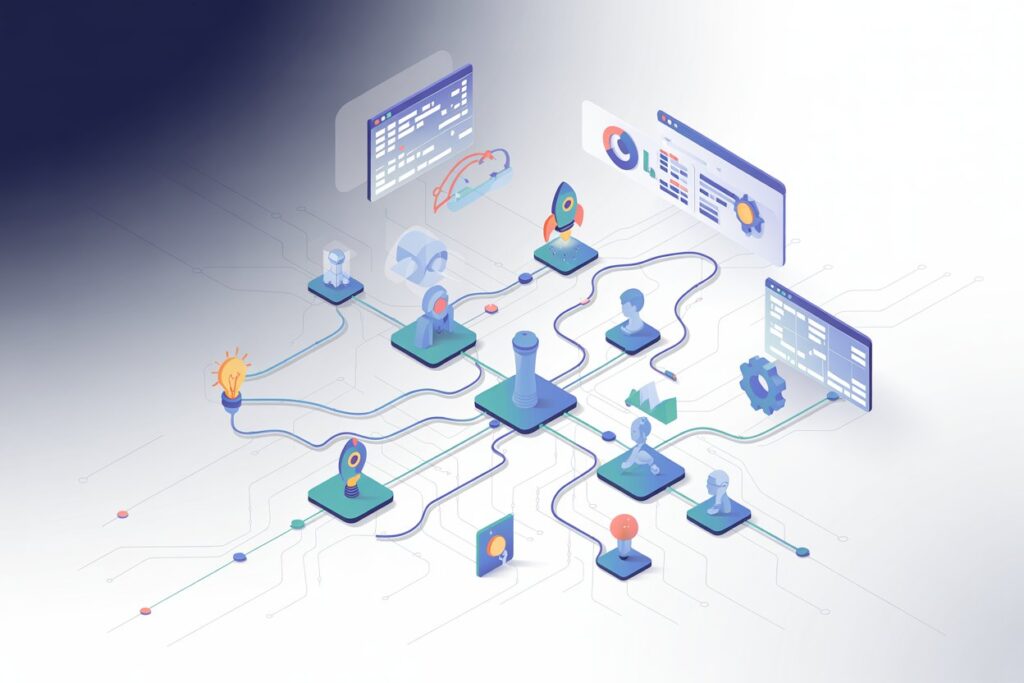
Laid out one after another, these strategies can look like a sequential checklist. They’re not really that. They’re more like a set of principles that should be running simultaneously — each one reinforcing the others.
The validation work from Strategy 1 sharpens your AI for startups in 2026 architecture decisions in Strategy 2. The agentic outcome approach from Strategy 3 makes your regional launch in Strategy 4 dramatically easier to execute because the product value is immediately obvious rather than requiring education. And the acquisition readiness discipline from Strategy 5 forces a level of operational rigor that makes everything else better.
The founders who execute all five of these — even imperfectly — are building something durable. The founders who skip the ones that feel slow or boring almost always pay for that skip later.
If you want to talk through how these strategies apply to your specific startup idea, the Asapp Studio team works with early-stage founders across the US and is worth a conversation. We’ve built AI-powered products for startups at the MVP stage and beyond, and we take the early decisions seriously because we’ve seen how much they matter.
You can also explore our services page and about us to understand the full range of what we build and how we work.
Because the US market is not one market — it’s 50 markets inside one country — a few brief notes on where AI for startups in 2026 hits hardest by industry:
Artificial intelligence in healthcare — Validation is non-negotiable before building anything. Regulatory complexity is real. But the demand is massive, particularly for AI tools that reduce administrative burden on clinical staff. If you’re in this space, Strategy 1 and Strategy 5 are your most important priorities.
AI startups for finance — Dense regional traction in New York or Chicago matters enormously. The buy-vs-build calculus at large financial institutions means acquisition is a realistic exit, making Strategy 5 very relevant from early on.
AI startups for manufacturing — The upper Midwest is underserved and hungry. Toledo, Cleveland, Detroit, Indianapolis — mid-size manufacturers in these cities are actively looking for what AI ML consulting services are helpful for startups and automation tools but rarely get approached by coastal-focused companies. Regional focus (Strategy 4) is your edge here.
AI startups for education — Agentic workflow MVPs (Strategy 3) have enormous potential. Teachers, administrators, and instructional coaches spend extraordinary amounts of time on documentation, communications, and reporting that AI for startups can largely automate. The market is real. Pick a school district cluster in a specific state and go deep before going broad.
AI startups for marketing — Crowded and competitive nationally. The winners are niching down within the niche: AI for restaurant marketing, AI for regional law firms, AI for independent insurance agencies. Hyper-specific positioning plus regional density equals a path to traction that broader marketing AI tools can’t easily replicate.
AI startups for coding — Developer tools are a saturated category nationally but wide open in vertical-specific applications. A startup building AI-assisted coding tools specifically for healthcare software teams, or for government contractors, has far less competition and far more focused buyer personas than one targeting “developers” broadly.
One question founders across the US ask before committing to an AI for startups strategy is: what’s the actual return on this investment?
The honest answer is that the ROI of AI for startups depends almost entirely on what you’re automating and how well you’ve validated that the automation actually removes friction the customer cares about.
A startup that uses AI productivity tools to cut its customer support response time from 12 hours to 4 minutes — in an industry where that speed is genuinely valued — will see measurable impact on retention and conversion almost immediately. A startup that uses the same tools to automate a workflow nobody particularly cared about sees nothing.
Can AI help startups reduce operational costs? Yes, significantly — when the automation targets the right workflows. AI customer service automation, AI sales automation, and AI operations automation have all matured to the point where early-stage startups can implement them without massive engineering investment. The founders who do this well aren’t chasing every new model release. They pick two or three high-leverage internal processes, automate them properly, and reinvest the saved capacity into the work that actually requires human creativity and judgment.
How do startups automate workflows with AI? The pattern that works is: identify the task, map every step manually, find the steps that are purely mechanical or pattern-matching in nature, and replace those with an AI layer while keeping humans in the loop for decisions that require context or judgment. Start with one workflow. Get it working properly. Then expand.
The through-line across everything in this guide is this: the best use of AI for startups in 2026 is to learn faster, not just to build faster.
Launching feels good. It’s the milestone everyone congratulates you on. But the learning — the quiet, unglamorous work of understanding your customer deeply enough to build something they actually pay for — that’s the thing that determines whether your startup is still around in three years.
AI for startups in 2026 is the most powerful toolkit for compressing that learning cycle that has ever existed. Use it that way. Not to ship more, but to learn more before you ship. Not to automate away the thinking, but to think more precisely about the right things.
That mindset, combined with the five strategies in this guide, is a real foundation for building something that matters — whether you’re a first-time founder in Austin figuring out your first MVP, or a second-time founder in Boston who knows exactly what you want to build and needs the right team to help you build it properly.
If you’re ready to start building — or if you have a product that needs to be rebuilt with a cleaner AI-first foundation — contact the Asapp Studio team. We work with founders across the United States from our Temecula, California office, and the conversation is free.
Q1: What is the best AI for startups in 2026?
It depends on use case and data sensitivity. Open-source models suit regulated industries; proprietary APIs suit speed-first builds. Match the tool to your product goal, not the hype cycle.
Q2: How can startups use AI to grow faster?
Automate repeatable tasks in sales, onboarding, support, and reporting. Agentic AI workflows free your team to focus on decisions that need human judgment and accelerate learning loops significantly.
Q3: How much does AI implementation cost for a startup?
Basic AI stacks start under $500/month. Custom systems vary by scope. Early planning with an experienced team prevents costly rebuilds and keeps development budgets predictable throughout the process.
Q4: What are the risks of using AI in startups?
Overbuilding, data privacy gaps, and skipping validation are the biggest risks. Build the minimum that answers a real question, and get compliance and data architecture right from the start.
Q5: Can AI help startups reduce operational costs?
Yes — significantly. AI automates customer support, onboarding, internal reporting, and admin tasks. Most startups see real time and cost savings within 60 to 90 days of intelligent implementation.