
My colleague Teresa runs a small but growing logistics company out of Memphis, Tennessee. Forty-some employees, a fleet of regional trucks, and a dispatch system her team has been patching and re-patching since 2019. Until about eight months ago, she had a single server rack in what used to be a supply closet on the second floor. Her whole IT setup was held together by one guy named Kevin, who happened to know Linux.
Last spring, Kevin put in his two weeks. Not because anything blew up — he just got a better offer from a company in Nashville. Teresa called me soon after, not panicked exactly, but unsettled in a way that’s hard to articulate. Because at that moment she realized she had no real idea what was running on those servers. Everything Kevin knew lived in Kevin’s head, and Kevin was leaving.
That’s the cloud architecture conversation in miniature. It’s rarely a glamorous story about startups rethinking their microservices strategy. It’s usually something like Teresa — a business that’s outgrown what its current infrastructure can support, run by people who are genuinely capable and have zero extra hours to become cloud engineers on top of everything else. And yet the decisions you make about cloud architecture — how systems are structured, where data lives, how services talk to each other, who can access what — those decisions follow your business for years. Get them right and infrastructure bends with growth. Get them wrong and you’re rebuilding under pressure, usually at the worst possible time.
That’s what this is about. Not a polished overview. The actual state of cloud architecture in 2026 — what’s changed, what matters, and where organizations across the US are getting stuck or, occasionally, getting it right.
Before the jargon takes over — and it will — let’s get clear on what we’re talking about when we say cloud architecture.
At its most basic, cloud architecture is the set of decisions that defines how your computing infrastructure is organized. Which services you use. How they connect. Where data lives and how it moves. What happens when something fails. Who’s allowed to do what, and how you enforce that. The whole blueprint.
What is cloud architecture in 2026 specifically? It’s all of that, now layered with things that have gotten significantly more complicated in the past few years.
The biggest change is AI. Not “we have a chatbot on our contact page” AI — actual AI infrastructure. GPU clusters for model training. Vector databases for retrieval. Inference endpoints serving predictions fast enough that users don’t notice. AI-driven cloud architecture is no longer a specialty track for research labs and tech giants. It’s becoming the baseline assumption for how serious engineering teams build. If your cloud architecture design doesn’t account for AI workloads — today or within eighteen months — you’re going to be redesigning sooner than you planned.
The second shift is the edge. The old mental model of cloud computing was clean: data goes to the data center, gets processed, comes back. That still works for a lot of things. But a manufacturing plant in Detroit running real-time quality control can’t afford that round trip. A retail chain in Dallas doing in-store computer vision can’t send every video frame to a cloud region in Northern Virginia — the bandwidth cost alone would be ruinous. So the architecture of cloud in 2026 spans from hyperscaler data centers all the way out to edge nodes running in the actual facilities. Designing for that full span is now a standard problem, not an exotic one.
Third: security stopped being the thing you add at the end. Cloud security architecture and hybrid cloud security architecture are built into the design from the beginning, or they’re missing entirely. Zero trust cloud security, which sounds buzzword-y but describes something meaningful, is now the reference model for serious organizations. And fourth — cost. Cloud cost management 2026 is a genuine engineering discipline. The “we’ll optimize later” era is over, because “later” tends to arrive as an invoice nobody can explain.
That’s the real version of what is cloud computing architecture in 2026. More complex than the vendor materials suggest, and genuinely more capable than what was possible five years ago.
The “trends to watch” lists that come out every January tend to recycle the same ideas with new packaging. So I want to be specific about what’s actually different this year.
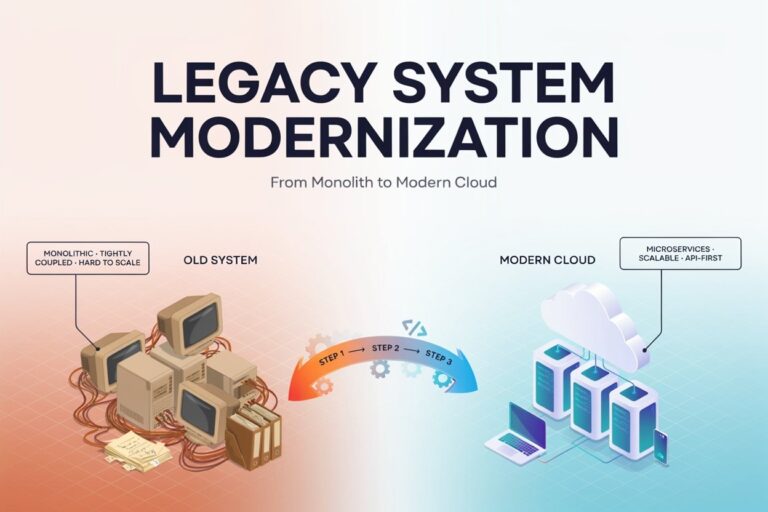
The public-cloud-versus-on-premise debate has largely resolved itself — not because anyone won, but because organizations figured out the question was framed wrong. The future of cloud architecture isn’t a single model. It’s distributed hybrid infrastructure where workloads live in whatever environment makes real sense for them.
A manufacturer in Cleveland might run its operational technology — systems controlling physical equipment — on private infrastructure, because the latency and reliability requirements don’t tolerate cloud round-trips. Meanwhile, their analytics platform runs on AWS, because they need elastic compute for machine learning that spikes unpredictably. And their customer-facing ordering system runs on Azure because they’re already invested in Microsoft 365 and the identity integration is simpler. That’s hybrid cloud architecture 2026 in practice. Not a clean model. A collection of pragmatic decisions made under real constraints, hopefully held together by consistent networking and security policy.
This is genuinely new territory. AI infrastructure cloud — the architecture patterns, hardware choices, and operational practices specific to running AI at scale — has grown complex enough that it’s becoming its own specialization. GPU orchestration cloud is a real engineering problem. Figuring out how to pool expensive GPU instances across training and inference workloads, avoiding idle capacity without starving real-time requests, requires coordinated decisions at the compute, scheduling, and networking layers simultaneously. Teams in Seattle and San Francisco have been working through this for two years. The rest of the country is catching up fast.
The DevOps model solved real problems, but at a certain scale — somewhere around 100 engineers — it starts creating new ones. When every team configures its own cloud environments independently, you get inconsistency, security gaps, and developers spending a significant fraction of their time on infrastructure instead of product. Platform engineering cloud addresses this by building an Internal Developer Platform (IDP) — a layer that developers interact with instead of talking directly to AWS or Azure. The platform enforces standards automatically. Product teams get self-service access to infrastructure without needing to understand its internals.
AIOps cloud management has moved from concept to production in organizations serious enough to invest in it. Healthcare networks in Chicago. Logistics companies in Atlanta. E-commerce platforms in Los Angeles. These organizations run AI systems that detect anomalies before they become incidents, predict capacity needs from historical patterns, and trigger remediation automatically. Autonomous cloud operations don’t replace human judgment on genuinely hard problems. They handle the routine work automatically, which frees people for the problems that actually need them.
Some workloads are moving back out of public cloud. The term is cloud repatriation, and it’s not a repudiation of cloud computing — it’s a sign of maturity. Predictable, high-volume workloads that run at constant load can sometimes be cheaper on owned hardware at scale than on reserved cloud instances. Smart organizations use this insight to build more intentional hybrid cloud architectures where workload portability is designed in from the start.
If you’re provisioning cloud infrastructure manually in 2026, your cloud architecture has fragilities you probably haven’t discovered yet. Infrastructure as Code (IaC) — using Terraform, Pulumi, or AWS CloudFormation to define infrastructure in version-controlled code — is the baseline now. It’s the foundation of DevSecOps cloud practices, consistent environments across regions, and the ability to reproduce your infrastructure reliably when you need to.
ARM-based cloud infrastructure — AWS Graviton, Azure Cobalt, Google Axion — has crossed into mainstream consideration. The performance-per-watt improvement over x86 is real for most general-purpose workloads. For organizations building sustainable green cloud architecture, ARM is part of how you reduce energy consumption without giving up performance.
I want to spend real time on this because AI-driven cloud architecture is not a marginal trend. It’s the central story of cloud computing in 2026, and it changes most of the design decisions you’d otherwise make.
Three years ago, if you were running serious AI workloads, you were either a research lab, a big tech company, or a startup with AI as your core product. Today, a regional bank in Charlotte runs credit risk models. A mid-size retailer in Phoenix does demand forecasting with ML. A healthcare group in Nashville processes clinical notes with language models. The range of organizations running meaningful AI has expanded dramatically — and most of them built their cloud infrastructure before AI was a real consideration.
That creates a genuine problem. Traditional cloud computing architecture was designed around CPU compute, network throughput, and storage IOPS. AI workloads break those assumptions in a few specific ways.
GPU compute is the bottleneck, not CPU. If your cloud architecture design isn’t built around GPU orchestration cloud strategies — how you provision, share, schedule, and right-size GPU instances — you’re either paying massively for idle GPU capacity or waiting in queues for compute that’s always saturated.
Data gravity and data locality become critical in ways they weren’t before. Training is data-hungry. Moving terabytes of training data across regions or between storage tiers is expensive and slow. The cloud data architecture has to keep compute co-located with data, or the economics of training start to fall apart.
Inference serving and training are completely different beasts. Training is bursty, GPU-intensive, often interruptible. Inference is real-time, latency-sensitive, and needs high availability. Your architecture of cloud computing needs to support both without letting training jobs crowd out real-time serving — or paying for two completely separate stacks when shared infrastructure would work with the right design.
AI agent meshes — systems where multiple AI agents interact with APIs, databases, and each other over extended periods — need event-driven architectures with reliable messaging, strong identity controls, and thorough audit logging. They fail in ways that are harder to debug than traditional software. The architecture has to account for that upfront, not after the first production incident.
And then there’s model versioning. Models update constantly. You need to deploy new versions without taking down production, run shadow traffic against candidates before promoting them, and roll back quickly when something goes wrong. None of that happens without deliberate work in how your cloud architecture handles deployment and state.
Asapp Studio’s AI development team works with organizations across the US to design AI infrastructure cloud systems that handle these requirements correctly from the start — before the expensive mistakes.
Vendor whitepapers make hybrid cloud architecture 2026 look elegant. In practice, it involves managing connections between systems built by different teams at different times using different assumptions, and making them behave consistently across environments. That’s genuinely hard. Still the right answer for most established organizations — just harder than the diagrams suggest.
A fully public cloud strategy makes sense for greenfield applications built without legacy constraints. A fully on-premise strategy makes sense for fewer and fewer use cases with each passing year. Most real businesses live in the middle.
Hybrid cloud architecture means workloads span at least two computing environments, usually private cloud or on-premise alongside one or more public clouds. The environments have to be connected in ways that are fast, secure, and consistent.
Hybrid cloud network architecture is where most of the complexity concentrates. You need direct connections between environments — AWS Direct Connect, Azure ExpressRoute — rather than public internet VPNs for production workloads. Public internet is fine for backup connectivity or non-critical traffic. Production workloads with latency requirements need dedicated connections.
A consistent identity layer across environments matters enormously. If on-premise systems use Active Directory and cloud environments use each provider’s native IAM independently, you have an identity mess. Everything needs to anchor to a single identity provider with consistent policy enforcement.
A service mesh for microservice communication across environments — tools like Istio and Linkerd — gives you encrypted service-to-service communication, traffic management, observability, and fine-grained access control. They’re operationally complex to run. The alternative — services communicating without consistent policy across environment boundaries — is worse.
The attack surface of a hybrid cloud architecture is larger than either environment alone. You have more components, more network paths, more identity contexts to manage. Hybrid cloud security architecture in 2026 is built on zero trust principles because the old perimeter model doesn’t work when your infrastructure spans a Memphis data center, an AWS region in Ohio, and an Azure region in Virginia simultaneously.
Zero trust cloud security means every access request gets evaluated on its own merits. The service or user asking for access proves who they are, and the system decides whether this specific request — from this identity, at this time, from this location, using this device — should be granted. Not “they’re on the corporate network so they’re fine.” Every request, every time.
This sounds paranoid. It is, appropriately so. For organizations in regulated industries — healthcare in Chicago, financial services in New York, defense contractors in Northern Virginia — secure cloud architecture built on zero trust isn’t theoretical. It’s the compliance baseline.
Not all hybrid cloud architectures look the same. A few patterns that show up repeatedly in practice:
Data sovereignty hybrid: Sensitive data stays on private infrastructure. Analytics and AI workloads run on public cloud using anonymized or aggregated data. Common in healthcare and financial services, where data residency requirements drive the separation.
Burst hybrid: Steady-state compute runs on owned infrastructure for cost efficiency. Unpredictable spikes burst into the public cloud. Makes sense for seasonal businesses where the peak-to-average ratio is large — retail around the holidays, tax software in Q1.
Dev/prod hybrid: Development and testing on public cloud for cost and flexibility. Production on private infrastructure for compliance and control. The economics are sometimes counterintuitive but make sense for specific workload profiles.
Distributed hybrid infrastructure: Workloads move between environments based on cost, latency, compliance, and data locality, managed by an orchestration layer with AIOps. The most sophisticated version, and it takes real operational maturity to run well.
Which pattern fits your situation depends on workloads, compliance requirements, existing infrastructure, and your team’s capacity to operate what gets built. Asapp Studio’s software development team can work through that with you before you commit to an architecture that’s wrong for your context.
Multi-cloud architecture is talked about constantly and misunderstood at roughly the same rate.
Multi-cloud means running workloads across multiple public cloud providers intentionally — not because you inherited different clouds from acquisitions, but as a deliberate strategy. AWS for certain compute workloads. Azure for Microsoft-ecosystem applications. Google Cloud for data analytics. Each cloud is used for what it does genuinely well.
Multi-cloud architecture is distinct from hybrid cloud architecture: hybrid mixes public cloud with private or on-premise infrastructure, multi-cloud stays in the public cloud but uses multiple providers. Most large enterprises end up with both — hybrid multi-cloud architecture that spans on-premise, private cloud, and multiple public clouds simultaneously. Interesting to design. Expensive to operate.
The real case for multi-cloud: reducing lock-in to a single vendor, using genuinely differentiated services (Google BigQuery is real, AWS SageMaker is real, Azure Active Directory integrations are real — these aren’t interchangeable), and satisfying regulatory or geographic requirements that push against concentrating everything with one provider.
The honest case against multi-cloud for most mid-market organizations: your team now needs expertise in multiple cloud platforms, multiple billing models, multiple security frameworks, multiple networking paradigms, multiple sets of operational tools. That’s not a paperwork issue. That’s an engineering bandwidth problem, a hiring problem, and eventually a reliability problem when your on-call engineer at midnight isn’t sure which cloud the broken thing lives in.
Workload portability — designing applications to run on Kubernetes orchestration AI as an abstraction layer rather than on provider-specific services — is what makes multi-cloud architecturally viable. It works. But it also means you can’t fully use many of the managed services that make individual clouds appealing in the first place.
Is multi-cloud the future of enterprise architecture? For large enterprises with dedicated platform teams: yes, with significant operational discipline. For organizations with fewer than 150 engineers: probably not yet. Design for portability from the beginning. Operate on one or two clouds until you have a specific, justified reason to add a third.
The number of organizations — in Houston, in Raleigh, in Sacramento — that treat security as something to add later would be alarming if it weren’t so consistent. There seems to be a persistent belief that the cloud provider handles security, so you don’t have to worry about it.
The shared responsibility model works like this: the cloud provider secures the physical data center, the hardware, the hypervisor. You are responsible for everything above that. Your applications. Your data. Your identity is controlled. Your network configuration. Your API security. Your encryption keys. Your logging and monitoring. All of it. The provider gives you tools to do this. Using them is your job.
Cloud computing security architecture in 2026 is built around a few ideas that have moved from theoretical best practice to actual implementation standard.
Zero trust means the network perimeter doesn’t exist as a security boundary anymore. When engineers work from Dallas and Miami and Portland, when services span three cloud environments and the corporate office network, there is no “inside.” There is only authenticated, authorized access or denied access.
Every access request — a user logging in, an API call between services, a CI/CD pipeline deploying code, an admin script touching a database — goes through the same evaluation: who is this, are they who they claim to be, do they have permission for this specific action at this time from this context? Micro-segmentation limits the blast radius. If one component gets compromised, it can’t pivot freely through the rest of the system.
The old model: developers ship code, a security team reviews before release, finds problems, sends it back. In a world where teams deploy multiple times a day, that doesn’t work. By the time security review happens, developers have moved on to three other things.
DevSecOps cloud practices embed security into the pipeline. Every commit gets scanned. Every container image gets checked for vulnerabilities before deployment. Every infrastructure-as-code change gets validated against security policy before it touches a real environment. Every secret is managed through a secrets manager, not hardcoded in config files. The tooling — SAST scanners, container scanners, IaC policy validation tools like Chekhov, secrets detection — is mature enough in 2026 that there’s no good excuse for not using it.
Cloud data architecture in 2026 has to address data classification (know what you have, where it lives, how sensitive it is, and who can access it — most organizations can’t fully answer all four), encryption everywhere (at rest, in transit, and increasingly in use through confidential computing), and data loss prevention (automated controls that catch sensitive data heading somewhere it shouldn’t before it gets there).
For organizations handling consumer data in California, health data under HIPAA, payment data under PCI-DSS, or government data under FedRAMP, the cost of cloud computing security architecture done right is significant. The cost of a breach — regulatory fines, breach notification, customer trust, legal liability — is orders of magnitude higher.
The Asapp Studio IT support team helps organizations across the US establish cloud security architecture baselines and ongoing compliance monitoring.
Cloud-native architecture is the approach to building software that actually takes advantage of what cloud infrastructure can do — the elasticity, the managed services, the global distribution — rather than simply running old software on new hardware.
What is cloud-native architecture in practice? Microservices: applications broken into small, independently deployable pieces that can be scaled, updated, and failed independently. Containers: services packaged with everything needed to run, consistently across any infrastructure. Kubernetes orchestration AI: managing those containers at scale, with AI-assisted scheduling in 2026 that learns from workload patterns and makes smarter placement decisions automatically. And CI/CD pipelines that automate building, testing, and deploying continuously.
Cloud-native development 2026 also means event-driven architectures, where services communicate through events rather than direct calls — making them more loosely coupled and independently scalable. It means service mesh for secure, observable inter-service communication. And serverless computing in 2026 for the event-triggered parts of an application that don’t need persistent compute.
What is cloud native architecture going to cost you if you ignore it? A few things. You pay for peak capacity even when you’re not near your peak. You can’t deploy changes to parts of the system independently. You hit scaling walls earlier than you should. Dependencies accumulate and the system becomes increasingly expensive to change. None of these are hypothetical — they’re what shows up consistently in systems that were built for a smaller scale and never rearchitected.
Cloud-native isn’t appropriate for everything. A small internal tool doesn’t need microservices. The principle is applying cloud-native patterns where benefits outweigh operational complexity — not adopting them reflexively everywhere.
For organizations building customer-facing applications — a healthcare portal in Boston, a logistics platform in Dallas, a fintech application in Charlotte — Asapp Studio’s web development team builds on cloud-native principles from the start.
The simplest way to explain why edge computing in cloud architecture matters: not everything can wait for a round trip to a cloud region.
For most web applications, that round trip is fine. For a growing class of applications, it isn’t. Industrial machinery making safety decisions needs to respond in milliseconds. Autonomous systems operating on a factory floor in Detroit can’t depend on a network connection that might drop. Retail video analytics in a Chicago store would generate astronomical bandwidth costs if every frame went to the cloud. Medical devices processing patient vitals need to respond locally.
Edge computing cloud architecture puts compute closer to where data is generated and where decisions need to happen — not instead of cloud, but alongside it. The edge handles real-time processing and immediate decisions. The cloud handles training, large-scale analytics, long-term storage, and the management of the edge nodes themselves.
CDN networking cloud architecture was the first generation of this — pushing static content and cached responses closer to users. In 2026, the edge has moved well beyond CDN. AWS Outposts, Azure Stack Edge, Google Distributed Cloud, and platforms like Fastly let organizations run actual compute at edge locations, managed centrally from the cloud.
IoT cloud architecture in 2026 is almost always an edge-cloud hybrid. Sensors and devices generate data. Edge nodes run lightweight models, filter that data, and send only what’s relevant to the cloud. The ratio of data generated to data sent to the cloud might be 100:1 or 1000:1. Getting that architecture right is what keeps economics from being impossible.
For organizations building connected products or industrial monitoring systems, Asapp Studio’s IoT development team designs edge-cloud architectures that handle unreliable connectivity, constrained edge hardware, and the operational reality of managing distributed compute in the field.
Serverless computing in 2026 is more mature than it was, and it’s still not the answer to everything. Anyone who tells you otherwise has a conference talk to give.
The early friction with serverless — cold start latency that made real-time applications painful, execution time limits that ruled out longer jobs, debugging experiences that were genuinely terrible — has been meaningfully reduced. Cold starts on AWS Lambda, Azure Functions, and Google Cloud Functions are faster for most runtimes. Timeout limits have been extended. Observability tooling has improved. The rough edges are smoother.
Serverless genuinely excels at event-triggered processing: a user uploads a document, a function fires to process it. An API call arrives during a traffic spike, serverless scales to handle it without pre-provisioned capacity. A scheduled job runs nightly to generate reports. Variable, unpredictable traffic where paying per-invocation is more economical than paying for always-on compute. Cloud-native development 2026 workflows where development velocity is the priority over absolute performance optimization.
Where serverless still struggles: stateful workloads, because functions are designed to be stateless and short-lived. Long-running jobs. AI training, which is GPU-intensive, long-running, and stateful — the opposite of what serverless does well. Very low-latency requirements at the tail end, where P99 latency on serverless is still higher than a pre-warmed container would give you.
Serverless computing 2026 is best treated as one tool in the cloud architecture toolkit, not a replacement for all other compute models. Some parts of your system belong serverless. Some belong in containers on Kubernetes. Some belong on managed compute for specialized workloads. The architecture question is which parts belong where.
A company in Atlanta spending $600,000 a year on cloud infrastructure — completely normal for a mid-market organization in 2026 — might be wasting $200,000 of it. That estimate isn’t pulled from thin air. Industry data consistently puts cloud waste at 30–35%, and it’s not because these companies are run carelessly. Cloud billing is genuinely complex, cost visibility is poor by default, and the teams generating the spend rarely see the bill until after it’s happened.
FinOps cloud optimization is the discipline of fixing that. It means bringing financial accountability to cloud spending — making sure the people making architectural decisions can see the cost implications of those decisions in real time.
Tagging governance is where it starts. Every cloud resource — every compute instance, every storage bucket, every database — needs metadata that answers who owns it, what application it supports, what environment it’s in, what budget it belongs to. Without consistent tagging, you cannot attribute cost and you cannot manage it.
Anomaly detection matters because cloud costs can escalate fast. A misconfigured auto-scaling group spinning up 500 instances when it meant 5 generates tens of thousands of dollars in charges before a human notices. Automated alerts that fire when spending deviates from historical patterns — AIOps cloud management applied to the billing layer — catch these before they become crises.
Reserved capacity commitments are where the real savings are. For workloads running predictably at consistent scale, committing to reserved instances or savings plans on AWS, Azure, or Google Cloud typically saves 40–60% versus on-demand pricing. Cloud cost management 2026 means systematically identifying where those commitments make sense and making them deliberately.
Right-sizing is tedious and worth doing anyway. Most cloud environments accumulate over-provisioned instances — someone sized a server for load that never materialized, or kept a comfortable buffer that became permanent excess capacity. Automated tools identify these. Eliminating them routinely is part of how cost stays under control as the environment grows.
The insight that matters most: cloud cost management is an architecture decision, not a finance team problem. The choices made in cloud architecture design — which services to use, how auto-scaling is configured, where data is stored and for how long, how traffic is routed — are the primary drivers of your cloud bill. An architect who doesn’t think about cost carefully is leaving money on the table, sometimes a lot of it.
Cloud agnostic architecture tools that manage and optimize cost across multiple cloud providers simultaneously are increasingly useful for organizations running hybrid multi-cloud architecture where billing visibility across environments is otherwise fragmented.
Sustainable green cloud architecture has crossed from voluntary corporate responsibility talking point to actual technical and business requirement, and the pace of that shift has surprised people.
Several US states have active data center sustainability regulations or disclosure requirements. California’s energy regulations for data centers. New York’s climate reporting requirements. Colorado and Washington state’s legislative activity. The SEC’s climate disclosure rules require large public companies to report emissions that include their cloud infrastructure footprint. If you’re a public company, or supplying to a large enterprise with ESG reporting requirements, this is heading your way.
Enterprise procurement increasingly includes sustainability criteria. If your cloud architecture’s carbon profile is significantly worse than a competitor’s, that gap shows up in RFP evaluations now.
The practical cloud architecture choices that make a difference:
Choosing cloud regions powered by renewable energy matters. AWS, Azure, and Google all publish sustainability information by region. Oregon and US West for AWS. Iowa for Google. Nordic regions for Azure. These have meaningfully different carbon profiles than regions running on coal-heavy grids.
ARM-based cloud infrastructure — AWS Graviton, Azure Cobalt, Google Axion — delivers better performance per watt than x86 equivalents for most general-purpose workloads. Running on ARM where the workload is compatible is a straightforward energy efficiency gain.
Eliminating idle compute is the most effective single action most organizations can take. Containerization, serverless, and right-sizing all reduce idle capacity. They also reduce cost. This is one of those areas where doing the right thing for sustainability and doing the right thing for the budget point in the same direction.
Data transfer optimization has both a cost and an energy footprint. Moving data unnecessarily across regions or between services costs money and uses energy. Cloud architecture design that minimizes unnecessary data movement is better on both dimensions.
For organizations where ESG reporting is a business reality, Asapp Studio’s software development team can design cloud systems that meet sustainability criteria without trading away performance or cost efficiency.
The question comes up enough that it deserves a straight answer. Cloud architecture salary in the United States in 2026 — what’s the market actually paying?
Cloud architects are among the most in-demand technical roles in the country. Demand has outpaced supply for years, and the growth of AI infrastructure requirements has widened that gap. The numbers:
| Role | US Median Range | Top of Market |
| Cloud Solutions Architect | $145,000–$175,000 | $220,000–$280,000+ |
| Cloud Security Architect | $155,000–$190,000 | $230,000–$310,000+ |
| Principal Cloud Architect | $180,000–$225,000 | $280,000–$360,000+ |
| Cloud Native Architect | $150,000–$185,000 | $235,000–$295,000+ |
| AI Infrastructure Architect | $175,000–$215,000 | $260,000–$360,000+ |
The highest compensation concentrates in San Francisco, Seattle, and New York. But remote work has substantially compressed the geographic premium. Cloud architects working remotely from Austin, Denver, Atlanta, and Raleigh now regularly earn what would have been coastal-only compensation five years ago.
The skills commanding the biggest premiums right now: AI infrastructure cloud design and GPU orchestration cloud experience, zero trust cloud security architecture implementation, platform engineering and IDP design, FinOps at enterprise scale, and multi-cloud or hybrid cloud network architecture. Anyone combining genuine depth in cloud security with AI infrastructure experience is particularly hard to find and compensated accordingly.
Organizations that can’t hire senior cloud architects internally — which is most mid-market companies, because senior architects mostly go to larger companies or consulting firms — are increasingly turning to cloud architecture consulting arrangements.
Cloud architecture certification remains a meaningful signal of competency in the hiring market. The ones actually carrying weight in 2026:
AWS: The AWS Certified Solutions Architect – Professional (SAP-C02) remains the gold standard for AWS cloud architecture. Hard to pass, validates real knowledge. The AWS Certified Security – Specialty is important for anyone focused on cloud security architecture. AWS Certified Advanced Networking – Specialty for cloud network architecture specialists.
Microsoft Azure: The Azure Solutions Architect Expert (AZ-305) is the equivalent for azure cloud computing architecture. The Azure Security Engineer Associate (AZ-500) covers hybrid cloud security architecture on the Microsoft stack.
Google Cloud: The Professional Cloud Architect covers the google cloud architecture framework pillars and system design on GCP. The Professional Cloud Security Engineer for secure cloud architecture on Google Cloud.
Vendor-Neutral: TOGAF 10 for cloud enterprise architecture in the context of broader IT strategy. Certified Kubernetes Administrator (CKA) for anyone doing serious work in cloud-native architecture and Kubernetes orchestration.
Cloud architecture courses worth your time: A Cloud Guru, Pluralsight, Linux Foundation, and the official training paths from AWS, Azure, and Google all offer solid preparation. For AI infrastructure cloud specialization specifically, NVIDIA’s Deep Learning Institute covers the hardware and systems side that most cloud certification programs skip entirely.
One honest note on certifications: they’re useful evidence of competency, not a guarantee of it. I’ve met multiply-certified architects who couldn’t design a sensible system, and builders of impressive production infrastructure without a single exam. Certification is a useful signal, not a replacement for looking at what someone has actually built.
This is the question I’m getting most often from engineering leaders in 2026. Here’s what actually works.
Not all AI workloads have the same requirements. The first step in designing resilient cloud architecture for AI workloads is clarity on what type of workload you’re dealing with.
Training workloads are large, GPU-intensive compute jobs — often run on a schedule or triggered by data availability. They can tolerate some delay. Primary concerns: GPU availability, storage throughput to feed the training process, cost per training run.
Inference serving is real-time. Users submit requests and expect responses without noticeable wait. Latency at P95 and P99 matters significantly. Throughput matters. Availability matters. Cost per request matters because at scale, small per-request costs become large aggregate costs.
Data pipelines — ETL, feature engineering, generating embeddings — are often batch, can be highly parallelized, and typically run on more economical compute. Primary concerns: throughput, reliability, cost.
AI agent meshes are the newest and architecturally most demanding. Long-running, stateful workflows where agents interact with APIs, databases, and each other over extended periods. The failure modes are complex. Retry logic, idempotency, state management, audit logging — these are critical, not optional.
Separate training and inference infrastructure. Don’t try to run them on the same compute pool. They have different scaling patterns, different latency requirements, different cost profiles, and different reliability requirements. Mixing them creates contention in both directions.
Build a feature store. A centralized repository of precomputed features that both training pipelines and inference serving can access. Without it, you get training-serving skew — the model trained on features computed one way, inference computing them differently in production, and suddenly the model behaves differently in production than in training. A feature store prevents this.
Use Kubernetes orchestration AI as your control plane. Kubernetes extended with tools like KubeRay for distributed computing and KServe for model serving gives you a unified management layer for diverse AI workloads. The operational complexity of setting this up is real. It’s worth it.
Design for model governance from the start. In healthcare, in financial services, in any regulated industry, your cloud architecture must support audit logging of model decisions, version control, explainability metadata, and rollback capability. Building this in after the fact is expensive and painful.
Plan for data locality at the design stage. Your cloud data architecture should ensure training clusters and training data live in the same availability zone, or at most the same region. Moving petabytes of training data across regions is expensive enough to change the economics of the whole operation.
Asapp Studio’s artificial intelligence team works with organizations across the US to get these architecture patterns right — before the expensive mistakes, not after.
Cloud adoption across the United States isn’t uniform. It’s shaped by the industries that dominate each region, the regulatory environment, the talent market, and the infrastructure that already exists. What that looks like on the ground:
California is the most mature cloud market in the country, which also means the most complicated. Companies in San Francisco and Los Angeles have been cloud-native long enough to learn hard lessons and rebuild things twice. CCPA and CPRA have pushed cloud security architecture and data governance further here than most other states. PG&E’s reliability challenges and the state’s renewable energy requirements have shaped cloud infrastructure architecture diagram designs toward multi-region redundancy and sustainable green cloud architecture as standard practice.
Texas — Houston, Dallas, Austin — is one of the fastest-growing cloud markets in the country. Houston’s energy sector drives serious demand for IoT cloud architecture and industrial edge computing. Austin’s tech scene is large and increasingly cloud-native. The combination of no state income tax and lower cost of living has pulled significant engineering talent into Texas, making cloud architecture hiring more competitive than it was three years ago.
New York is dominated by financial services, and cloud adoption patterns reflect that. Regulatory requirements from the SEC, FINRA, and the New York Department of Financial Services shape every architecture decision. Cloud computing security architecture, compliance controls, and carefully designed hybrid cloud architecture that keeps the right data in the right places are the defining characteristics of the New York cloud market.
Washington State is unusual because it’s home to AWS and Microsoft, meaning the local talent pool has some of the deepest cloud expertise anywhere. The Seattle-Bellevue corridor has engineers who helped build the platforms everyone else uses. Azure cloud computing architecture and AWS cloud architecture expertise is embedded in the local engineering culture in ways that don’t exist at the same concentration elsewhere.
Georgia — Atlanta specifically — has developed into a real hub for fintech and healthcare IT. Cloud adoption is accelerating, with particular strength in cloud-native development and hybrid cloud strategies for healthcare organizations navigating HIPAA requirements. The fintech community there has been especially active in building cloud-native systems from the ground up.
Illinois — Chicago’s financial district and its large healthcare sector — drives sophisticated hybrid cloud security architecture requirements. Chicago is also a significant data center hub, making colocation-to-cloud hybrid architectures common in ways that differ from markets without the same local data center presence.
Virginia, specifically Northern Virginia, is the cloud capital of the US East Coast. AWS’s primary US East region is here. The largest concentration of federal data centers in the country is here. Cloud architecture for government and defense contractors — FedRAMP, GovCloud, air-gapped environments — defines a significant portion of the market in ways that are unique to this region.
Colorado — Denver and Boulder — has genuine depth in DevSecOps cloud practices and cloud-native application architecture. The state’s renewable energy profile has pushed sustainable green cloud architecture further into standard practice than many other markets.
Platform engineering cloud is the organizational response to a scaling problem that most engineering organizations hit somewhere between 75 and 150 engineers: the DevOps model creates as many problems as it solves at a certain scale.
The DevOps model — development teams own their infrastructure and operate their own services — is a major improvement over the old world of throwing code over a wall to an operations team. But at 100+ engineers all configuring their own AWS environments independently, you end up with 100 different environments with different security configurations, different naming conventions, different monitoring setups. Sprawl. Inconsistency. Security gaps. Developers spending meaningful time on infrastructure instead of product.
Platform engineering creates an Internal Developer Platform (IDP) — a layer built on top of cloud infrastructure that developers interact with instead of talking directly to cloud APIs. The platform team owns the underlying infrastructure. Product teams get self-service access to provision compute, databases, message queues, and other resources without needing to know the internals of how it’s configured.
From a cloud architecture design perspective, building an IDP requires the underlying architecture to support it. Service catalogs. Policy-as-code that validates and rejects non-compliant requests automatically. Integrated observability — logging, metrics, and tracing configured correctly by default for every service deployed through the platform. Automatic cost tagging so FinOps attribution works without manual effort from development teams.
The demand for architects who understand platform engineering and can design cloud systems design 2026 that supports an IDP is real. The supply is still catching up to it.
IoT cloud architecture has a scale asymmetry problem at its core. A hundred thousand devices, or a million, each generating small amounts of data continuously — your cloud platform has to handle all of that ingest, process it, store it, and act on it reliably, at low latency, at reasonable cost. The math gets complicated fast.
A reference architecture that works in practice for most IoT cloud architecture use cases in 2026:
At the device: Lightweight, secure communication using TLS 1.3 and certificate-based device authentication. Protocol appropriate for the device’s constraints — MQTT for battery-powered or constrained devices, HTTPS for devices with more compute headroom. Edge inference running on-device where the model is small enough and decisions need to be immediate.
At the edge layer: Local compute running near clusters of devices — AWS Greengrass, Azure IoT Edge, or custom edge hardware. Local preprocessing and filtering that reduces the data volume sent to the cloud by a large factor. This is where the cost math often lives — filtering at the edge so you’re not paying cloud ingestion and storage costs for data you don’t need in the cloud.
At the connectivity layer: A managed IoT broker — AWS IoT Core, Azure IoT Hub — handling device connection management at scale. Millions of concurrent connections from IoT devices is a different engineering problem than millions of HTTP requests from web browsers, and managed IoT brokers are designed specifically for it.
At the processing layer: Stream processing (Apache Kafka, AWS Kinesis, Azure Event Hubs) for real-time data ingestion and transformation. Time-series databases — InfluxDB, TimescaleDB, Amazon Timestream — for storing sensor data in formats built for time-based queries.
At the AI layer: Models trained on historical data in the cloud, deployed back to the edge for local inference and to cloud endpoints for centralized analytics. The feedback loop between cloud training and edge deployment is one of the more interesting engineering challenges in private cloud architecture and edge hybrid systems.
Getting this architecture right matters enormously for product economics. The cost of moving and storing data scales with data volume. The cost of edge compute is largely fixed. The ratio between them determines whether the product is economically viable. Asapp Studio’s IoT development team has designed IoT cloud architectures for products from smart building systems to agricultural monitoring to industrial equipment — and the specific architecture decisions are always product decisions as much as technical ones.
Cloud architecture consulting has no credential requirement, no licensing board, no meaningful barrier to entry. Anyone can call themselves a cloud architect and set up a practice. That makes evaluating who you’re actually talking to genuinely important.
The behaviors that separate good cloud architecture consulting from just expensive consulting:
Good consultants start by understanding your business before recommending technology. They want to know what you’re trying to accomplish, what your constraints are, what your team can actually operate, and what getting it wrong would cost you. If someone leads with a technology recommendation before doing that discovery, they’re fitting your problem to their preferred answer — not the other way around.
Good consultants talk about trade-offs. Every cloud architecture design decision involves trade-offs — performance versus cost, simplicity versus flexibility, speed to market versus long-term scalability. If a consultant presents a solution with no downsides, they’re either not thinking carefully or not being straight with you.
Good consultants produce work you can actually use. A cloud architecture diagram that accurately maps your system. A design document that explains decisions and their rationale. A migration plan with realistic timelines and identified risks. These should be yours — not locked in proprietary tooling, not dependent on the consultant’s continued involvement to make sense.
Good consultants care about what happens after they leave. Designing a system that requires expertise your team doesn’t have to operate is a bad outcome. Good cloud architecture consulting includes thinking about the operational reality: who’s on call, how incidents get diagnosed, what the team’s actual capability is to run what gets built.
Red flags worth taking seriously: immediate recommendations before they’ve understood your situation; no interest in your existing team’s skills; recommending the most complex solution when simpler ones would work; no discussion of cost management or FinOps; a cloud architecture consulting engagement that produces a design document and then disappears.
Asapp Studio’s team approaches cloud architecture as a full engagement — discovery, design, implementation, and ongoing support — across software development, AI infrastructure, IoT systems, and web development. We work with organizations across the United States — from early-stage companies in Denver and Austin to established enterprises in New York and Los Angeles — to build cloud systems that hold up in production, not just in diagrams.
A note on cloud architecture diagram documentation before we close, because it gets less attention than it deserves: a cloud computing architecture diagram is not a slide deck decoration. A useful cloud infrastructure architecture diagram shows every meaningful service, its dependencies, its data flows, the security boundaries between components, and the rationale for key design decisions. A cloud application architecture diagram focused on the application layer needs to show how services interact, what APIs they expose, how they handle state, and how they scale. Kept current — ideally as code alongside your infrastructure code, using tools like Mermaid, Structurizr, or Cloudcraft — it’s one of the most valuable operational documents your engineering organization has.
Q1: What is cloud architecture in 2026?
Cloud architecture in 2026 is the design of infrastructure spanning AI workloads, hybrid environments, edge nodes, and multi-cloud platforms. It’s built on zero trust security, IaC, FinOps, and AIOps-driven autonomous operations as standard expectations, not advanced features.
Q2: What are the top cloud architecture trends to watch in 2026?
The key cloud architecture trends 2026 include AI infrastructure design, distributed hybrid architecture, platform engineering with IDPs, FinOps discipline, ARM compute, zero trust security, autonomous operations, and sustainable green cloud architecture becoming baseline practice.
Q3: How is AI changing cloud architecture in 2026?
AI makes GPU orchestration, vector databases, AI agent meshes, and AIOps management core design requirements. AI infrastructure cloud is now a distinct engineering discipline with its own architecture patterns, specialized tooling, and certification paths separate from general cloud architecture.
Q4: What is the average cloud architecture salary in the US in 2026?
Mid-level cloud architects earn $145,000–$175,000. Senior and principal roles at top-tier companies reach $280,000–$360,000+. AI infrastructure architecture and cloud security specializations command the highest premiums in today’s market nationwide.
Q5: Is hybrid cloud architecture better than multi-cloud in 2026?
They solve different problems. Hybrid cloud architecture suits regulated industries needing private infrastructure alongside public cloud. Multi-cloud architecture targets best-of-breed cloud services across providers. Most large enterprises run both as hybrid multi-cloud architecture simultaneously.