
Let me paint you a picture.
A mid-sized real estate firm in Austin, Texas was drowning in spreadsheets. Their sales reps were manually copying lead data from emails into a shared Google Sheet, their support team had zero visibility into customer history, and their manager was flying blind on revenue forecasts. They were using one of the biggest off-the-shelf CRM platforms out there — one that costs them $400 a month per user — and it still didn’t do half of what they actually needed.
Sound familiar?
Here’s what changed everything for them: they switched to a custom CRM development solution that was built around their actual workflow. Not a generic template. Not a bloated enterprise product with 200 features they’d never touch. A system designed specifically for how their team worked, where they worked, and what they needed to grow.
Six months later? Lead conversion was up. Customer churn was down. And their support team actually answered emails on the same day.
That’s what the benefits of custom CRM software feel like in the real world — not in a brochure, but in actual business outcomes.
Before we get into the deep benefits, let’s make sure we’re on the same page.
Customer relationship management software is the backbone of how businesses interact with their customers — tracking conversations, managing leads, automating follow-ups, logging support tickets, and giving leadership visibility into what’s actually happening inside their sales and service pipelines.
The customizable part is where things get interesting.
Off-the-shelf CRM tools — your Salesforces, your HubSpots, your Zohos — are built to serve everyone, which means they serve no one perfectly. They’re loaded with features that don’t apply to your industry. They force your team to adapt to their workflow instead of the other way around. And the moment your business grows or pivots, you hit a wall.
A fully customizable CRM, on the other hand, is built around your business. Your sales cycle. Your terminology. Your reporting needs. Your integrations. It scales when you scale, and it changes when you change.
In 2026, with US businesses facing tighter competition, higher customer expectations, and smarter AI-driven tools entering every market — the choice between custom CRM vs off-the-shelf CRM benefits is no longer just a tech conversation. It’s a strategic one.
This sounds simple, but it’s the root of everything else.
One of the most common complaints from sales and support teams across states like California, Florida, New York, and Texas is that their CRM “doesn’t work the way we do.” They end up maintaining a separate spreadsheet anyway, using the CRM just for reports, and spending 30% of their workday on manual data entry that should have been automated.
With a custom CRM builder approach, you start with your actual process and build software around it. Your sales stages. Your client categorization. Your follow-up rules. Your onboarding steps. The CRM user experience improvements that come from this alone are enough to drive adoption rates through the roof — and adoption is the single biggest reason CRM investments fail or succeed.
Whether your team is in Chicago, running calls from a home office in Denver, or attending a trade show in Las Vegas — cloud-based crm software customer interactions engagement benefits are non-negotiable in 2026.
A custom cloud-hosted CRM means your team logs in from anywhere, sees the same real-time data, and never falls behind because of a location barrier. For businesses with remote teams, field sales reps, or multiple office locations across different US states, this is massive.
And unlike public cloud tools that throw your data into shared infrastructure with thousands of other businesses, a custom solution can be deployed on dedicated private cloud or hybrid infrastructure — giving you better data control and security.
Ask any sales rep what they hate most about their job, and they’ll tell you: admin work.
Data entry. Follow-up emails. Moving leads through stages. Reassigning tickets. Sending onboarding links. These are the kinds of tasks that eat hours every day and contribute nothing to actual revenue.
Workflow automation with CRM changes this completely. With a custom system, you define the rules:
These aren’t hypothetical features. These are the exact types of automations that businesses in industries from healthcare in Ohio to retail in Georgia are building into their custom CRM systems right now.
The time savings are significant. The error reduction is real. And the impact on revenue is measurable.
There’s a difference between tracking customers and understanding them.
Generic CRMs track names, emails, and deals. A well-built custom system can track behavioral patterns, purchase history, preferred communication channels, response timing, product usage, support sentiment, and much more — all in one unified place.
This is what crm software customer engagement benefits really means: having the full picture of every customer relationship, so your team can have genuinely relevant conversations instead of reading from a script.
For example, a software company in Seattle using a custom CRM might see that a particular client opened the same feature announcement email three times but never clicked through. That’s a signal. A warm one. A smart rep can pick up the phone with context. That’s personalized CRM system advantages working in real life.
And when your customer engagement is this informed, the downstream effects on CRM data centralization are just as powerful — every team, from sales to support to marketing, is working from the same source of truth.
Customer support is where most businesses bleed customer loyalty without realizing it.
When a customer calls your support line and the agent has to ask them to repeat information they already gave you six months ago, that’s a trust failure. When a ticket sits unresolved because no one knows who owns it, that’s a system failure.
The crm software customer support benefits that come from a custom build are transformative:
For small businesses in states like Arizona, Michigan, or North Carolina — where you’re often competing against national brands on service quality rather than price — improved customer service with custom CRM can be the competitive edge that keeps customers coming back.
Most businesses drown in data. The problem isn’t a lack of data — it’s a lack of meaningful data presented in a way that humans can act on.
Generic CRM dashboards give you generic reports. Revenue by month. Leads by source. Tickets closed. That’s fine for a quarterly review. It’s useless for making real-time business decisions.
The CRM analytics and reporting benefits of a custom system are night and day:
For leadership teams at growing companies across US cities — from Houston to Philadelphia to Miami — this kind of visibility is what separates reactive management from proactive strategy.
Here’s a misconception worth killing right now: custom CRM solutions are not just for large corporations.
In fact, some of the most impactful CRM adoption for small business growth stories come from companies with fewer than 50 employees. Why? Because small businesses feel the pain of a bad tool much faster. There’s less margin for waste. Every hour of admin work that could be automated is an hour a small team doesn’t have.
A custom CRM for a small business in, say, a boutique financial advisory firm in Nashville or a property management company in Phoenix doesn’t need all 300 features of a Salesforce Enterprise license. It needs five things done perfectly, automated intelligently, and accessible from a mobile phone.
That’s exactly what a good custom crm builder delivers.
And the custom CRM implementation cost vs benefits analysis almost always tilts toward “worth it” faster than people expect — especially when you factor in the elimination of per-user licensing fees that scale with headcount.
The moment you outgrow your off-the-shelf CRM, you’re in trouble. Migrating data, retraining staff, rebuilding integrations — it’s a project that costs six figures and kills six months of productivity.
Scalable CRM solutions built on a custom foundation don’t have this problem. You build for your current state and architect for growth. New team members get onboarded into the same system. New product lines get a new module added. New markets get new workflows configured. No migration needed.
For US businesses planning geographic expansion — opening offices in multiple states, scaling from a regional to a national footprint — this scalability isn’t just convenient. It’s essential.
The enterprise CRM customization benefits are especially clear here: large organizations with complex hierarchies, multiple sales teams, and diverse product lines need a system that handles their structure, not a system that forces them into a one-size box.
No software lives in isolation. Your CRM needs to talk to your email system, your accounting software, your marketing automation platform, your helpdesk, your ecommerce store, your ERP.
One of the top benefits of custom CRM software is the ability to build exactly the integrations you need — and skip the ones you don’t.
For businesses using platforms like QuickBooks in the Midwest, Shopify-based stores on the East Coast, or healthcare billing systems in the South — CRM integration with business tools means your data flows cleanly across systems without manual export/import cycles or expensive middleware subscriptions.
If you’re already running a custom ERP development setup, the synergy between a custom ERP and a custom CRM is particularly powerful. Inventory data flows into sales. Invoice status flows into customer support. Customer data informs supply chain decisions. It’s a connected operation.
At the end of the day, every business tool has to justify itself in revenue.
When you look at the numbers behind businesses that increase sales with custom CRM systems, the pattern is consistent:
These aren’t soft benefits. They show up in the revenue line.
And the Custom CRM ROI 2026 picture looks even stronger when you account for what businesses stop spending — on manual labor, on data correction, on multiple disconnected tools, on missed upsell opportunities because no one had visibility.
Customer acquisition is expensive. Retention is where the money really lives.
CRM for customer retention in 2026 means having a system that proactively flags signals before a customer walks out the door:
A custom CRM can be configured to alert your team to these signals automatically and trigger a retention workflow — a check-in call, a satisfaction survey, a personalized offer, a priority escalation.
For subscription businesses, SaaS companies, and service providers across the US, the difference between a 90% and 85% retention rate is enormous over time. That gap gets closed with smarter, more proactive customer management — which is exactly what tailored customer relationship management software enables.
Here’s what nobody tells you about the comparison clearly:
| Factor | Off-the-Shelf CRM | Custom CRM |
| Time to deploy | Fast | Longer upfront |
| Cost structure | Monthly per-user fees | One-time development + maintenance |
| Feature fit | Generic | Exact |
| Scalability | Limited by vendor | Unlimited |
| Integration | Pre-built connectors only | Any integration possible |
| Data ownership | Vendor-controlled | You own it |
| Customization | Surface-level | Deep and unlimited |
| Long-term ROI | Fees compound | Investment pays off |
The honest takeaway: if you’re testing a concept or you’re a very early-stage startup with no defined sales process, a generic CRM is fine to start. But the moment you have a real customer base, a real team, and a real process — the custom CRM software advantages become hard to ignore.
A few things have shifted in the US market that make 2026 the right time to think seriously about a custom CRM investment:
AI integration is now table stakes. Businesses that want to use AI for lead scoring, sentiment analysis, and predictive customer behavior need a CRM that can be wired into these capabilities. Generic tools are adding AI features slowly. Custom systems can integrate directly with the AI tools you choose.
Customer expectations have risen. Consumers and B2B buyers in 2026 expect personalization. They’ve been trained by Amazon, Netflix, and Spotify to expect that you know them. A CRM that can support this level of personalization is no longer optional for retention.
Data privacy regulations are tightening. States like California (CCPA), Colorado, Virginia, and others have data privacy laws that require businesses to have control over where customer data lives and how it’s processed. A custom CRM gives you that control. A vendor-hosted generic tool may not.
Remote and hybrid work is permanent. US businesses have permanently restructured around distributed teams. Cloud-based crm software customer interactions engagement benefits are now a baseline requirement for operational continuity.
If you want to explore what a tailored solution looks like for your specific business, AsappStudio’s software development services can walk you through the options without pressure or jargon.
Your sales team stops wasting time on data entry and manual follow-ups. Lead scoring tells them where to focus. Pipeline reporting tells management what’s real. Automation handles the repetitive touchpoints. The whole team sells more.
Marketing connects campaigns directly to revenue. They can see which email sequence drove a closed deal, which ad source brings the highest-quality leads, and which customer segment responds to what message. CRM data centralization makes attribution actually work.
Support reps see the full customer journey before a call even connects. Tickets get routed intelligently, resolved faster, and tracked against SLA commitments. Customer satisfaction data feeds directly back to product and sales teams.
Executives stop flying blind. Real-time dashboards show pipeline health, team performance, customer satisfaction trends, and revenue forecasts — all built around the metrics that actually matter to your specific business model.
If you’re planning a custom CRM implementation, here are the features worth prioritizing:
Our team at AsappStudio has built each of these capabilities into real client CRM systems. If you want to see how a custom CRM looks in action, the AsappStudio CRM is a working example of what’s possible.
Large organizations have unique challenges that generic CRMs genuinely cannot solve:
Enterprise CRM customization benefits go beyond features. They include data architecture decisions, security protocols, performance under load, and the ability to support thousands of concurrent users without degradation.
If your organization is at this scale, the conversation isn’t really “should we build custom?” It’s “who do we trust to build it right?” That answer starts with experience, transparency, and a track record of real deployments — all of which you can review in AsappStudio’s case studies.
Healthcare (Texas, Florida, New York): HIPAA-compliant CRM systems with patient interaction logs, appointment tracking, follow-up automation, and integration with billing and EHR systems.
Real Estate (California, Arizona, Colorado): Lead-to-lease pipeline management, property matching automation, client communication tracking, and MLS data integration.
Legal Services (Illinois, Georgia, Pennsylvania): Matter management, client intake automation, billing integration, document tracking, and secure client communication portals.
eCommerce and Retail (nationwide): Order history tied to customer profiles, loyalty program management, support ticket automation, and personalized re-engagement campaigns.
Financial Services (New York, Texas, Florida): Compliance-aware communication logging, client portfolio tracking, automated regulatory documentation, and advisor performance dashboards.
If you’re in one of these verticals, talk to a team that has actually built CRM systems for your industry — not one selling you a generic product with a custom logo. Our contact page is a good place to start that conversation.
People focus on the upfront cost of building a custom CRM without doing the full math.
Here’s a more complete picture:
What you pay for a generic CRM over 3 years:
What you pay for a custom CRM over 3 years:
The custom CRM ROI 2026 math works out clearly over a 2-3 year period for most businesses with 15+ users or complex enough workflows to justify the investment. And the CRM customization benefits compound over time — the system gets more valuable as your team customizes it further, not less valuable as you hit vendor limitations.
You can always start a conversation about what your specific build might cost with our custom software development team.
Here’s the uncomfortable truth about the CRM software market: the tools with the biggest marketing budgets are not necessarily the best tools for your specific business.
The best CRM for your business is the one your team actually uses, that fits your actual process, that gives your leadership actual visibility, and that grows with your actual ambitions.
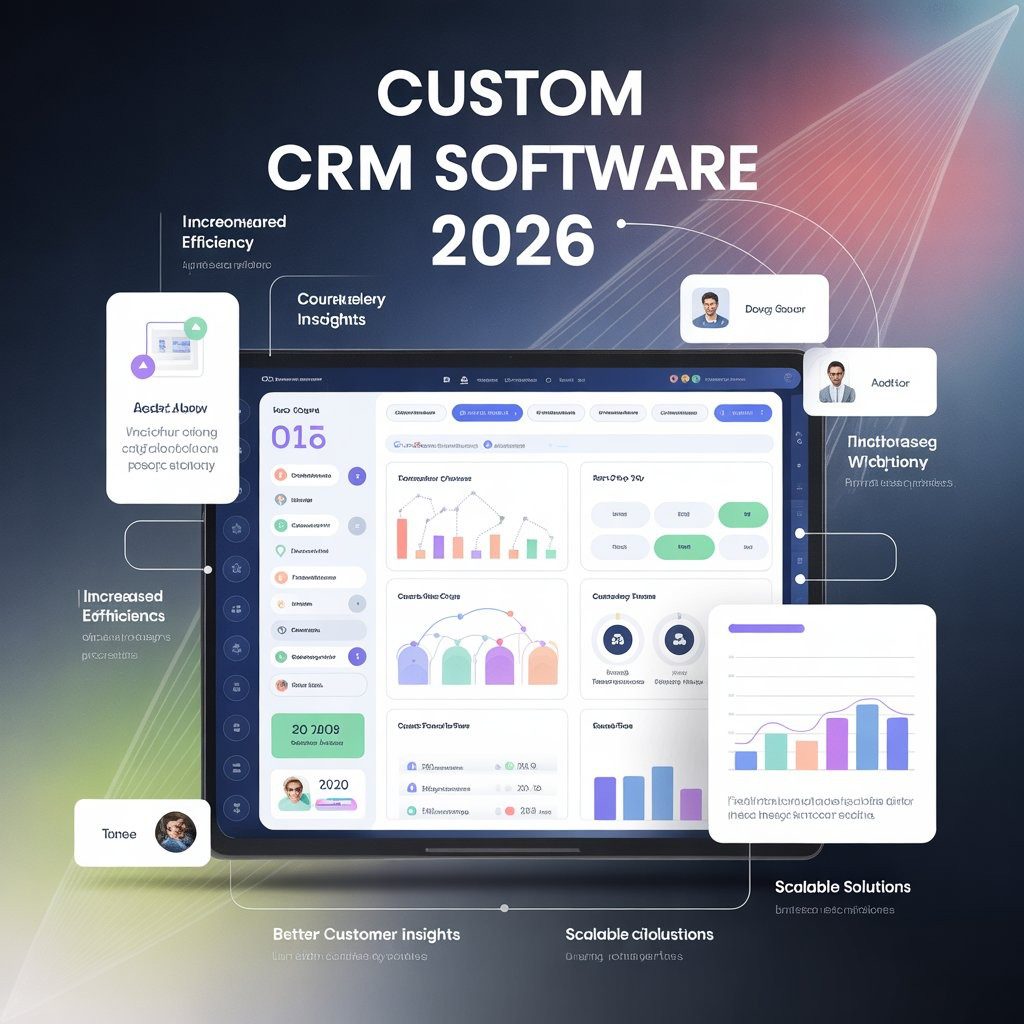
That’s what Custom CRM Software Benefits 2026 is really about. Not features on a checklist. Not a vendor comparison matrix. But a system that becomes a genuine competitive advantage — one that your competitors can’t replicate because it’s built for you.
Whether you’re a 10-person startup in Seattle trying to get serious about your customer pipeline, or a 500-person company in Chicago ready to replace a fragmented CRM ecosystem with something unified and powerful — the path to a better customer relationship management system starts with the decision to stop settling for generic.
AsappStudio has helped businesses across the United States build custom CRM systems that deliver on this promise. From discovery to deployment to ongoing support, we build solutions that are made to last and made to grow.
Ready to talk about what a custom CRM could look like for your business? Get in touch with our team today.
Q1: What are the top Custom CRM Software Benefits 2026 for US businesses?
Custom CRM boosts sales, automates workflows, improves customer retention, centralizes data, and offers scalable, fully tailored solutions that generic tools simply cannot match.
Q2: How does custom CRM compare to off-the-shelf CRM in terms of ROI?
Custom CRM eliminates per-user fees and scales freely. Over 2–3 years, most businesses recoup development costs and gain a long-term operational and financial advantage.
Q3: Is custom CRM software suitable for small businesses?
Yes. Small businesses benefit greatly — custom CRM eliminates unnecessary features, reduces admin work, and gives teams tools built around their exact workflow and growth stage.
Q4: What is the average cost of custom CRM development in 2026?
Development typically ranges from $40,000 to $120,000 depending on complexity. Ongoing hosting and maintenance average $500–$2,000/month with no per-user licensing fees.
Q5: How long does it take to build and deploy a custom CRM system?
Most custom CRM projects take 3 to 6 months from discovery to launch, depending on feature depth, integrations required, and the size of the development team involved.