
Last Tuesday, I’m sprawled on my couch, stomach growling, too tired to cook. Hit the order button. Twenty minutes later—knock knock. Except not really a knock. More like a polite robot beep.
I open the door expecting some teenager with my burrito. Instead? This adorable six-wheeled thing sitting there, blinking at me like a patient puppy. The lid pops open. Steam rises from my food. Hot, fresh, perfect. And zero human interaction required.
That moment hit different. This wasn’t some tech expo stunt. This was my regular Thursday, except suddenly living in what used to be tomorrow. Innovations in delivery robots and autonomous vehicles in 2025 stopped being headlines and became my actual life.
Working at Asapp Studio, I build software for this exact stuff. But experiencing it as a regular hungry person? Whole different vibe. Let me walk you through what’s actually going down in our streets right now.
Seriously, take a walk. You’ll probably spot one. Delivery robots went from “huh, interesting” to completely normal faster than anyone predicted. My neighbor’s kid named the one that brings their groceries. They call it Roberto. That’s where we’re at.
Starship Technologies figured something out that others missed. Their Starship robots aren’t trying to be fancy. They’re just reliable workhorses that get stuff done. Watch one navigate a crowded sidewalk—it’s weirdly polite, stopping for people, waiting at crosswalks like it was raised right.
They’ve got thousands of these starship delivery machines running around college campuses and cities. Students don’t even think twice anymore. Order snacks between classes, robot brings them to the library. Done. Everyone’s wondering about starship technologies stock and when the starship technologies stock ipo date drops, but honestly? Their real flex is making robot delivery feel boring. Boring in the best way—like it just works.
Each starship robot covers way more ground than any delivery driver could, never complains about weather, never gets lost. The starship robot price makes sense when you calculate miles delivered over years. These things are marathon runners, not sprinters.
Remember those clunky first-generation food delivery robots that looked like rolling trash cans? Yeah, we don’t talk about those anymore. Current models are slick. Restaurants that couldn’t afford their own delivery fleets now compete with the big chains.
The food delivery robot price dropped enough that mid-sized places can actually swing it. Not just tech companies showing off. Real businesses making real money. Delivery robots San Francisco helped pioneer this, but now you’ll find them from Phoenix to Pittsburgh.
Marble robot was doing cool stuff before getting acquired. Their approach taught everyone that last-mile delivery needs ground-level solutions, literally. Roads are one thing, but navigating actual sidewalks with cracks, curbs, random obstacles? That’s the real test. Modern robotics technology finally cracked that code.
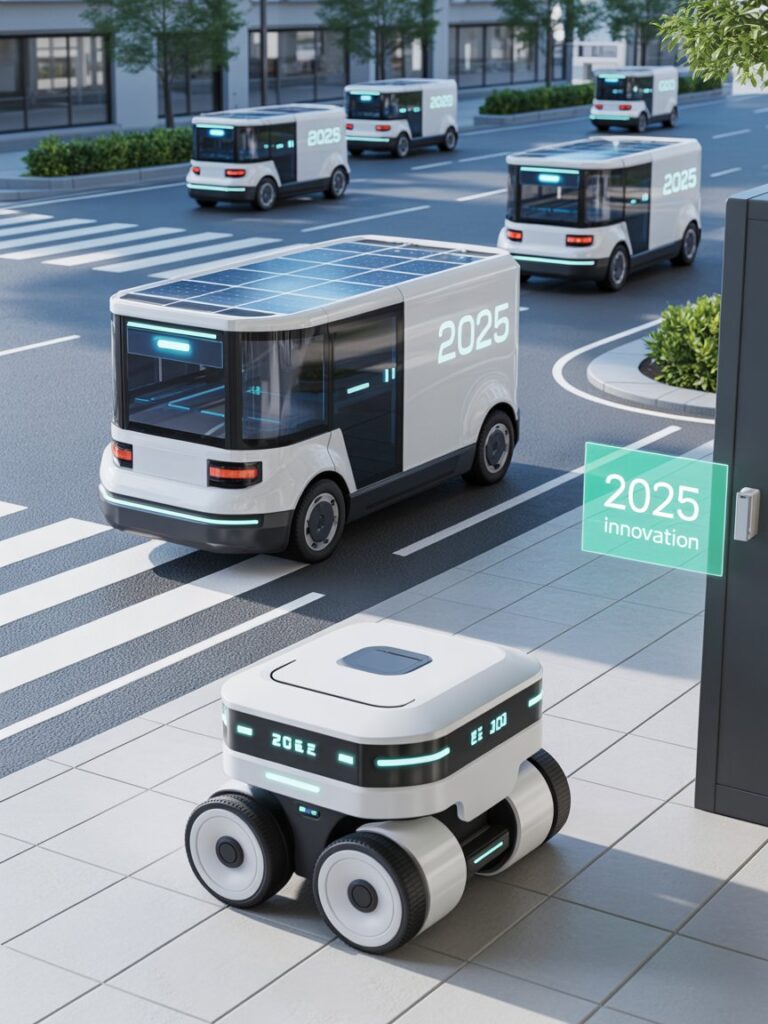
While tiny robots handle tacos, bigger autonomous vehicles are tackling serious logistics. Self-driving cars in 2025 still can’t go everywhere unsupervised, but in the right spots? They’re crushing it.
Last-mile delivery has always been the expensive part. That final stretch from warehouse to front door eats profit margins alive. Autonomous delivery solutions just completely flipped this economics problem.
Watch smart delivery vehicles work their routes now. They learn patterns, optimize constantly, communicate with each other about traffic or road closures. Electric delivery robots handle neighborhood runs without gas costs or emissions. Electric vehicles aren’t just environmental PR—they’re legitimately cheaper to operate long-term.
Here’s what blows my mind about AI in delivery robots: it’s not just programming anymore. These systems actually learn. One robot encounters something weird—construction blocking a usual path, festival closing streets—and boom, every robot in the network knows instantly.
AI-powered transportation gets smarter every single day. The autonomous fleet learns from millions of combined miles. When engineers at Asapp Studio work on AI development solutions, we’re basically teaching digital brains to think spatially, predict human behavior, and make split-second safety calls.
It’s wild stuff. Processing sensor data faster than human reaction time, managing security against hacking attempts, coordinating with cloud systems while operating independently. Building software for this isn’t regular coding—it’s creating machine consciousness, kinda.
Urban mobility solutions powered by driverless technology are forcing city planners to completely rethink infrastructure. Dedicated robot lanes appearing on sidewalks. Charging stations multiplying like coffee shops. Local laws updating monthly trying to keep pace.
Transportation automation ripples beyond just deliveries. Bus systems testing autonomous shuttles. Parking garages converting to fulfillment centers. The physical layout of cities morphing to accommodate these new mechanical residents.
Some autonomous delivery robot projects show where this is headed better than others. Robotic delivery systems handling groceries in multiple countries now, getting fresh produce to doors within hours. Robot delivery systems moving medical supplies between hospitals and clinics, transporting prescriptions and lab samples autonomously.
Hospitals are even using autonomous vehicles internally—moving supplies across sprawling campuses without tying up staff. Delivery automation expanded way past consumer stuff. Industrial sites run autonomous parts delivery. Warehouses have robot fleets working alongside humans seamlessly.
The future of transportation isn’t about eliminating people. It’s about augmenting what humans can handle with tireless machines doing the repetitive, physically demanding work.
You’re probably thinking: haven’t people been promising robot cars forever? Fair point. So what actually changed?
Three things converged that weren’t ready before:
Battery tech finally caught up to ambition. Modern electric delivery robots run all day, full shifts, single charge. Range anxiety? Dead and buried.
5G networks rolled out for real. Not marketing hype—actual reliable bandwidth everywhere. Real-time cloud processing supplements onboard computers. Robots stay connected even in tricky spots.
Regulations caught up to reality. Governments worldwide figured out actual rules for autonomous delivery operations. That legal fog that froze projects? Mostly cleared. Companies can actually deploy now without wondering if they’ll get sued or shut down.
Most articles miss the real story. The hardest part isn’t building robots—it’s the invisible software ecosystem keeping everything running smoothly.
Fleet management platforms coordinating thousands of vehicles simultaneously. Predictive maintenance catching problems before breakdowns. Customer apps showing real-time tracking accurate to within seconds. Security systems fighting off cyber threats 24/7.
At Asapp Studio, this is our bread and butter. Custom software development for these exact challenges. Building IoT development services that connect sensor networks. Creating blockchain solutions for tamper-proof delivery verification. The software infrastructure behind autonomous delivery is staggeringly complex.
Current autonomous delivery robot projects target specific real-world problems, not sci-fi fantasies. Medical campuses need HIPAA-compliant robots. Retail chains want seamless inventory integration. Universities require systems navigating dense pedestrian traffic safely.
Each situation demands custom software. Off-the-shelf solutions crash and burn when real money and reputations are on the line. You need systems built specifically for your exact use case.
Let’s cut through hype and talk practical impact. What does delivery automation actually do for people?
Retailers are slashing delivery costs hard. One major pizza chain I talked to reported 30% expense reduction after deploying robots. Those savings either lower customer prices or pad margins—competitive advantages that matter in tight markets.
For regular people, autonomous delivery solutions enable convenience that literally couldn’t exist before. Order something at 3 AM? No problem, robot doesn’t care. Need medication delivered discreetly? Robot doesn’t gossip. Zero awkward doorstep small talk. No calculating tips in your head while someone stands there waiting.
Environment-wise, electric vehicles and electric delivery robots measurably improve air quality. Cities with high robot density show real emissions drops. Not saving the world alone, but every bit helps when it comes to climate stuff.
Real talk: innovations in delivery robots and autonomous vehicles in 2025 still face genuine obstacles. Not everything’s solved.
Weather remains legitimately tricky. Heavy rain messes with cameras. Snow buries navigation markers. Autonomous systems crush sunny days but struggle when Mother Nature gets moody.
Theft and vandalism are ongoing headaches. Some people apparently can’t resist kicking robots or trying to break into compartments. Security gets better constantly, but human unpredictability challenges even the smartest AI.
Regulatory inconsistency frustrates everyone. What’s totally legal in California gets you shut down in Texas. International expansion means navigating dozens of different frameworks. Industry-wide standardization would accelerate adoption massively.
Let’s address the elephant in the room: what happens to delivery drivers?
Honestly? It’s complicated. Yeah, some traditional delivery gigs will vanish. But new positions emerge simultaneously: robot fleet managers, maintenance techs, remote operators handling tricky situations. Driverless technology doesn’t just delete jobs—it transforms the entire employment landscape.
Smart companies retrain existing workers for updated roles. Delivery drivers become robot supervisors, leveraging their route knowledge and customer service experience in new contexts. It’s not perfect. It’s not always smooth. But it’s more nuanced than “robots stealing jobs” panic headlines.
The future of transportation gets even wilder from here. Aerial delivery drones will complement ground robots. Autonomous trucks transforming long-haul shipping completely. Eventually, the entire supply chain—factory floor to your doorstep—might run without human drivers touching anything.
Robotic delivery systems will fade into invisible infrastructure, like electricity or plumbing. You won’t think about them any more than you wonder how water reaches your tap. They’ll just work, silently, constantly, reliably.
Integration accelerates fast. Your smart home will coordinate with delivery robots automatically. Schedule dinner arrival for exactly when you return from work. The autonomous vehicle talks to your calendar, your GPS app, your smart lock. Everything connects seamlessly.
Whether you’re running a business exploring delivery automation or you’re a developer curious about IoT development, right now is the moment to engage with these technologies actively.
Companies winning in 2025 didn’t sit around waiting for perfect solutions. They experimented early, learned from failures, iterated constantly. Innovations in delivery robots and autonomous vehicles for 2025 reward bold moves and punish hesitation hard.
At Asapp Studio, we guide businesses through exactly this transformation. Mobile app development integrating with autonomous fleets. Custom software solutions managing complex logistics. We build the digital foundations these systems absolutely require to function.
Innovations in delivery robots and autonomous vehicles in 2025 aren’t some future concept—they’re your current reality. Sidewalk robots delivering lunch to hungry students. Autonomous vans handling package routes. Electric vehicles eliminating emissions block by block. AI-powered transportation learning and improving literally every single day.
This transformation moves faster than most people realize. Starship Technologies and countless other companies deploy thousands of new robots monthly. Autonomous fleet expansion accelerates globally. Robotics technology improves at rates that would’ve seemed impossible five years ago.
The real question isn’t whether autonomous delivery will dominate—it absolutely will. The question is whether your business adapts quickly enough to benefit instead of scrambling to catch up later. Companies embracing delivery automation early gain competitive advantages measured in years, not months.
The future of transportation isn’t some distant sci-fi fantasy living in movies. It’s rolling down your street right this second, six wheels at a time, carrying someone’s dinner with quiet efficiency.
And you know what? That future looks pretty damn exciting to me.
Q1: What are delivery robots and how do they work in 2025?
Delivery robots are autonomous machines that transport goods using sensors, AI, and GPS. They navigate sidewalks safely, avoid obstacles, and deliver items to specified locations without human drivers.
Q2: Are Starship Technologies robots available in my area?
Starship robots operate in select cities and campuses worldwide. Check their website for coverage areas. Expansion continues rapidly throughout 2025, with new locations added monthly in partnering regions.
Q3: How much does a food delivery robot cost for businesses?
Food delivery robot prices range from $5,000-$15,000 per unit, plus operational costs. However, many companies lease robots through service agreements, reducing upfront investment and including maintenance coverage.
Q4: What makes autonomous vehicles different from self-driving cars?
Autonomous vehicles include all driverless transportation—delivery robots, trucks, shuttles. Self-driving cars specifically refer to passenger vehicles. Both use similar AI and sensor technology for navigation.
Q5: Will delivery robots replace human delivery drivers completely?
Not entirely. Robots excel at routine deliveries in controlled environments. Humans remain essential for complex situations, customer service, and areas where autonomous operations aren’t yet practical or legal.