
So last Tuesday, I’m sitting in bumper-to-bumper traffic on the 405—because of course I am—when this small aircraft zooms past overhead. Not a helicopter. Not a plane. A drone. Carrying what looked like somebody’s Chipotle order. And I’m just sitting there like an idiot, burning $5 worth of gas to move three feet, while this little robot’s already halfway to its destination.
That’s when it hit me. Drone Transport in 2026 isn’t some Jetsons fantasy anymore. It’s literally happening while we’re stuck complaining about traffic.
Okay, real talk. When I say drone transportation, I’m not talking about your buddy’s $200 camera drone from Best Buy. I’m talking about serious unmanned aerial vehicles moving packages, medical supplies, groceries, and yeah—eventually people—through the air instead of clogging up our already ridiculous road system.
This whole thing’s turned into a $2.74 billion industry this year. By 2034? Nearly $30 billion. That’s not growth. That’s an explosion.
And before you ask—no, I didn’t make those numbers up. The drone logistics and transportation market was sitting at $2.05 billion last year and they’re predicting $87.6 billion by 2035. That’s a 45.5% compound annual growth rate. Which basically means this thing’s growing faster than your teenager’s appetite.
North America’s grabbed over 45% of the global market. California’s going crazy with it. Texas too. Florida, Arizona—they’re all racing to see who can get the most drones in the air first. It’s like the Gold Rush, except instead of pickaxes, everyone’s got quadcopters.
These transport drones aren’t what you think. They’ve got AI navigation that makes decisions on the fly (pun absolutely intended). There’s this detect-and-avoid tech that’s basically like having a paranoid co-pilot who never sleeps. Remote ID compliance so the FAA knows exactly who’s flying what. And autonomous routing that would make your phone’s GPS look like a paper map from 1987.
The folks at AsappStudio work on this exact technology—artificial intelligence andIoT development that powers these drone transportation services. Same stuff they use for building killer mobile apps and software solutions. Just, you know, flying.
Beyond Visual Line of Sight. That’s what BVLOS means. Used to be, if you couldn’t see your drone, you couldn’t fly it. BVLOS threw that rule out the window. Now these things can fly miles away, completely on their own.
We’re talking infrastructure inspections across state lines. Deliveries to the middle of nowhere. Pipeline monitoring that doesn’t require a helicopter crew. The FAA’s Part 108 regulations just opened the floodgates—companies can now get permits for up to 100 drones, each weighing 55 pounds. Need heavier? Operating certificates let you fly 110-pound drones pretty much anywhere.
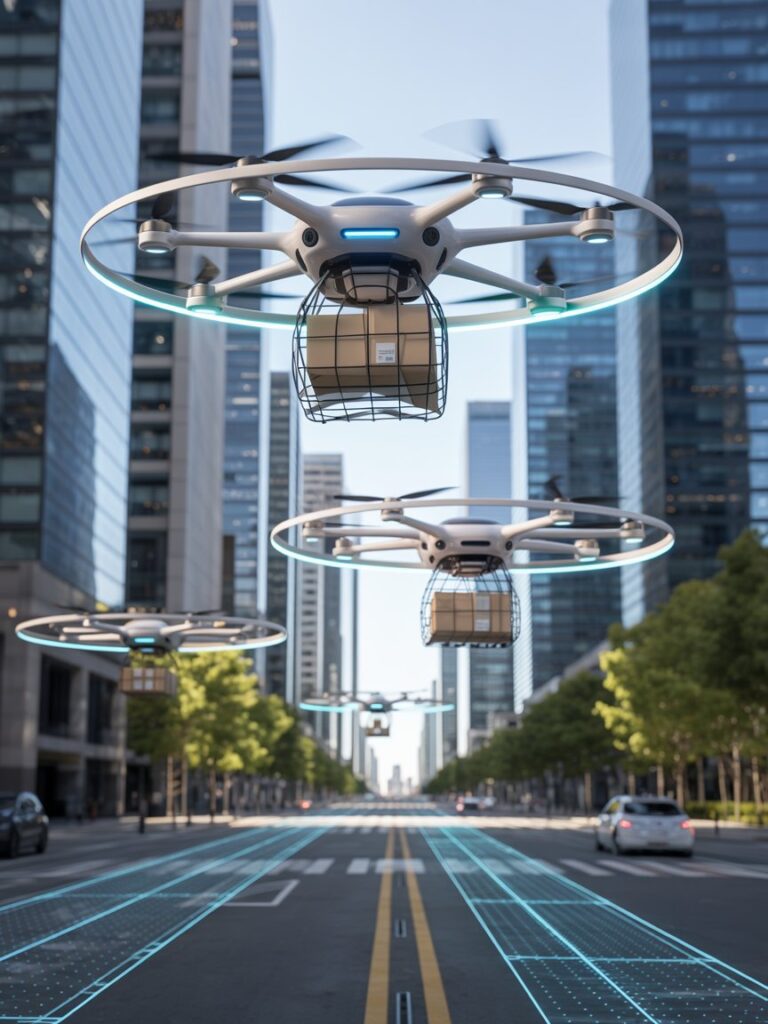
Remember the Jetsons? George just hopped in his flying car every morning? Well, personal drones for transportation are getting weirdly close to that reality. Dubai’s already testing flying taxi services. Not tiny drones—full-on passenger aircraft that skip traffic by literally flying over it.
The personal transportation drone thing is happening faster than most people realize. Los Angeles is gearing up for the 2028 Olympics with massive drone infrastructure investments. They’re building Unmanned Traffic Management systems that’ll coordinate hundreds of drones flying around at the same time. It’s like air traffic control but for robots.
Everyone keeps asking me this. Will drones be banned? Short answer: Nope. The FAA’s not stupid. They’re not trying to kill innovation—they’re trying to make it safe.
What’s actually happening is smarter regulation. Yeah, the FCC added some foreign-made drones to their covered list because of security concerns around big events like the 2026 World Cup. But that’s not a ban on existing operations. It’s about limiting new sketchy equipment from entering the market.
Alright, let’s get specific because this is where it gets wild. Zipline, Amazon Prime Air, Wing (which is basically Google), UPS Flight Forward—they’re all actively delivering packages by drone right now. Not testing. Not pilot programs. Actually doing it.
E-commerce has grabbed over 50% of the market. Makes sense, right? Last-mile delivery—that final hop from the warehouse to your doorstep—is expensive and slow with trucks. With drones? Faster, cheaper, way more efficient.
Healthcare’s the other big winner. Medical supplies, prescription meds, blood samples—all being flown to rural hospitals and emergency sites. When someone’s dying and you need blood now, a drone beats an ambulance stuck in traffic every single time.
Right now, drone delivery is live in Arizona, Arkansas, California, Florida, Missouri, North Carolina, Ohio, Oregon, Texas, Utah, and Virginia. More states coming online soon.
These aren’t bigger versions of toys. They’re sophisticated machines with serious computing power.
Artificial intelligence handles route planning, dodges obstacles, and even predicts when parts need replacing before they break. These systems learn from every single flight. They’re literally getting smarter every day. That’s the kind of software development AsappStudio builds—tech that learns and adapts.
How heavy can a drone be? Commercial ones usually run 25 to 110 pounds depending on certification. But what matters more is payload—how much cargo they can actually carry.
Your standard delivery drone handles packages up to 5 pounds. Heavy-duty cargo drones? They’re hauling 100 pounds or more. The thrust they produce gets calculated based on their weight, what they’re carrying, and where they’re going.
Here’s the exciting part. CES 2025 just showcased the world’s first solid-state battery for drones. This could be the breakthrough everyone’s been waiting for. Way longer flight times. More payload capacity. Suddenly, long-distance drone transportation becomes actually practical instead of theoretical.
Current lithium-polymer batteries give you maybe 15-30 minutes of flight time. Solid-state batteries could triple that. Whole new use cases just opened up.
You can’t have thousands of flying robots buzzing around without some serious traffic control. That’s where UTM comes in—Unmanned Aircraft System Traffic Management.
Think of it like GPS had a baby with air traffic control and your smart home system. These platforms coordinate drones in low-altitude airspace, stop them from smashing into each other, and manage flight corridors. By 2026, lots of states have organized corridors specifically for autonomous drone flights.
Operators file flight plans, get real-time airspace updates, and make sure they’re following all the rules. If you want to run a legit drone operation, you’re using UTM. Not optional.
From a business angle, drone logistics 2026 is where the real cash is flowing. Companies have moved past “let’s try this” and into “this is our actual business model.” They’ve got dedicated fleets, trained operators, standardized processes—the whole nine yards.
Traditional last-mile delivery costs $10-15 per package. Painful. Drones can cut that by 40-60% once you’re running at scale. No driver salaries. No vehicle maintenance. No gas. And deliveries happen way faster.
For e-commerce drone transport, this changes everything. Customers get stuff faster. Companies save money. Win-win.
Big companies are investing in automated drone fleets. These systems launch multiple aircraft at once, manage charging schedules, flag maintenance issues, and optimize delivery routes—all automatically.
The expertise in mobile app development and IoT solutions that AsappStudio brings to the table applies directly here. Managing a drone fleet needs sophisticated software juggling real-time data from dozens of sources simultaneously.
Regulations are changing fast. If you’re not paying attention, you’re gonna get left behind or worse—fined.
Part 107’s the standard rule for commercial drones under 55 pounds. Most operations still fall under this. Part 108’s the new kid specifically for BVLOS operations and bigger drone delivery operations.
The difference:
Every commercial drone has to broadcast its location and ID in real-time. Started in 2023, fully enforced now. It’s basically a license plate for your drone. Authorities can track who’s flying what and where.
The FAA requires environmental assessments for drone package delivery operations. They’re reviewing a Programmatic Environmental Assessment right now that’ll cover nationwide delivery. Public comments are open, and what people say actually matters here.
Let’s break down what’s actually happening across the US.
California’s leading the pack, especially Silicon Valley and LA. Tech companies testing everything—medical deliveries, food service, you name it. The 2028 LA Olympics are pushing major investments in UTM systems and drone corridors.
Texas has become the testing ground for long-range operations. Huge state, mixed urban-rural landscape—perfect for proving out new tech. Companies running trials for both last-mile and middle-mile logistics.
Florida’s flat terrain and year-round good weather make it perfect for drones. Several major companies set up testing facilities here. Focus on coastal delivery routes and hurricane response.
Clear weather and friendly regulations brought tons of drone companies to Arizona. Phoenix and Tucson are hotspots for testing new aircraft designs and autonomous systems.
Urban drone delivery in NYC is trickier because of population density and congested airspace. But the city’s actively building UTM infrastructure to make safe operations possible soon.
Where’s this all heading? Best guess—we’re moving toward a fully integrated aerial logistics network.
By 2030, we’ll probably see drone highways—dedicated airspace corridors where AI-managed aircraft move cargo without any human touching the controls. Machine learning will optimize routes, predict maintenance, and adapt to weather changes in real-time.
Flying taxis aren’t sci-fi anymore. Multiple companies developing passenger drones that could completely change urban transportation. Skip rush hour by flying over it. The technology’s ready. We’re just building the infrastructure and regulations to make it safe.
Future transportation technology 2050 sees drones as core infrastructure alongside self-driving cars, hyperloop systems, and traditional transit. Seamless, multimodal transportation networks.
AsappStudio’s blockchain development work could fit here too—distributed ledger tech managing drone flight permissions, package tracking, and autonomous payments.
Hell yes. The question isn’t if drone delivery becomes mainstream—it’s when. Every major logistics company’s dumping money into this. Amazon, Walmart, UPS, FedEx—they’re all racing.
Why? Customers want faster delivery. Companies want lower costs. Cities want less traffic. Drones solve all three.
The drone transportation industry’s projected to handle millions of deliveries annually by 2028. That’s happening whether you’re ready or not.
Look, drone transport isn’t perfect. There are legit issues:
Drones hate heavy rain, snow, and high winds. Companies are building tougher aircraft and better weather prediction systems to work around it.
Current batteries limit flight time and range. Those new solid-state batteries might be the game-changer everyone needs.
Some folks worry about noise, privacy, and safety. Fair concerns. Transparent operations, community engagement, and clear regulations are helping address them.
Navigating FAA requirements, state laws, and local rules gets complicated fast. Professional software and compliance systems help.
Creating a working drone transport network needs more than flying robots:
Infrastructure: Landing pads, charging stations, maintenance facilities
Software: Flight management, route optimization, fleet tracking
Regulations: Rules that balance innovation with safety
Training: Certified pilots and ground crew
Public Education: Helping communities understand and accept operations
At AsappStudio, we’re perfectly positioned to help companies entering this space. Our work in custom software development, AI integration, and IoT systems translates directly to building drone management platforms.
The startup scene around drone delivery’s exploding. New companies popping up with fresh approaches to everything—aircraft design, logistics software, UTM platforms.
Categories to watch:
Thinking about launching something drone-related? Now’s the time. Tech’s mature enough to work but new enough that opportunities are everywhere.
Need help with the software side? Check out our app development services and UI/UX design.
Drone transportation services offer real environmental benefits. Electric drones produce zero direct emissions. Urban drone delivery solutions could pull thousands of delivery trucks off roads, cutting congestion and air pollution.
But we gotta consider the full picture—battery production, electricity sources, aircraft manufacturing. The industry’s working toward sustainable solutions like renewable energy charging stations and recyclable materials.
Modern drone routing uses crazy sophisticated algorithms considering:
These systems run on AI and machine learning, constantly improving. The AI-powered solutions AsappStudio develops use similar tech to optimize complex workflows.
Thinking about integrating drone delivery? Here’s what you need:
Don’t build everything yourself. Partner with people who know the tech and regulations.
Let’s talk actual money. What’s the return on investment for drone delivery?
Cost savings: 40-60% reduction in last-mile costs at scale Speed improvements: Hours become minutes Customer satisfaction: Faster delivery means better reviews, repeat business Competitive advantage: First movers build advantages hard for competitors to match
Upfront investment’s significant—aircraft, software, training, compliance all cost money. But early adopters are building advantages that’ll pay off long-term.
Everything we’ve discussed—AI navigation, fleet management software, mobile apps for tracking, IoT integration for monitoring—this is exactly what we build at AsappStudio.
Our software development team creates complex systems handling real-time data, autonomous decisions, and seamless user experiences. Need a custom mobile app for managing your fleet? An AI-powered analytics platform optimizing routes? We’ve got you.
Check our case studies to see solutions we’ve built. From blockchain integration for secure package tracking to custom ERP systems managing operations—we’ve done it all.
Drone Transport in 2026 isn’t coming. It’s already here. The technology works. Regulations are evolving. Companies are investing billions. Whether you’re looking to implement drone delivery, develop related technology, or just curious where this heads—now’s the time to pay attention.
The skies above your neighborhood are about to get a lot busier. And honestly? That’s exciting as hell.
Ready to jump into the drone transport revolution? Contact AsappStudio to discuss building the technology powering your vision.
Q1: What is drone transport and how does it work in 2026?
Drone transport uses unmanned aerial vehicles with AI navigation, detect-and-avoid tech, and autonomous routing to deliver packages and cargo. The industry is worth $2.74 billion this year.
Q2: Are personal drones for transportation available yet?
Personal transport drones and flying taxis are in testing phases, with Dubai and LA leading. Passenger drones aren’t widely available but are expected within 3-5 years as regulations evolve.
Q3: Will drones be banned in the United States?
No, drones won’t be banned. The FAA is creating new regulations for safe integration. Recent FCC rules limit foreign-made drones for security reasons but don’t ban existing operations.
Q4: How much weight can a delivery drone carry?
Delivery drones certified under FAA Part 108 can weigh up to 110 pounds and carry payloads ranging from 5 to 100+ pounds depending on the aircraft design and mission requirements.
Q5: Which states currently have active drone delivery services?
Active drone delivery operates in Arizona, Arkansas, California, Florida, Missouri, North Carolina, Ohio, Oregon, Texas, Utah, and Virginia with expanding coverage planned.
Looking to build innovative technology solutions? Explore AsappStudio’s services including mobile app development, AI solutions, and IoT development.