
My friend Kevin manages a manufacturing plant outside Dayton, Ohio. About 300 people on the floor. Stamping equipment, robotic arms, conveyors, the whole thing. About four years ago his company started connecting their machines to the network so the operations team could pull real-time production data without walking the floor every hour.
Good idea. It made real sense.
Last year someone on his IT team ran a basic network scan and found 47 devices on their OT network that nobody had officially authorized or inventoried. Some vendors had connected something during a maintenance visit and never told anyone. A few were still running with the default credentials they shipped with.
Kevin called me a little shaken. Not because anything had gone wrong yet. Because he’d just realized how long he’d been assuming someone else was watching.
That’s the Industrial IoT Security conversation I keep having with people who run real operations across the U.S. Not theoretical. Not abstract risk frameworks. Just the slow creep of connected devices, accumulated over years, in environments that weren’t built with network security as a baseline assumption.
And now it matters. A lot.
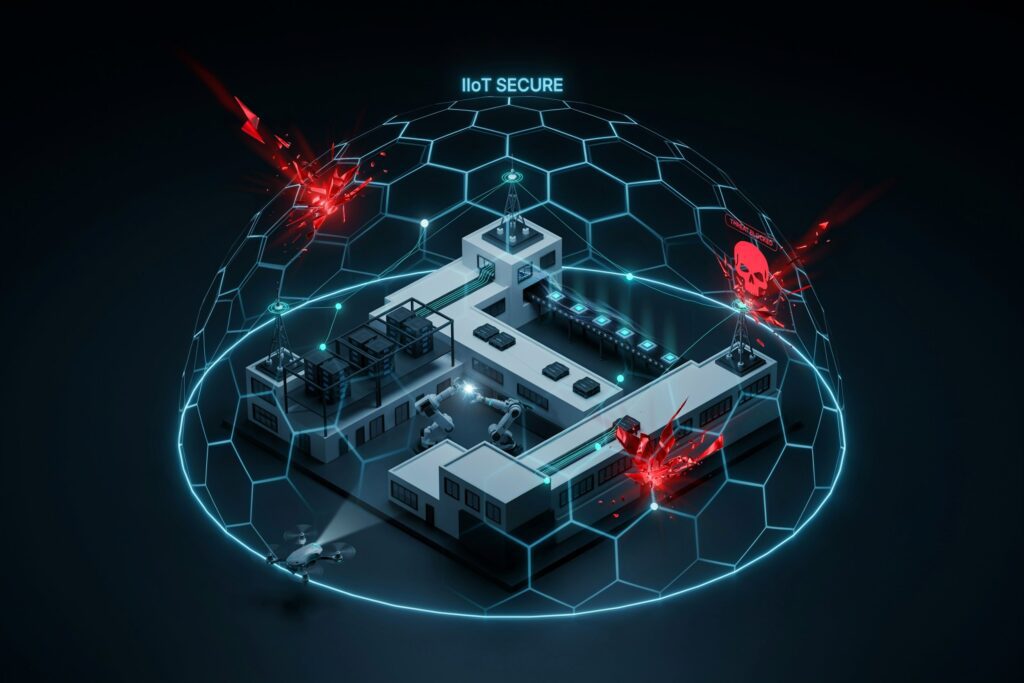
Industrial IoT Security — also written as IIoT Security or Industrial Internet of Things Security — is the discipline of protecting the connected devices, networks, control systems, and data that run industrial operations. Manufacturing lines. Power grids. Oil and gas infrastructure. Water treatment plants. Chemical processing facilities. Food production. Transportation networks.
The “industrial” qualifier is doing a lot of work in that definition. Consumer IoT security is about your smart thermostat. Industrial IoT Cybersecurity is about systems where a breach doesn’t just mean stolen data — it can mean a gas valve opening when it shouldn’t, a chemical reactor running outside its safe operating range, a water system getting contaminated, or a factory going dark mid-shift.
The physical world and the digital world aren’t separate things in an industrial setting. A sensor reading pressure inside a pipeline isn’t just producing data — it’s the mechanism that keeps that pipeline safe. When you connect those systems to a network, you make them more useful and more vulnerable at the same time. IIoT Cybersecurity exists because someone has to manage that tradeoff deliberately.
How does IoT security work in an industrial context? It layers controls across multiple levels — the devices themselves, the networks they communicate on, the data they produce, the people and systems that access them — so that a compromise at any one level doesn’t cascade into something catastrophic. That’s the theory. What it looks like in a real plant in 2026 is a lot messier, and a lot more interesting.
Walk into a mid-size manufacturing facility in Grand Rapids, Michigan or Greenville, South Carolina and count the connected things. Pressure transducers. Temperature sensors. PLC controllers running assembly equipment. Vision systems doing quality checks on a line. Vibration monitors on motors. HMI screens at operator stations. Environmental sensors. Energy meters. Maybe a SCADA system pulling all of it together.
Then count the devices in the logistics operation. Fleet tracking. Cold chain sensors. Warehouse management systems. Dock scheduling software talking to carrier APIs.
Then count what connects to the corporate network. ERP integration. Remote monitoring portals for vendors. Cloud historian pushing process data to analytics tools.
How is IoT used in industry in 2026? The honest answer is: extensively, often without a complete picture of the full scope, and faster than the security practices meant to govern it have been able to keep up.
That’s not a knock on the people running these facilities. Most of them are dealing with decisions made by different teams over many years. The maintenance team connected remote access to the air compressors because the vendor offered it. The energy team connected the utility meters for the sustainability reporting initiative. The ops team connected the line sensors because the new MES system required it. All reasonable decisions. Nobody was keeping a master ledger.
The result is what Kevin found. Dozens of devices, many with unclear ownership, some with known vulnerabilities, sitting on a network that’s increasingly connected to everything else.
This is the conversation I have most often with IT directors who’ve just been handed responsibility for OT environments and are trying to figure out what’s different.
Everything is different. The problems overlap but they’re not the same problems.
In IT security, availability matters but a few hours of downtime is usually survivable. You patch things. You reboot. You push updates. You run vulnerability scans. The system tolerates it.
In Operational Technology (OT) environments, availability isn’t just a priority — it’s sometimes the priority that overrides everything else. A PLC managing a chemical reactor is running a continuous process. You can’t pause it for a reboot. You can’t scan it with an active network scanner without potentially triggering commands that affect physical equipment. The engineering standard that governs everything in that environment is: do not disrupt the process.
So patching gets deferred. Vulnerability management looks completely different. You can’t apply the same tools in the same way.
Then there’s the age issue. Industrial control systems in the U.S. run old. Genuinely old. PLCs installed in 2004, still in production, still running firmware that’s never been updated because updating firmware on a controller running a $40 million production line is a serious event that requires a maintenance shutdown, change management approval, a rollback plan, and probably a vendor on-site. You don’t do that casually. So the vulnerabilities sit.
And then there’s the protocol issue. Modbus. DNP3. Profibus. OPC DA. These are industrial communication protocols designed decades ago for isolated environments. They have no authentication. They transmit in plain text. They were built for reliability in closed systems — not for network security in environments where they’re now talking to cloud services.
Cyber physical systems security is the term the academic and defense community uses for this intersection. Attacks that produce physical consequences. Not data theft — actual physical harm, equipment damage, process disruption. The industrial IoT security challenges here are genuinely different from what most IT security frameworks were designed to handle. NIST, ISO, IEC all have specific frameworks for OT environments for this reason.
February 2021. Oldsmar, Florida. Someone accessed the water treatment plant’s control system through an exposed remote desktop connection and tried to increase the sodium hydroxide level to 111 times the normal amount. The operator caught it. The city’s drinking water was fine. But the lesson wasn’t subtle.
2021 again. Colonial Pipeline. Ransomware hit the IT side of the operation. The company shut down the pipeline proactively — not because the OT systems were directly compromised, but because they couldn’t trust the integrity of the systems well enough to keep running. 45% of the East Coast’s fuel supply was interrupted for nearly a week. $4.4 million ransom paid.
These are the ones that made the news.
Industrial IoT security news from the past few years is full of incidents that didn’t make the front page. Water utilities in the Midwest discovering unauthorized access. Manufacturers in Ohio and Indiana dealing with ransomware that spread from a corporate email click into production scheduling systems. A food processing company in California lost four days of output because a compromised vendor account was used to push malicious configuration changes to packaging equipment.
The iot security industry has grown significantly in direct response to this. Industrial IoT security firms — Dragos, Claroty, Nozomi Networks, Armis, Tenable — have built substantial businesses because the demand is real and the stakes are high. The industrial IoT markets and security picture going into 2026 shows a security market north of $22 billion that analysts expect to double before 2030. That kind of market growth doesn’t happen because people are theoretically worried. It happens because real things went wrong.
Here’s what I see consistently when security assessments happen in real industrial environments across the U.S.
Nobody has the full asset list. This is the most common problem, and it’s almost universal in facilities that have been operating for more than ten years. Devices accumulate. Vendors connect things during site visits. Teams add sensors without going through a formal commissioning process. The result is what Kevin found — dozens of unauthorized devices on a network nobody thought to audit. Industrial IoT asset management and asset discovery are foundational for this reason. You can’t protect what you don’t know exists.
The legacy stuff is untouchable. A stamping plant in Toledo has PLCs from 2006 managing their press lines. Those PLCs run proprietary firmware that hasn’t been updated since Obama’s first term. The vendor no longer supports them. There’s no patch to apply even if they wanted to. Industrial IoT firmware security in practice means working around equipment that was never designed to be secured in a networked environment — using compensating controls like network segmentation and monitoring because the device itself can’t be hardened.
Remote access was set up fast and never properly hardened. COVID pushed a lot of U.S. manufacturers to enable remote access to their plant systems quickly. Vendors needed to support equipment remotely. Engineers needed to monitor processes from home. Those connections got set up in a hurry. Many of them are still running with the same configuration they had in April 2020. Industrial IoT remote access security — proper VPNs, multi-factor authentication, session monitoring, time-limited access — is one of the most consistent gaps in assessments right now.
IT and OT don’t talk to each other. Not personally, mostly. The IT security team lives in the corporate office. The OT engineers live on the plant floor. They have different reporting chains, different tool sets, different priorities, different vocabularies. When someone connects an OT system to the corporate network, the gap between those two worlds becomes a security gap. OT cybersecurity as a discipline grew specifically because neither side could cover that seam alone.
Supply chain exposure is real and underestimated. The industrial IoT devices going into plants come from dozens of different manufacturers. Software libraries embedded in those devices come from dozens of others. An industrial IoT supply chain security failure — a backdoor in a vendor’s firmware update mechanism, a compromised library inside a controller’s operating software — can introduce risk into an environment without anyone at the facility doing anything wrong. The SolarWinds attack taught the enterprise world this. The industrial world learned the same lesson more slowly.
The protocols don’t have security built in. Modbus sends commands with no authentication. Anyone on the network can send a Modbus write command and the controller will execute it. DNP3 has optional authentication that most deployments don’t enable. EtherNet/IP is better but still has significant vulnerabilities in typical configurations. Industrial IoT security protocols at the device and communication level are a serious structural problem that compensating controls at the network layer can partially address but can’t fully eliminate.
Let me be specific about what actually goes wrong, because the generic “cyber threats” framing doesn’t help anyone build a real risk picture.
Ransomware targeting production is the most common serious incident right now. Groups that used to focus on corporate IT environments have figured out that manufacturing plants and utilities will pay to get their operations back because every hour of downtime has a real dollar cost. A stamping plant in Indiana can lose $80,000 an hour in unplanned downtime. That math makes industrial targets attractive. ICS security incidents involving ransomware have roughly doubled in the past three years.
Credential theft targeting engineers and operators is the common entry point. An engineer at a chemical facility in Texas gets a phishing email that looks like it’s from their SCADA vendor about a software update. They click it. Their VPN credentials get harvested. The attacker uses those credentials to access the plant network from the outside — legitimately authenticated, so the firewall doesn’t stop them. Industrial IoT identity management and multi-factor authentication exist specifically for this scenario.
Unauthorized device connections happen constantly. A contractor plugs a laptop into the control network to run a diagnostic tool. They’ve got malware on that laptop from a previous job site. It spreads laterally across the OT network. Nobody knew it was there until two weeks later when the historian started behaving oddly. Industrial IoT endpoint security and strict policies about what can connect to the OT network are the countermeasures, but they require enforcement that many facilities don’t have.
SCADA security breaches are particularly consequential because SCADA security systems provide centralized visibility and control across an entire facility or utility. Compromising the SCADA layer gives an attacker a dashboard view of the whole operation — and potentially the ability to send commands to any device that system manages.
IoT security risks retail industry — distribution centers, cold chain logistics, connected retail infrastructure — sit at a specific intersection worth mentioning. These environments blend commercial IoT with operational technology in ways that neither IT nor OT security teams fully own. A cold storage facility in Georgia operating 200 connected refrigeration units across three warehouses has a security profile that doesn’t fit cleanly into enterprise IT security frameworks or pure ICS security frameworks. That gap is where incidents happen.
There are actual industrial IoT security standards with teeth. Some are voluntary frameworks. Some are mandatory regulatory requirements depending on your sector. Here’s the real picture.
IEC 62443 is the one that matters most for industrial automation security. It’s a comprehensive set of standards — actually a family of related documents — covering security management, system design, and component-level requirements for industrial control systems. It defines security levels, establishes roles and responsibilities for asset owners, system integrators, and product suppliers, and provides a framework for systematically reducing risk in OT environments. If you’re building or assessing an industrial IoT security framework for a manufacturing or utility environment, IEC 62443 is where the serious work happens.
The NIST Cybersecurity Framework — updated to version 2.0 in 2024 — is the baseline governance framework for most U.S. regulated industries. It’s organized around six functions: Identify, Protect, Detect, Respond, Recover, and Govern. It’s not OT-specific, which makes it useful for programs that span IT and OT, but you need NIST SP 800-82 alongside it for actual OT security guidance. Together they’re the most common starting point for U.S. companies building formal ICS security programs.
The industrial internet security framework from the Industrial Internet Consortium provides practical guidance for IIoT deployments across sectors — how to think about endpoint security, communications security, and security monitoring for industrial IoT specifically. Less prescriptive than IEC 62443 but useful for organizations newer to formal IIoT security practice.
ISO 27001 is the information security management standard. For industrial organizations it provides the governance structure for managing security as an organizational practice. ISO 27001 certification is showing up increasingly in government and enterprise supply chain contracts as a requirement for vendors.
NERC CIP is mandatory for electric power operators. Non-negotiable. Legally enforceable. Updated to address industrial IoT and internet-connected assets in power infrastructure.
TSA Pipeline Security Directives came out of Colonial Pipeline. They require incident reporting, designated cybersecurity coordinators, network segmentation, and access management controls. If you operate pipeline infrastructure, these are not optional.
The industrial IoT security standards landscape for water utilities is still developing. EPA has issued guidance. Several states have passed legislation. Federal requirements are coming. If you run water infrastructure, the regulatory floor beneath you is rising and the timeline is not indefinite.
There are a lot of lists of industrial IoT security best practices on the internet. Most of them are correct. Most of them are also not things people actually do without some friction, so I want to talk about them honestly.
Build the asset inventory first and keep it current. You cannot run a meaningful security program without knowing what’s on your network. In OT environments, passive discovery tools — tools that observe network traffic without generating any themselves, because active scanning can disrupt sensitive equipment — are the right approach. Dragos, Claroty, and Nozomi all do this. The output is a map of every device, its protocol, its firmware, its communication relationships. Do this before anything else. And then build a process to keep it current, because new devices will keep appearing.
Segment OT from IT and segment within OT. Industrial IoT network segmentation is the single highest-value control most facilities aren’t fully implementing. A properly segmented network limits how far an attacker can move after getting in somewhere. The Purdue Model and the ISA/IEC 62443 zone and conduit approach both provide proven architectures. The engineering to implement it in a running facility is real work — you can’t just put a firewall between the two networks and call it done — but it’s worth it. A breach that stays contained to one zone is a recoverable incident. A breach that propagates across everything is not.
Fix the remote access problem. Multi-factor authentication on every remote access connection. Session recording on vendor access. Time-limited access windows. Access scoped to the specific systems and functions the vendor or remote operator actually needs — not blanket network access. Secure remote access in an industrial environment requires tools built for OT, not generic VPN solutions retrofitted from IT. The effort to implement this properly is proportional to the risk reduction.
Apply least privilege everywhere. Every user account should have exactly the access their role requires and nothing else. Shared accounts should not exist in OT environments. Contractor accounts should be time-limited and reviewed. People who left the company should not still have active credentials. Industrial IoT access control and identity and access management that enforces these principles dramatically reduces the blast radius when credentials get compromised — and they will get compromised.
Handle firmware and patches with a formal process. “We can’t patch because it might break something” is a real constraint in OT environments, not an excuse. But it’s not an acceptable permanent state. Work with vendors to understand what’s patchable, what requires downtime, and what requires replacement. For devices that genuinely can’t be updated, document the compensating controls that reduce the risk. For things that can be patched — patch them. Patch management in OT environments needs to be planned and deliberate, not indefinitely deferred.
Monitor continuously with tools that understand industrial protocols. An enterprise SIEM pointed at OT network traffic will produce mostly noise because it doesn’t know what normal looks like for Modbus or EtherNet/IP. Industrial IoT security monitoring requires tools that understand industrial communication patterns and can distinguish between a normal PLC poll cycle and an anomalous command sequence. Anomaly detection built on behavioral baselines for specific industrial environments is the standard now — not just signature-based detection.
Build an incident response plan that covers OT specifically. Generic incident response playbooks do not account for the reality that in an industrial environment, taking a system offline might be more dangerous than leaving it up. Industrial IoT incident response planning has to involve both IT and OT teams, has to account for the physical safety implications of different response actions, and has to be rehearsed. Tabletop exercises that simulate realistic industrial scenarios — a ransomware infection spreading from IT toward OT, an attacker sending malicious commands through a compromised engineering workstation — are how you find out whether your plan actually works before something real forces the test.

Industrial IoT security architecture is a design question before it’s a product question. The tools you buy matter less than how the environment is structured.
Defense in depth — multiple layers of controls so no single failure opens up everything — is the right model. In practice it looks like this: you have controls at the perimeter between OT and IT. Controls at the boundaries between zones within OT. Controls on individual endpoint devices where the equipment supports it. Encrypted communications where the protocol allows it. And monitoring running across all of it continuously.
Industrial IoT gateway security is where a lot of this gets implemented in practice. A gateway sitting between legacy field devices and the rest of the network can enforce authentication, inspect traffic, log communications, and apply security policies even for devices that have no native security capabilities. A 1998 PLC that can’t do anything security-related itself can still be protected at the gateway level. This is the architectural approach that makes securing industrial IoT environments with old equipment practical.
Industrial IoT edge security is a different challenge. Edge nodes — compute hardware sitting inside the facility, running local processing to reduce latency and cloud dependency — are essentially small servers in an industrial environment. They need to be hardened like servers. They need update mechanisms. They need to be monitored. An edge node that gets compromised is a pivot point into both the plant network and whatever cloud infrastructure it’s connected to.
Industrial IoT cloud security matters more than it used to because more industrial data is moving to cloud environments for analytics, digital twin operations, and predictive maintenance. Data encrypted in transit and at rest, access controls on cloud resources, integrity verification for data pipelines running from plant floor to cloud — all of it needs to be designed deliberately. A cloud compromise that exposes detailed operational data about a facility’s production processes and equipment behavior is a serious security event even if nothing on the plant floor was directly touched.
Industrial IoT network security at the architecture level means thinking about visibility as much as controls. You need to be able to see what’s on the network, what’s communicating with what, and what’s anomalous. Network visibility and asset discovery are prerequisites for everything else. You can’t enforce policy on traffic you can’t see.
Picking which industrial IoT security framework to work from is a real decision with real consequences. Most serious programs use more than one.
| Framework | What It Covers | Who It’s For | Status in the U.S. |
| IEC 62443 | Comprehensive ICS security across all layers — management, architecture, components | Industrial automation operators, integrators, vendors | Widely adopted, increasingly referenced in contracts and audits |
| NIST CSF 2.0 | Risk management lifecycle across all security functions | All U.S. industries, especially regulated sectors | Baseline expectation for federal contractors and regulated industries |
| NIST SP 800-82 | OT-specific security guidance | Anyone with industrial control system environments | Essential companion to NIST CSF for OT contexts |
| Industrial Internet Security Framework | IIoT-specific security across endpoint, communications, monitoring | Organizations building IIoT deployments | Reference standard for industrial IoT companies and integrators |
| ISO 27001 | Information security management governance | Enterprise-level security management and certification | Required by growing number of government and enterprise contracts |
| NERC CIP | Critical infrastructure protection for electric power | Electric power operators | Legally mandatory for bulk electric system operators |
IEC 62443 is the technical foundation for the OT side. NIST CSF is the governance overlay that works across IT and OT. ISO 27001 if certification is a commercial or regulatory requirement. Sector-specific mandatory standards — NERC CIP, TSA directives — layered on top where applicable.
The industrial IoT security solutions that actually get deployed in production environments in 2026 fall into a few categories worth understanding.
OT network monitoring. Claroty, Dragos, Nozomi Networks, Tenable.OT. These platforms do passive traffic analysis — observing without generating traffic — and build asset inventories, behavioral baselines, and anomaly alerts from what they see. They understand industrial protocols at a semantic level, which means they can flag not just “this is unusual traffic” but “this command to this controller is something it has never received before.” That distinction matters in industrial environments where the difference between normal process variation and a malicious command can look similar at the packet level without protocol context.
Industrial firewalls and DMZ architecture. Fortinet’s industrial product line, Palo Alto, Cisco Industrial Networking. Firewalls are hardened for the physical and environmental conditions of industrial spaces — temperature ranges, vibration, industrial form factors — and configured to understand industrial protocols rather than just port/IP rules. The OT/IT DMZ they enforce is the physical manifestation of the segmentation principle.
Secure remote access platforms. Claroty xDome, Xyolo, BeyondTrust. Purpose-built for vendor and remote operator access to OT systems, these provide session recording, MFA, time-limited and role-scoped access, and a complete audit trail for every connection. When you need to investigate what a vendor did during a maintenance window three months ago, this is how you find out.
Vulnerability management for ICS. Tenable.OT, Armis. Agentless approaches that identify vulnerabilities in industrial assets without requiring software installation on the devices themselves — which is usually impossible on OT equipment anyway. Cross-referenced against ICS-CERT advisories and CVE databases to show which known vulnerabilities affect specific firmware versions in the current environment.
The best industrial IoT security solutions for manufacturing plants specifically aren’t any one of these — they’re a combination, designed around the specific environment, the specific protocols in use, and the specific threat model for that facility’s industry and location. The tool selection matters less than the architecture they’re deployed into.
Managed security services for industrial environments are increasingly relevant for mid-size manufacturers and utilities that don’t have internal OT security teams. The combination of monitoring infrastructure and 24/7 analyst coverage addressing OT-specific alerts is a model that works for facilities where hiring five dedicated OT security engineers isn’t realistic.
The industrial IoT security picture is not uniform across the country. The threats, the regulatory environment, the industry concentration, and the talent availability vary enough by region that it’s worth going state by state.
Texas is the largest oil and gas market in the country. Pipelines crossing the Permian Basin, refineries along the Gulf Coast, LNG export terminals, compressor stations — all of it falls under TSA pipeline security directives and the broader federal push on critical energy infrastructure security. Houston has a dense ecosystem of industrial IoT security firms and consultants specifically because of this. The threat activity targeting Texas energy infrastructure from nation-state actors is well-documented by CISA.
Michigan and Ohio are the industrial Midwest. Automotive manufacturing, auto parts suppliers, metal fabrication, chemical processing. Smart factory security in these states is being driven partly by federal regulation and partly by OEM and Tier 1 customer requirements that are pushing security standards down through supply chains. A Tier 2 stamping supplier in Toledo that didn’t get security questionnaires from their customers two years ago is getting them now. Manufacturing cybersecurity compliance has become a procurement requirement, not just a best practice.
California has aerospace and defense in Los Angeles and San Diego, semiconductor fabs in the Bay Area and Silicon Valley, energy infrastructure statewide, and one of the densest concentrations of industrial IoT companies in the country. The IoT security jobs market in California is the strongest in the U.S. The regulatory environment — CCPA on top of sector-specific federal requirements — adds complexity that facilities in other states don’t face.
Florida had Oldsmar. The state legislature responded with funding for water utility cybersecurity improvements. Since then, municipal water utilities across the state have conducted industrial IoT security assessments of their treatment and distribution infrastructure. What they found was not unique to Florida — it reflected a national pattern of remote access exposures, legacy equipment, and absent security monitoring in critical water infrastructure. The work of addressing that is ongoing.
Georgia is a logistics and distribution hub. The Port of Savannah is one of the busiest container ports in the country. Atlanta sits at the center of major freight networks. Cold storage, food processing, distribution centers — IIoT security for supply chain and logistics environments is an active concern here. Iot security risks retail industry applies directly to the warehouse and distribution side of the Georgia economy.
North Carolina has a growing advanced manufacturing sector — aerospace components, pharmaceuticals, electronics — alongside one of the most active cybersecurity communities on the East Coast. Charlotte’s financial services industry runs sophisticated OT cybersecurity programs for their data center and facilities infrastructure. The Research Triangle has significant biotech and pharma manufacturing where industrial IoT security systems for regulated production environments (FDA-regulated processes) add a compliance layer on top of the standard security requirements.
Illinois runs complex B2B industrial operations from Chicago — chemical manufacturers, food and beverage processors, industrial distributors with major warehousing and logistics operations. The supply chain density of the Chicago metro area creates significant industrial IoT supply chain security exposure. A security incident at one company in that network can propagate through connected partners in ways that affect operations across the region.
Washington has Boeing manufacturing on the Puget Sound, defense contractors, agricultural technology in the eastern part of the state, and the influence of Seattle’s tech community on how mid-market companies think about engineering quality. The hydroelectric infrastructure in the Pacific Northwest is a critical infrastructure security concern that CISA has flagged explicitly.
Virginia and the D.C. metro corridor have the highest concentration of defense industrial base contractors in the country. CMMC requirements for DIB companies are pushing ICS security into procurement compliance territory — companies that supply components or services to defense programs are being required to demonstrate security posture in their industrial environments, not just their IT environments.
North Dakota, Wyoming, and Montana have energy production infrastructure — Bakken formation oil, natural gas, coal, wind — relative to their populations that makes them some of the highest-infrastructure-per-capita states in the country. They also have among the smallest industrial security talent pools. The case for managed security services and remote monitoring for these states is particularly strong.
No matter which state you’re in, the underlying industrial IoT security challenges point to the same structural issues. The specifics of what’s most urgent — regulatory pressure, threat actor interest, industry type, equipment age — vary. The work of building a real security posture looks the same everywhere: start with what you have, understand where the gaps are, and close them in order of actual risk.
A proper industrial IoT security assessment is the diagnostic before the treatment. You need an honest picture of where things stand before you can make sensible decisions about what to fix first.
Here’s what a real assessment covers and why each piece matters.
Asset discovery. Passive network monitoring to build a complete inventory of every connected device — type, vendor, firmware version, communication patterns, network neighbors. This is typically where surprises emerge. Most facilities discover devices they didn’t know were there, firmware versions running years behind current, and communication relationships that shouldn’t exist.
Network architecture documentation. Mapping how the OT network is actually configured, how it connects to IT, what’s directly reachable from the internet, and where the segmentation boundaries are — versus where the documentation says they should be. These two things are often different.
Vulnerability mapping. Cross-referencing the asset inventory against ICS-CERT advisories, vendor bulletins, and the CVE database to identify which known vulnerabilities affect which devices in the environment. Not every vulnerability is equally urgent — exploitability in an industrial context depends on network accessibility and the criticality of the affected function, not just the CVSS score.
Access control review. Who has access to what, at what privilege level, through what mechanism. When was the access granted? Does it match the person’s current role? Are shared credentials in use. Are there vendor accounts active outside of maintenance windows? Are contractor accounts that should have been revoked still open.
Policy and process gap analysis. Does a formal security policy exist? Does it cover OT. Is there an incident response procedure? Does that procedure account for OT-specific scenarios? Is there a patch management process? Are new devices reviewed before they connect to the OT network.
Risk prioritization. The output that actually matters — translating technical findings into business and safety terms so that the plant manager, the security team, and the C-suite can make informed decisions about what gets fixed first. A vulnerability in a safety instrumented system is not the same risk as the same vulnerability in a standalone historian server. The prioritization has to reflect the operational reality.
Most U.S. industrial facilities doing their first real assessment come away with a list of findings that’s longer than they expected. Not because they’ve been negligent — because nobody had looked at this systematically before. That first assessment is also where most organizations realize that some of the things they assumed were protected aren’t.
Industrial IoT Zero Trust is one of those phrases that gets used a lot and implemented less.
The core idea is simple: stop assuming that anything inside the network perimeter is trustworthy. Verify every access request. Authenticate every connection. Grant access based on identity and context, not network location.
Why this matters in industrial environments: the perimeter is not a meaningful boundary anymore. Vendor connections. Cloud integrations. Remote monitoring portals. 5G-connected field devices. Mobile devices used on the plant floor. The distinction between “inside” and “outside” has eroded. An attacker who gets a set of valid credentials doesn’t need to cross a firewall — they walk in through the front door.
Industrial IoT Zero Trust in practice focuses on:
Industrial IoT authentication — every user and device has a verified identity, and that identity is the basis for access decisions rather than IP address or VLAN membership. Where devices can’t authenticate themselves directly, gateway-level authentication covers them.
Industrial IoT access control with least privilege enforcement — every access request is scoped to the minimum required for the task at hand. A vendor here to update firmware on one specific controller gets access to that controller during that maintenance window. Not to the broader OT network. Not indefinitely.
Continuous verification — access isn’t granted once at the start of a session and trusted for the duration. Behavior that deviates from expected patterns triggers re-verification or restriction.
The implementation challenge in industrial environments is real. You cannot install a Zero Trust agent on a 20-year-old PLC. The practical path is implementing Zero Trust principles at the gateway and network layer — enforcing them on behalf of devices that can’t enforce them themselves. It’s not theoretically perfect Zero Trust. It produces most of the security benefits of Zero Trust in environments where the devices themselves can’t participate.
Industrial IoT network segmentation combined with gateway-level authentication and continuous monitoring gets you to a posture that would stop most of the attacks that have actually succeeded against industrial environments over the past five years.
Real-time monitoring in an industrial environment is harder than in an IT environment, and it matters more.
Here’s the problem. An industrial facility generates enormous volumes of process data continuously. A single manufacturing line can produce millions of data points per shift — sensor readings, controller states, communication events. The overwhelming majority of it is normal. A pressure transducer reading 47.3 PSI ten times per second is not interesting. What’s interesting is when that reading starts drifting outside its historical range at a time that doesn’t correlate with a known process change, or when the controller it feeds starts receiving commands from a source it’s never communicated with before.
Anomaly detection in IIoT works by building behavioral baselines — what does normal look like for this specific device in this specific industrial environment — and then flagging deviations from that baseline. The challenge is that industrial processes have natural variability. Temperatures cycle. Pressures fluctuate with production demand. Some sensors drift seasonally. A monitoring system that can’t distinguish process variation from genuinely anomalous behavior generates too many false alerts to be useful.
OT-aware platforms like Dragos and Nozomi build their baselines specifically from industrial protocol traffic. They understand what a normal Modbus read/write cycle looks like. They know what EtherNet/IP traffic patterns are expected between specific controller pairs. When something deviates, they flag it in terms that an OT engineer can evaluate — not just “unusual network traffic” but “this controller received a write command from an IP address it has no legitimate reason to communicate with.”
Industrial IoT security monitoring in a complete deployment covers network traffic analysis, asset behavioral monitoring, correlation with newly published vulnerability advisories, and — for organizations with unified IT/OT security operations — correlation across both environments. That last piece is particularly important for catching attack patterns that cross the IT/OT boundary, which is where some of the most consequential incidents have originated.
Intrusion detection system technology designed for IT environments doesn’t translate directly to OT. The signatures are different. The protocols are different. The baselines are different. Industrial control systems require IDS capability that was built for them specifically, not adapted from enterprise IT tooling.
The industrial IoT trends that matter for security over the next two years are more organizational and regulatory than technical.
Regulation is tightening and it’s not going to loosen. Electric power operators have had NERC CIP for years. Pipeline operators have TSA directives. Water utilities are next — EPA guidance is already out and federal requirements are developing. Chemical manufacturers, food processors, and defense industrial base companies are all watching requirements develop for their sectors. The window for treating industrial IoT security as voluntary is closing, sector by sector.
The IT/OT security operations center convergence is happening at enterprise scale. Large U.S. manufacturers and utilities are consolidating separate IT and OT security teams — not because it’s elegant, but because the attacks move across both environments and a split security operations function has blind spots at the seam. Unified SOC capability requires tools and people who can work in both worlds, which is driving hiring demand for industrial IoT engineer profiles that combine OT process knowledge with IT security skills.
AI-driven threat detection is entering industrial environments in a real way. Not AI as marketing, but machine learning models trained on OT process data that catch behavioral anomalies rule-based detection systems miss. The same direction Marcus’s logistics operation took — AI running underneath things, making them work better without requiring constant human attention — is arriving in industrial security monitoring. The industrial IoT security systems being deployed now by serious operators are incorporating ML-based anomaly detection, not just rule-based alerting.
How many IoT devices in 2026 — the estimate is 16 to 18 billion globally, and the industrial share is growing faster than consumer IoT. How many IoT companies are building for that market — thousands. The proliferation of connected industrial devices is outpacing the security practices for deploying and managing them. That gap is the root problem, and it’s one that’s going to take sustained effort across the industry to close.
5G private wireless in industrial facilities expands what’s possible for connected devices — lower latency, better density, more flexible topology. It also expands the attack surface in ways that industrial IoT networking security teams are still working through. The security protocols in 5G are genuinely better than legacy wireless. Better isn’t the same as solved.
At Asapp Studio, we build connected systems. The IoT side and the security side aren’t separate conversations for us — they’re the same conversation, because a connected industrial system that isn’t secure isn’t actually working correctly.
Our IoT Development Services cover the full stack — device connectivity, gateway architecture, data pipelines, cloud integration — with security built into the design from the beginning. Network segmentation at the architecture stage. Role-based access control in the data model. Encrypted communications planned before the first line of code.
Our Artificial Intelligence work extends into IIoT security monitoring — building anomaly detection models that establish behavioral baselines for specific industrial environments and flag deviations in real time, rather than waiting for a human to notice something has gone wrong.
Our Software Development Services team builds custom industrial IoT security systems for environments where off-the-shelf tools don’t fit — facilities with unusual legacy equipment, non-standard protocol combinations, or operational constraints that generic products can’t accommodate.
Our IT Support team has dealt with the kind of situation Kevin found — an environment that accumulated risk over years and now needs a clear-eyed assessment and a realistic remediation plan.
If you’re running an industrial operation in the U.S. and the picture I’ve described here sounds familiar — the unknowns, the legacy equipment, the remote access that was set up in a hurry, the gap between your IT team and your OT team — come talk to us. Not a pitch. Just a real conversation about what your situation actually looks like and what would actually help.
Kevin finished hardening his environment. Took about nine months of prioritized work — asset inventory first, segmentation second, remote access third, monitoring standing up in parallel. Not perfect at the end of nine months. Better. Meaningfully better. The kind of better where if something does happen, the damage stays contained and the response is already planned.
He said the most useful thing they did early on was just making the list — the actual complete list of what was connected and why. Because before they had that list, every security conversation was abstract. After they had it, every conversation was concrete. This device. This connection. This risk. This fix.
That’s where Industrial IoT Security starts for most real industrial operations in the U.S. Not a framework selection or a product purchase. Just the honest accounting of what’s actually there.
Everything else builds from that.
Q1: What is Industrial IoT Security?
Industrial IoT Security protects connected devices, OT networks, and industrial control systems from cyberattacks that could cause production loss, equipment damage, safety incidents, or data compromise.
Q2: Why is IIoT security important for manufacturing?
Manufacturing systems directly control physical processes. A breach can halt production, damage equipment, or trigger safety emergencies — the consequences go far beyond typical IT security incidents.
Q3: What are the best IIoT security frameworks?
IEC 62443 is the leading standard for industrial control system security. NIST CSF 2.0 and NIST SP 800-82 cover risk management and OT-specific guidance widely used across U.S. industries.
Q4: How does Zero Trust improve IIoT security?
Zero Trust removes implicit network trust and verifies every access request by identity and context. It limits attacker movement significantly even after credentials or devices are compromised.
Q5: How to prevent Industrial IoT data breaches?
Segment OT from IT, enforce least-privilege access, encrypt communications, run continuous anomaly-detection monitoring, and patch firmware through scheduled and properly controlled maintenance cycles.