
Let’s be honest about something most blockchain articles won’t admit up front: most people who wrote “blockchain will change everything” in 2018 were wrong about the timeline, the mechanics, and what “change” would actually look like.
They weren’t wrong about the direction.
In 2026, blockchain isn’t the thing that Twitter traders argue about at midnight anymore. It’s infrastructure. Boring, load-bearing, critical infrastructure — the kind that doesn’t make headlines precisely because it’s working. The same way you don’t think about TCP/IP every time you send an email, procurement teams in Kansas City and logistics managers in Charlotte aren’t thinking about the distributed ledger running underneath their supplier verification systems. They’re just noticing that disputes take three hours instead of three weeks.
That’s what real world blockchain utility actually looks like. Not a revolution. A grind. Years of pilots, failures, iteration, and eventually — production deployments that quietly solve expensive problems.
This piece is about where that grind has paid off, what’s still messy, and what American businesses in 2026 need to understand if they want to be on the right side of this shift.
There was a specific window — roughly 2022 to 2024 — when enterprise blockchain adoption went from “let’s run a pilot” to “let’s decide where this lives in our stack permanently.” The pilots that survived that window shared three traits: they solved a problem that already had a dollar figure attached to it, they worked with existing compliance requirements rather than against them, and they didn’t require every counterparty to rip out their legacy systems to participate.
That last point matters more than most vendors will tell you. The reason supply chain blockchain took off in food safety before it took off in, say, aerospace isn’t because food is technologically simpler. It’s because the FDA gave food companies a hard deadline. Walmart didn’t ask its suppliers to join IBM Food Trust because blockchain was interesting. It gave them an ultimatum: get on the system or lose the contract. That’s not a technology story. It’s a procurement story.
The same dynamic played out in financial services when JPMorgan’s Onyx network hit real transaction volumes. The institutions that joined weren’t blockchain believers. They joined because their counterparties were already on the network and the settlement finality improvement was too significant to ignore. Losing two to three days of float on every overnight repo transaction, multiplied across hundreds of billions in daily volume — that’s a real number. Blockchain fixed it. That’s it.
In 2026, enterprise blockchain adoption isn’t driven by ideology. It’s driven by CFOs who can see the reconciliation cost reduction on a spreadsheet and CTOs who’ve watched a competitor cut their trade finance processing time in half.
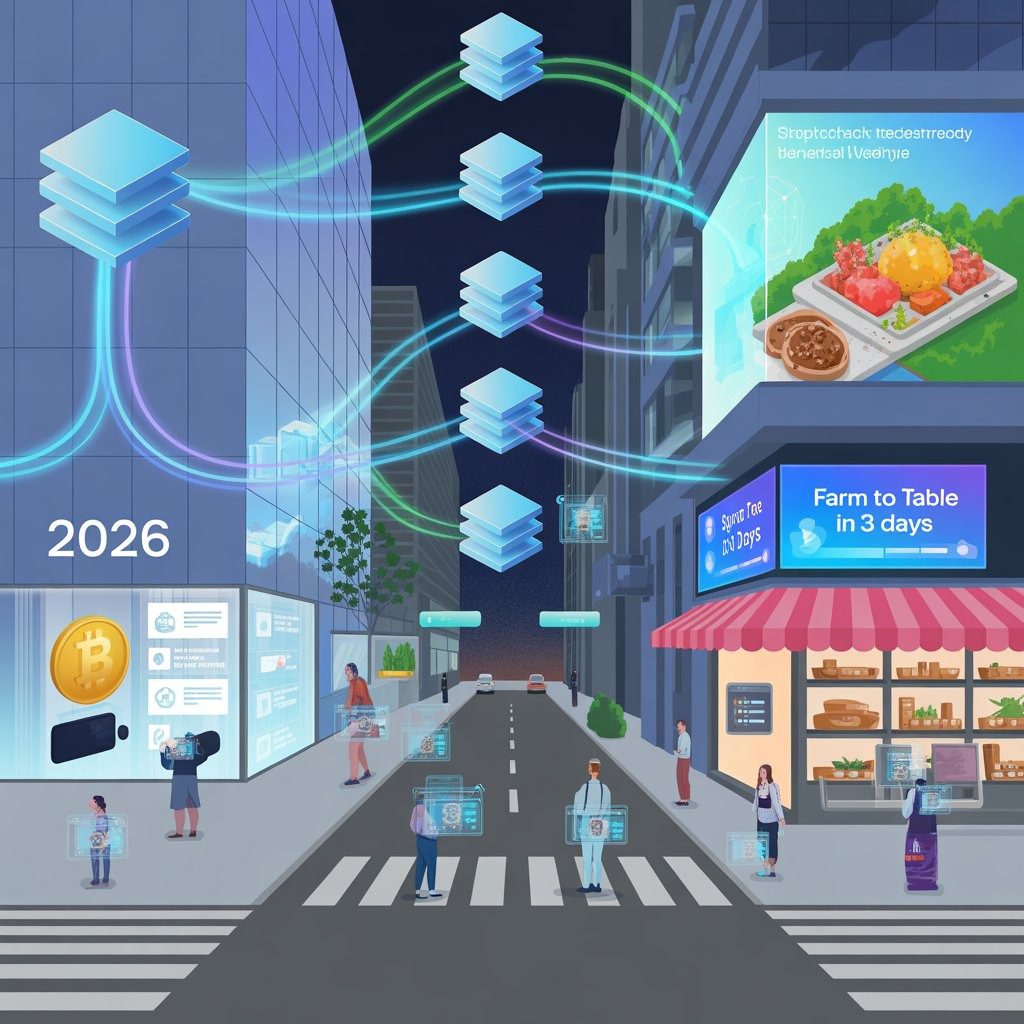
Blockchain supply chain transparency has graduated from pilot purgatory. The clearest signal isn’t the Walmart case — everyone knows that one. The clearer signal is what’s happening with smaller operators.
A mid-size organic food distributor in California’s Central Valley isn’t running blockchain because it’s trendy. It’s running it because retailers — particularly in states like Washington and Colorado where consumer demand for sourcing transparency is intense — are asking for proof of provenance documentation that a PDF supply chain report simply can’t provide convincingly anymore. Buyers know PDFs can be edited. An on-chain record with a hash-verified timestamp cannot.
In Texas, oilfield services companies managing complex multi-party contracts across exploration, drilling, and midstream operations use Distributed Ledger Technology (DLT) to handle something that used to require armies of contract administrators: making sure every party sees the same version of a contractual record at the same time. The disputes haven’t disappeared, but the “he said, she said” category of disputes — the ones about what was agreed and when — have dropped dramatically. Immutable audit logs do that.
The pharmaceutical sector is another real-world deployment zone. The FDA’s DSCSA requirements pushed drug manufacturers and distributors toward unit-level serialization and traceability. Blockchain gave that requirement a credible technical infrastructure. A drug moving from a manufacturing facility in New Jersey through a distribution network to a hospital pharmacy in Chicago now has a chain of custody record that is genuinely tamper-proof, not just policy-compliant on paper.
CBDC cross-border payments is where geopolitics and blockchain development collide in uncomfortable but important ways. The Federal Reserve has been cautious — correctly cautious, given the dollar’s global reserve status and the political sensitivity around any hint of surveillance infrastructure in a digital dollar. But the payment problem being addressed is real regardless of how the CBDC debate resolves.
A manufacturing company in Michigan sending payment to a component supplier in Vietnam still interacts with a correspondent banking chain that was designed in the 1970s. Multiple intermediary banks. Weekend cutoffs. Fees extracted at each hop. A wire that initiates Friday afternoon may not clear until Tuesday. For companies managing tight inventory cycles, that’s not an inconvenience — it’s a cash flow problem.
Interoperability protocols like those being built by the BIS’s Project Nexus and various private-sector consortia are threading blockchain-based settlement rails between national payment systems. The goal isn’t to replace SWIFT overnight. The goal is to give settlement finality to cross-border transactions the same way domestic ACH gives finality to domestic ones — just a lot faster, without the weekend dead zones.
Some regional banks in Illinois and New York have already joined permissioned settlement networks. They’re not announcing it loudly. But if you’re a corporate treasurer at a mid-size exporter and your bank is suddenly offering same-day international settlement on corridors that used to take three days, that’s the blockchain working in the background.
The narrative that traditional finance and DeFi were opposing forces was always more Twitter drama than economic reality. The efficiency mechanisms that made decentralized protocols interesting — automated market making, programmable liquidity, 24/7 settlement — were always going to end up in institutional finance. The question was timing and compliance infrastructure.
Institutional DeFi protocols — permissioned versions that layer KYC/AML verification on top of on-chain financial mechanics — are now a serious part of how some of the biggest names in American finance operate. BlackRock’s tokenized money market fund. Goldman’s on-chain repo trades. Franklin Templeton’s on-chain registered fund. These aren’t blockchain experiments. They’re live financial products with real assets.
The plumbing underneath those products depends on oracle data feeds — real-world data piped onto the chain so that smart contracts can reference things like Treasury yields, exchange rates, and credit events. Without reliable oracles, a smart contract can’t respond to what’s happening in the actual economy. Chainlink has become critical infrastructure for this layer, the same way Bloomberg terminals became critical infrastructure for traditional fixed income.
Tokenized securities are the broader category here. When a Treasury bill, a money market share, or a corporate bond is represented as a blockchain token, it becomes programmable. It can be used as collateral automatically. It can be fractionally transferred. It can move across borders without a custodian chain. Tokenized Treasury bills specifically have grown from a niche institutional experiment to a multi-billion-dollar asset class because the yield is real, the liquidity is genuine, and the settlement is immediate.
Nobody serious talks about deploying enterprise workloads on Ethereum Layer 1 for most use cases anymore. The gas costs and throughput limits made that a non-starter for anything with real transaction volume. Layer 2 scaling for business — specifically ZK-rollup architectures — changed the math entirely.
A factory floor in Michigan with hundreds of IoT sensors logging temperature, humidity, and machine status every few seconds generates thousands of data points per hour. Anchoring all of that on-chain as immutable quality assurance records is the kind of use case that would have been economically absurd two years ago. On a Layer 2 solution with batch settlement, it’s a budget line item.
Post-merge Ethereum scalability also took a political objection off the table. When Ethereum moved to proof-of-stake, its energy consumption dropped by something north of 99%. The ESG argument against blockchain — which was a genuine obstacle in board-level conversations at companies with sustainability commitments — lost most of its teeth. That mattered in corporate America more than most blockchain developers appreciated.
The fundamental tension in enterprise blockchain was always this: the value of a shared ledger comes from multiple parties seeing the same data. But businesses don’t want their competitors seeing their transaction data, their supplier pricing, or their customer relationships.
Zero-Knowledge Proofs (ZKP) resolve that paradox at the cryptographic level. You can prove a statement is true — “this shipment meets regulatory temperature requirements,” “this counterparty has completed KYC,” “this company’s capital ratio is above the regulatory minimum” — without revealing the underlying data that makes the statement true.
For financial institutions dealing with regulatory reporting, this is significant. A bank can prove to the SEC that its exposure limits are within compliance bounds without handing over the confidential transaction records that generated those numbers. For supply chain participants, a manufacturer can prove to a retailer that a product meets specification without exposing their proprietary production process data.
The technical cost of ZKP verification has dropped sharply as the tooling has matured. What required custom cryptographic engineering a few years ago now has developer-friendly frameworks and cloud-based proving services. That accessibility shift is what’s moved ZKP from academic research to production enterprise deployments.
The American identity infrastructure is genuinely broken in ways that are so normalized we’ve stopped noticing. You have a Social Security number that was never designed to be an authentication credential but became one by default. You have credit bureaus that own your financial identity and can make errors that take years to correct. You have dozens of organizations holding copies of documents that were meant to be yours.
Self-sovereign identity (SSI) rebuilds this from first principles. Your identity credentials — your driver’s license, your professional certifications, your employment history, your medical records — live in a digital wallet you control. When a mortgage lender needs income verification, you share a cryptographically signed credential. The lender verifies it’s authentic without calling your employer, without pulling a credit report that may contain errors, and without storing your W-2 in their system indefinitely.
States are moving on this. Colorado and California have digital driver’s license programs active. The TSA is testing mobile digital IDs at airports. The Veterans Administration is exploring SSI for benefits verification to reduce the documentation burden on veterans who need services.
The infrastructure here relies on W3C Decentralized Identifiers and verifiable credentials — both of which use blockchain as the root of trust, ensuring that credentials can be verified without relying on any single centralized registry that could be taken offline, hacked, or politically compromised.
Smart contract automation gets oversold in the context of exotic financial instruments and undersold in the context of genuinely tedious operational workflows where it’s delivering real value right now.
Consider trade finance. A letter of credit — a bank’s guarantee that a buyer’s payment will reach a seller once shipping conditions are met — is a financial instrument that has worked basically the same way since the Medici family ran banking in Renaissance Florence. The paperwork is enormous. The process is manual. Banks in New York and Chicago have entire departments whose job is to verify LC documents against shipment records.
A smart contract does that verification automatically. When the bill of lading is digitally confirmed by the shipping company, when the goods pass customs inspection, when the delivery receipt is signed — the payment releases. No document review, no manual matching, no three-day processing window. The same thing is happening in insurance, real estate closing, royalty distribution, and procurement workflows across every industry with repetitive, rules-based payment processes.
Legacy system migration is the honest hard part here. Most of the companies that need smart contract automation the most are running ERP systems from the early 2000s, Oracle databases that predate smartphones, and payment workflows that still involve faxed confirmations in some cases. Building the bridge between those systems and blockchain-based automation requires careful architecture work — not just blockchain development, but deep integration with existing infrastructure.
That bridge-building is exactly the kind of work that separates firms that can actually deliver from those that can only demo. At Asapp Studio, the integration layer is where a significant portion of real project complexity lives, and it’s where we invest heavily in our software development practice.
AI and blockchain convergence is a phrase that gets thrown around loosely, but there are specific, concrete intersections that matter for enterprise technology planning.
The most immediate one is data provenance for AI systems. When a hospital deploys an AI diagnostic model, the model’s reliability depends entirely on the integrity of its training data and the consistency of its versioning. If someone modifies the training dataset or rolls back the model version without documentation, a diagnosis might be based on a model that’s materially different from the one that was validated. Blockchain provides the immutable audit trail for model versions, training data hashes, and inference records that AI governance requires.
In fraud detection, AI models trained on transaction patterns work better when paired with blockchain’s tamper-proof transaction history. The AI identifies anomalies; the blockchain provides the verified evidence chain that makes the anomaly actionable for regulators or prosecutors rather than just a flag in a system.
Data marketplaces are another real convergence point. AI development consumes enormous quantities of labeled training data. Blockchain enables verified, permission-controlled data sharing with token-based compensation for data contributors — creating economic models where individuals and organizations can monetize their data for AI training without surrendering it to a centralized aggregator.
Our artificial intelligence development practice at Asapp Studio navigates this intersection actively, particularly for clients who need AI systems with auditable decision trails.
The voluntary carbon market has had a rough few years from a credibility standpoint. Major investigations revealed that a significant portion of offset credits that corporations were purchasing and retiring to hit net-zero targets were either over-credited, double-counted, or tied to projects that weren’t protecting the carbon they claimed to protect.
On-chain carbon credit tracking addresses the structural problem directly. When a carbon credit is minted as a blockchain token tied to a verified underlying project — with satellite monitoring data, third-party verification records, and retirement status all anchored on-chain — the audit trail is continuous and tamper-proof. The credit cannot be sold twice. Its provenance can be verified independently by anyone. Its retirement is permanent and publicly visible.
California’s cap-and-trade program and Washington state’s carbon market are both engaged in conversations about integrating blockchain-based tracking into their registry infrastructure. For public companies navigating the SEC’s climate disclosure requirements — now mandatory for large filers — having on-chain carbon credit records changes the audit process from a manual document review to a cryptographic verification.
Decentralized Physical Infrastructure (DePIN) is what happens when you apply the token incentive model to real-world infrastructure problems — the same mechanism that makes Bitcoin miners secure a network in exchange for block rewards, but aimed at wireless coverage, data storage, mapping, or computing power.
Helium started it with wireless coverage. Thousands of Americans in cities from Miami to Seattle run small radio hotspots. The network deployed faster and more granularly than any single carrier’s rollout plan. For rural coverage in Montana, Wyoming, and the Dakotas — where traditional carriers have no economic motivation to build — DePIN networks offer a realistic path.
Hivemapper is doing the same with mapping. Dashcam-equipped drivers earn tokens when their map data is incorporated into the network’s mapping product. The result is fresher, more granular mapping data than any single company can maintain with a fleet of dedicated vehicles.
The economic logic here is significant. Traditional infrastructure requires capital concentration. DePIN distributes both the capital expenditure and the ongoing operational responsibility across thousands of participants — who are compensated in proportion to their contribution. It is a fundamentally different model for how physical infrastructure gets built and maintained, and it is working in production at scale.
The regulatory climate for blockchain in the U.S. is genuinely uneven in ways that matter for business location and investment decisions. Regulatory compliance frameworks vary significantly by state, and that variation is shaping where blockchain companies plant their flags.
Wyoming has been the most systematic. Twenty-five-plus blockchain-specific statutes. The DAO LLC Act. Special Purpose Depository Institutions specifically chartered for digital assets. The state made a deliberate policy decision to become the Delaware of blockchain company formation — and it worked. Multiple crypto-native banks, dozens of DAO-structured organizations, and major custody entities are Wyoming entities.
Texas leaned into Bitcoin mining and digital asset rights. Texas law protects the right to mine, to self-custody, and to transact in digital assets. The state’s cheap energy and business-friendly regulatory culture drew major mining operations that survived the post-2021 shakeout.
New York’s BitLicense is demanding — the compliance burden is high and it’s pushed some companies to incorporate elsewhere. But for businesses targeting New York’s financial market participants, having a BitLicense is table stakes. The framework is strict, but it’s clear, and clarity has its own value.
Florida has actively courted blockchain and fintech companies with favorable tax treatment and a regulatory posture that asks fewer questions. Miami’s emergence as a crypto-adjacent financial hub didn’t happen by accident.
Colorado and Arizona passed statutes recognizing blockchain records as legally valid in commercial transactions — a quiet but important step that removed the legal ambiguity that previously made corporate counsel nervous about putting contract-critical records on-chain.
For any business weighing where to structure a blockchain-enabled operation, the state-level picture is a material business consideration, not just a compliance footnote.
For all the progress, there are genuine friction points that anyone building on blockchain needs to plan around honestly.
Interoperability between different blockchain networks is still messier than marketing materials suggest. Ethereum, Hyperledger Fabric, Corda, and private permissioned networks don’t communicate natively. Interoperability protocols like Polkadot’s cross-chain messaging, Cosmos’s IBC, and various bridge architectures help — but they add complexity and, in some cases, introduce new security surface area. Bridges have been the site of some of the largest hacks in blockchain history.
Oracle data feeds remain a dependency risk. A smart contract executing on faulty price data — whether because the oracle was manipulated or simply wrong — can cause significant financial losses. The oracle problem is understood and being addressed, but it’s not fully solved for every use case.
Legacy system migration deserves to be flagged again because it’s consistently underestimated in project scoping. The blockchain layer itself often gets built on time and on budget. The integration work — connecting to SAP, Oracle, aging mainframes, and banking APIs with 1990s-era documentation — is where timelines extend and budgets get tested.
None of these are dealbreakers. They’re engineering problems with engineering solutions. But anyone telling you a blockchain deployment is simple either hasn’t done one or is selling you something.
The question worth sitting with isn’t “is blockchain real?” It demonstrably is. The question is where it creates leverage for your specific operation.
If you move physical goods and your customers or regulators are asking harder questions about provenance and chain of custody — that’s the supply chain transparency case. If you do high-volume cross-border payment or settlement and the current process involves multiple banking intermediaries and multi-day clearing windows — that’s the settlement finality case. If you manage contracts with multiple external counterparties and reconciliation is a recurring overhead — that’s the smart contract automation case. If you hold or manage assets that are currently illiquid, hard to fractionally divide, or expensive to transfer — that’s the tokenization case.
These are not hypothetical future applications. They are active production deployments at companies across every sector in the United States right now.
The firms building competitive advantage from Real World Blockchain Utility in 2026 are not doing it because they bet on blockchain as a technology. They’re doing it because they identified a specific, expensive operational problem and found that blockchain infrastructure was the right fit for their constraints.
If you want to work out whether that’s true for your business, the starting point is a conversation, not a whitepaper. Our team at Asapp Studio — covering blockchain development, AI, mobile, and enterprise software — starts every engagement by understanding the problem before proposing a solution. That order matters.
Q1. What is Real World Blockchain Utility in 2026?
It’s measurable, live blockchain deployment — in supply chains, payments, identity, and finance — delivering documented operational ROI, not theoretical promise or speculative token value.
Q2. Which U.S. states lead in enterprise blockchain adoption 2026?
Wyoming leads on legal frameworks, Texas on digital asset rights, New York on institutional finance, Florida on fintech incentives, Colorado and Arizona on blockchain contract recognition.
Q3. What makes tokenized Treasury bills different from regular T-bills?
Tokenized T-bills settle instantly, transfer peer-to-peer 24/7, support fractional ownership, and can serve as on-chain collateral — functions traditional T-bills can’t perform without custodian chains.
Q4. How do Zero-Knowledge Proofs protect sensitive business data on blockchain?
ZKP lets parties cryptographically prove a claim is true — compliance status, credit range, shipment conditions — without revealing the underlying confidential data that supports the claim.
Q5. Is Blockchain-as-a-Service enough for most mid-market businesses?
For most use cases, yes. BaaS covers infrastructure, compliance connectors, and node management. Custom builds suit unique requirements but cost significantly more time and capital upfront.