
Last Tuesday, I watched a robot make coffee. Not some fancy barista bot at a tech expo—just a regular café arm pouring milk into my cappuccino. The guy behind the counter? He was designing latte art for another customer. That’s robotics and automation in 2025. It’s not dramatic. It’s just… everywhere.
People ask me all the time: what is robotics and automation? Here’s my take after years in tech—robotics is the stuff you can touch. The metal arms, wheels, sensors. Automation is what tells that stuff what to do and when to do it.
But 2025 changed the game completely. These machines don’t just follow orders anymore. They figure things out. A warehouse robot hits an obstacle? It reroutes itself. A surgical bot detects tissue resistance? It adjusts pressure in microseconds.
The definition of robotics and automation used to fit in a sentence. Now? It’s this sprawling ecosystem where AI in robotics makes machines think, sensors let them see, and edge computing for automation means they react faster than human reflexes.We’ve been building solutions at Asapp Studio long enough to see this transformation up close. What clients wanted five years ago versus now? Completely different universe.
Step into any factory in 2025 and you’ll spot something weird—people actually working next to robots. No cages. No yellow safety tape. Just collaborative robots, or cobots, doing the heavy lifting while humans handle the tricky bits.
Industrial robotics finally figured out its role. These machines aren’t stealing jobs—they’re taking the soul-crushing repetitive tasks nobody wanted anyway. The robotics and automation industry spent years getting this wrong before finally cracking the code.
Supply chain automation became critical after the global logistics mess we all survived. Autonomous mobile robots (AMRs) zip around warehouses now, dodging forklifts and people without breaking a sweat. Robotic vision systems catch defects human eyes miss after hour six of an eight-hour shift.
I attended part of the robotics and automation exhibition 2025 in Chicago. The standout wasn’t the flashiest robot—it was these flexible manufacturing systems that swap between products in under three hours. That kind of agility keeps companies alive when markets shift overnight.
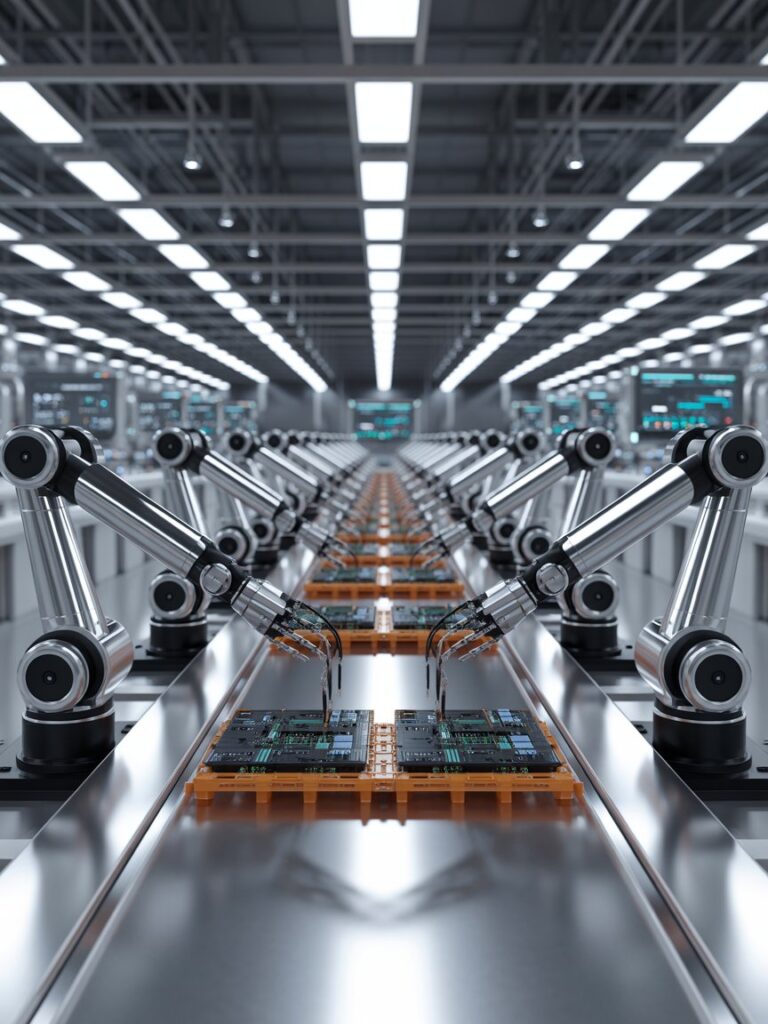
Forget everything you’ve heard about smart manufacturing. It’s not about cramming sensors onto old equipment and hoping for magic.
Real smart manufacturing in 2025 means your physical factory has a digital twin—a virtual copy that mirrors everything happening in real-time. Machine learning in robotics algorithms catch problems before they exist. A slight temperature increase? Predictive maintenance schedules a fix during the planned shutdown next week, not during your biggest production rush.
The industrial internet of things (IIoT) ties this together. Every sensor, every robot, every control system talks to each other through industrial IoT protocols. It’s like giving your factory a nervous system that actually works.
ICRA 2025 (the big IEEE International Conference on Robotics and Automation) showcased some wild stuff this year. The ICRA 2025 program had sessions on reinforcement learning in robotics—basically robots teaching themselves through trial and error. One of the ICRA 2025 accepted papers showed a robot arm learning to assemble random objects without any programming. Just learned it. That’s the future walking into our present.
Human-robot interaction (HRI) research presented at ICRA 2025 workshop sessions proved that robots work better when they communicate like humans expect—gestures, simple language, predictable movements. Turns out making robots more “robotic” was the wrong move all along.
Robotics in 2025 broke out of factories and went everywhere. Seriously, everywhere.
Robotics in healthcare might be the most dramatic shift. Surgical robots now have haptic feedback letting surgeons “feel” tissue through the machine. Autonomous mobile robots deliver meds through hospital halls 24/7. Rehab robots adjust therapy based on patient response in real-time, something rigid protocols never pulled off.
The 42nd International Symposium on Automation and Robotics in Construction (ISARC 2025) showed how construction sites use robots for bricklaying, welding, site surveys—all the dangerous stuff. These machines work night shifts in conditions that’d violate every labor law for humans.
Even weird niche applications exploded. The International Conference on Informatics in Control Automation and Robotics (ICINCO 2025) had entire tracks on robotic process automation (RPA)—software bots handling invoices, data entry, compliance checks. Not physical robots, just automation doing the administrative grunt work.
The International Symposium on Automation and Robotics in Construction ISARC 2025 had some eye-opening stats: construction automation reduced project times by 30% and workplace injuries by 60%. Those aren’t incremental improvements. That’s transformation.
Let’s get into the weeds for a minute because this matters. Several technologies converged in 2025 that made this robotics boom possible.
Robot Operating System (ROS) became the Linux of robotics—open source, flexible, everyone uses it. Programming an industrial arm? ROS. Building a delivery drone? ROS. It’s the foundation under everything.
Machine learning in robotics changed the entire paradigm. Instead of programming every scenario (impossible), robots learn from experience. They encounter new situations and figure out solutions, then apply those lessons elsewhere. That’s genuinely intelligent behavior, not just fancy scripts.
Edge computing for automation solved the latency nightmare. Critical decisions happen on the robot itself, not after bouncing data to some cloud server three states away. When you’re moving at manufacturing speeds or navigating traffic, milliseconds matter.
Robotic simulation platforms let engineers crash and burn a thousand times virtually before touching real hardware. You can test algorithms against every bizarre edge case without destroying expensive equipment or delaying production.
The International Conference on Methods and Models in Automation and Robotics 2025 featured breakthrough designs in robotic end effectors—the “hands” grabbing objects. New versions with tactile feedback handle eggs and engine blocks with the same gripper. That versatility was impossible three years ago.
Sensor integration reached new levels too. Robots now combine visual, tactile, thermal, and even chemical sensors to build complete environmental awareness. They “understand” their workspace in ways that shame older systems.
Is automation and robotics a good career? I get asked this constantly. Short answer: absolutely, but it’s complicated.
The robotics and automation jobs market in 2025 looks nothing like predictions from five years back. Yeah, some manual positions disappeared. But new roles emerged faster: robotics technicians, AI trainers, automation ethicists, human-robot interaction designers, cyber-physical systems specialists.
Robotics and automation technology salary numbers are solid. Entry-level technicians start around $55k-$70k. Experienced robotics engineers pull $90k-$150k+ depending on specialization. AI in robotics experts and machine learning specialists? They’re commanding top-tier compensation, often north of $150k with the right experience.
We’re constantly hiring at Asapp Studio for people who bridge technical skills with industry knowledge. A robotics expert who gets healthcare workflows? Incredibly valuable. Same for professionals combining robotics with supply chain expertise or construction safety protocols.
The skills gap is real though. Universities are still teaching 2020 robotics to students entering a 2025 market. Self-learning, online courses, and hands-on projects matter more than ever.
The robotics conferences circuit in 2025 has been intense. Beyond ICRA 2025, several events shaped industry direction this year.
IROS 2025 (International Conference on Intelligent Robots and Systems) went deep on autonomous systems in unstructured environments—disaster response robots, agricultural automation in unpredictable fields, all the scenarios where you can’t control variables.
The Automation and Robotics 2025 Summit in Paris brought industry leaders together with surprising data about European adoption rates. France’s manufacturing sector embraced flexible automation way faster than anyone predicted. The conversations there about regulatory frameworks were honestly more interesting than the tech presentations.
Robotics conferences evolved in 2025. They’re not just academic paper presentations anymore. The robotics and automation show 2025 events mixed technical workshops with live demonstrations. You’d watch a presentation on an ICRA 2025 accepted paper in the morning, then see that exact algorithm running on real hardware by afternoon.
Robotics and automation trade shows 2025 focused on complete solutions, not just isolated technology. Vendors showcased entire ecosystems—robots plus software plus training plus ongoing support. Everyone finally realized that tech adoption succeeds or fails on implementation, not capability.
The ICRA 2025 workshop sessions tackled unsexy but critical problems: integrating legacy equipment with modern automation, cybersecurity for cyber-physical systems, addressing the skills gap without relying on universities that can’t keep up. These practical discussions mattered more than the flashy keynotes.
Planning for ICRA 2026 is already rolling, with proposed themes around large-scale swarm robotics and decentralized autonomous systems. That’s where research energy is flowing.
Here’s where robotics 2025 gets legitimately wild. AI-powered automation isn’t about making individual robots smarter—it’s about making complete systems intelligent.
Digital twins powered by AI continuously optimize everything. They run “what if” scenarios constantly: reroute these robots, adjust that schedule, change this parameter. The AI tests thousands of variations, then implements the best strategy automatically without human input.
Reinforcement learning in robotics produces behaviors engineers never imagined. You give a robot a goal and constraints, let it experiment, and it discovers solutions nobody programmed. The resulting strategies often surprise their creators—more efficient paths, novel problem-solving approaches, adaptive responses to weird situations.
We work with businesses implementing these AI-powered automation solutions at Asapp Studio. The transformation isn’t instant, but once it’s running, the competitive advantage is undeniable. Companies using this stuff operate in a different league.
Cutting through hype, here are the robotics trends 2025 that’ll stick around:
Democratization of robotics: No-code platforms make basic automation accessible to small businesses. You don’t need a robotics degree to automate repetitive tasks anymore. Drag-and-drop interfaces, pre-built modules, cloud-based programming—barriers dropped significantly.
Sustainability focus: Energy-efficient robots and waste-reducing automation moved from “nice to have” to “requirement.” Environmental regulations and consumer pressure made this non-negotiable. Companies can’t ignore sustainability anymore.
Modular systems: Buy a base platform, add capabilities as needed. This Lego approach reduces upfront costs and adapts to changing requirements. Crucial for businesses facing uncertain futures who can’t commit to massive fixed investments.
Human-centric design: The best human-robot interaction (HRI) in 2025 makes robots approachable. Intuitive interfaces, natural language processing, emotional intelligence algorithms—robots that fit naturally into human workflows instead of forcing humans to adapt to robot limitations.
Predictions are tough, but based on current momentum, here’s where robotics in the next 10 years is headed.
By robotics 2030, expect truly general-purpose robots—machines handling varied tasks without extensive reprogramming. The household robot dream might finally materialize, though probably not looking like Hollywood imagined.
Robots in 2025 already exceed humans in narrow domains. In robotics in 20 years? We’ll likely see human-robot teams where separating individual contributions becomes meaningless. The question won’t be “human or robot?” but “what’s the optimal collaboration for this specific task?”
Biological inspiration will accelerate dramatically. Soft robotics mimicking muscle movement, neuromorphic chips copying brain structures, self-healing materials borrowed from nature—these approaches push boundaries we’re barely exploring now.
The 2025 DE 01 04 GenAI4EU in Robotics and Industrial Automation (RIA) initiative in Europe signals government recognition that robotics competitiveness equals national competitiveness. Expect more public-private partnerships globally fueling innovation over the next decade. Countries are realizing this is strategic infrastructure, not just commercial technology.
Whether you run manufacturing, healthcare, logistics, retail, or something else entirely, robotics and automation in 2025 offers concrete benefits you can’t get elsewhere:
Consistency: Robots don’t have off days. Quality stays uniform shift after shift. That reliability translates directly to customer satisfaction and reduced waste.
Scalability: Handle demand spikes without emergency hiring or burning out staff. Scale up for holiday rushes, scale down for slow seasons, all without the human cost.
Safety: Machines handle dangerous tasks. Humans tackle judgment calls requiring creativity and ethical reasoning. Everyone works in their strength zone.
Data generation: Every sensor produces insights. Automation reveals optimization opportunities invisible to human observation. You discover problems you didn’t know existed.
Competitiveness: Companies avoiding automation risk getting undercut by competitors who embrace it. This isn’t hypothetical—it’s happening now across industries.
At Asapp Studio, we guide businesses through digital transformations leveraging automation principles daily. The pattern repeats: initial skepticism, careful planning, phased implementation, then astonishment at what suddenly becomes possible. Clients wonder how they operated before automation once they experience the difference.
Feeling overwhelmed? Start small and build momentum:
Identify pain points: Where do errors cluster? Which processes create bottlenecks? What tasks drain morale? Map your actual problems before shopping for solutions.
Research solutions: Attend robotics and automation trade shows 2025 or virtual equivalents. Read ICRA 2025 accepted papers for academic perspectives. Join online communities where practitioners share real experiences, not just marketing claims.
Pilot before scaling: Test automation in controlled environments. Learn what works in your specific context. Adjust based on real results, not assumptions.
Invest in people: Technology succeeds when your team embraces it. Training matters more than hardware specs. Culture eats strategy for breakfast, and it’ll eat your automation investment too if you neglect the human side.
Partner wisely: Work with agencies like Asapp Studio that understand both technology and business context. Avoid vendors pushing products without understanding your actual needs.
The robots aren’t coming—they’re already here, working quietly alongside us. They’re not replacing humans. They’re handling what we do worst so we can focus on what we do best. That’s the actual promise of robotics and automation in 2025, stripped of hype.
The field evolves weekly. Staying current isn’t optional if you’re serious about this.
Subscribe to robotics and automation news sources that cut through marketing fluff. Follow researchers presenting at IROS 2025 and similar venues. Engage with communities discussing specialized events like the International Symposium on Automation and Robotics in Construction 2025.
Join forums where engineers share practical implementation tips, not just theory. Attend workshops at the next robots conference in your area. The robotics community is surprisingly open—most experts genuinely want to share knowledge and accelerate adoption rather than hoarding information.
If you’re serious about implementing these technologies, connect with specialists who’ve actually done this before. At Asapp Studio, we combine technical expertise with practical implementation experience, ensuring your automation investment delivers measurable value instead of just impressive demos that don’t improve your bottom line.
Q: What is robotics and automation?
Robotics is physical machines doing tasks, automation is the smart control layer. Combined, they create systems working autonomously with minimal human intervention needed.
Q: Is automation and robotics a good career in 2025?
Absolutely yes. Salaries range $55k-$150k+ with growing demand across industries. Great opportunities exist for skilled professionals who keep learning and adapting.
Q: What’s the typical robotics and automation technology salary?
Entry-level techs earn $55k-$70k, experienced engineers make $90k-$150k+. AI and machine learning specialists in robotics earn premium pay at top ranges.
Q: How is AI used in robotics in 2025?
AI lets robots learn from experience, make autonomous decisions, predict maintenance needs, and adapt to changes without reprogramming for every scenario.
Q: Where can I learn more about robotics trends 2025?
Attend conferences like ICRA 2025, IROS 2025, and trade shows. Read papers, join communities, and follow robotics and automation news for latest developments.