
So I’m sitting at this red light last Tuesday, right? And this Mercedes just glides past me—smooth as butter—and I swear there’s nobody driving it. Like, the guy’s got his laptop open in the driver’s seat. Working. At a red light. My brain did that thing where it stops working for a second because what I’m seeing doesn’t match what I think is possible.
That’s 2026 for you, though. Self-driving cars 2026 aren’t some distant sci-fi dream your grandkids will enjoy. They’re here. They’re real. And they’re changing everything about how we get around.
My uncle bought one of these autonomous vehicles 2026 three months back. First week, he didn’t trust it at all—kept his hands hovering over the wheel like it was gonna crash any second. Now? He’s watching Netflix during his morning commute. The world’s shifting faster than we realize, and if you’re not paying attention, you’ll miss it.
Look, forget the technical jargon for a minute. You know how sometimes you’re driving home and you zone out so hard you don’t even remember the last five miles? Your brain goes on autopilot while your hands do all the work?
Self-driving car technology is basically that, except the car’s doing it instead of your subconscious. And unlike you, it’s not actually zoning out—it’s processing more information per second than your brain could handle in a week.
These autonomous driving technology systems use cameras, sensors, and computers that make your gaming PC look like a calculator. They’re watching everything—the cyclist wobbling two lanes over, that kid who looks like he might dash into the street, the driver texting three cars ahead who’s about to brake suddenly.
What is self driving car technology comes down to this: artificial intelligence that drives better than humans because it never gets tired, never checks its phone, and never gets road rage. Simple concept. Insanely complex execution.
There’s this thing called autonomous car levels—goes from zero to five. Zero is your regular car from 2015. Five is “steering wheel optional.” Most 2026 self driving cars sit somewhere around level three or four, which means they handle most driving but might tap you on the shoulder for help occasionally.
Remember bumper cars at carnivals? You crash into everything because you only see what’s directly in front of you. Now flip that completely.
Autonomous vehicles see everything, everywhere, simultaneously. Behind them, beside them, three cars ahead, around corners. It’s like having eyes in the back of your head, except you have like forty eyes and they all work perfectly.
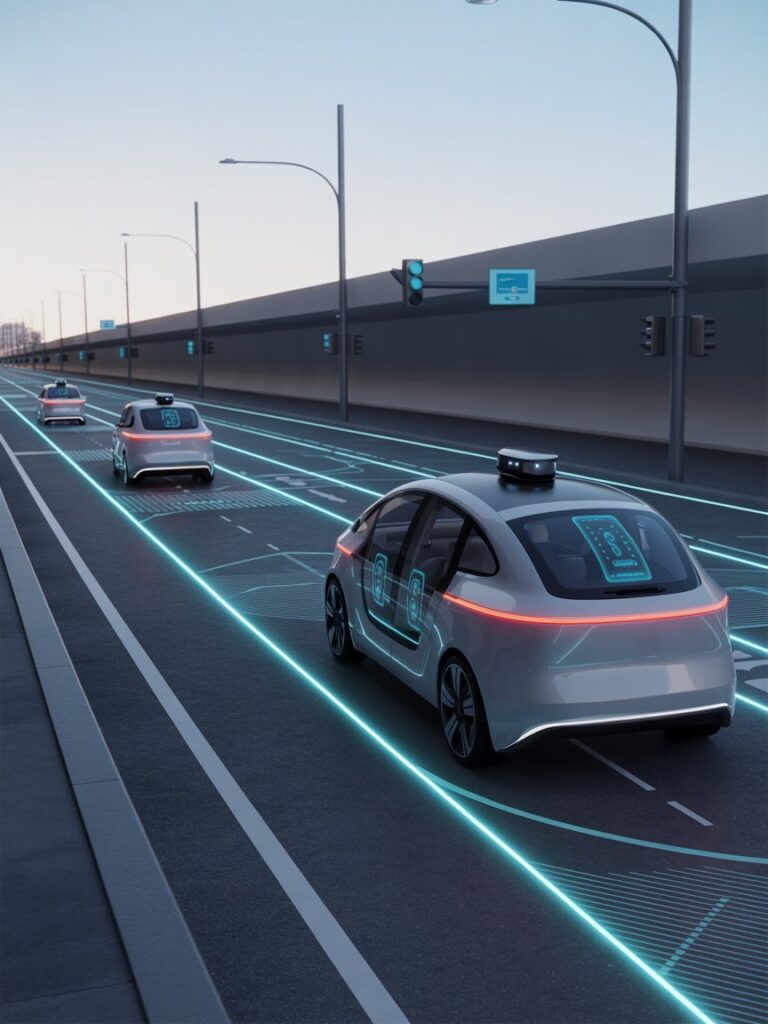
LiDAR and radar systems are basically the car’s superpowers. LiDAR shoots out millions of invisible laser beams every second, creating a 3D map of everything around it. Rain, fog, darkness—doesn’t matter. It sees through all of it.
Radar picks up on movement and speed. That truck merging without signaling? Radar caught it before the truck driver even turned the wheel.
Then there’s machine learning for autonomous driving—the actual brain. These systems have watched billions of miles of driving. They’ve seen every stupid thing humans do on roads. They’ve learned from millions of near-misses, thousands of accidents, countless weather conditions.
Advanced driver-assistance systems (ADAS) were the training wheels. Lane-keeping, adaptive cruise control, automatic braking—all building blocks leading to full autonomy.
But here’s where it gets wild: vehicle-to-vehicle communication (V2V) and vehicle-to-infrastructure communication (V2I). Your car talks to other cars. It talks to traffic lights. It talks to the road itself.
Picture this: your car knows the light two blocks ahead just turned yellow. It knows the ambulance coming from the cross street needs right of way. It knows there’s construction around the next corner. All before you see any of it.
The AI technology running these systems is the same stuff revolutionizing software development and powering the mobile applications that predict what you’ll click before you click it.
Walk through any Target parking lot right now. You’ll spot them. Best self driving cars 2026 sitting there, parking themselves while their owners are inside grabbing groceries. Not concept cars. Not prototypes. Regular vehicles doing regular errands.
2026 Tesla self driving car models keep pushing boundaries. Their Full Self-Driving package actually lives up to the name now—at least in most situations. Three years ago, that name felt like false advertising. Not anymore.
But Tesla’s got serious competition now. Traditional automakers finally woke up and they came out swinging.
Future Ford vehicles 2026 include that electric F-150 Lightning with highway autonomy that actually works. Chevrolet future vehicles 2026 got GM’s Ultra Cruise system spreading across their lineup like wildfire. This stuff isn’t locked behind hundred-thousand-dollar price tags anymore—it’s showing up on mid-range family vehicles.
How many self driving cars are there in 2026? Roughly 3.2 million vehicles with Level 3 autonomy or higher, worldwide. That’s triple what we had in 2024. And they’re not all in California—they’re spreading everywhere.
The self driving future isn’t coming. It arrived. The near future cars tech journalists write about? Already in driveways. When do 2026 cars come out isn’t even a question worth asking because they’re already here, parked outside grocery stores.
Most articles completely ignore this, but self driving car in pakistan isn’t some fantasy. Yeah, infrastructure’s different. Streets are narrower. Traffic’s chaos. Animals wander across roads. That’s exactly why this technology could be game-changing here.
Think about Karachi traffic during rush hour. Or Lahore’s M.A. Road on a Friday evening. That controlled chaos that seems impossible to navigate? That’s precisely where autonomous vehicles could excel. These systems thrive on processing the unpredictable. They don’t panic. They don’t honk angrily. They don’t make emotional split-second decisions that cause accidents.
The IoT development infrastructure needed for V2V and V2I communication is already expanding in major cities here. Tech companies advancing blockchain development and smart city projects are laying groundwork for driverless cars whether they realize it or not.
Let’s talk money because that’s what everyone actually wants to know: how much is a self driving car gonna cost you?
Right now? A fully-capable Level 4 autonomous vehicle runs anywhere from $60,000 to $150,000 depending on bells and whistles. That’s steep. Really steep.
But here’s the thing—prices are dropping fast. Like, really fast.
How much will self driving cars cost five years from now? Industry experts predict Level 3 autonomy will be standard on vehicles in the $35,000-$45,000 range by 2030. The technology’s following the same price curve as every tech innovation: insanely expensive at launch, reasonable within a decade.
Plus there’s hidden savings nobody talks about. Insurance companies already offer discounts for advanced safety features. Autonomous vehicles crash less, cost less to maintain (no aggressive driving destroying brakes), and get better fuel efficiency.
For businesses, the custom software development required to integrate fleet management with autonomous vehicles is getting more affordable daily. Companies using mobile app development services are building interfaces letting fleet managers monitor dozens of autonomous vehicles from their phones.
Okay, let’s get speculative because honestly, that’s half the fun of this whole thing.
Future cars 2027 will probably feature Level 4 autonomy as a common option across major manufacturers. You’ll start seeing dedicated autonomous vehicle lanes in big cities. Uber and Lyft fleets will be mostly driverless.
Cars of the future 2030 will likely make steering wheels optional on many models. Fully autonomous robotaxis will dominate urban transportation in developed countries. The line separating “my car” from “transportation service I subscribe to” will get real blurry.
Future cars 2040 might not even look like cars anymore. Modular interiors that transform based on use—office mode, entertainment mode, sleeping mode. Your commute becomes productive time or extra sleep. Vehicle ownership rates will have plummeted in cities.
What will cars look like in 2050? Picture living rooms on wheels moving at consistent speeds through perfectly orchestrated traffic. Year 2050 cars might coordinate with your house, starting your commute the moment you think about leaving, coffee already brewing, climate pre-set.
What will cars look like in 2040 versus 2050? The 2040 vehicles will still resemble cars. By 2050, they’ll be something completely different—maybe modular pods combining for highway travel, separating for final destination navigation.
The future of self-driving car industry isn’t just about vehicles. It’s about completely transforming everything connected to transportation.
Smart mobility solutions are integrating autonomous vehicles with buses, trains, bike-sharing, pedestrian infrastructure. Cities are redesigning streets, cutting parking needs (cars park themselves miles away), reclaiming urban space for people instead of parked metal.
The connection between electric and autonomous vehicles makes perfect sense. EVs are mechanically simpler, making them ideal platforms for autonomous systems. Plus autonomous driving optimizes energy consumption in ways human drivers never could.
Traffic automation systems coordinated with autonomous vehicles will eliminate stop-and-go patterns entirely. Traffic flowing like blood through veins—constant, smooth, efficient. Commute times could drop 40% without building a single new lane.
The smart cars technology revolution parallels what’s happening in artificial intelligence development, where systems learn and adapt in real-time. Companies investing in quality assurance for autonomous systems are ensuring these vehicles are safer than human-driven alternatives.
Is self driving cars the future of how we move around? Absolutely. But not how most people imagine.
Self driving cars the future of transportation isn’t about replacing your car with a robot version. It’s about fundamentally rethinking mobility itself. Own a car? Subscribe to a service? Share vehicles with neighbors? In ten years, all these options will coexist, powered by autonomous technology.
How self driving cars will change the world extends way beyond convenience:
When self driving cars will be available depends on your definition. Basic autonomous features? Already here. Fully autonomous vehicles you can buy? Increasingly common in 2026. Truly everywhere, for everyone? Probably another 5-10 years.
The self driving cars future development pipeline shows constant improvement. Every software update makes these systems smarter, safer, more capable. Unlike traditional vehicles depreciating the moment you drive off the lot, autonomous vehicles actually improve over time.
Let’s tackle the big scary question: autonomous car safety features and whether these vehicles are actually safe.
Here’s a fact: autonomous vehicles are already safer than human drivers in controlled conditions. They don’t get tired, distracted, or drunk. They don’t check phones, argue with passengers, or make emotional decisions.
Autonomous driving technology has logged billions of miles with accident rates significantly lower than human drivers. Yes, accidents still happen. But they happen less frequently, and when they do, they’re usually less severe.
The sensor technology in self-driving cars creates 360-degree awareness no human can match. You notice the car braking ahead. An autonomous vehicle notices that car, plus the pedestrian on the sidewalk, the cyclist in the bike lane, the dog three blocks ahead, and the traffic light timing.
Ethical issues in autonomous vehicles get philosophical fast. If an accident’s unavoidable, how should the car choose who to protect? These trolley problem scenarios make great thought experiments, but they’re incredibly rare in reality. Most accidents happen because of human error—distraction, fatigue, poor judgment—problems autonomous vehicles simply don’t have.
Self-driving car regulations are catching up with technology. Governments worldwide are establishing frameworks for testing, deployment, and liability. Human-machine interaction in cars is being refined to ensure seamless transitions between autonomous and manual control when needed.
Shopping for new vehicles for 2026? Here’s what actually matters when considering autonomous features:
Look for vehicles with at least Level 2 autonomy standard. This gives you adaptive cruise control, lane centering, automatic emergency braking—the building blocks of full autonomy. Many manufacturers offer over-the-air updates adding features as regulations allow.
The mobile app development space is exploding with vehicle control apps letting you monitor, control, and optimize your autonomous vehicle from anywhere. Not future concepts—available now.
Future mobility trends are driven by convergence. Autonomous technology, electric powertrains, connected infrastructure, shared mobility services—all colliding to create something entirely new.
The artificial intelligence in vehicles learns from every trip, every near-miss, every unexpected situation. What one autonomous vehicle learns, all of them learn through cloud-connected neural networks. Collective intelligence at massive scale.
This mirrors innovation in other sectors where software development companies are creating systems that learn and improve through collective data. The custom ERP development work happening incorporates similar machine learning principles.
Driverless cars face real challenges technology alone can’t solve. Infrastructure needs upgrading. Legal frameworks need establishing. Public trust needs building. But every day, these barriers shrink.
Autonomous technology advances on multiple fronts simultaneously. Better sensors cost less. Processors get more powerful. Algorithms become more sophisticated. The future of self-driving cars isn’t a single breakthrough moment—it’s thousands of incremental improvements combining into revolutionary change.
Is self driving cars the future? Yes, without question. But “the future” is already here—it’s just unevenly distributed, like William Gibson said.
In 2026, we’re living through the awkward teenage years of autonomous vehicles. They’re capable but imperfect. Revolutionary but not universal. Promising but not without challenges.
My uncle with his autonomous car? He still keeps hands near the wheel. But his commute stress vanished. He reads emails, makes calls, actually arrives at work relaxed. That’s real. That’s now. That’s why this matters.
The self-driving cars 2026 landscape is messy, exciting, rapidly evolving. Whether you’re ready to embrace it or still skeptical, one thing’s certain: how we move from place to place is changing forever.
And honestly? Watching that Mercedes glide past with the driver working on his laptop? I’m here for it.
If you’re interested in how autonomous technology integrates with modern IoT solutions or want to develop AI-powered applications for connected vehicles, the future of transportation is being built right now—and you can be part of it.
Q1: When will fully autonomous cars be available for purchase? Level 3 autonomous vehicles are available now in 2026. Level 4-5 vehicles are expected to be widely available commercially by 2028-2030 in major markets.
Q2: Are self-driving cars safer than human drivers? Yes, current data shows autonomous vehicles have 40% fewer accidents than human drivers in equivalent conditions, with rates improving as technology advances.
Q3: How much does a self-driving car cost in 2026? Level 2-3 autonomous features add $5,000-$15,000 to vehicle cost. Fully autonomous Level 4 vehicles range from $60,000-$150,000 depending on brand and features.
Q4: Can autonomous cars drive in bad weather? Modern autonomous vehicles handle light rain and fog well. Heavy snow and severe weather still require human intervention, though technology is improving rapidly.
Q5: Will self-driving cars eliminate traffic congestion? Autonomous vehicles can reduce congestion by 30-40% through optimized spacing and speed coordination, though complete elimination requires high autonomous vehicle adoption rates.