
Let me be straight with you.
I’ve talked to logistics managers who are still running dispatch off a shared Google Sheet. I’ve met warehouse supervisors in Ohio who track inventory on clipboards — actual clipboards — in 2026. And I’ve spoken with freight brokers in Texas who are so buried in emails from carriers that they miss rate windows and lose loads they should have won.
None of this is a judgment. Running a logistics operation in the United States is hard. You’re dealing with driver shortages, diesel price swings, port backlogs, and customers who want to know where their shipment is every six hours. The pressure is constant, and the margin for error is razor thin.
But here’s what those conversations also taught me: the businesses that are pulling ahead right now aren’t necessarily the biggest or the best-funded. They’re the ones that chose the right software — and actually committed to using it.
The logistics software market in the US is massive and still growing. There are over 18,000 logistics companies in the US, from coast to coast, competing for the same freight, the same contracts, and the same customers. The ones winning are using better logistics IT solutions than their competitors. It’s that simple.
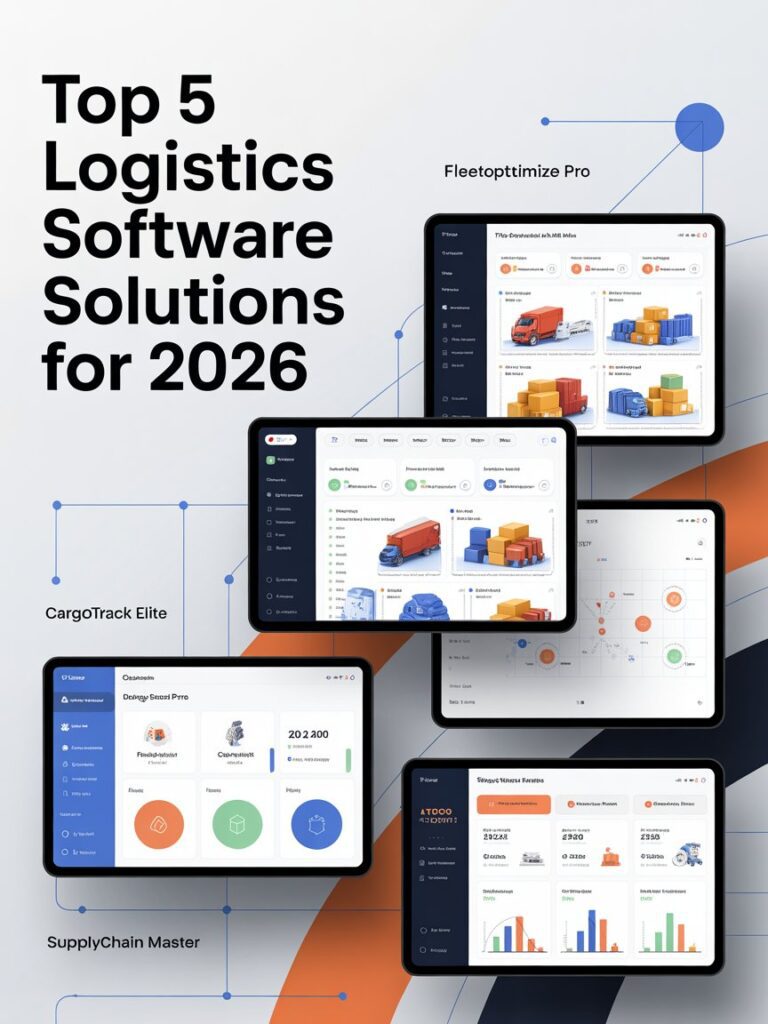
So I put together this breakdown of the Top 5 Logistics Software Solutions for 2026 — not based on sponsored rankings or press releases, but on what’s actually being used and trusted by US operators right now.
I want to explain how I picked these five, because the criteria matter.
The logistics tech trends 2026 aren’t just about which platform has the most features. It’s about which platforms are solving real operational pain — right now, in places like Memphis distribution centers, Midwest trucking corridors, and ecommerce fulfillment hubs in Nevada and New Jersey.
The platforms on this list had to check real boxes. Real-time shipment tracking that actually works across multiple carriers — not just a tracking number that refreshes once a day. Route optimization technology that accounts for real traffic, not just map distance. Warehouse management solutions that keep a live count of inventory without requiring a manual audit every quarter. Freight management systems that handle carrier contracts, load tenders, and billing in one place. Logistics automation tools that eliminate the copy-paste work that burns out good employees. And ideally, a SaaS logistics platform model so your IT team doesn’t need to babysit a server farm.
Every platform below earns its spot. Let’s get into it.
There’s a reason the largest shippers in the country — retailers moving product into thousands of stores, manufacturers coordinating inbound raw materials from a dozen suppliers, distributors managing multi-modal freight across every US region — keep paying for Oracle OTM year after year.
It is the most capable transportation management system on the market. Period.
What Oracle built here isn’t just transportation management software — it’s an entire logistics command center. You can manage carrier procurement, build and optimize loads, execute shipments across TL, LTL, intermodal, parcel, and air, settle freight invoices, and pull analytics reports that actually inform decisions. All in one system.
For a company running freight operations out of a Chicago hub that touches 48 states, or a Southeast retailer managing inbound ocean containers and outbound store replenishment simultaneously, OTM is the tms transportation platform that handles that complexity without falling apart.
Standout capabilities:
The logistics analytics software inside OTM is deep. You can track carrier performance over time, model lane costs, analyze mode shift opportunities, and run what-if scenarios on your freight spend. That level of insight is genuinely valuable when you’re spending $50 million or more a year on transportation.
The freight management systems functionality covers the full lifecycle — from rate solicitation and carrier contracts through execution, tracking, proof of delivery, and automated freight audit and pay. That freight audit capability alone saves large shippers hundreds of thousands of dollars per year in billing errors.
The compliance toolset is built for the US regulatory environment — FMCSA, DOT, hazmat requirements, and cross-border documentation for Canada and Mexico.
The honest downsides:
It is expensive, it is complex, and it takes time to implement properly. Realistically 9 to 18 months for a full enterprise deployment. It is not designed for a 30-truck carrier or a small freight broker.
Best fit: Large shippers and manufacturers. Companies spending $20M+ annually on freight. Enterprise logistics systems touching multiple modes and US regions.
Pricing: Custom enterprise contracts — realistically $100,000 to $500,000+ annually.
If your company already runs SAP — and a massive number of US manufacturers, distributors, and retailers do — then SAP TM is not just a logistics platform. It’s the missing piece that makes your entire operation coherent.
The argument for SAP TM has always been integration. When your ERP, procurement, finance, and logistics are all inside the SAP ecosystem, the data flows cleanly. Purchase orders connect to inbound shipments. Sales orders connect to outbound deliveries. Freight costs post directly to the right cost centers. Finance closes the books faster. That end-to-end visibility across supply chain software solutions is what makes SAP TM so valuable for companies with complex networks.
A food and beverage manufacturer in the Midwest with tight inbound ingredient schedules and retail replenishment deadlines. A medical device company managing temperature-controlled freight and strict delivery compliance. An industrial distributor in the Northeast running both customer deliveries and field service parts logistics. These are the environments where SAP TM justifies itself.
What it brings to the table:
The route optimization technology in SAP TM factors in time windows, carrier capacity, mode preference, and lane-level cost targets. The carrier collaboration portal lets freight partners work directly in the system, cutting down email volume and missed tenders dramatically.
The logistics automation tools for load building and carrier selection are rule-based but highly configurable — you can automate 80% of routine freight decisions and let your team focus on the exceptions.
The freight management systems capability covers inbound and outbound, domestic and cross-border, with solid US customs compliance documentation support built in.
The honest downsides:
SAP TM is not a plug-and-play SaaS logistics platform. It requires real implementation expertise. If you don’t already have SAP in your stack, the argument for choosing it gets complicated fast.
Best fit: Companies already on SAP ERP or S/4HANA. Large manufacturers, global distributors, businesses with complex multi-mode supply chain software solutions needs.
Pricing: Custom — typically $150,000 to $500,000+ annually depending on scope.
Here’s what most comparisons get wrong about Manhattan Associates: they evaluate it only as a warehouse management solutions provider and undervalue the transportation side. Or they look at it as a TMS and forget that the warehouse integration is the whole point.
Manhattan built its WMS and TMS on a single unified platform — not two products forced together through an acquisition. That architectural decision changes everything operationally. The inventory data and the transportation data are the same data. When a pick is confirmed in the warehouse, the transportation system knows instantly. When a carrier appointment is set, the warehouse knows what’s coming and when.
That native connectivity between warehouse management solutions and transportation management software is rare, and it pays off in real ways — faster order release, better load consolidation, fewer shipment delays caused by warehouse-to-dock disconnects.
For US fulfillment operations dealing with the volume pressures of ecommerce, this matters enormously. Manhattan is one of the dominant ecommerce logistics and shipping software solution platforms in the country. A distribution center in the Dallas Metroplex shipping 15,000 orders a day or a retail DC in Pennsylvania managing both store replenishment and direct-to-consumer channels — Manhattan is a legitimate, proven answer for both.
What it does better than most:
The inventory tracking software is genuinely strong — real-time visibility down to the license plate or serial number level, with cycle count automation that keeps shrinkage in check without shutting operations down for a full physical count.
The labor management system inside the WMS tracks individual performance and helps supervisors make real-time staffing decisions based on actual workload, not gut feel.
The 3PL software capabilities are solid for third-party providers managing multiple client accounts — client-specific billing, inventory segregation, and reporting all handled inside one platform.
The cloud-native SaaS logistics platform model means faster feature releases, no on-premise hardware headaches, and solid uptime.
The honest downsides:
Manhattan is a major investment. For smaller operations, the ROI math doesn’t work. Implementation takes months and configuration is substantial. This is a platform for serious, growing operations — not a starter tool.
Best fit: High-volume fulfillment centers, omnichannel retailers, 3PL software users managing complex client networks, grocery distributors, specialty retailers with fast-moving inventory.
Pricing: Cloud subscription — typically $200,000 to $800,000+ annually.
Let me explain why project44 made this list even though it’s not a TMS, not a WMS, and doesn’t do freight procurement or invoice management.
It does one thing: it tells you exactly where every shipment is — right now — across every carrier, every mode, every lane. And it does that better than any other platform in the logistics software market today.
That might sound narrow. It isn’t. For a lot of US shippers, real-time shipment tracking and exception visibility are the biggest unsolved problems in their stack. They’ve got a TMS handling execution and a WMS handling fulfillment — but they’re still calling carriers to chase ETAs, still fielding “where’s my order” calls from retail customers and internal stakeholders, still discovering problems after the damage is already done.
project44 connects to over 1,000 North American carriers via ELD, GPS, API, and EDI feeds. It doesn’t just show you a carrier’s self-reported status — it provides actual position data, predictive ETAs based on real-world conditions, and proactive alerts when a shipment is at risk.
For a retail shipper managing OTIF compliance requirements from big-box retailers in the Southeast, that predictive ETA capability can directly prevent chargebacks. For a manufacturer in the Midwest managing inbound materials with tight production schedules, knowing 48 hours early that a critical shipment is running late gives the operations team time to react rather than scramble.
What makes it worth the investment:
The logistics analytics software layer is strong — carrier scorecards, lane-level on-time performance, delivery trend analysis, and network-wide data that helps transportation teams make smarter carrier selection decisions over time.
The integration architecture is built for enterprise environments. project44 plugs into your existing TMS or ERP via API. You don’t rip and replace anything — you add a visibility layer on top of what you already have.
The customer-facing tracking portal is a real differentiator for 3PLs and carriers. Offering shippers a professional live tracking experience strengthens partnerships and cuts inbound status inquiry calls dramatically.
The honest downsides:
project44 is a visibility layer, not an execution platform. It doesn’t plan loads, select carriers, or pay invoices. You need it alongside a transportation management system, not as a replacement for one. For very small operations running a handful of shipments a day, the cost-benefit probably doesn’t hold up.
Best fit: Mid-to-large shippers with complex carrier networks, 3PLs using logistics IT solutions as a competitive differentiator, companies with retail compliance requirements, supply chain teams that have execution covered but lack visibility.
Pricing: SaaS subscription — typically $50,000 to $200,000+ annually based on shipment volume.
The first four platforms on this list are built for big operations. Rose Rocket is different — and it belongs on this list for exactly that reason.
There are thousands of carriers in the US running between 10 and 150 trucks. Regional operators in Tennessee, Kansas, the Carolinas, the Pacific Northwest. They’re not moving $500 million in freight a year. They’re building a business, trying to run professional operations with limited staff, and competing with larger carriers for quality customers.
For years, the logistics software for small business segment had bad options. Either way too expensive and complex — systems built for Fortune 500 companies that small carriers couldn’t afford or figure out. Or way too basic — tools that barely did more than a spreadsheet with a nicer interface.
Rose Rocket fills that gap. It is a modern, cloud-native tms transportation platform built specifically for carriers and freight brokers who want real software without the enterprise price tag or the six-month implementation project.
The interface is clean enough that a dispatcher with no tech background learns it in a couple of days. The driver mobile app works on any smartphone and handles load updates, document capture, and communication without requiring drivers to call the office for every status check.
Why it works for smaller operations:
The fleet management software integrations connect directly with major ELD providers — no manual data entry, no reconciling driver logs from two separate systems.
The customer portal gives your shippers a branded real-time shipment tracking experience without you building anything custom. For a small carrier trying to win business from quality shippers, that professional presentation matters more than most people admit.
The load management and dispatch workflow is clean: create a load, assign a driver, tender it, capture the POD, and invoice — all in one flow, without jumping between systems.
The best logistic software pricing for this segment is transparent. No six-figure implementation contracts. No surprise add-on fees for basic features. You know what you’re paying from month one.
The honest downsides:
Rose Rocket is built for carriers and brokers — not shippers looking for inventory tracking software, demand forecasting, or warehouse management. If that’s what you need, look elsewhere on this list.
Best fit: Small to mid-size carriers (10 to 300 trucks), regional freight brokers, growing 3PL software users who want modern tools without enterprise complexity.
Pricing: Subscription-based — starting around $500 to $2,500 per month depending on users and features.
The temptation when evaluating software is to look at feature comparison tables and pick whichever platform has the most checkmarks. That’s how companies end up paying for tools they use 30% of.
The better question is simpler: what is the single biggest problem slowing your logistics operation down right now?
If it’s freight cost and carrier management at scale — Oracle OTM or SAP TM.
If it’s warehouse and transportation running disconnected from each other — Manhattan Associates.
If it’s no visibility into where shipments actually are — project44.
If it’s dispatch and billing still running on spreadsheets and email — Rose Rocket.
And if the answer is that none of these platforms do exactly what your operation needs — that’s a custom development conversation. At Asapp Studio, we build custom software, mobile applications, AI-powered tools, and custom ERP systems for businesses that need logistics IT solutions shaped around their own workflows. We’ve built driver-facing apps, dispatch automation tools, and freight tracking integrations for clients who outgrew off-the-shelf options. If that’s where you are, let’s talk.
A few forces are reshaping the best logistics software 2026 landscape in ways worth understanding before you make a platform decision.
AI is no longer just a marketing claim. The top logistics platforms are using machine learning in carrier selection, predictive ETA modeling, inventory replenishment, and freight invoice anomaly detection. This is live in production systems and generating documented savings — not just demos at industry conferences.
Logistics automation tools are eliminating whole categories of manual work. Invoice matching, load building, appointment scheduling, carrier tendering — the best platforms automate most of this. The labor that used to go into those tasks is shifting toward exception management and customer relationships, where humans actually add value.
The ecommerce logistics and shipping software solution market has matured fast. D2C brands and marketplace sellers are demanding the same visibility and tracking experience from their logistics partners that their own customers expect. 3PLs and carriers that can deliver that are winning the business.
SaaS logistics platforms have won the deployment debate. On-premise TMS installations are a fading part of the market. Cloud-native platforms update faster, cost less to maintain, and work better on mobile — which is where most actual logistics work happens.
3PL software is getting genuinely sophisticated. As outsourced logistics grows, 3PLs are investing in platforms that let them offer real-time data feeds and shipper portals as part of their service. The 3PLs that show clients professional visibility tools are winning renewals that competitors are losing.
The top 5 logistics companies on the software side — Oracle OTM, SAP TM, Manhattan Associates, project44, and Rose Rocket — each represent a different, well-considered answer to a different kind of logistics problem. None of them is right for every operation. All of them are genuinely excellent for the right one.
If you’re evaluating logistics software solutions in 2026, start with your real problem — not a feature matrix. Find the platform that solves that specific problem well, can grow with you, and fits your cost reality. That’s the right software.
And if you find yourself needing something these platforms don’t offer — a custom integration, a mobile app your drivers will actually use, an AI-driven dispatch tool, or a freight management system built around your specific workflow — the team at Asapp Studio builds exactly that. Check out our services, review our case studies, and reach out when you’re ready.
Q1: What are the Top 5 Logistics Software Solutions for 2026?
Oracle OTM, SAP TM, Manhattan Associates, project44, and Rose Rocket are the best logistics software 2026 picks for US-based operators of varying sizes.
Q2: How many logistics companies are in the US?
There are 18,000+ logistics companies in the US, including large 3PLs, mid-size carriers, regional brokers, and freight forwarders across all 50 states.
Q3: What does a transportation management system do?
A TMS handles freight planning, carrier selection, load execution, and cost tracking — the operational core of any serious logistics software solutions setup.
Q4: What is the best logistics software for small business carriers?
Rose Rocket is the top pick for small carriers and brokers — modern, affordable, built for lean teams without big IT budgets or long implementation timelines.
Q5: What are the top logistics tech trends in 2026?
AI forecasting, real-time shipment tracking, logistics automation tools, SaaS platforms, and advanced 3PL software are the defining trends shaping the market in 2026.