
Walk into any tech meetup in Austin, San Francisco, or New York City right now and you’ll hear the same question bouncing around: “Is Flutter the next big thing?” Honestly, after everything we’ve seen and shipped in early 2026, the answer is yes — and then some.
Flutter has stopped being a framework that development teams experiment with. It’s the framework that businesses are betting real products on. And if you’ve been watching mobile app development trends 2026 closely, that shift was not subtle. It’s been loud, fast, and hard to ignore.
Whether you’re a startup founder in Chicago pitching investors on a new consumer app, a product manager in Seattle mapping out a 12-month roadmap, or a developer in Miami deciding which skills to double down on — understanding the top Flutter trends 2026 is no longer optional. It’s table stakes.
At Asapp Studio, we build Flutter apps for clients across the United States. Healthcare platforms in Houston. E-commerce solutions in Los Angeles. Enterprise tools in New York. We’re inside these trends every single day — not reading about them, but living them. This post is what we’re actually seeing, what we’re recommending, and where we think this is all going.
Let’s get into it.
Before jumping into specific flutter trending topics, it’s worth establishing why Flutter is so dominant right now. This didn’t happen by accident.
Google backed Flutter with serious engineering investment. Dart grew into a genuinely productive, type-safe language. The Flutter package ecosystem went from sparse to extraordinary. And perhaps most importantly — the ‘is Flutter production-ready?’ conversation is completely over. Nobody is asking that anymore.
According to developer surveys from late 2025, Flutter consistently ranks as one of the most loved and most used cross-platform frameworks globally. For businesses evaluating cross-platform app development options, Flutter isn’t one option among many anymore. It’s typically the first one on the whiteboard.
Here’s what’s driving that in 2026, trend by trend.
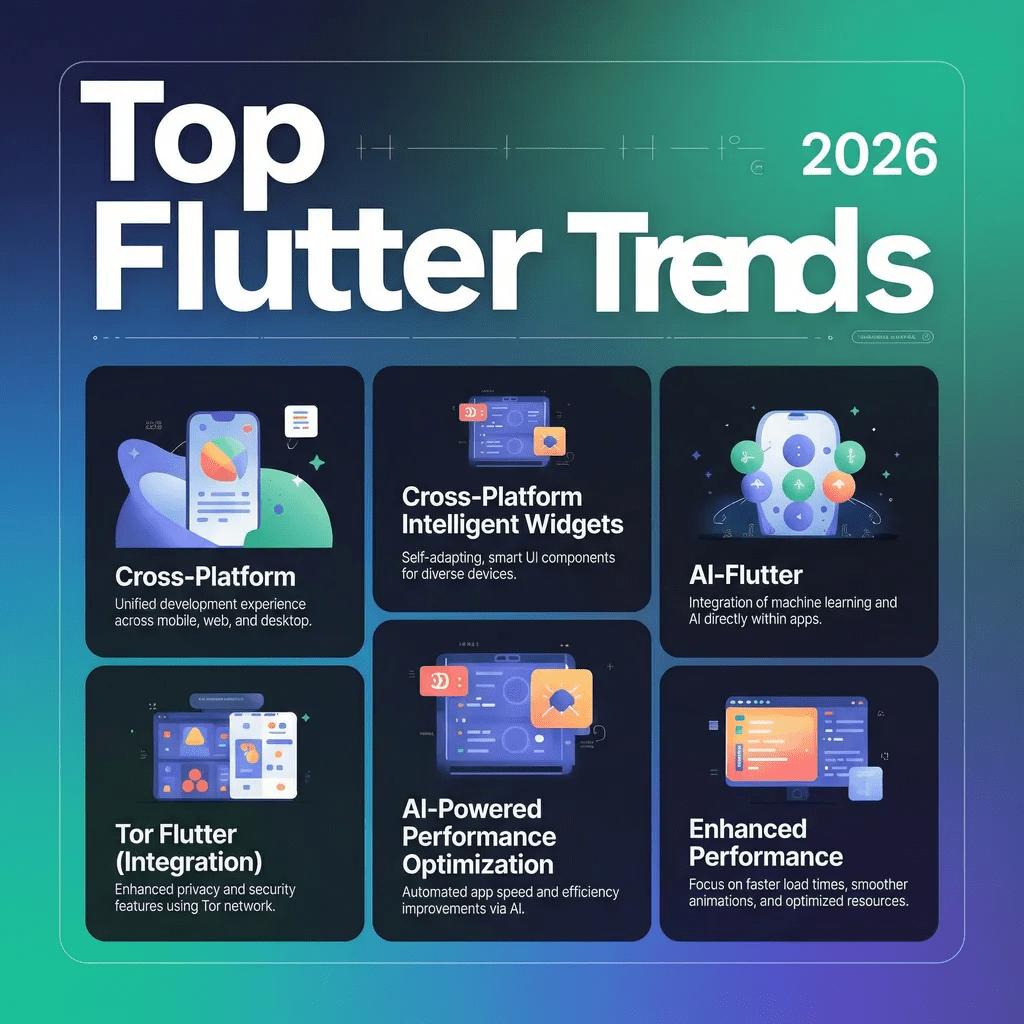
This is the biggest story in Flutter development trends 2026. Not because AI is new — it’s not — but because Flutter machine learning support has finally crossed the line from “interesting proof of concept” to “things we’re shipping in real apps for real users.”
Teams are not just dropping chatbots into their apps and calling it intelligence. We’re talking about on-device inference, real-time image recognition, personalized recommendation engines, and predictive UI that changes based on how individual users behave — all inside Flutter apps running on standard consumer hardware.
The combination of TensorFlow Lite, Google ML Kit, and Firebase’s Vertex AI integration has made this accessible without requiring a team of ML engineers or a massive cloud spend. We helped a healthcare client in Dallas build an on-device symptom triage feature earlier this year. The model runs locally. Zero latency. No PHI sent to the cloud. The compliance team loved it, and users barely noticed it was powered by AI — which is kind of the point.
If you’re planning any mobile product in 2026 — whether consumer or enterprise — Flutter machine learning support should be somewhere on your roadmap. Our artificial intelligence services team works alongside Flutter developers on projects exactly like this, and the results consistently exceed client expectations.
A year and a half ago, augmented reality in Flutter was something you’d show at a conference demo to impress people. Nobody was shipping it in production. In 2026, that has changed in a real and meaningful way.
Flutter 3D and AR integration is showing up in actual live apps. Furniture retailers in Phoenix letting users visualize sofas in their living rooms before purchasing. Real estate platforms in Atlanta offering virtual walkthroughs of listings. Fitness apps in Boston overlaying rep-counting guidance on live camera feeds. These are real products, used by real customers, generating real revenue.
The ARCore and ARKit plugin ecosystem has matured considerably over the past year. Flame — Flutter’s open-source game engine — has added capabilities that push it well beyond games into immersive app experiences. The rendering pipeline is cleaner, performance on mid-range devices is solid, and the developer tooling around 3D assets has improved significantly.
Flutter 3D and AR integration is easily one of the top future technologies in 2026 for mobile. If your business touches retail, real estate, education, healthcare, or entertainment, this is worth serious evaluation. Our gaming development team has been deep in this space, and what’s being built is genuinely impressive.
For a stretch of time — probably 2022 through early 2024 — Flutter for web and desktop felt like a promise that kept getting renewed but never quite cashed. Performance was inconsistent. Web bundle sizes were too large. Desktop support was incomplete. Developers who tried it came back frustrated.
In 2026, that story is different. Noticeably different.
Web support has matured to the point where Flutter web apps are genuinely competitive on performance. The CanvasKit renderer produces crisp, consistent output. Tree-shaking has gotten more aggressive, meaning leaner bundle sizes. And desktop support — particularly on Windows and macOS — is being used by enterprise teams for internal tools, not just hobbyist projects.
The credit largely goes to Dart language improvements on the compiler side, and to Google’s team consistently prioritizing Flutter framework updates 2026 with web and desktop in scope rather than as afterthoughts.
We’ve shipped internal dashboard tools for clients in the Pacific Northwest that run on Flutter web. The conversation with stakeholders has shifted from “can Flutter really do this?” to “when can we launch?” One team, one codebase, four platforms. The ROI math is compelling.
For businesses thinking through software development strategy in 2026, this multi-platform reality changes the entire cost structure. You’re not funding four separate development workstreams anymore.
If you want an honest read on where mobile UI/UX is heading in 2026, pay attention to what Flutter developers build in their spare time. These teams are design-obsessed in a way that’s genuinely unusual for a developer community, and the bar for what “good” looks like has risen considerably over the past 18 months.
Here are the specific top mobile UI/UX design trends for Flutter apps that we’re seeing dominate new projects:
Glassmorphism and layered depth effects — frosted glass aesthetics that use blur, transparency, and luminosity to suggest depth rather than flat shadows. Particularly popular in fintech and lifestyle categories.
Micro-animations with actual purpose — not decoration, but animation that communicates state changes, directs user attention, and provides tactile feedback. Flutter’s animation engine makes this easier to implement correctly than any other framework, and the best teams are exploiting that advantage.
Flutter adaptive design — genuinely adaptive layouts that respond to screen size, orientation, input method, and platform context. In 2026, this is not optional. An app that feels weird on a tablet or desktop is an app that gets uninstalled.
Dynamic theming and Material 3 — users expect control over how apps look. Material You theming, dark mode handling, and system-level color extraction have all become table stakes. Flutter’s theming system has been rebuilt around this reality.
Neobrutalism creeping into B2B — bold typography, flat colors, deliberate rawness. It’s a reaction against the homogenization of app design, and it’s finding a real audience in productivity tools and enterprise dashboards.
These UI trends 2026 are shaping what clients ask for and what users respond to. Our UI/UX services team applies these principles to every Flutter project we touch in 2026, and the engagement metrics back up the investment.
As Flutter apps grow in complexity — more screens, more state management, more third-party integrations — Flutter performance optimization has evolved from a nice-to-have into a full discipline that the best teams take seriously from day one.
The biggest technical story here is Impeller. Flutter’s new rendering engine — which replaced Skia as the default on iOS and is rolling out more broadly — has delivered real-world performance improvements that users actually feel. The jank and occasional frame drops that used to show up in complex Flutter animations are dramatically reduced. Apps feel more native because the rendering pipeline is working more efficiently with platform hardware.
Beyond Impeller, the best Flutter teams in 2026 are practicing performance discipline throughout the development lifecycle. Lazy loading widgets rather than mounting everything upfront. Strategic use of const constructors. Aggressive profiling with Flutter DevTools before shipping. Code splitting for web builds. Smart caching strategies for data-heavy screens.
Flutter performance optimization in 2026 is less about individual tricks and more about a mindset. Build with performance in mind. Measure everything. Ship fast apps.
Of all the flutter trends 2026, this one carries the most weight for business decision-makers. Flutter for enterprise apps has crossed the chasm. Definitively.
We are not talking about scrappy startups experimenting with a new framework to save money on development. We are talking about healthcare networks, logistics platforms, financial institutions, and manufacturing companies putting serious budget behind Flutter because the value proposition is undeniable.
Why is enterprise adoption accelerating this fast? A few things are working together:
First, one codebase covering iOS, Android, web, and desktop means enterprise IT teams can maintain and update a single product that works everywhere their workforce operates. That’s not a marginal efficiency gain — it’s a structural cost reduction.
Second, Dart’s strong typing, growing tooling support, and increasingly mature testing infrastructure make large codebases manageable in ways that matter to engineering organizations running long-lived software.
Third, Flutter framework updates 2026 have doubled down on accessibility compliance, enterprise security patterns, and platform integration — precisely the areas that enterprise procurement teams care about most.
We’ve built custom ERP solutions and CRM platforms in Flutter for mid-market and enterprise clients across New York, Chicago, and Houston. The development velocity advantage is real, and it compounds over time.
Firebase and Flutter updates in 2026 continue strengthening one of the most productive technology pairings in mobile development. Real-time Firestore syncing, Firebase Authentication, Cloud Functions, crashlytics, and Analytics all connect to Flutter through official, actively maintained packages that the community trusts.
What’s new in 2026 is the depth of generative AI capabilities flowing through Firebase’s Vertex AI integration. Teams can now add intelligent, AI-powered features to Flutter apps using Firebase as the conduit — without standing up their own model infrastructure or managing GPU capacity. For startups that need to move fast, this is a genuine competitive accelerator.
Firebase’s observability tooling has also sharpened considerably. Crashlytics gives development teams in Boston, Denver, and Seattle the real-time visibility they need to operate production apps with confidence. Performance monitoring has gotten more granular. The developer experience around the Firebase console has improved.
If you’re building a Flutter app in 2026, Firebase remains the fastest and most mature path to a production-ready backend infrastructure. That hasn’t changed — it’s just getting better.
People still ask about Flutter vs React Native trends. It’s a fair question and deserves a straight answer rather than marketing spin.
React Native’s new architecture — bridgeless mode and the Fabric renderer — has closed meaningful performance gaps that used to clearly favor Flutter. If you’re evaluating Flutter vs React Native trends in 2026, React Native is genuinely more competitive on raw performance than it was two years ago. That’s worth acknowledging.
Flutter’s advantages remain clear in specific areas. Rendering consistency — Flutter paints its own pixels, so the app looks and behaves identically across every device and platform — is still a meaningful differentiator for design-critical products. Animation-heavy apps consistently perform better in Flutter. The single codebase story covering mobile, web, and desktop is more complete in Flutter than in React Native.
React Native’s advantage is JavaScript. Millions of developers already know it. The talent pool is enormous. If your existing team has strong JavaScript experience and you’re not building something particularly animation-heavy or design-demanding, React Native is a defensible choice.
Our Flutter app development team and our React Native team both build production apps in 2026. The right framework depends on your product requirements, your team’s background, and your platform targets. We’re happy to help you think it through.
One of the legitimate criticisms of Flutter in its earlier years was that the Flutter package ecosystem was thin compared to npm or CocoaPods. In 2026, that criticism no longer holds up.
pub.dev hosts tens of thousands of packages. More importantly, the quality of the most-used packages — for state management, networking, local storage, authentication, payment processing, mapping, and analytics — is genuinely excellent. These aren’t hobby projects. They’re maintained by teams that treat package quality as a serious responsibility.
Flutter plugins 2026 are being built with proper semantic versioning, responsive maintainers, comprehensive test suites, and documentation that actually helps. The ecosystem has grown up in the way that any healthy open-source community eventually does.
Community standards have also emerged organically. go_router for navigation. riverpod or flutter_bloc for state management. dio for networking. These are de facto standards now, and the shared knowledge base that comes with community consensus makes troubleshooting faster and onboarding new developers easier.
Dart language improvements in 2026 deserve their own dedicated attention. The language team has been shipping meaningful improvements at a pace that’s easy to underestimate if you’re only watching Flutter’s headline features.
Pattern matching, sealed classes, records, improved sound null safety, and enhanced type inference have all landed in the past 18 months. If you wrote Dart code in 2022 and haven’t touched it since, coming back now genuinely feels like using a more capable language — not just the same language with patches applied.
Dart is finding its voice. Strongly typed, fast to compile, clear in intent, increasingly ergonomic for modern architectural patterns, and performant in ways that matter for mobile. The learning curve for developers coming from Swift, Kotlin, or TypeScript is reasonable, and the reward on the other side — a productive, safe, expressive language — is worth the ramp.
This also matters for hiring. Developers who try Dart for the first time in 2026 are less likely to bounce off it than they would have been two or three years ago. The language is just genuinely better.
Frameworks live or die on their communities. Flutter’s community in 2026 is one of the healthiest in mobile development — not just large, but genuinely engaged and productive.
Flutter Forward, Google I/O, and dozens of regional meetups and conferences across the United States — in cities like Portland, Philadelphia, Minneapolis, Denver, and Raleigh — have built a community that takes its craft seriously. The quality of open-source contributions, tutorial content, and shared tooling coming from this community is world-class.
Flutter community innovations show up in places you might not expect: new layout approaches that simplify complex adaptive UIs, testing utilities that make widget testing less painful, design system tools that bridge Figma and Flutter more cleanly, and devtools extensions that surface performance data in smarter ways.
This community energy compounds. Better packages lead to better apps, which attract more developers, which creates more packages. That flywheel is spinning fast in 2026.
To see how our team translates these community innovations into real products, take a look at our portfolio.
Flutter adoption is not uniform across the country. Different regional markets are embracing it for different reasons, and the patterns are interesting.
California remains the epicenter of US Flutter adoption. San Francisco and LA startups are using Flutter to ship cross-platform MVPs faster than they could with separate native teams. The culture of moving fast, learning fast, and iterating continuously aligns with everything Flutter is good at. Venture-backed mobile-first products in California are increasingly defaulting to Flutter from day one.
Texas’s tech sector — particularly Austin’s fast-growing startup scene — has embraced Flutter for healthcare, logistics, and energy industry apps. Enterprise clients in Dallas and Houston building field worker tools and operational dashboards find Flutter for enterprise apps to be a natural fit. The cost of development talent in Texas is lower than coastal markets, which makes Flutter’s productivity advantages even more impactful on overall project ROI.
New York’s fintech and media sectors are the primary Flutter drivers here. Fintech startups in Manhattan are building trading interfaces and banking dashboards where Flutter UI/UX quality matches the premium design expectations of financial product users. Media companies are using Flutter for content delivery and streaming apps. The design culture in New York raises the bar, and Flutter rises to meet it.
Seattle’s enterprise-first tech culture — shaped by proximity to Amazon, Microsoft, and a dense B2B SaaS ecosystem — has pushed Flutter into the internal tools and enterprise productivity space. Teams building operational software for large organizations are finding that Firebase and Flutter updates and the improving desktop support make Flutter a practical choice even for complex enterprise use cases.
Miami has emerged as a legitimate startup hub over the past two years, and Flutter is well-represented there. Tourism, hospitality, and real estate apps built on Flutter serve Florida’s unique economic mix. The multilingual and multicultural population also makes Flutter’s excellent internationalization support particularly valuable for Florida-based products.
Chicago’s diversified economy — finance, healthcare, logistics, manufacturing — maps well onto Flutter’s versatility as a framework. Flutter app development in supply chain visibility tools, custom POS systems, and telehealth platforms is active and growing across the Chicago metro. Our custom POS development work for retail clients in the Midwest has benefited directly from Flutter’s cross-platform reach.
These are our near future predictions based on what we’re building, what clients are asking for, and where the technology is pointing:
Flutter becomes the assumed default for new cross-platform projects started in the US market. The question will stop being “should we use Flutter?” and start being “why would we not use Flutter?” for most mobile product conversations.
AI-powered Flutter development tooling emerges as a category. Think LLM-driven widget generation, AI-assisted state management suggestions, and automated accessibility checks — tools that compress the gap between design intent and shipped code.
Flutter for wearables and embedded surfaces moves from experimental to early production. We’re watching this space. The signs are pointing toward meaningful movement by Q3 2026.
Enterprise Flutter tooling matures significantly. CI/CD pipelines optimized for Flutter’s multi-platform builds, design-to-code tools with deeper Figma integration, and testing frameworks that handle widget-level and integration testing at scale are all moving fast.
The flutter latest trends conversation would be incomplete without addressing the low-code wave. Top FlutterFlow companies have made it genuinely possible for non-developers to build Flutter-powered apps, and this is shifting how some organizations think about their internal tooling and MVP strategy.
What makes FlutterFlow interesting rather than threatening to professional developers is that it generates real Flutter code. The output is actual Dart and Flutter widgets — not some proprietary blob that locks you in. Skilled developers can extend FlutterFlow projects, debug them, and evolve them as complexity grows.
We see FlutterFlow as a useful tool for specific contexts: internal tools with bounded complexity, rapid prototyping before a proper development engagement, or apps where the user’s domain knowledge far exceeds their development capacity. When apps need custom business logic, advanced third-party integrations, or enterprise security architecture — that’s when professional development takes over.
The flutter trend 2026 is clear, and the businesses moving fastest are the ones that aren’t waiting for more evidence. Flutter is production-ready, enterprise-capable, design-competitive, and community-supported in ways that make the case for building on it stronger every quarter.
At Asapp Studio, we’ve shipped Flutter apps for clients across California, Texas, New York, Florida, Illinois, and beyond. Our mobile app development team understands this ecosystem at a technical depth that comes from building in it daily — not just following it.
If you’re a startup mapping out your first cross-platform product, or an enterprise team modernizing a legacy mobile solution, we’d genuinely enjoy talking through what’s possible. Browse our case studies, explore our portfolio, or get in touch to start a conversation.
The flutter future 2026 is being built right now. Let’s build your piece of it together.
Q1. What are the top Flutter trends 2026 businesses should prioritize first?
AI/ML integration, Flutter for enterprise apps, adaptive UI design, AR integration, and performance optimization with Impeller are the most impactful Flutter trends 2026 for businesses to act on immediately.
Q2. Is Flutter better than React Native in 2026?
Flutter wins on rendering consistency and animation performance. React Native suits JavaScript teams. For design-critical or multi-platform products, Flutter vs React Native trends clearly favor Flutter in 2026.
Q3. Is Flutter the next big thing in mobile app development?
Yes. Flutter’s cross-platform reach, Google backing, strong package ecosystem, and Dart improvements make it the leading framework for new mobile and multi-platform projects heading into the near future.
Q4. What Dart language improvements are making Flutter stronger in 2026?
Pattern matching, sealed classes, records, and improved null safety make Dart more expressive, safer, and more productive — reducing bugs and making large Flutter codebases significantly easier to manage and scale.
Q5. Can Flutter handle enterprise-grade app development in 2026?
Yes, fully. Flutter for enterprise apps is proven across ERP, CRM, healthcare, logistics, and finance platforms. One codebase across all platforms cuts development and maintenance costs while meeting enterprise-grade security and accessibility standards.