
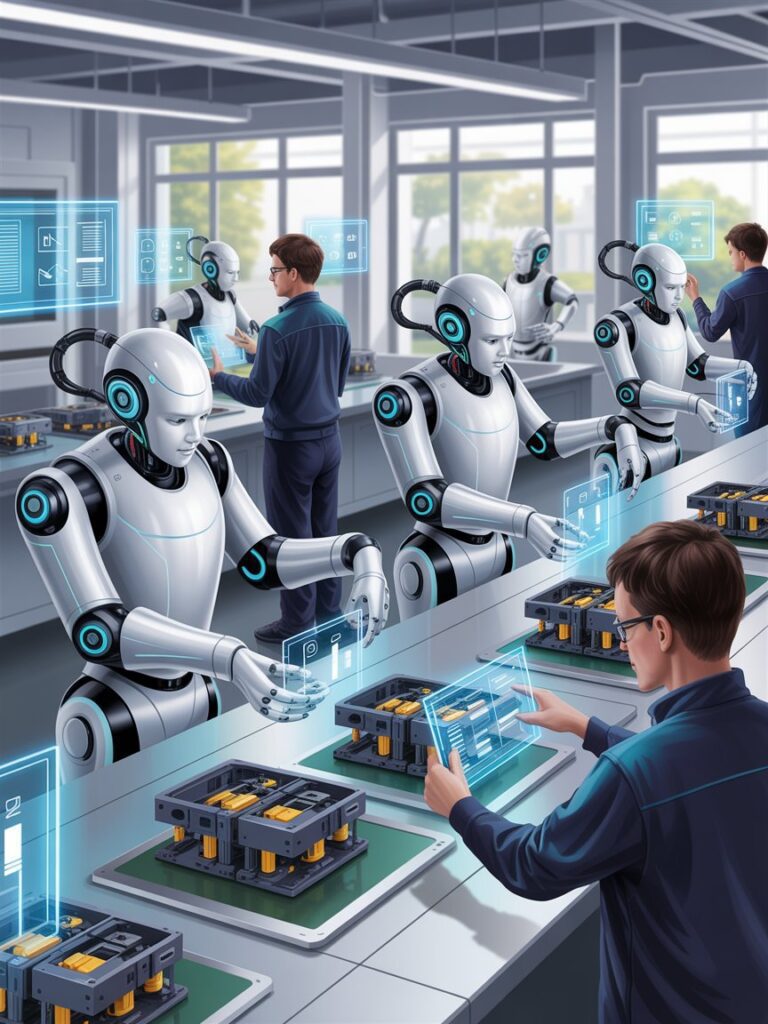
Collaborative robots in 2026 have become the factory floor’s best-kept secret—except it’s not a secret anymore. Last month, my buddy Marcus called me from his packaging plant outside Cleveland. “Dude, you gotta see this,” he says. “We got a robot. It’s working next to Jenny. No cage, no drama, just… working together.”
I drove three hours to see it. Worth every mile.
The collaborative robots market 2026 looks nothing like the dystopian factory floors people imagine. There’s no Terminator music playing. No ominous red lights. Just regular folks working alongside machines that actually seem to care if they bump into you. And that’s the whole point.
Here’s what nobody tells you about the cobot revolution: it’s messy, it’s human, and it’s happening faster than anyone expected. Small shops in rural America are buying these things. Warehouses in Southeast Asia are deploying them. Even my neighbor’s cousin—who runs a specialty chocolate business—just installed one to handle their packaging rush during holidays.
So what are collaborative robots? Strip away the marketing fluff and here’s the truth: they’re industrial robots designed NOT to kill you if you get too close.
Sounds like a low bar, right? But that’s actually revolutionary.
Traditional industrial robots are beasts. Fast, powerful, zero chill. Get in their way and you’re toast. That’s why they live in cages—for your protection, not theirs. Cobots, though? Different breed entirely. They’ve got sensors that make them stop the instant they touch something unexpected. Force limits that prevent them from crushing your hand. Programming so simple that Carol from accounting could probably figure it out.
I watched a training session once. New hire, first day, never touched a robot in his life. By hour three, he’s teaching the cobot a new motion just by moving its arm where he wants it to go. No coding. No engineering degree. Just grab and show.
How do robots work when they’re collaborative? Think of it like this: remember when cars started getting backup cameras and automatic braking? Cobots are basically that concept applied to manufacturing. Tons of sensors constantly checking: “Am I about to hit something? Is there a person nearby? Should I slow down?”
The tech involves torque sensors in every joint, vision systems tracking movement, and AI algorithms that honestly make my smartphone look dumb. But you don’t need to understand any of that to use one, which is the entire point.
Everyone wants to know about the best collaborative robots and which ones are the top 10 collaborative robots in 2026. I get it. You’re about to drop serious cash on equipment.
Here’s my unfiltered take after visiting about forty different facilities this year:
Universal Robots is still the iPhone of cobots—everyone knows them, everyone wants them, and they’re expensive for good reason. Their UR series just works. I’ve seen UR cobots running in dusty machine shops, climate-controlled clean rooms, and everything between. The Universal Robots Automatica 2026 showcase blew people’s minds with their new AI features. Universal Robots Automate 2026 proved they’re not coasting on reputation.
FANUC collaborative robot models are for folks who need reliability and don’t care about looking cool. Boxy, industrial, boring—and they’ll run for a decade without whining. The automotive industry loves them. Collaborative robots in automotive manufacturing? FANUC’s everywhere. Their CR-15iA handles heavier parts than most cobots dare touch.
ABB’s YuMi looks like something from a Pixar movie—two arms, compact, kinda cute. Perfect for electronics assembly where precision matters more than muscle. Watched one assembling circuit boards last spring. Poetry in motion, honestly.
KUKA brings German engineering to the party. Their LBR iiwa is so sensitive it can feel the difference between a firm handshake and a gentle tap. Crazy stuff. Medical device manufacturers worship these things.
Techman Robot from Taiwan is the value play everyone sleeps on. Built-in vision, decent pricing, solid support. Not flashy, just effective.
Then you’ve got Doosan, Kawasaki, Yaskawa, Franka Emika, and about twenty others fighting for market share. The collaborative robot manufacturers landscape is crowded, which means prices keep dropping while features keep improving. Great time to be a buyer.
Let’s talk money. Collaborative robots in 2026 price is probably the first thing your boss asked when you mentioned automation.
Basic cobots start around twenty grand. That’s for the arm only—no gripper, no stand, no integration. Think of it like buying a car without wheels, seats, or an engine. Technically you own a car, but you’re not driving anywhere.
Mid-range collaborative robot price hits $35K to $65K. This is where most companies land. You’re getting established brands, proven reliability, decent payload capacity. Add another $15K to $30K for end-effectors, sensors, programming, and installation.
Yeah, ouch. I know.
But here’s the thing Marcus discovered at his plant: his cobot paid for itself in fourteen months. How? It runs sixteen hours daily. Never calls in sick. Doesn’t need health insurance. Makes zero mistakes on repetitive tasks that humans mess up when tired. Three workers who used to do that boring job now handle customer service and problem-solving—stuff humans are actually good at.
The collaborative robot benefits stack up fast. Less waste from errors. Consistent quality. Flexibility to switch between products. Safety improvements that lower insurance premiums. One food processing company I visited cut their workers’ comp claims by sixty percent after cobots took over the injury-prone tasks.
Sure, how much will robots cost in the future is dropping. Prices fall about ten to fifteen percent yearly while capabilities double. But waiting means losing money today. ROI calculations usually favor buying now, learning fast, and expanding.
Collaborative robot applications in 2026 range from obvious to “wait, they can do THAT?”
Picking and placing is cobot bread-and-butter. Sounds boring until you watch one sorting mixed parts at speeds that make your eyes water. Cobot applications for this task have gotten stupid sophisticated. Vision systems identify objects they’ve never seen, calculate grasp angles, adjust for lighting changes, and adapt when products shift position.
Saw a warehouse demo where the cobot picked random items—bottles, boxes, bags—without anyone telling it what to expect. Just figured it out. Five years ago that required weeks of programming. Now? Works out of the box.
Packaging operations have gone absolutely nuts with cobots. E-commerce killed fixed automation. How do you design a machine for every possible product size? You don’t. You buy flexible manufacturing robots that adapt. The facility I toured last Tuesday had mobile collaborative robots rolling between stations. Different product every hour. Cobot just adjusts and keeps working.
Assembly tasks are where cobots found their groove. Electronics, automotive components, furniture, toys—anywhere you need precise, repetitive assembly that changes frequently enough to make fixed automation stupid expensive. A small electronics maker showed me their cobot assembling three different products on the same line. Changeover took six minutes. Their old fixed automation needed three hours and two technicians.
Collaborative robots in warehouses are everywhere now. Not just stationary arms—actual mobile collaborative robots that navigate floors, avoid people, transport goods, and return to charging stations automatically. It’s like someone crossed a cobot with a Roomba and taught it logistics.
Machine tending frees up skilled workers from babysitting. Cobot loads CNC machines, removes finished parts, even does basic inspection. One job shop owner told me his machinist nearly cried (happy tears) when they installed their first cobot. Fifteen years of standing at a machine waiting for cycles to finish—finally over.
Quality inspection is sneaky important. Humans get bored checking the same thing repeatedly. Miss defects. Cobots with vision systems catch everything, every time, forever. Food processing, pharmaceuticals, aerospace—industries where defects cost fortunes love this application.
Collaborative robots in manufacturing also handle welding, gluing, painting, polishing, screwdriving, and probably fifty other tasks I’m forgetting. The versatility is honestly their superpower.
For businesses wanting custom solutions that connect cobots to existing systems, our software development services build interfaces that make integration painless. We’ve helped manufacturers go from “how does this work” to fully automated in weeks.
Human-robot collaboration in manufacturing sounds great in PowerPoints. Reality’s more complicated.
Marcus’s plant hired a consultant before their cobot arrived. Smart move. The consultant interviewed everyone—veteran workers, new hires, supervisors, even the maintenance crew. Asked what tasks sucked. What caused injuries. What made people dread Mondays.
Then they bought a cobot to fix those specific problems.
Here’s what failed at other places I visited: management bought cobots, announced “we’re automating,” and acted surprised when workers freaked out. Of course they freaked out. “Automation” is corporate-speak for “we’re replacing you.”
Successful human-robot collaboration starts with honesty. “This robot handles the stuff destroying your back and boring your brain. You’ll learn new skills, do more interesting work, and frankly, we need your expertise to make this robot useful.”
One automotive plant let their line workers choose which tasks to automate. Vote and everything. Workers picked the awful jobs—nobody fought to keep the task that gave them carpal tunnel. Then they trained workers to program the cobots. Gave them ownership.
Six months later, workers named the cobots. Made jokes about them. Treated them like slightly incompetent coworkers (the good-natured kind). That’s when you know it’s working.
The culture shift isn’t automatic, though. Some workers never adjust. Usually older folks set in their ways or people who built identity around physical tasks. Fair enough. But most people? Given the choice between repetitive physical labor and supervising robots while learning new skills? They choose the latter.Industry 5.0 and collaborative robots represents this human-centric philosophy. Technology that enhances rather than replaces. Sounds nice, might actually be real.
Industrial automation with cobots sounds plug-and-play. Marketing materials show clean factories, smiling workers, robots humming along. Reality includes cursing, troubleshooting, and that special moment when your $50K robot refuses to talk to your $500K machine.
Collaborative robot challenges start with legacy equipment. Your plant probably has machines older than your newest employee. They speak ancient communication protocols—MODBUS, RS-232, proprietary nonsense the manufacturer doesn’t support anymore. Getting a 2026 AI-powered cobot to integrate? Good luck.
One manufacturer spent six weeks just establishing communication between their cobot and a CNC machine from 2003. Eventually needed custom software to translate between systems. Expensive, time-consuming, necessary.
Safety is another headache. Collaborative robot safety standards exist—ISO 10218, ISO/TS 15066—but interpretation varies. Your insurance company, local regulations, and corporate lawyers might all have different ideas about what’s safe. Risk assessments take time. Documentation is tedious but mandatory.
Then there’s programming. Sure, cobots are “easy to program” compared to traditional robots. But “easy” is relative. Teaching simple pick-and-place? Fine. Programming complex sequences with conditional logic, error handling, and integration with other systems? Still requires skills most workers don’t have.
Solutions that work:
Start small. One cobot, one simple application. Prove it works, learn the quirks, build confidence. Every successful deployment I’ve seen follows this pattern. Companies that tried automating entire lines immediately always regretted it.
Invest in training—real training, not just a two-hour webinar. Hands-on sessions where workers actually program the cobot, troubleshoot problems, experiment safely. One plant brought in their potential cobot users during the selection process. Let them test different brands, give feedback. Bought the one workers liked, not the one engineers preferred. Smart move.
Choose modular cobots that can switch tasks. Production needs change constantly. That cobot handling packaging today might need to do assembly next quarter. Industrial collaborative robots 2026 models increasingly support tool-changing systems and reprogramming without starting from scratch.
Partner with good integrators. The cheapest quote usually comes from people who’ll disappear after installation. Pay for experience, responsiveness, and someone who’ll answer calls when things break.
If you need custom integration solutions, our IoT development services connect cobots with existing factory systems. We’ve bridged decades-old equipment with cutting-edge automation more times than I can count.
AI-powered collaborative robots are simultaneously impressive and unsettling.
Watched a demo last month. Technician tells the cobot, “Parts are smaller today, adjust grip.” Robot understood. English. Just regular talking. Adjusted its force sensors and carried on. No programming interface. No technical commands. Conversation.
These 2026 robots use machine learning to improve constantly. Computer vision that recognizes objects better than humans in many cases. Natural language processing for verbal commands. Predictive algorithms that optimize movements and anticipate problems.
A packaging facility showed me their AI cobot that learned product variations on its own. Different box sizes, random orientations, damaged packaging—figured it all out without human intervention. Three years ago, that application needed custom programming for every product variant. Now the robot just learns.
The intelligence comes with tradeoffs. These systems need data—mountains of it. Computing power that isn’t cheap. Someone who understands both AI and manufacturing to oversee deployment. And workers comfortable with increasingly autonomous machines making decisions.
But the benefits? Programming time drops from days to hours. Adaptability to product changes happens automatically. Predictive maintenance prevents expensive breakdowns—robots literally schedule their own repairs before failing. Continuous optimization means performance improves rather than degrades over time.
One plant manager told me his AI cobot now runs processes fifteen percent faster than initial programming, with fewer errors. Just figured out better ways to move through observation and experimentation. Kinda creepy, kinda cool.
Digital twin for cobots technology saved one company I know about $80K in mistakes.
They were planning a new assembly line with four cobots. Instead of buying equipment first, they built a complete virtual replica of their factory. Dropped in virtual cobots. Ran simulations.
Found problems everywhere. Collision risks between robots. Cycle times that didn’t match projections. Ergonomic issues for human workers. In the simulation? Click, adjust, retest. Cost? Basically nothing compared to fixing mistakes with real equipment.
Took three weeks of virtual testing before they bought actual cobots. Installation went smooth because they’d already solved most problems digitally. The digital twin continues earning its keep—used for training new workers, testing process changes, troubleshooting issues without disrupting production.
The technology isn’t perfect. Building accurate simulations takes expertise. Computing requirements are substantial. But companies doing significant cobot deployments increasingly consider digital twins essential rather than optional.
For businesses exploring advanced manufacturing technologies, our AI development services create digital twin systems and AI-powered simulations. We help companies test ideas virtually before spending on hardware.
Cobots trends 2026 point several directions simultaneously.
Mobility is huge. Mobile collaborative robots that roll themselves where needed rather than staying bolted down. Flexibility for facilities that need robots in different locations throughout the day. One warehouse deployed mobile cobots that work picking in the morning, packaging in the afternoon, loading in the evening. Same robots, three different applications daily.
Cobot market growth rate continues shocking analysts—roughly thirty percent annually. The collaborative robots market 2026 exceeded $9 billion globally. Small number compared to traditional industrial robots, but growing way faster.
Cobot adoption 2026 is spreading beyond manufacturing. Warehouses, hospitals, restaurants, retail stores, research labs—industries that never considered robots now deploying cobots. Turns out, lots of tasks involve repetitive work that benefits from automation, regardless of industry.
Collaborative robot end-effectors and sensors are getting wild. Tool-changing systems that let one cobot swap grippers automatically. Advanced vision systems that work in terrible lighting. Tactile sensors providing feedback that rivals human touch.
Geographic expansion is accelerating. Developed markets still dominate, but Southeast Asia, Latin America, and parts of Africa are catching up. As manufacturing grows and labor costs rise in these regions, cobots become increasingly attractive.
The collaborative robot manufacturers landscape includes obvious giants and surprising underdogs.
Universal Robots owns the largest collaborative robot market share—somewhere around forty percent, depending who’s counting. Danish company, founded specifically for cobots, massive ecosystem of third-party developers. Their UR3, UR5, UR10, UR16, and UR20 models cover most common applications. Expensive but reliable.
FANUC leveraged their traditional robotics dominance into the cobot space. Japanese precision, industrial reliability, global support network. Their CR series targets manufacturers who already use FANUC equipment and want consistent platforms.
ABB, another traditional robotics giant, focuses on specific niches. YuMi for small parts, GoFa for heavier payloads. Swiss engineering, premium pricing, excellent for applications requiring precision.
Collaborative robot companies from Asia are gaining ground fast. Doosan Robotics from Korea makes surprisingly good cobots at competitive prices. Techman Robot from Taiwan bundles vision systems standard. KUKA (now Chinese-owned despite German origins) continues pushing technical boundaries.
Smaller players like Franka Emika, Rethink Robotics, Productive Robotics, and Precise Automation serve specialized markets. Research labs, education, unique applications where mass-market cobots don’t fit.
The cobot manufacturers diversity means choices for every budget, application, and preference. Competition drives prices down and capabilities up—good times for buyers.
Cobots vs robots confusion is real. Had a client last month ask if cobots are just “baby robots.” Close, but not quite.
Traditional industrial robots are optimized for one thing: productivity. Speed, power, precision, uptime. They work in cages because they’re dangerous—zero safety features, maximum performance. Programming requires specialists. Redeployment needs engineers. But for high-volume production of consistent products, nothing beats them.
Cobots prioritize flexibility and human collaboration over raw performance. Slower, lighter payloads, tons of safety features. Programming simple enough for workers to handle. Easy redeployment. Perfect for low-to-medium volume production with product variety and frequent changes.
Think of it practically: stamping steel car panels? Industrial robot. Assembling custom electronics with product changes weekly? Cobot. Different tools for different problems.
Increasingly, though, the line blurs. Some industrial collaborative robots 2026 models offer selectable modes—collaborative when humans are nearby, full power when operating alone. Best of both worlds, higher cost, worth it for some applications.
How robots are programmed used to mean learning proprietary languages and spending weeks on simple tasks. Not anymore.
Teach-by-demonstration is the killer feature for cobots. Literally grab the robot arm, move it through desired motions, hit save. Robot repeats what you showed it. My nephew figured this out in about ten minutes. No coding, no special knowledge, just show and repeat.
Visual programming interfaces use flowcharts rather than code. Drag blocks representing actions, connect them in sequence, done. If you’ve used Scratch or similar tools, you’re qualified. Handles probably seventy percent of cobot applications.
Traditional programming remains available for complex needs. Python support is common. Proprietary languages for maximum control. But most users never touch code-level programming.
Collaborative robot end-effectors determine what tasks cobots can perform. The arm is generic—the gripper is specialized. Parallel grippers for boxes, vacuum grippers for glass, magnetic grippers for steel, compliant grippers for delicate items.
Robotiq, OnRobot, Schunk, and others sell tool-changing systems. One cobot, multiple grippers, automatic swapping. Like giving your robot a full toolbox rather than one wrench.
Sensors enable collaboration. Force-torque sensors detect contact. Proximity sensors prevent collisions. Vision systems for inspection and guidance. Modern cobots pack more sensing than smartphones—just focused on different tasks.
For companies needing custom automation that integrates seamlessly with existing workflows, our mobile app development services create interfaces that make controlling cobots intuitive. We’ve built systems where workers use tablets to command entire production lines.
Collaborative robots in manufacturing look great in case studies. Here’s what actually happens:
Small furniture maker in North Carolina had quality problems with glue application. Too much waste, inconsistent results, workers hated the task. Brought in a cobot with precision dispensing. Quality defects dropped eighty-seven percent first month. Workers moved to finishing and custom work requiring actual skill and creativity.
Medical device company in California needed clean room assembly. Humans in full protective gear are expensive, uncomfortable, and contamination risks. Cobots work sterile environments without issues. Production capacity doubled while meeting FDA standards.
Job shop in Michigan bought their first cobot skeptically. Eight employees, tight margins, worried about complexity and cost. Three months later, lead machinist insisted they buy two more. Why? The cobot let them run machines during breaks, lunch, after hours—dramatically increased throughput without hiring or extending shifts.
These aren’t marketing stories. These are actual conversations I’ve had while visiting facilities. Real people making cobot adoption work despite challenges.
A chocolate maker (mentioned earlier) handles seasonal demand spikes with cobots now. Rather than hiring temporary workers who need training right before the holiday rush, they reprogram existing cobots for packaging tasks. Flexible workforce without hiring headaches.
Robots in 2026 are impressive. What about 2030? 2050? Where’s this heading?
Will there be robots in 2026? Yes, obviously—they’re everywhere. Better question: will robots take over in 2026? Depends what you mean by “take over.”
Are robots replacing some jobs? Absolutely. Repetitive, physically demanding, dangerous tasks—yeah, automation’s coming for those. But robots in the workplace are creating jobs too. Programming, maintenance, oversight, integration, custom solutions—entire industries built around making robots useful.
When will robots be available to the public? They’re available now. Any business can buy cobots. Price point remains the barrier, not availability. How much will robots cost in the future? Prices keep dropping while capabilities improve. Entry-level cobots might hit $10K within five years. That puts them within reach of tiny businesses and even individuals.
What will robots be like in 2050? Pure speculation, but extrapolating from current trends: fully autonomous, AI-driven, conversational interfaces, self-programming, energy-independent, integrated with networks of other machines. How many robots are in the world 2026? Roughly four to five million industrial and collaborative robots currently operating globally, with cobots representing about ten percent of that total.
New robots in 2026 keep pushing boundaries. AI capabilities that seemed impossible five years ago are standard features now. Vision systems that surpass human perception in specific tasks. Learning algorithms that optimize performance without human input.
The robot inteligente 2026 isn’t science fiction—it’s factory reality. And honestly? We’re just getting started. Future robots 2026 and beyond will make today’s cobots look primitive.
So you’re considering collaborative robots. Smart. But pause and think through this properly.
Start with a clear problem. What specific task is killing you? Bottlenecks, quality issues, safety concerns, worker shortage—what’s the actual problem? If you can’t articulate this clearly, you’re not ready for cobots. Technology looking for problems rarely works.
Calculate real ROI. Don’t just look at sticker prices. Factor in installation, training, end-effectors, integration, ongoing support. Then honestly assess the value of solving your problem. Account for reduced errors, increased throughput, safety improvements, worker satisfaction. Most companies find the numbers work better than expected once they count everything.
Assess your readiness. Stable processes? Decent production volumes? Workers open to learning? If not, fix those first. Cobots amplify good processes and expose dysfunction. Get your house in order before automating.
Think small initially. One cobot, one application, prove the concept. Learn the quirks, build confidence, train people. The “automate everything overnight” approach fails spectacularly. Every successful deployment I’ve witnessed started small and expanded methodically.
Choose partners carefully. Robot brand matters, but your integrator or distributor matters more. You want someone answering calls, showing up for problems, helping maximize your investment. Cheap quotes from companies that disappear after installation cost way more than premium partners who stick around.
For businesses exploring automation possibilities, our app development company creates custom software that makes cobot integration smooth. We’ve helped manufacturers go from exploration to full deployment without the usual headaches.
Collaborative robots in 2026 represent more than industrial technology. They’re a fundamental shift in how we think about work, automation, and human-machine relationships.
Factories succeeding in coming years won’t be the ones eliminating humans. They’ll be the ones recognizing unique strengths of both humans and robots, creating systems where collaboration produces results neither achieves alone.
Technology is mature. Prices are accessible. ROI is proven. The ecosystem of cobot robot manufacturers, software providers, integrators, and trainers is robust and competitive.
Whether you’re running a massive automotive plant or a small machine shop, there’s probably a cobot application making sense for your operation. Question isn’t whether to adopt collaborative robots. It’s when and how.
The future of manufacturing is collaborative. And I’m genuinely excited to see where this takes us.
1. How much will robots cost in the future?
Entry-level collaborative robots currently start around $20,000, with mid-range models at $35,000-$65,000. Prices are expected to decrease 10-15% annually while capabilities improve significantly.
2. When will robots be available to the public?
Collaborative robots are already widely available. Any business can purchase cobots from manufacturers like Universal Robots, FANUC, or ABB through authorized distributors and integrators globally today.
3. What will robots be like in 2050?
By 2050, robots will likely feature advanced AI, seamless human-robot communication, energy-autonomous operation, self-programming capabilities, and integration with emerging technologies we can barely imagine today.
4. How many robots are in the world 2026?
Approximately 4-5 million industrial and collaborative robots are currently operational globally, with collaborative robots representing about 10-12% of that total and growing rapidly each year now.
5. Will there be robots in 2026?
Yes! Collaborative robots are thriving in 2026 across manufacturing, warehousing, logistics, healthcare, food service, and retail sectors, with over 400,000 cobots currently deployed in factories worldwide.