
A warehouse manager I know runs a third-party logistics operation out of Memphis, Tennessee. Around 180 employees, a distribution center the size of three football fields, and a forklift fleet that costs more per year to maintain than most small businesses earn in total revenue. About eighteen months ago, he told me the single biggest problem in his entire operation was not staffing, not fuel prices, not margins. It was that he had zero visibility.
He did not know which forklifts were running hot. He did not know which loading dock doors were being left open in the middle of January, bleeding heat and money into the Memphis cold. He did not know when a conveyor belt was trending toward a breakdown. He found out about failures when they happened, not before — and every failure cost him hours, sometimes entire days.
He finally pulled the trigger on a connected infrastructure project early last year. Sensors on every critical piece of equipment. Temperature monitors spread across the facility. Real-time dashboards on tablets his supervisors could read while walking the floor. Eight months in, his unplanned downtime had dropped by more than half. Maintenance costs were down. His team stopped firefighting and started actually managing their operation.
That is the real story behind IoT Development Solutions 2026. Not the market projections. Not the tech conference keynotes. A warehouse manager in Memphis who finally knows what is happening in his own building — before it costs him something.
I keep coming back to that story whenever someone asks me to explain what is IoT technology in honest, plain terms. Because at its core, the Internet of Things is exactly that: the ability to know what is happening with your physical assets, your equipment, your spaces, and your operations — in real time, from anywhere. The technology is just the mechanism. The outcome is visibility. And visibility, in any industry, is power.
So let us answer the question properly before going any further. What is IoT technology? It is the network of physical devices — sensors, machines, vehicles, wearables, industrial equipment, environmental monitors — embedded with hardware and software to collect data and communicate it over the internet or private networks to systems that can act on it.
That definition has not changed. What has changed in IoT 2026 is the depth, speed, and intelligence of what those connected devices can do with their data.
Five years ago, a connected temperature sensor told you the temperature. Today, a temperature sensor embedded in a Smart IoT Solutions framework does not just report — it predicts. It spots a pattern trending toward a threshold breach hours before it gets there. It cross-references readings from a dozen other sensors in the same zone. It triggers an alert, logs the anomaly, adjusts a connected HVAC system, and pushes a work order to the maintenance team’s mobile dashboard — all without a human in the loop.
That is the shift. And it is why businesses across every U.S. state are no longer asking whether to invest in iot solutions — they are asking how fast they can move and who they should trust to get them there without expensive mistakes.
Why IoT is the future is no longer a philosophical argument. It is an operational one. Companies running connected infrastructure are making decisions faster, wasting less, catching problems earlier, and delivering better experiences to their customers. The ones that have not moved yet are running slower, spending more, and watching a gap widen every quarter that does not close on its own.
Let us talk real numbers, because IoT predictions 2026 from serious research firms are not built on optimism. They reflect actual capital allocation decisions happening across American industry today.
How many IoT devices by 2026? Depending on the research firm, the global connected device count sits between 27 billion and 30 billion by the end of this year. The United States accounts for a significant share of enterprise and industrial deployments across that number. Healthcare networks, manufacturing facilities, logistics operations, utilities, smart building developers, and city governments are all active buyers of iot development services right now — not in pilot mode, but at production scale.
The global IoT market is forecast to exceed $650 billion in value through 2026. That number is not speculation. It reflects real spending on iot application development, platform infrastructure, device manufacturing, and internet of things consulting services from enterprises that have done their own ROI analysis and liked what they found.
What is more telling than the global headline, though, is what individual U.S. states are actually doing. And the picture there is specific enough to be useful to any business trying to understand where they sit relative to their industry.
The honest truth about IoT Development Solutions 2026 in the United States is that it does not look the same in Austin as it does in Cleveland. Different industries, different infrastructure priorities, different regulatory environments, different problems worth solving first. Here is what is actually happening in the markets where iot development investment is most active.
Walk into any major petrochemical facility along the Gulf Coast and you are standing in the middle of one of the most complex Industrial IoT Solutions deployments on earth. Pipeline monitoring, pressure sensors, temperature gauges, flow meters — all feeding real-time data into control centers where engineers now manage by exception rather than manual inspection round the clock.
The oil and gas sector in Texas drove early IIoT Development adoption, but it has spread well beyond that. Dallas logistics companies run full IoT Device Management platforms across their truck fleets. Fort Worth food processing facilities use IoT sensors and devices to monitor cold chain conditions from the moment product enters the building to the moment it ships. Agricultural operations across West Texas and the Panhandle deploy LoRaWAN / LPWAN for IoT connectivity to monitor soil conditions, manage irrigation systems, and track equipment across fields that stretch for miles with no Wi-Fi or reliable cell coverage anywhere nearby.
California is where Smart Cities IoT gets built, tested, and eventually scaled across the country. Los Angeles has active smart traffic management programs using adaptive signal control fed by real-time vehicle density data. San Jose is running connected parking infrastructure that reduces the time drivers spend circling blocks looking for spots — and cuts the emissions generated while doing it. San Francisco and Oakland have deployed environmental sensor networks monitoring air quality block by block, feeding public dashboards that residents actually use.
California’s Central Valley is also one of the most technology-intensive agricultural regions in the world. Precision irrigation systems guided by IoT sensors and devices monitoring soil moisture and crop stress are saving billions of gallons of water annually in a state where water is not an abstract sustainability concern — it is a survival issue for farming operations.
The iot software development ecosystem centered in the Bay Area is also where a significant portion of the AIoT (AI-powered IoT) frameworks powering today’s connected infrastructure were originally engineered. That concentration of engineering talent continues to drive IoT platform development innovation that the rest of the country then adopts.
Michigan lives and breathes manufacturing, and in 2026 that means it lives and breathes IoT in Smart Manufacturing / Industry 4.0. The automotive supply chain running through Detroit, Flint, Lansing, and the surrounding region has been substantially rebuilt around connected manufacturing infrastructure over the past four years.
Assembly plants that once relied on manual quality inspection now use Real-time IoT Analytics to flag a dimension deviation on a stamped part in milliseconds — before it moves twenty feet down the line and becomes a much more expensive reject. Tier 1 and Tier 2 suppliers are running Predictive Maintenance IoT on CNC machines and robotic welders, catching bearing wear and alignment drift weeks before they cause a line stoppage.
Automotive IoT in Michigan also means the vehicle itself. Connected diagnostics, over-the-air software updates, telematics for fleet management, driver behavior analytics for insurance programs — all requiring serious iot software development capability and Firmware Development for IoT expertise built around the specific constraints of embedded automotive systems.
New York City’s hospital networks are among the most aggressive adopters of Healthcare IoT in the country. Remote patient monitoring programs at major medical centers are keeping high-risk patients out of emergency rooms by tracking vitals continuously and alerting care teams when readings move outside safe ranges. Connected infusion pumps, smart medication dispensing systems, and real-time location tracking for expensive equipment are reducing waste and improving response times in facilities running at constant capacity.
This is also where IoT Cybersecurity / IoT Security by Design matters with the most urgency. The consequences of a security breach in a hospital network running connected medical devices are not abstract — patient safety, regulatory liability, and reputational damage all depend on security engineered into the architecture from day one, not discovered as a gap during a post-incident review months later.
New York’s financial sector runs its own Enterprise IoT Solutions story. Trading floor infrastructure, secure facility access control, environmental monitoring for data centers, and connected building management across dozens of high-rise properties are active IoT investments in a market where downtime costs dollars per second.
Chicago and the manufacturing corridor running through Rockford, Joliet, and down toward Peoria represents one of the densest concentrations of industrial IoT investment in the Midwest. Facilities producing packaging equipment, industrial fasteners, food products, and specialty chemicals are running IoT in Smart Manufacturing / Industry 4.0 deployments that would have been considered advanced just two years ago.
Over-the-Air (OTA) Updates for IoT are a particularly active concern in Illinois manufacturing because these plants run multi-shift operations around the clock. Pushing firmware updates to production equipment during a short maintenance window without stopping the line is a real engineering challenge with real financial stakes — and it separates experienced iot development services providers from teams still learning what OTA means at production scale.
Florida has a natural testing ground for Smart IoT Solutions because it has everything at once: high-density urban environments in Miami and Tampa, one of the world’s largest tourism ecosystems in Orlando, a large retiree population with specific healthcare needs, and a coastline requiring continuous environmental monitoring.
The hospitality industry here is investing heavily in iot application development services to power connected guest experiences. Smart room controls, occupancy-based HVAC management, keyless entry systems, and real-time service request routing are giving hotel operators operational data they have never had before while delivering experiences that guests — who already live with smart home technology — now expect when they travel.
Seattle is where a disproportionate share of the cloud infrastructure that powers global IoT deployments actually lives. Microsoft Azure IoT Hub and AWS IoT Core — both products of Seattle-area engineering organizations — underpin millions of connected device deployments worldwide. The local software ecosystem has developed serious IoT platform development and Scalable IoT Platforms engineering capability that the rest of the industry draws on continuously.
Edge Computing in IoT is a significant priority in Washington partly because the state’s utility infrastructure — hydroelectric dams, power distribution networks, remote substations — operates in environments where cloud round-trips are too slow and connectivity is too unreliable to depend on. Processing at the edge is not a design preference in those contexts. It is a hard operational requirement that shapes the entire architecture.
Ohio sits at the geographic center of U.S. logistics, making it a proving ground for Enterprise IoT Solutions in warehousing and distribution. Columbus has become a significant e-commerce and third-party logistics hub, with operations running connected inventory systems, automated receiving processes, and fleet management platforms built on serious iot development foundations. Cincinnati’s manufacturing base — consumer goods, aerospace components, healthcare devices — is deploying IoT Hardware Development and Firmware Development for IoT to instrument equipment that was previously invisible from a data perspective.
You cannot talk about IoT Development Solutions 2026 without getting specific about technology. Here is what is genuinely shaping iot development project scopes right now — not trend predictions but active investment areas:
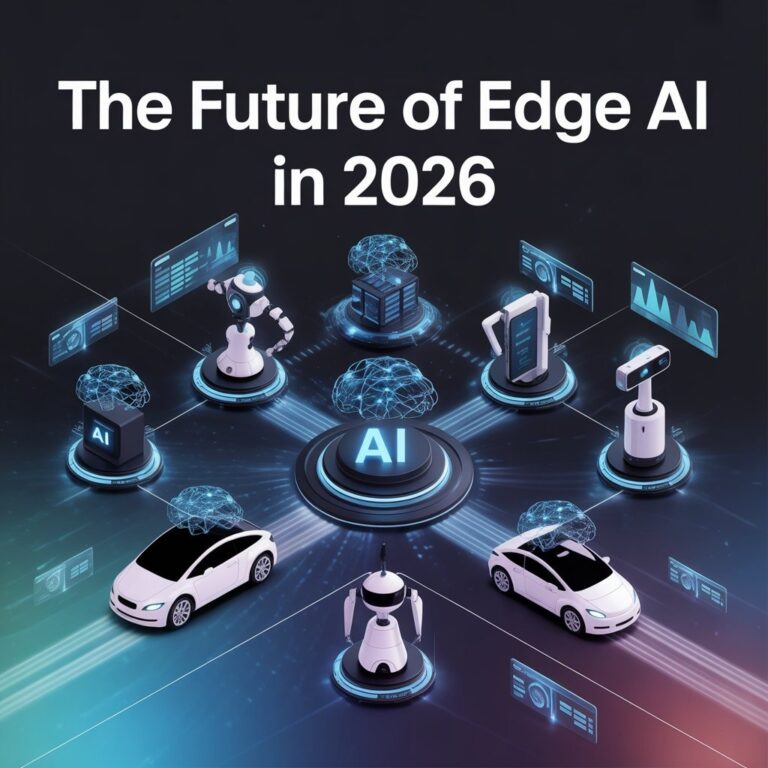
Edge Computing in IoT shifts processing from a distant cloud to a local device or nearby gateway. The practical benefits are real: faster response times, lower bandwidth costs, continued operation during network interruptions, and reduced exposure in IoT Cybersecurity terms because sensitive data does not have to travel unnecessarily.
A food processing facility in Georgia running quality control cameras on a high-speed production line cannot afford a 200-millisecond cloud round-trip to decide whether to reject a product. That decision needs to happen locally, in under 10 milliseconds. Edge AI for IoT makes that possible — running trained machine learning models directly on the camera hardware or a local inference device mounted at the production line.
AIoT (AI-powered IoT) is the most transformative development in connected devices right now. The word transformative gets overused in tech writing — I use it carefully here because it is accurate. The combination of machine learning models with continuous sensor streams changes what IoT infrastructure can actually do in a way that is genuinely new.
Instead of telling you a machine’s bearing temperature is 185 degrees, an AIoT system tells you that based on how that machine has been warming over six weeks, combined with subtle shifts in its vibration signature over 72 hours, you have an 87 percent probability of a bearing failure within the next two weeks. That is not monitoring. That is prediction. And prediction fundamentally changes the economics of Predictive Maintenance IoT — you stop replacing parts on a calendar schedule and start replacing them exactly when the data says they need replacing.
At AsappStudio, our Artificial Intelligence services are built directly into our iot development workflows — not as an add-on feature, but as a core architectural consideration from the first design session.
5G IoT Connectivity has crossed from emerging technology to operational reality in most U.S. metro markets. The combination of low latency, high device density support, and reliable throughput removes practical barriers to deploying connected infrastructure at a scale that 4G could not support economically.
The clearest impact is in Smart Cities IoT. A city block in San Jose or Phoenix can now run hundreds of connected sensors — traffic, environmental, utility, public safety — on 5G infrastructure without the network becoming a bottleneck. In industrial environments, 5G private networks are replacing legacy wired infrastructure in factories and ports, enabling autonomous mobile robotics and real-time process analytics that were not viable before.
Digital Twins deserve more serious attention than they typically receive in IoT conversations. The concept is straightforward: a live virtual replica of a physical asset, process, or entire system — continuously updated with real sensor data from its physical counterpart.
An oil refinery in Louisiana can run simulations of a proposed maintenance procedure on its Digital Twin before touching the actual equipment. A hospital in Minnesota can model the impact of adding a new patient wing on its existing building management infrastructure before breaking ground. A port operator in Baltimore can simulate container routing scenarios against a live model of current yard conditions before committing equipment and labor. These are not theoretical applications. They are active deployments running today.
Not every deployment needs 5G bandwidth or its costs. LoRaWAN / LPWAN for IoT protocols serve a completely different set of use cases: long range, very low power consumption, low data rate. For agricultural sensors that need to run two years on a battery while transmitting hourly soil readings from a field in Iowa, LoRaWAN is the right answer. For utility meters spread across a rural county in Montana with no cellular coverage, LPWAN makes connectivity practical where it otherwise would not be economically viable.
Understanding which connectivity technology fits which deployment environment is one of the practical skills that separates an experienced internet of things development company from one that applies the same technology stack to every problem regardless of fit.
Sustainable IoT / Green IoT has moved from a corporate responsibility talking point to a genuine financial driver. Companies under ESG reporting obligations need real, verifiable data — not estimates or extrapolations from last year’s utility bills. They need continuous measurements from connected building systems, manufacturing equipment, vehicle fleets, and data center infrastructure.
Connected energy management systems are helping facilities in states like Colorado and Oregon reduce consumption by 20 to 30 percent — not through blunt reduction mandates but through granular, real-time visibility into exactly where energy is being consumed and where it is being wasted. That visibility is what makes targeted action possible.
Here is the point that tends to get softened in polite IoT conversations: a connected device is an endpoint, and every endpoint is a potential entry point into your network. A hospital deploying 3,000 connected infusion pumps has added 3,000 potential attack surfaces to its infrastructure. A manufacturing facility deploying 500 connected sensors on the production floor has created 500 points of potential compromise.
Security built in from the very start — secure boot processes, end-to-end encryption, certificate-based device authentication, role-based access control, and regular Over-the-Air (OTA) Updates for IoT to patch vulnerabilities as they are discovered — is the only responsible way to deploy connected infrastructure at enterprise scale. It is also increasingly a hard procurement requirement. Large U.S. enterprise buyers are now asking detailed security questions of their iot development company partners before contracts are signed.
When businesses go looking for iot development services, they are often working from an incomplete picture of what the engagement actually covers. Here is what real internet of things development services look like when delivered properly:
Everything starts here. Internet of things consulting services are where an experienced team helps you understand your current infrastructure, clarify the problem you are actually trying to solve, select the right architecture, and build a realistic plan before a line of code is written or a piece of hardware is ordered.
Good internet of things consulting prevents expensive mistakes: bad hardware choices, platform lock-in that limits future scaling, security gaps found post-deployment, and integration failures with existing enterprise systems. These problems are more common in the industry than anyone likes to admit, and most are entirely preventable with proper upfront thinking.
At AsappStudio, every iot development engagement starts with a structured discovery phase that produces a clear architecture document, a security model, an integration map, and a realistic timeline — before any development work begins.
IoT Hardware Development covers the physical device layer — circuit board design, component selection, sensor integration, power management, enclosure design, and regulatory certification where applicable. Firmware Development for IoT is the embedded software running on the device itself — the code that reads sensor data, manages connectivity, handles power cycles to preserve battery life, and communicates with the platform layer above it.
These two disciplines must be engineered together. Firmware written without close coordination with the hardware team produces devices that underperform on battery life, overheat in real-world conditions, or fail to meet connectivity reliability requirements in the actual environments they are deployed in. The best iot development company teams treat hardware and firmware as a single engineering challenge from the start.
IoT software development covers everything above the device layer — the backend systems that receive data from devices, store it, process it, route it, and make it available to applications and integration partners. This includes device registry and management systems, data ingestion pipelines, storage architecture, real-time processing and alerting engines, and API layers for connecting to third-party systems.
IoT platform development packages this into coherent, managed infrastructure. A well-designed Scalable IoT Platform handles device onboarding cleanly, manages authentication and access control across potentially large device fleets, supports Over-the-Air (OTA) Updates for IoT for firmware and software patches, and provides the monitoring and alerting tools that operations teams actually depend on.
Cloud IoT Integration is a significant component — connecting your device fleet to AWS, Azure, or Google Cloud infrastructure and building the data pipelines that feed your business intelligence tools, ERP systems, and analytics platforms.
IoT app development builds the human interface — the dashboards, mobile applications, and web tools that let your team interact with and act on the data your connected infrastructure generates. A sensor network producing terabytes of data per month is worth nothing if the people making decisions cannot access that data in a clear, intuitive format.
IoT application development services from a team that understands both the data layer and the user experience layer produce applications that field technicians actually use daily, operations managers actually trust, and executives can read meaningfully in a brief walk-through.
Our mobile app development team works directly alongside our IoT engineers to ensure that the data pipeline and the application interface are built as a coherent system. Our UI/UX services applied to IoT dashboards follow the same standards we bring to consumer applications — because the bar for usability does not drop just because the user is a plant engineer rather than a retail consumer.
Most U.S. enterprises already operate significant software infrastructure: ERP platforms, CRM systems, legacy manufacturing execution systems, business intelligence tools the executive team lives in. IoT System Integration is the work of connecting new connected device infrastructure to the systems already running the business — without creating data silos, without duplicating records, and without requiring operations staff to manage two separate systems that do not talk to each other.
Done well, IoT System Integration means a predictive maintenance alert from a floor sensor automatically creates a work order in the ERP, assigns it to the correct technician, and logs the event in the asset management system — with no one copying or pasting anything between systems.
IoT product development is the full journey from a concept to a market-ready connected device. If you are building a connected product to sell — a smart industrial sensor, a healthcare wearable, an agricultural monitoring unit, a connected consumer appliance — you need a partner who can manage the entire development arc: product definition, hardware engineering, firmware, cloud backend, mobile application, regulatory compliance, and manufacturing readiness.
This is a longer and more complex engagement than deploying connected infrastructure for internal use, and it requires a partner with genuine end-to-end capability rather than a team strong in one layer that relies on subcontractors for the rest.
Healthcare IoT across hospital networks in New York, Minnesota, and Massachusetts is reducing readmission rates through remote patient monitoring. Patients with chronic conditions who previously required frequent in-person visits are now monitored continuously from home, with care teams alerted only when readings move outside safe parameters. Patients receive better care. Hospitals reduce cost. The economics work, which is why adoption is accelerating.
Predictive Maintenance IoT in manufacturing is the clearest ROI story in the industrial sector. A single avoided unplanned shutdown at a mid-sized production facility can save between $50,000 and $500,000 depending on the industry. IoT sensors and devices monitoring vibration, temperature, pressure, and acoustic signatures on critical equipment are catching failures weeks before they become production stoppages — at a fraction of the cost of the failure itself.
Smart Cities IoT in municipalities from Phoenix to Philadelphia is reducing operating costs across public infrastructure. Smart street lighting that adjusts based on actual occupancy reduces energy spend by 40 to 60 percent without affecting public safety. Connected water infrastructure detects leaks within hours rather than weeks. Adaptive traffic signals that respond to live flow data cut average commute times while reducing vehicle emissions.
Automotive IoT in Michigan, Ohio, and Indiana is driving manufacturing quality and vehicle connectivity simultaneously. On the plant floor, Real-time IoT Analytics are improving first-pass quality rates on production lines running thousands of parts per shift. In the vehicle itself, connected diagnostics and Over-the-Air (OTA) Updates for IoT give manufacturers the ability to improve vehicles after they are sold — a capability that changes the entire product lifecycle model.
A lot of companies approach iot solutions like they are buying a product from a catalog. They ask for a quote, get a number, and expect something finished to appear. Real End-to-End IoT Development does not work that way, and understanding the actual process sets honest expectations from the beginning.
Phase 1: Discovery and Internet of Things Consulting — Understanding your operation, existing systems, connectivity environment, and the specific problem driving the investment. This phase produces an architecture document that becomes the single source of truth for every subsequent decision.
Phase 2: Architecture Design and Technology Selection — Connectivity protocol, cloud platform, edge processing strategy, IoT Cybersecurity / IoT Security by Design model, and IoT platform development approach. These decisions carry long-term consequences and deserve careful engineering judgment.
Phase 3: IoT Hardware Development and Firmware Development for IoT — Prototype, test, and validate physical devices in conditions that replicate the actual deployment environment. This is where hardware-software co-design prevents the problems that show up in field deployments when shortcuts were taken in a lab.
Phase 4: IoT Software Development and Platform — Backend infrastructure, device management, data ingestion, processing, storage, alerting, API layer, Cloud IoT Integration architecture, and the Over-the-Air (OTA) Updates for IoT mechanism that keeps the deployment current over its operational life.
Phase 5: IoT Application Development — Our mobile app development team and web development engineers work alongside the platform team to build the interfaces as an integrated system, not separate deliverables that need to be stitched together after the fact.
Phase 6: IoT System Integration — Connecting the new infrastructure to existing business systems. When the foundation was designed to support clean integrations, this phase takes days. When it was not, it takes months.
Phase 7: Deployment, IoT Device Management, and Ongoing Support — Production rollout, IoT Device Management protocols, monitoring and alerting configuration, team training, and the ongoing support model that handles firmware updates, scaling, and device lifecycle management for years ahead.
Companies that run this process properly are the ones with IoT infrastructure that works reliably three years later and has grown with their business. The ones that compressed phases because the timeline felt long are usually doing expensive rework somewhere in phase four.
There is a version of the iot solutions conversation focused entirely on which platform, which protocol, which cloud. Those decisions matter. But they matter less than the team making them.
The right iot development company has shipped real connected infrastructure — not just demonstrated it. It has dealt with firmware defects that surface at 2 AM on a production deployment. It has debugged Cloud IoT Integration failures in environments where the network is intermittent and the consequences are real. It has managed Over-the-Air (OTA) Updates for IoT across large device fleets in the field and learned firsthand what happens when an update goes wrong.
Internet of things development services from a partner who has built real things in real-world conditions are categorically different from the same services from a team that is still learning on your engagement budget.
At AsappStudio, our iot development services span the full stack — hardware, firmware, platform, application, and integration. We do not hand off the hard parts. Our software development engineers, AI specialists, and IoT team work together on every engagement. The work visible in our case studies and project portfolio reflects real projects, real clients, and real outcomes.
If you are ready to talk specifics about what IoT Development Solutions 2026 look like for your operation, you can contact us directly or book a free consultation with an engineer — not a salesperson.
The warehouse manager in Memphis I mentioned at the start of this piece waited three years longer than he should have. During those three years he had equipment failures he could have predicted. Energy costs he could have cut. Inventory discrepancies that cost hours to resolve that a connected system would have caught instantly. The dollars are not abstract to him — he can name them, quarter by quarter.
Businesses that invested in IoT Development Solutions in 2022 and 2023 are now running second-generation deployments. Their Real-time IoT Analytics have months or years of operational data to learn from. Their Predictive Maintenance IoT models have been trained on real failure events from their own equipment and are genuinely predictive because of it. Their operations teams know the system, trust the data, and have built workflows around it.
That institutional knowledge does not exist on day one. It has to be earned through time and iteration. Every quarter of delay is a quarter that gap grows.
Whether you run a logistics operation in Ohio, a manufacturing facility in Michigan, a hospital network in New York, a smart building development in Florida, a tech operation in California, or a utility in Washington — the conversation around IoT Solutions 2026 is not about whether. It is about how and with whom.
Explore our IoT Development services, review our software development approach, or browse our complete services portfolio. When you are ready to move, we are here.
Q1. What are IoT Development Solutions 2026?
IoT Development Solutions 2026 are full-stack connected device services — hardware, firmware, software, and apps — built on 2026-standard tech: 5G, AIoT, and edge computing.
Q2. How many IoT devices are expected by 2026?
Global IoT device count is projected at 27–30 billion by end of 2026. The U.S. leads enterprise deployment across manufacturing, healthcare, logistics, and smart cities sectors.
Q3. Why is IoT the future of business technology?
IoT delivers real-time visibility, predictive maintenance, energy savings, and automation — giving U.S. businesses measurable cost reductions and competitive advantages across industries.
Q4. What should I look for in an IoT development company?
Prioritize full-stack expertise in hardware, firmware, cloud, and apps — plus real deployment experience, strong IoT security practices, and honest consulting before development begins.
Q5. What is the difference between IoT software development and IoT app development?
IoT software development covers backend systems and device data pipelines. IoT app development builds the user-facing mobile or web interfaces teams use to act on that data.