
Nobody talks about the boring part of artificial intelligence. Everyone wants to discuss the chatbot or the image generator — the flashy stuff that lands on the front page of TechCrunch. But the more interesting story, the one with real consequences for American businesses and everyday people, is happening somewhere far less glamorous.
It’s happening inside a vibration sensor bolted to a compressor on a factory floor in Gary, Indiana. Inside a patient monitor running through the night in a cardiac ward in Houston. Inside the camera above a checkout lane in a Walmart in suburban Atlanta. These devices are running AI locally, right there on the hardware, without ever pinging a cloud server for permission to think.
That’s Edge AI. And in 2026, it stopped being a niche topic for embedded systems engineers and became something every organization with a physical operation in the United States needs to understand.
This isn’t a hype piece. The deployments are real. The cost savings are documented. The data exists. Let’s actually get into what’s happening and why it matters.
Strip away the buzzwords and the concept is straightforward.
Traditional cloud AI works like this: your device captures some data — a voice command, a camera frame, a sensor reading — and sends it over the internet to a server farm somewhere in northern Virginia or eastern Oregon. That server processes the data using a big, powerful model, then sends the answer back. The whole loop might take half a second. Maybe less. Usually you don’t notice.
But in plenty of situations, half a second is catastrophically long. A vehicle traveling at highway speed. A machine about to fail. A patient whose vitals are shifting in a direction they shouldn’t be. In those contexts, cloud latency isn’t an inconvenience — it’s a disqualifier.
Edge AI runs the artificial intelligence model directly on the local device. The sensor, the camera, the phone, the vehicle’s onboard computer. No data sent out. No waiting on a network. The decision happens at the device, in milliseconds, regardless of whether there’s a cell signal or a Wi-Fi connection within fifty miles.
Local inference, engineers call it. The model is baked into the device. It processes whatever it sees, hears, or measures right there.
This is not a new idea. What’s new is that the hardware to do it cheaply, reliably, and at scale has finally arrived — and the ecosystem of tools, frameworks, and trained engineers around it has caught up enough to make real deployments practical.
People have been saying edge computing and AI is the next big thing for a while. The reason 2026 actually feels different comes down to a few things arriving at the same time rather than one dramatic breakthrough.
The chips are finally inside everything. Dedicated neural processing units — silicon specifically designed for AI math — are now standard components in consumer smartphones, laptops, and a growing share of industrial hardware. A couple of years ago, an NPU was a premium feature. Now it’s just part of the spec. That means there’s an enormous installed base of hardware that can genuinely run capable on-device AI without heroic engineering effort.
The models shrank, but not in a way that broke them. Compression techniques — quantization, pruning, knowledge distillation — have gotten much better. Small language models in the 1–7 billion parameter range now handle real tasks competently on normal consumer devices. The tradeoff between capability and size that used to be painful has become much more manageable.
Cloud bills got attention. When AI runs in the cloud, every inference call costs money. As AI gets embedded into more workflows and products, those costs compound fast. Finance teams started asking questions. Moving local inference to the device eliminates per-call cloud costs entirely. That’s a real budget argument, not a technical one, and budget arguments get things done inside organizations.
The Edge AI market growth trajectory reflects all of this. Estimates put the global market at roughly $14–15 billion as of 2025, with projections running past $100 billion by the early 2030s. Those projections aren’t built on wishful thinking — they’re built on hardware purchase orders, enterprise contracts, and deployment pipelines already in motion.
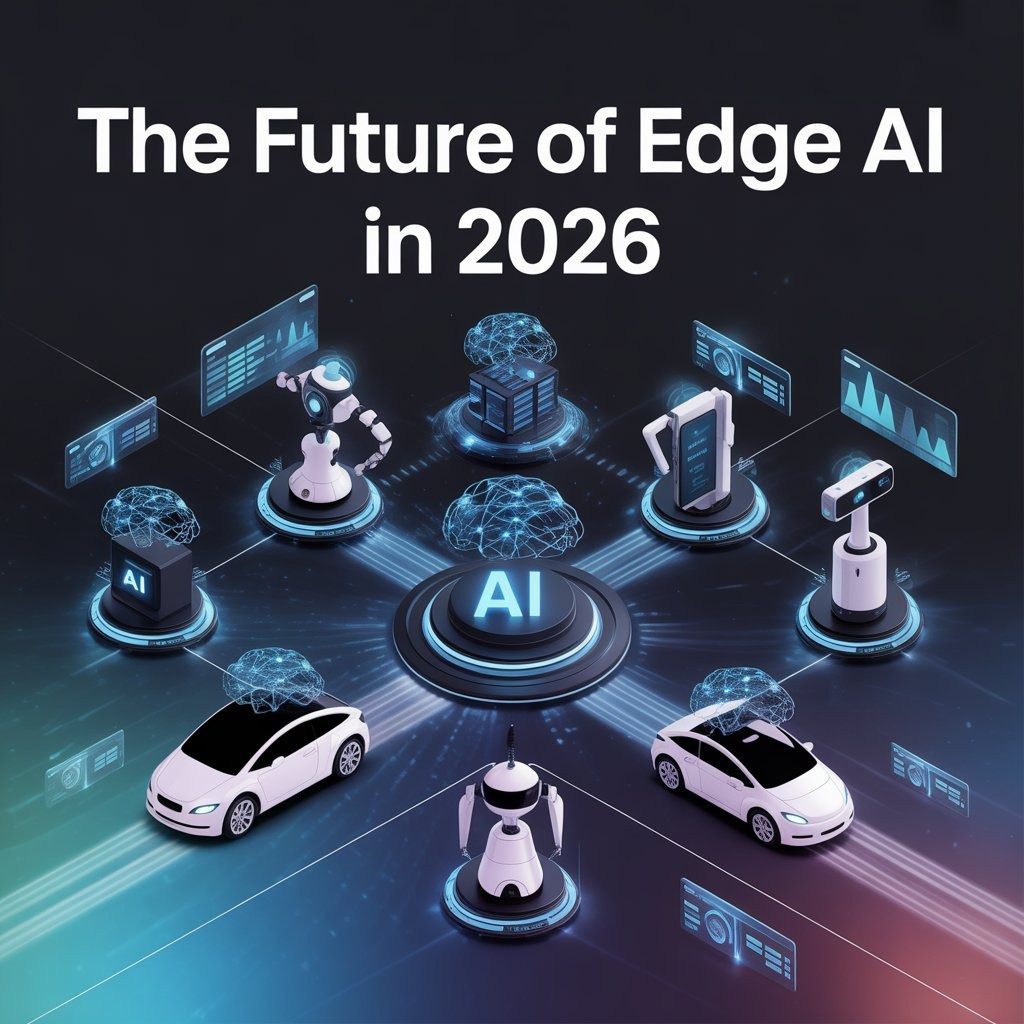
TinyML and Edge AI have become essentially inseparable as a topic. The ability to run a trained machine learning model on a microcontroller that draws a few milliwatts of power has moved from academic research to commercial deployment at a scale that would’ve seemed optimistic three years ago.
A predictive maintenance sensor attached to an industrial pump in a Dayton, Ohio chemical plant runs a TinyML vibration model continuously. No internet connection. Battery life measured in months. The model flags bearing wear patterns before they become failures, and it does it from a device that costs less than a decent pair of work boots.
That’s TinyML and Edge AI in practice. Unglamorous, reliable, and directly valuable. The global count of IoT devices running some flavor of TinyML is projected to reach a billion in 2026 — a milestone that reflects how thoroughly this technology has moved into commodity hardware.
The quiet hardware story of the past two years is how thoroughly neural processing units have spread into everyday devices. Apple’s Neural Engine. Qualcomm’s Hexagon NPU. MediaTek’s APU. Intel’s NPU in Core Ultra chips. These are not add-on features anymore — they’re built into the baseline silicon.
What changes when AI chips for edge devices are standard equipment? The cost equation for on-device AI shifts dramatically. Developers no longer need to choose between a capable model and an affordable device. The compute is there. The job becomes writing software intelligent enough to use it properly.
U.S.-based chip design companies — and there are more of them now, partly because of CHIPS Act incentives — are building increasingly specialized AI accelerators for industrial, automotive, and medical edge applications where general-purpose consumer chips don’t quite fit the requirements.
The arrival of capable small language models is one of the more significant practical developments in 2026 that hasn’t gotten enough mainstream coverage.
Large language models — the ones that power ChatGPT and similar tools — are cloud-bound by necessity. Their parameter counts require server-grade hardware. But a well-optimized model in the 3–7 billion parameter range can run on a modern laptop or high-end phone without breaking the hardware or the battery. For many real business tasks — document summarization, classification, extraction, basic generation — these smaller models are good enough.
That matters enormously for offline AI processing use cases. A legal firm that doesn’t want client documents leaving its network. A hospital that processes clinical notes locally for HIPAA reasons. A school district in a rural part of Texas with unreliable broadband. Small language models on local hardware solve all of these without requiring a cloud subscription or a legal review of a data processing agreement.
Of all the Edge AI applications in commercial deployment today, computer vision at the edge is probably the most mature. Getting capable vision models small enough to run on embedded processors inside smart cameras was the central challenge of the last few years. That challenge is largely behind us.
The edge analytics generated by these deployments — inventory levels, occupancy counts, defect detection results, anomaly alerts — are replacing workflows that previously required either human observation or expensive cloud video analysis pipelines. The cameras process footage locally, generate structured data outputs, and transmit only those outputs — not the raw video — to enterprise systems. Bandwidth efficiency improves dramatically. Privacy risk drops to near zero.
The Edge AI vs cloud AI framing used to produce a lot of passionate either/or takes. That conversation has settled down in practice because real deployments proved what actually mattered.
Here’s a table worth keeping:
| Factor | Edge AI | Cloud AI |
| Speed | Milliseconds — genuine real-time AI processing | Variable — network-dependent, often seconds |
| Privacy | Data never leaves the device — strong by default | Data crosses network boundaries — risk by design |
| Offline? | Yes — offline AI processing is the whole point | No — requires consistent connectivity |
| Bandwidth | Near zero — bandwidth efficiency is a structural advantage | High — especially at scale |
| Model Power | Constrained by device hardware, improving steadily | Essentially unlimited |
| Updating | Requires OTA infrastructure — genuinely complicated | Server-side change — immediately live everywhere |
| Cost at Scale | Near zero marginal inference cost | Per-call cloud costs accumulate fast |
| Security | Smaller attack surface — less to protect in transit | Centralized target — managed but broad exposure |
The organizations running AI effectively in 2026 are not choosing one or the other. They’re running hybrid architectures. Latency-sensitive tasks, privacy-sensitive tasks, real-time operational decisions — those go to the edge. Model training, large-scale analytics, non-urgent batch processing — those stay in the cloud. Reducing cloud dependency doesn’t mean abandoning cloud infrastructure. It means being intentional about what actually needs to live there.
Walk through a cardiac unit in Boston, a post-surgical recovery floor in Baltimore, or a long-term care facility in Phoenix, and you’ll find healthcare AI devices doing continuous monitoring work at the bedside that simply wasn’t feasible five years ago.
Wearable and bedside monitors running embedded AI watch physiological signals — heart rate variability, respiratory patterns, SpO2 trends — and generate alerts in seconds. The model is on the monitor. The computation is local. Nothing goes to an outside server.
The reason this matters isn’t just speed — it’s regulation. Patient health data under HIPAA can’t freely leave a device and travel to a third-party cloud API. Edge AI solves this architecturally. If the raw physiological data never leaves the device, there’s no data-in-transit exposure to manage. The hospital gets real-time intelligence. The patient’s data stays inside the device.
Wearable AI cardiac monitors that patients take home. Continuous glucose monitors with local anomaly detection. Fall detection systems in assisted living facilities across Florida and Arizona. These are commercial products in active use today, not prototypes.
Our Artificial Intelligence development services at AsappStudio are built around exactly these constraints — helping healthcare and enterprise clients design AI-enabled devices where performance requirements and compliance requirements have to coexist.
The American manufacturing belt — Ohio, Indiana, Michigan, Pennsylvania, Tennessee — is in the middle of a quiet operational transformation driven by Edge AI.
Predictive maintenance systems built on edge-deployed machine learning analyze sensor data processing outputs from motors, compressors, bearings, and CNC machines continuously. Vibration profiles. Acoustic signatures. Thermal drift. The model running on the embedded controller next to the equipment doesn’t need a cloud connection to recognize a bearing that’s three weeks from failure. It flags the issue. A maintenance ticket gets generated. The machine gets serviced before the breakdown, not after.
In smart manufacturing environments, industrial automation driven by computer vision at the edge handles inline quality inspection — catching surface defects, dimensional errors, and assembly mistakes faster than any human inspector without any production footage leaving the facility.
The efficiency gains are real and documented. The ROI timelines are short enough that mid-sized manufacturers in states like South Carolina, Alabama, and Kentucky are deploying this technology, not just automotive giants in Detroit.
Our IoT Development services connect these intelligent edge devices into manageable, scalable systems so that the business value of Edge AI for IoT shows up in operations dashboards, not just engineering reports.
There is no version of autonomous vehicle technology that works through a remote server. A vehicle traveling at 70 miles per hour on I-10 in Arizona makes thousands of real-time decision-making computations per second. Object recognition. Lane interpretation. Pedestrian prediction. Hazard response. All of it runs on hardware inside the vehicle, with latencies measured in microseconds rather than milliseconds.
Autonomous vehicles represent the sharpest possible argument for low latency AI. The AI chips for edge devices inside these systems — from NVIDIA, Mobileye, Qualcomm, and others — are purpose-built for maximum inference throughput within strict power and thermal envelopes.
The AV development corridors of California, Michigan, Texas, and Arizona are the most visible parts of this story, but the downstream effects reach everywhere. Logistics fleets. Agricultural vehicles. Mining equipment in Nevada and Wyoming. Edge computing hardware built for autonomous driving is being adapted for every application where a machine needs to interpret its physical environment and respond without help from a remote server.
U.S. retailers — large chains and independent stores alike — are deploying smart cameras with computer vision at the edge for loss prevention, inventory management, and customer flow analysis in ways that would have required a very large budget just a few years ago.
The technical details matter here. These cameras process video locally. The raw footage never leaves the store. What gets transmitted to the retailer’s systems is structured data — an alert, a count, a detection event. That’s a fraction of the bandwidth that streaming raw video would consume, and it eliminates the significant privacy and legal exposure of sending customer footage to an external vendor’s servers.
Edge analytics from these deployments give independent retailers in Georgia, North Carolina, and Colorado access to insights that used to be exclusive to companies with dedicated data science teams and cloud video infrastructure budgets.
The current generation of smartwatches, fitness trackers, and wireless earbuds from Apple, Google, Samsung, and a growing field of health-focused startups runs genuine on-device AI for health monitoring, anomaly detection, and personalization. The cloud connection is optional for most of the real functionality now.
More interesting for enterprise purposes: wearable AI for occupational use cases. Smart glasses for field technicians that surface repair documentation and parts identification. Wearable sensors that monitor construction workers for heat stress and fatigue indicators in real time on job sites in Texas and Florida. These are industrial tools, not consumer gadgets, and they’re starting to appear in meaningful numbers.
The future of AI in education is a topic that generates a lot of noise and not enough honest specificity. Most of the coverage focuses on cheating concerns and philosophical debates about what students should learn. Very little of it focuses on the infrastructure problem that actually determines whether AI tools work in schools at all.
Here’s the infrastructure problem: a significant portion of American schools, particularly in rural districts across Appalachia, the Mississippi Delta, the Great Plains, and rural Texas, do not have broadband connectivity reliable enough to support cloud-dependent AI tools throughout the school day. A tutoring application that requires a stable internet connection is functionally unavailable to students in those classrooms.
On-device AI running locally on a student tablet or laptop doesn’t have this problem. An adaptive reading tool that adjusts difficulty based on response patterns. A math tutor that identifies procedural errors and modifies explanations without phoning home. A language learning app that runs speech recognition locally without sending a student’s voice to a server in another state. These work in a school with mediocre internet because they don’t need internet to function.
The future of education with AI that actually works for all American students — not just those in well-funded urban districts with fiber internet — runs on edge-deployed models. That’s not an ideological position. It’s a connectivity map.
There’s also the regulatory dimension. Student data, especially for minors, is among the most protected categories in the United States under FERPA and COPPA. School districts and parents are justifiably cautious about AI tools that transmit student behavior data and assessment responses to third-party platforms. Edge AI tools that process student interactions locally and generate no transmittable personal data eliminate most of that compliance concern at the architecture level.
AsappStudio’s Custom School Management System development work reflects these realities — tools that give districts real AI capability without the data exposure that makes administrators and parents understandably nervous.
The robotics and edge computing relationship has always been obvious to anyone who actually thinks about how robots work in physical environments. A robot arm on a manufacturing line that has to query a remote server before deciding how to grip a part is not a useful robot. A drone scouting a 600-acre field in Kansas that stops working when LTE drops is not useful either.
Collaborative robotics — cobots — on U.S. manufacturing floors in South Carolina, Alabama, and along the Gulf Coast are running computer vision at the edge and local inference to work safely alongside human employees. These systems interpret their immediate environment in real time, adjusting movements continuously. The edge architecture here also addresses industrial espionage concerns that arise when production footage streams to external servers.
Agricultural robotics is a category worth taking seriously. In California’s Central Valley, Iowa’s corn belt, and the grain fields of Kansas and Nebraska, autonomous agricultural vehicles and crop-monitoring drones are running Edge AI to identify disease, detect pests, measure soil moisture, and optimize irrigation without connectivity requirements. These operations often span areas with effectively zero cellular coverage. The AI has to run on the vehicle. That’s just the operational reality.
This category of Edge AI for IoT — remote, connectivity-independent deployments with real physical consequences — is one of the fastest-growing application areas, even if it doesn’t get the tech media coverage that consumer AI products do.
None of this runs on goodwill. It runs on silicon, and the silicon story in 2026 is worth understanding.
AI accelerators come in a few distinct flavors that suit different use cases:
Neural processing units (NPUs) handle the matrix math that underlies most machine learning inference. They’re now embedded in consumer and commercial chips from Apple, Qualcomm, MediaTek, Intel, and Samsung. For many Edge AI applications, an NPU on a standard consumer chip provides more than enough inference capacity.
FPGAs (Field-Programmable Gate Arrays) remain the choice for industrial and defense applications where engineers need to optimize hardware specifically for a defined workload. The reconfigurability is the point — you can tune the silicon to a particular machine learning model architecture.
ASICs (Application-Specific Integrated Circuits) offer maximum energy-efficient AI performance within a specific domain. Custom AI inference chips from Google, a range of funded U.S. startups, and established semiconductor companies are being designed for specific edge deployment contexts — automotive, medical, industrial — where general-purpose chips don’t quite fit.
The CHIPS Act investments in domestic semiconductor manufacturing are relevant here beyond economics. Edge AI deployments in defense, healthcare, and critical infrastructure increasingly require verifiable domestic supply chains for security reasons. American chip manufacturing capacity is growing partly in response to that requirement.
The bottom line on hardware: energy-efficient AI on constrained edge devices is not a research aspiration in 2026. It’s a product specification that the chip industry is actively meeting.
I’d argue data privacy is the single most important driver of enterprise Edge AI adoption in 2026, and it gets less credit than it deserves.
The U.S. privacy regulatory environment is complicated and getting more active. California’s CCPA and CPRA set the most comprehensive state-level framework, but Virginia, Colorado, Connecticut, Texas, Montana, Indiana, Iowa, and Tennessee have all passed their own consumer privacy statutes in the past few years. Federal legislation remains stalled, but state-level enforcement is real, and the penalties are not symbolic.
For businesses operating across multiple states — which is most enterprises of meaningful size — the safest architecture is one that minimizes data leaving the device in the first place. Edge AI provides that structurally. You can’t have a breach of data in transit if no data is in transit.
This is not just a compliance argument. Consumer trust is a real competitive variable. A healthcare company, financial services firm, or education platform that can credibly tell users their data is processed locally and never transmitted externally has a genuine differentiator. On-device AI makes that claim structurally true in a way that cloud AI architectures simply cannot match.
Edge security benefits from the same logic. A system where raw data stays on the device and only structured, anonymized outputs travel the network has a dramatically smaller attack surface than a system streaming sensitive data to a cloud platform. There’s less to intercept. The cloud infrastructure becomes a much less interesting target when it only receives aggregate results.
AsappStudio’s Software Development Services build security-by-design into edge and IoT systems from the first architectural decision — because retrofitting security into an edge deployment is significantly more expensive and more dangerous than getting it right initially.
Edge AI technology in 2026 is mature enough to bet real operations on. It is not without problems. Here’s where the friction is actually located.
Model compression is specialized work. Getting a model from cloud-performance to edge-performance without losing too much capability requires expertise in quantization, pruning, and distillation techniques. This is not something a standard ML team can do well without specific experience. That expertise is in short supply and commands premium compensation. Many organizations underestimate this going in.
Hardware diversity creates real engineering headaches. The range of edge computing hardware — different chip architectures, different instruction sets, different memory models, different operating systems — means that optimizing a model for one deployment environment doesn’t transfer cleanly to another. Universal runtimes and abstraction layers exist and are improving, but hardware fragmentation adds meaningful engineering cost to any serious edge deployment.
Managing models at scale in the field is hard. When your AI lives on a cloud server, updates are trivial — change the server, every user gets the new version immediately. When your AI lives on ten thousand devices distributed across factories, hospitals, and retail stores in thirty states, you need robust OTA update infrastructure, staged rollout capabilities, rollback mechanisms, and ongoing monitoring. Most organizations dramatically underestimate this operational burden before they deploy.
Power budgets are real constraints. Running AI locally draws power. For mains-powered industrial equipment this is manageable. For battery-powered wearables, agricultural sensors, and remote monitoring nodes, the energy-efficient AI challenge is genuine. Getting meaningful AI capability within a tight power budget requires hardware and software working in close coordination — and it often requires revisiting hardware choices that seemed reasonable early in the design process.
None of these are reasons to avoid Edge AI. They’re reasons to approach it with realistic expectations, plan for the operational complexity, and invest in the engineering depth needed to do it properly rather than in a rush.
The gap between organizations actively building Edge AI capability and those waiting to see how it develops is widening. The cost of being on the wrong side of that gap grows every quarter as competitors build operational advantages that are genuinely hard to catch up to.
A practical starting framework:
Find your latency and privacy pain points first. Not every workflow benefits from edge deployment. The ones that do tend to share characteristics: they need fast responses, or they handle data you’d rather not transmit externally, or they need to work without reliable connectivity. Identify those workflows. They’re where edge deployment delivers the clearest return.
Audit your existing hardware honestly. Many IoT devices deployed five or more years ago don’t have the compute capacity for modern edge models. Know what you actually have before planning what you want to build. A hardware refresh may be a prerequisite, not an afterthought.
Take the operational side as seriously as the technical side. How will you push model updates to devices in production? How will you monitor inference quality across a distributed fleet? How will you handle devices that go offline for extended periods? These questions need answers before you deploy, not after.
Pilot one use case and measure it against a real baseline. Use actual results — not vendor case studies — to build the internal case for scaling. One successful, well-documented pilot is worth more than ten theoretical arguments.
Whether you’re building your first Edge AI for IoT product or modernizing an existing system, AsappStudio’s Mobile App Development team has hands-on experience across the edge deployment stack — from hardware selection and model optimization to production monitoring and OTA update infrastructure.
Our Blockchain Development capabilities also help organizations build the auditability and trust layers that edge deployments increasingly require for compliance and operational transparency.
The Future of Edge AI in 2026 is not a speculative topic. It is a description of what is already deployed, already generating returns, and already creating competitive separation between organizations that moved early and those that haven’t moved yet.
The compressor sensors in Indiana. The patient monitors in Houston. The vision systems on factory floors in South Carolina. The autonomous vehicles in Arizona. The crop-monitoring drones in Iowa. These are not pilot programs or press releases. They are operational infrastructure running Edge AI technology at production scale.
Real-time decision-making at the device level. Offline AI processing that doesn’t fail when connectivity does. Data privacy built into the architecture rather than added as an afterthought. Distributed intelligence that puts capability exactly where and when decisions actually need to be made.
These are structural advantages that compound over time. Organizations building toward them now are not chasing a trend — they’re building the operational foundation that will define their competitive position for the next decade.
Reach out to the AsappStudio team when you’re ready to talk about what Edge AI technology actually looks like in your industry and your operational context. We’ve built this. We can help you build it right.
Q1. What is The Future of Edge AI in 2026 expected to look like?
On-device AI, dedicated NPU chips, and small language models are enabling real-time edge deployments across U.S. healthcare, manufacturing, retail, and education with reduced cloud dependency.
Q2. How does Edge AI protect data privacy better than cloud AI?
Edge AI processes everything locally on the device. No raw data crosses a network, eliminating data-in-transit risk and reducing regulatory exposure under CCPA, HIPAA, and state privacy laws.
Q3. Which U.S. industries are deploying Edge AI applications most actively right now?
Healthcare AI devices, smart manufacturing, autonomous vehicles, retail smart cameras, agricultural robotics, and wearable AI across U.S. states lead active commercial Edge AI deployments in 2026.
Q4. What roles do TinyML and small language models play in Edge AI trends 2026?
TinyML runs capable models on microcontrollers using near-zero power. Small language models enable offline AI processing on standard devices — both eliminate cloud dependency for real workloads.
Q5. How should a business start adopting Edge AI technology in 2026?
Identify latency-sensitive or privacy-critical workflows, audit existing IoT hardware, plan OTA update infrastructure early, then pilot one high-value use case before scaling across operations.