
Three years ago, half the people talking about web3 apps were selling you something. Monkey JPEGs. Token presales. “Utility” that never shipped. You remember how that went.
Here’s what nobody says loudly enough: most of that stuff deserved to die. It was speculation dressed up as innovation. The crash wasn’t a bug — it was a filter. And what it filtered out was the noise.
What’s left standing in 2026 is different. It’s quieter, less flashy, more useful.
A hospital network in Massachusetts is letting patients carry their own medical records on-chain. A real estate platform in Miami is letting regular people buy fractional ownership in rental properties for $50. A New York fintech is settling bond trades in minutes instead of two business days using smart contracts. A Nashville venue is selling concert tickets as NFTs so scalpers can’t run the market anymore.
None of these companies are leading with “we’re a Web3 company.” They’re leading with the problem they solve. The blockchain is just the tool they used to solve it.
That’s what web3 apps in 2026 actually looks like. Not a revolution with a press release. A quiet infrastructure upgrade happening across industries while most people aren’t watching.
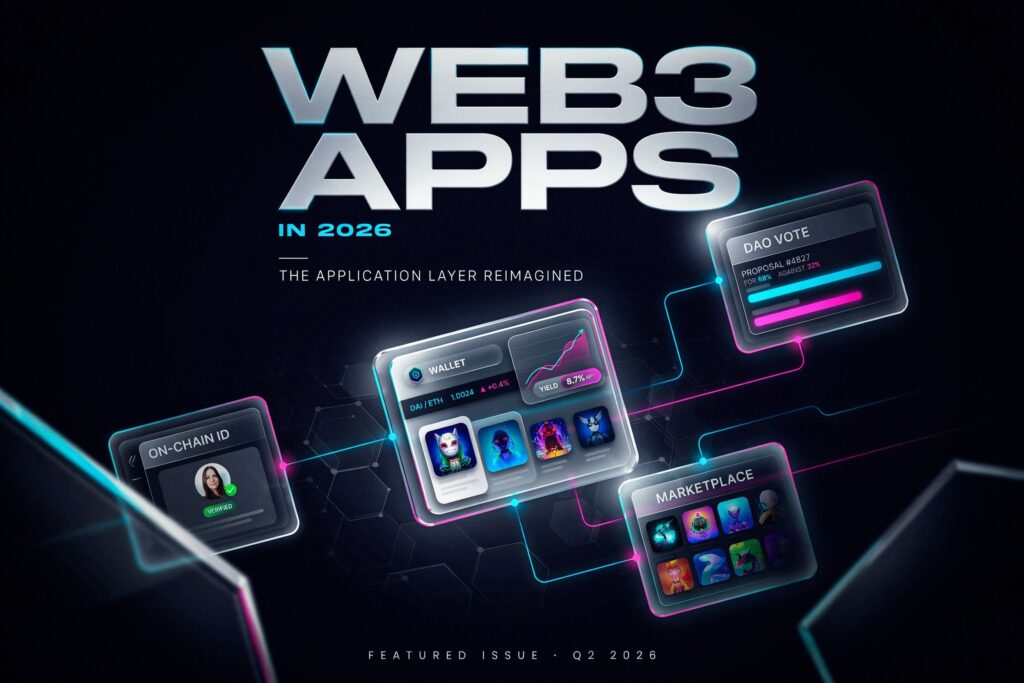
Strip everything away and here’s what a web3 app is:
It’s an app where the rules live in code on a blockchain instead of on a company’s server. The code runs automatically. Nobody — not the developer, not an admin, not a government agency — can change the outcome after it’s been set.
That’s it. That’s the whole idea.
When you use Venmo, Venmo’s servers decide whether your transaction goes through. They can freeze your account. They can reverse a payment. They can block you for any reason they want.
When you use a web3 application, the transaction goes through the moment the smart contract conditions are met. There’s no Venmo. There’s no customer service line. There’s no company in the middle taking a cut and holding the keys.
Does that mean every app should work this way? No. Your food delivery app doesn’t need to be decentralized. But your healthcare records? Your property title? Your professional credentials? Your financial identity? Yeah — those are exactly the things that shouldn’t live on some company’s server where they can be hacked, sold, or deleted.
Web3 apps in 2026 span a wide range — web3 wallet apps, decentralized social media platforms, web3 gaming titles, DeFi protocols, web3 earning apps, and industry-specific tools across web3 healthcare, web3 real estate, web3 insurance, web3 elearning, and more. The technology is the same. The problems being solved are wildly different.
Forget the diagrams with nodes and circles. Here’s web2 vs web3 in real terms.
Web2: You give a company your data. They give you a service. Behind the scenes, they store everything, own everything, and profit from everything. Instagram’s business model is your attention and your data. Twitter’s was the same. You are not the customer. You’re the product.
Web3: You keep your data. You keep your assets. You interact with services through your own wallet — a piece of software where only you hold the keys. No company can lock you out, delete your account, or sell your information to advertisers, because your information was never theirs.
| Question | Web2 | Web3 |
| Who owns my data? | The platform | You |
| Who can delete my account? | The company, anytime | Nobody — unless the protocol rules say so |
| Who takes transaction fees? | The platform | Smart contract (often far lower) |
| What happens if the company goes under? | You lose everything | The protocol keeps running |
| Can I take my followers to another app? | No | Yes — if it’s built on an open protocol |
| Do I need to trust the company? | Yes, completely | No — the code is public and auditable |
The switch from web2 to web3 isn’t about replacing every app overnight. That’s not how it works and that’s not the goal. The goal is: for the things that actually matter — your money, your identity, your creative work, your property — you have options that don’t require trusting a corporation.
That’s web3 explained in the most practical terms.
A question worth answering before you build anything: how does a web3 application actually hold together?
There are five layers that matter.
The blockchain network. This is where your app’s state lives — balances, ownership records, transaction history. Ethereum is the gold standard for security and ecosystem size. But in 2026, Solana, Base, Polygon, and Avalanche all have serious ecosystems. Which chain you pick determines your fees, your speed, your user base, and your tooling options.
Smart contracts. The logic layer. These are programs deployed on the blockchain that execute when conditions are met. A DeFi protocol’s lending rules. An NFT’s transfer conditions. A web3 insurance app’s payout trigger. Smart contracts don’t have downtime, don’t have office hours, and don’t take bribes. They just run.
The wallet layer. Every user who interacts with your web3 app does it through a wallet. MetaMask, Coinbase Wallet, Rainbow, Phantom, Trust Wallet. The wallet signs transactions, proves identity, and holds assets. In 2026, embedded wallets (Privy, Dynamic) let you give users a wallet behind the scenes using a Google or Apple login — killing the biggest UX barrier this space has ever had.
Decentralized storage. Your app’s data — NFT metadata, user content, documents — lives on IPFS, Arweave, or Filecoin. Not AWS. Not Azure. Nobody can pull the plug on it, and it doesn’t go offline when a company decides to shut down.
The frontend. This is the part that looks like a regular app. React, Next.js, React Native, Flutter. The user doesn’t know or care that there’s a blockchain behind it. They click buttons and things happen. Connecting the frontend to the chain runs through libraries like viem, ethers.js, or wagmi.
This is web3 application architecture — five layers working together to create something a central server can’t fake.
Not the ones on investor pitch decks. The ones with real users.
Uniswap has been processing billions in trading volume for years without an employee approving a single trade. That’s a web3 application doing something traditional finance can’t replicate.
Aave lets you borrow against your crypto assets at algorithmically-set interest rates. No loan officer. No credit check. If you have collateral, the contract lends to you. Period.
Farcaster is the web3 social app worth watching. Built on an open protocol, it means your account is tied to your wallet — not a company’s database. Your social graph is portable. If Farcaster’s team shuts down tomorrow, clients built on the protocol keep working. That’s what blockchain social media done properly looks like.
ENS (Ethereum Name Service) — your .eth name is your decentralized identity on-chain. Over two million registered. People use it as their wallet address, their on-chain profile, their calling card.
Lens Protocol is the web3 social media infrastructure that other apps build on. Think of it as what happens when the social graph itself is a public good instead of a private asset.
Render Network pays GPU owners in tokens for contributing compute to AI rendering jobs. Helium rewards hotspot operators for providing wireless coverage. These web3 earning apps aren’t speculative — they’re paying people for real services rendered.
On the web3 gaming side, titles on Immutable X have finally figured out how to make games that are actually fun first and blockchain-enabled second. The order of priority matters.
These are the best web3 apps in 2026 — not because a listicle ranked them, but because they’ve retained users through multiple market cycles.
Where are real web3 app ideas getting traction right now in the United States?
Scattered medical records are a genuine crisis. A patient who sees three different specialists across two states has records split across three systems that can’t talk to each other. Web3 healthcare app development is addressing this with self-sovereign health wallets — you hold your records, you share access, you control who sees what.
Hospitals in Massachusetts, California, and New York are piloting on-chain credential verification for physicians. Verify a license in seconds instead of calling a state board.
Web3 real estate app development is making property investment accessible. Fractional ownership via tokenized real estate lets someone in Wyoming buy a slice of a Miami apartment building with $100. The smart contract handles distributions, the title lives on-chain, and the escrow happens automatically.
In states like Florida, Texas, and California — where real estate is the dominant investment vehicle for regular households — this matters enormously.
Web3 elearning app development is fighting diploma fraud. A bootcamp certificate issued on-chain from Austin can be verified by an employer in Chicago in ten seconds. No registrar call. No fake PDF. Blockchain-issued credentials are public, permanent, and unfakeable.
Web3 event app development with NFT-based ticketing eliminates scalping at the contract level. The artist sets maximum resale prices or royalties in the smart contract. No third-party ticketing platform needed. Venues in Nashville, Los Angeles, and New York are already doing this.
Web3 insurance app development — parametric specifically — is the most underrated vertical in this space. Iowa farmer? Your drought insurance can pay automatically the moment a weather oracle records the rainfall threshold you agreed to. No claim form. No adjuster. No 90-day waiting period.
Web3 social media app development is the hottest category for startup activity in San Francisco and New York right now. The pitch: own your content, take your audience with you if you leave, and get paid directly by the community instead of through ad revenue that a platform keeps.
Decentralized social networks are still early but growing. The trend line is pointed up.
Web3 companies aren’t a California story anymore.
California — Dense talent, Coinbase’s Base network, the largest cluster of web3 app developer professionals in the country. San Francisco leads DeFi and consumer web3. LA is NFT and creator economy.
New York — Wall Street’s web3 pivot is real. Tokenized bonds, on-chain money markets, enterprise blockchain applications for financial services. The institutional money is here.
Texas — Austin especially. Business-friendly, fast-growing tech scene, major energy and supply chain companies exploring blockchain. Web3 app development company startups are multiplying here quickly.
Florida (Miami) — City leadership embraced crypto early and it stuck. Strong Latin American user base for crypto products. Web3 real estate app development and DeFi platforms are clustered here.
Illinois — Chicago is the FinTech capital of the Midwest. Derivatives platforms and institutional trading infrastructure being rebuilt on-chain.
Wyoming and Colorado — The most progressive state-level crypto legislation in the country. DAO legal status, crypto banking charters, digital asset frameworks. If you’re building a web3 community platform or DAO governance app, these states give you legal footing.
Washington — Seattle’s enterprise developer culture plus Microsoft adjacency is producing interesting work in web3 application identity and enterprise cloud integration.
A straight answer to a common question: can I build a web3 app that works properly on iOS and Android?
Yes. With caveats.
Apple is still protective of its App Store revenue. In-app NFT purchases require Apple’s 30% cut — otherwise they block the feature. But wallet connections work fine via WalletConnect. MetaMask Mobile, Rainbow, and Coinbase Wallet are on the App Store with full self-custody functionality.
For web3 ios app development, build around Apple’s restrictions from day one. React Native with wagmi and viem is the standard stack. WalletConnect v2 handles deep link callbacks for wallet auth. Embedded wallets via Privy or Dynamic sidestep a lot of the Apple-specific friction because the wallet is invisible to the user.
More permissive. Google Play allows crypto wallets, blockchain gaming with NFT items, and token transactions with fewer restrictions. Sideloading is possible for apps that don’t pass Google’s review. Web3 android app development is less of a regulatory obstacle course.
Kotlin SDKs, WalletConnect’s Android SDK, and hardware security module support for key storage are all mature in 2026. If you’re building a high-frequency trading or gaming app where Android users are your primary base, the platform gets out of your way.
Most serious web3 mobile app development teams use React Native or Flutter for the client layer. You write the core logic once, connect to chain via a shared service layer, and ship to both platforms. Asapp Studio’s cross-platform team handles exactly this — mobile-native development alongside blockchain development in the same team.
Your web3 wallet app is not a bank account. It doesn’t “hold” your tokens the way a leather wallet holds cash. Your tokens live on the blockchain. The wallet holds the private key — a cryptographic proof of ownership. Whoever has that key owns those assets.
This is why “not your keys, not your coins” is taken so seriously in this space. An exchange wallet means the exchange holds your keys. A self-custody web3 wallet app means you hold your own keys. The difference is the same as keeping cash in your own safe vs. trusting a stranger to hold it for you.
MetaMask — the default. 30+ million users. Works on every EVM chain. Browser extension and mobile. If you’re building a web3 app targeting Ethereum, Base, Arbitrum, or Polygon users, assume many already have MetaMask.
Coinbase Wallet — not the Coinbase exchange app. Self-custody. Popular with US users who came through the Coinbase onboarding funnel. Recovery options make it less intimidating for non-technical users.
Rainbow — best UI in the space. Ethereum and Base focused. The wallet that doesn’t look like developer tooling. Good sign-in experience for consumer-facing web3 app design projects.
Phantom — dominant on Solana, now multi-chain. If you’re building on Solana, this is your primary target.
Trust Wallet — widest chain support of any wallet. Users who are spread across multiple ecosystems tend to land here.
Web3 wallet app download numbers jumped sharply in early 2026. The reasons: Base’s consumer-facing apps brought new users on-chain, embedded wallets removed the setup friction, and a broader market uptick reminded people these tools existed.
A web3 super app — combining wallet, identity, social, DeFi access, and real-world utility in one interface — is actively being built by multiple teams right now. Farcaster clients, Coinbase’s consumer products, and several well-funded startups are all racing toward this model.
If you’ve Googled “how to build a web3 app” and landed on a tutorial written in 2020 pointing to deprecated libraries — welcome to the updated version.
Step 1: Does this need a blockchain?
Ask it plainly. Decentralization only earns its complexity when you actually need it. If your use case benefits from user ownership, trustless logic, censorship resistance, or token-based incentives — yes, build on Web3. If you just want a database with an audit trail, use Postgres and save yourself the headache.
Step 2: Pick your chain.
This shapes everything downstream — tooling, ecosystem, fees, your users’ existing wallets.
Step 3: Write your smart contracts.
Solidity for EVM chains. Rust for Solana. Your contracts are the app’s business logic — what users can do, how value moves, what the system allows or refuses. Get them wrong and you cannot patch them after deployment. That’s not a figure of speech.
Audit before mainnet. Non-negotiable if user funds are involved. Firms like OpenZeppelin, Trail of Bits, and Halborn are the names in this space.
Step 4: Build the frontend.
React or Next.js for web. React Native or Flutter for mobile. Connect to chain via:
For scaffold: Scaffold-ETH, Thirdweb, and Alchemy’s create-web3-dapp are the fastest way to launch a scalable web3 app from a blank slate.
Step 5: Wallet connection.
Use WalletConnect or RainbowKit. Both handle the UX of connecting MetaMask, Coinbase Wallet, Rainbow, and others cleanly. For mobile or non-crypto-native users, embedded wallets via Privy or Dynamic let you do social login with a wallet provisioned silently in the background.
Step 6: Node provider / API layer.
You need a node provider to communicate with the blockchain without running your own node. Details in the APIs section below.
Step 7: Deploy on testnet first. Then mainnet.
Sepolia for Ethereum. Devnet for Solana. Run your full integration test suite on testnet before touching mainnet. After mainnet deploy, use Tenderly for monitoring and OpenZeppelin Defender for contract management.
Want to skip the “assembling freelancers” phase and work with one team that covers all of this? Asapp Studio handles full-cycle web3 app development alongside mobile, iOS, Android, and AI integrations. Get in touch here.
What are the most reliable web3 APIs for apps in 2026? Based on actual production usage — not marketing pages:
Alchemy — Most developer-friendly, hands down. Enhanced APIs for NFT metadata, transaction history, token balances. Webhooks. Good uptime. If you’re building a web3 consumer app and need to move fast, start here.
QuickNode — Speed is the differentiator. Lowest latency on the market for real-time apps. If your app is a trading dashboard or high-frequency gaming, QuickNode is worth the price.
Infura — The veteran. Built by ConsenSys. Less fancy than Alchemy but rock-solid. IPFS support built in. A lot of teams that have been in this space since 2017 still run on Infura and haven’t had reason to switch.
Moralis — Cross-chain querying without the headache. If your web3 app spans Ethereum, Polygon, BSC, and Solana, Moralis gives you one unified API instead of four separate integrations.
OP Stack (Optimism) — Powers Base, Worldchain, and dozens of app-specific chains. Battle-tested. Huge community. Standard choice for most new chains launching in 2026.
Arbitrum Orbit — More flexible than OP Stack on chain economics. Custom gas tokens, deep DeFi ecosystem integration. Better fit for chains with custom tokenomics.
zkSync Hyperchains — Zero-knowledge proofs. Maximum privacy guarantees. More complex to build on but the right call for sensitive use cases — web3 healthcare apps, enterprise credential systems, legal applications.
Polygon CDK — Enterprise-focused. Good regulatory compliance story. Strong institutional support. The best rollup service for web3 apps when your client list includes Fortune 500 companies.
No padding here. Realistic US market pricing:
| What You’re Building | Cost Range |
| Simple dApp — staking, minting, basic token swap | $15,000 – $40,000 |
| Web3 wallet app (basic self-custody) | $25,000 – $60,000 |
| Web3 social media or community platform | $60,000 – $150,000 |
| Web3 real estate or healthcare platform | $80,000 – $200,000 |
| DeFi lending or trading protocol | $100,000 – $350,000+ |
| Web3 super app — multi-feature, multi-chain | $200,000 – $500,000+ |
These ranges include: smart contract development, security audit, frontend/mobile UI, wallet integration, backend APIs, testnet and mainnet deployment, QA.
One thing worth knowing: hiring a single web3 app development company that handles the full stack is cheaper and safer than stitching together separate contractors for smart contracts, frontend, mobile, and security. When nobody owns the whole thing, security gaps appear at the seams. A unified team closes those gaps.
What separates a real web3 app development company from a regular dev shop that “also does crypto”?
A few things.
Smart contract security is not the same as regular code review. Reentrancy attacks, oracle manipulation, front-running — these are attack vectors that have drained hundreds of millions from projects that had otherwise functional code. A team that’s shipped mainnet contracts in production knows what to look for. A team learning on your budget doesn’t.
UX that regular people can actually use. The biggest silent killer of web3 adoption is bad UX. Wallet connection screens that time out. Gas fee error messages in hex. Transaction confirmations that look like cryptographic gibberish. The best web3 app design makes all of that invisible. That takes real product thinking, not just blockchain code.
US regulatory awareness. Web3 healthcare app development means HIPAA. Web3 real estate app development means understanding SEC guidance on tokenized securities. Web3 insurance app development means state insurance commission context. A development shop without this experience will build you something that legal shuts down six months after launch.
Cross-chain experience. A production web3 mobile app that works across Ethereum, Base, and Polygon with consistent behavior, correct fee estimation, and clean error handling is not a beginner project. It needs people who’ve done it before.
At Asapp Studio, our blockchain development team sits in the same room as our mobile developers, UI/UX designers, and AI specialists. One team. One project timeline. No finger-pointing between vendors when something breaks.
We’ve built and shipped across the full web3 app stack — from iOS and Android mobile apps to software systems that integrate blockchain at the core. If you want to build a web3 app that’s actually usable, secure, and scalable — that’s the conversation we want to have.
What is the future of web3? In plain terms, three things are happening simultaneously.
AI and Web3 are converging. This is the biggest story in the space right now. Web3 AI app builders are giving language models crypto wallets so they can autonomously interact with smart contracts, pay for compute, and execute DeFi strategies. An AI agent that manages your portfolio on-chain without you touching it isn’t theoretical — it’s running in testnet right now and will be on mainnet this year. Web3 4.0 is the shorthand for this convergence, and it’s coming faster than most people expect.
Real-world assets are moving on-chain. BlackRock. Franklin Templeton. JPMorgan. These aren’t Web3 companies. They’re using Web3 infrastructure because tokenized treasuries, tokenized real estate, and tokenized private credit are demonstrably more efficient than legacy settlement systems. Real-world asset tokenization is the institutional on-ramp that makes top web3 apps in 2026 relevant to people who never touched DeFi.
The UX gap is closing. Embedded wallets mean users don’t need to know what a seed phrase is. Gas abstraction means they don’t need ETH to pay fees. Account abstraction means they can recover their wallet with a Google login if they lose their device. The friction that killed web3 consumer apps in 2021 is being engineered out of existence, one layer at a time.
The web3 app ecosystem in 2027 will look like: apps that are clearly better than their Web2 equivalents, that happen to run on blockchain, and that most users interact with without knowing or caring about the underlying infrastructure.
That’s where this is going. The question for businesses isn’t whether web3 applications will matter. It’s whether you’ll be early or late.
Q1: What are web3 apps in 2026?
Decentralized apps built on blockchain where users own their data and assets. They span DeFi, healthcare, real estate, social media, gaming, and more across the US.
Q2: How is Web3 different from Web2?
In Web2, a company owns your data and controls your access. In Web3, your wallet holds your keys — no company can lock you out, delete your content, or sell your information.
Q3: Which blockchain works best for web3 app development in 2026?
Ethereum plus Layer 2s like Base or Arbitrum for most apps. Solana for high-speed gaming and trading. Polygon for enterprise and real estate web3 development.
Q4: How much does a web3 app cost to build in the US?
Basic dApps start at $15,000. Industry-specific platforms like web3 healthcare or real estate range from $80,000 to $200,000. Full web3 super apps can hit $500,000 or more.
Q5: Are web3 apps safe to use in 2026?
Audited apps from reputable teams are safe. The main risks are phishing and unaudited contracts. Hardware wallets, embedded wallets, and sticking to verified platforms keep your assets secure.