
Walking into any business meeting in the US right now — New York, Chicago, Austin, Atlanta, doesn’t matter — and somebody at the table is talking about AI. They’re excited. They’ve seen the demos. Maybe they’ve already signed contracts with three different vendors.
And a year later? Half of those tools are barely used. The pilot ran, nothing scaled, and now there’s budget pressure and no clear answer for why the results didn’t show up.
This isn’t a technology problem. The technology works. The problem is almost always the strategy — or the lack of one.
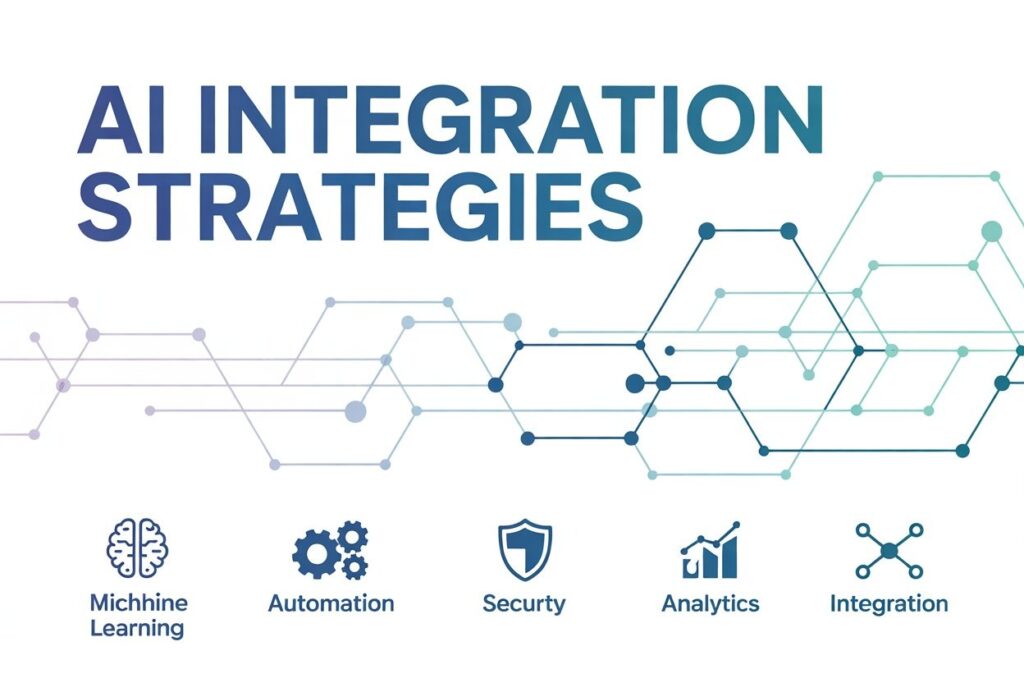
The companies actually winning with AI in 2026 aren’t the ones with the most tools. They’re the ones who figured out how to integrate AI into business in a way that fits the way they actually operate. That’s the difference. And that’s exactly what these Top 5 AI Integration Strategies are about.
No fluff. No recycled listicles. Just what’s working — and why.
Before we get into the strategies, here’s some context worth knowing.
Ai integration statistics from recent industry surveys show that while adoption is up sharply across the board, success rates haven’t kept pace. Lots of companies have AI running somewhere. Fewer have AI doing something meaningful for the business.
The gap between “we have AI” and “AI is creating real value” comes down to one thing: the ai integration strategy behind the deployment. Companies in California’s tech sector, Texas’s energy industry, Ohio’s manufacturing base, Florida’s hospitality market — they all face versions of the same issue. The tools are available. The playbook for using them well is still something most businesses are figuring out.
These five strategies are the ones closing that gap.
Here’s a scenario that plays out in companies all across the US constantly. Leadership approves an AI project. The vendor is impressive. The contract gets signed. And then, three months in, the team realizes the data the model needs doesn’t exist in one place — it’s sitting in eight different systems, half of which don’t talk to each other, and a third of which haven’t been cleaned or updated in years.
That’s not an AI failure. That’s a data infrastructure failure. And it kills more AI projects than anything else.
Data integration for AI is the foundation. There’s no version of a successful ai integration strategy that skips this step and still works. You can use the best machine learning algorithms on the market, but if the data going in is fragmented, inconsistent, or incomplete, the outputs are going to be unreliable — and teams will stop trusting the system fast.
What fixing this actually looks like in practice:
Centralizing your data sources is step one. Whether that’s a cloud-based data warehouse, a data lake, or a well-structured integration layer using APIs — the goal is to get your operational data, customer data, financial data, and product data talking to each other. For mid-size companies in states like Michigan or Pennsylvania running older enterprise software, this might mean a legacy systems migration effort before AI deployment can even begin.
Running a data audit matters more than most people want to admit. Before any model training or deployment, someone needs to go through the data and understand what’s there, what’s missing, how consistent the formatting is, and where the gaps are. This is painstaking. It is also completely necessary.
Building for AI system interoperability means making choices today that don’t box you in tomorrow. The vendor landscape is changing fast. Companies that hardcode dependencies into one AI platform and never think about how systems will connect down the road end up with expensive re-architecture projects a year or two later.
Ai governance and compliance starts here too. If you’re in healthcare in Massachusetts, finance in New York, or insurance in Colorado — states with active AI-related regulation — the way you store, access, and govern data determines what you’re legally allowed to do with it. Getting ahead of that at the infrastructure layer saves enormous headaches later.
At Asapp Studio, this is one of the first conversations we have with any client exploring Artificial Intelligence services. The data layer isn’t optional groundwork — it’s the whole game.
There’s a temptation — especially at the executive level — to go big right away. Company-wide AI transformation. Everything at once. New tools in every department by Q3.
That approach fails more often than it succeeds. The reason is simple: change at that scale breaks down in the middle. People get confused about what they’re supposed to do differently. Nobody owns the outcomes. And when something goes wrong — and something always does in early deployments — there’s no contained environment to fix it in.
The smarter move is what the most successful US companies are doing: pick one department, deploy agentic AI there, make it work properly, and then use that proof of concept to drive expansion.
Agentic ai integration strategy is one of the most discussed top 5 ai trends for 2026 because it represents a real leap beyond basic automation. Older automation tools follow rules. Agentic AI systems reason. They take in context, determine a course of action, execute steps in sequence, check results, and adjust. A well-built agentic system handling customer support doesn’t just respond to keywords — it reads the conversation, checks the order database, identifies the issue, resolves it or escalates appropriately, and logs the interaction. All of that without a human touching it.
Where this is working in practice across US businesses:
Customer support in retail and hospitality — Companies running operations across Florida, Nevada, and the Southeast are deploying agentic systems that handle tier-one queries end to end. These systems pull from live inventory data, loyalty program records, and return policy databases to resolve issues faster than any human team could at scale. This is also where ai chatbot website integration maximum engagement strategies have matured — the difference between a chatbot that frustrates customers and one that actually resolves their issues is almost entirely in the agentic design.
Sales pipeline management in B2B — Teams in technology companies across California and Washington are using agentic AI to qualify leads, personalize outreach sequences, and route prospects based on behavioural signals. The role of a head of go-to-market strategy in these organizations has shifted — less time managing outreach manually, more time designing the systems and reviewing what the AI produces.
Operations and scheduling in manufacturing — Plants in Ohio and Indiana are using agentic workflows to manage production scheduling, flag maintenance needs before breakdowns happen, and reroute supply based on real-time vendor data. The ai product integration position change that comes with this isn’t about job losses — it’s about what the operations team’s time gets spent on. Less firefighting, more strategic planning.
The rule for making this strategy work: pick a department where the process is well-defined, the volume is high enough to show real savings, and the data is accessible. Contain the deployment. Measure it. Then expand.
If you’re unsure where to start, Asapp Studio’s software development team has helped companies across the US identify the highest-ROI starting points based on their specific operations.
A lot of companies made their first AI move in the content space — and a lot of them did it badly. They handed a generic AI tool to the marketing team, told them to “use it,” and got inconsistent outputs that didn’t sound like the brand and sometimes contained errors nobody caught because nobody was checking.
The good news is that ai integration in content management strategies has gotten much more sophisticated. The companies doing this well in 2026 aren’t just using generative AI to write things faster. They’re embedding it into structured workflows where every step — generation, review, approval, distribution — is accounted for.
How to integrate AI into content strategy in a way that actually produces better content, not just more of it:
The first real shift is moving from “use AI to create content” to “use AI at specific points in the content process.” There’s a meaningful difference. AI is reliably good at drafts, variations, metadata, internal link suggestions, content reformatting, and summarization. It is less reliable at final editorial calls, nuanced brand voice, sensitive topic framing, and anything that requires institutional knowledge or relationship context. Knowing where to lean on it and where to step in as a human is the whole skill.
Building a RAG-based assistant is one of the highest-value moves a content-heavy organization can make right now. RAG — Retrieval-Augmented Generation — means the AI model answers questions by pulling from your documents first, not just its general training. A RAG system built on your product documentation, brand guidelines, historical content, and internal knowledge base gives your team an AI assistant that actually knows your business. That’s fundamentally different from a generic chatbot, and the output quality difference is significant.
For enterprise companies with SEO and digital PR goals, an ai-driven content strategy for enterprise seo and digital PR integration built around RAG systems gives content teams the ability to produce high-quality, brand-consistent material at a scale that was previously impossible without proportionally scaling headcount.
Collaborative strategies hr professionals ai integration matter here too. When AI starts handling portions of content production, the team needs clarity on what changes about their roles. Who reviews AI drafts? Who owns quality? How does this show up in performance metrics? Companies that get ahead of these questions avoid significant cultural friction. The ones that don’t tend to see quiet resistance that kills adoption from the inside.
One more thing worth saying plainly: integrate AI into organic traffic strategy with patience. Content SEO is a medium-to-long-term game. AI-assisted content pipelines that are well-structured will outperform manually-written content at scale over time — but “over time” means 90 to 180 days minimum before the traffic signals show up meaningfully. Don’t expect month-one results and pull the plug because the dashboard hasn’t moved yet.
Most businesses use data to look backward. Revenue last quarter. Churn rate last month. Support ticket volume last week. That information has value — but it’s fundamentally reactive. You’re seeing what already happened, and then deciding what to do about it after the fact.
Ai integration strategies for business intelligence change that dynamic. The shift is from descriptive analytics (“here’s what happened”) to predictive analytics (“here’s what’s likely to happen, and here’s what you might want to do about it before it does”).
This is where ai-powered decision making stops being a buzzword and becomes an actual operational advantage.
What this looks like across US industries:
Retail across the Midwest — A chain with locations in Illinois, Indiana, and Wisconsin can feed historical sales data, weather forecasts, local event calendars, and current inventory levels into a demand forecasting model that tells store managers two weeks in advance which products to order more of and which to discount before they sit. The inventory cost reductions from this kind of system compound over time and are consistently among the higher-ROI AI applications for retail businesses.
Financial services in New York and Connecticut — Risk modeling and fraud detection were early AI use cases in finance, and they’re now mature. What’s newer is using predictive analytics for client retention — identifying which clients are showing disengagement signals before they formally move assets — and for dynamic scenario modeling that gives finance teams probability-weighted forecasts rather than single-point estimates.
Healthcare in California and Texas — Predictive analytics for patient readmission risk, staffing demand forecasting, and supply chain planning for pharmaceuticals are all active investment areas. The governance requirements are significant, but the outcomes — both financial and clinical — make the investment defensible.
SaaS companies nationally — Customer churn prediction is probably the most widespread B2B application of predictive BI right now. The model flags customers showing early exit signals — login frequency dropping, feature adoption declining, support tickets spiking — and triggers proactive retention workflows before the cancellation happens. The ai integration statistics coming out of SaaS companies using this well are striking: some report 20-30% reductions in avoidable churn within the first year of deployment.
The critical thing about this strategy is the last mile. A predictive model that nobody acts on is just an expensive screen. Ai integration strategies for business intelligence only produce ROI when the outputs connect to actual decisions — when the demand forecast goes directly into the procurement workflow, when the churn prediction triggers an account manager follow-up, when the scenario model lands on the CFO’s desk before the board meeting.
Asapp Studio builds custom analytics layers and AI-powered BI integrations through its software development services — connecting the model output to the operational workflow where the decision actually happens.
This is the strategy most companies deprioritize. It doesn’t have a demo. It doesn’t generate a press release. It doesn’t show up as a line item with obvious ROI. And then something goes wrong — a biased hiring filter, a compliance violation, a data breach, a model producing outputs that embarrass the company publicly — and suddenly everyone wants to know why governance wasn’t in place.
Ai governance and compliance is not a formality. It is the foundation that determines whether your AI integration holds up over time — legally, ethically, operationally, and reputationally.
In the United States, this is also increasingly a regulatory reality with real teeth. California’s CPRA governs data use in AI applications. New York City’s Local Law 144 puts specific requirements on AI used in employment decisions. Colorado’s SB 21-169 addresses algorithmic discrimination in insurance. More state-level legislation is moving through legislatures in at least a dozen more states. If you need a consultant for integrating ai ethics into digital strategies, this is a legitimate business need — not a philosophical luxury.
What a real governance framework includes:
Transparency and explainability — Know which AI systems are influencing decisions that affect people. Document how those decisions are made. For high-stakes applications — credit, hiring, medical, legal — “the model said so” is not an acceptable explanation internally or to regulators.
Bias auditing — This is especially important for any system that makes or filters decisions involving people. A hiring tool trained on historical data from a company with non-diverse past hiring will replicate that pattern unless someone explicitly tests for it and corrects it. Bias audits aren’t one-time events — they’re periodic reviews built into the operational cadence.
Human override protocols — Every AI-influenced decision of consequence needs a clear path for human review. Define in advance: what does the AI decide autonomously, what requires a human to approve, and what is never delegated to an AI at all. Those boundaries need to be written down, communicated to teams, and enforced.
Data privacy compliance — If your AI systems process personal data from California residents, CPRA applies to you regardless of where your company is headquartered. If you handle protected health information, HIPAA governs how AI can interact with it. These aren’t optional considerations once you’re operating at any real scale.
Model monitoring and drift detection — Models degrade. The world changes, customer behavior shifts, market conditions evolve — and a model trained on data from 18 months ago may be producing increasingly inaccurate outputs today without anyone noticing. Build monitoring from the start. Set thresholds. Have a retraining schedule.
Ai integration knowledge business strategies 2026 increasingly factor governance into procurement decisions. Enterprise buyers are now asking vendors and partners hard questions about AI practices before signing deals. Companies that can demonstrate responsible AI use — documented, audited, and maintained — are winning business that less disciplined competitors are losing.
This is also where strategies for compliant traffic management Ai model integration become relevant for companies in regulated sectors. The governance framework isn’t separate from the commercial strategy. It’s part of it.
It’s worth being direct about how these five pieces fit together, because the sequence matters.
You cannot build effective agentic AI systems on top of fragmented, dirty data. So Strategy 1 is the prerequisite for Strategy 2. You cannot build trustworthy generative AI workflows without knowing what the model has access to and how outputs are reviewed. So Strategy 3 depends on elements of both Strategy 1 and Strategy 5. And predictive business intelligence (Strategy 4) requires not just good data, but enough organizational trust in AI outputs to actually act on them — trust that only builds when deployments have been proven in contained environments first (Strategy 2) and governed responsibly (Strategy 5).
This is what a real digital transformation roadmap for AI looks like. Not a tool-by-tool checklist. A sequenced, interconnected strategy built around your actual business.
The ai adoption roadmap that works:
Healthcare (California, Massachusetts, Texas): AI in clinical documentation, diagnostic support, and patient flow is moving fast. AI governance and compliance under HIPAA is non-negotiable. Every deployment needs a compliance review before go-live.
Retail and e-commerce (New York, Florida, Illinois): Demand forecasting, personalized recommendations, and AI-powered customer service are the primary value drivers. Ai workflow automation in the supply chain is cutting fulfillment costs for regional players that couldn’t have competed with this capability five years ago.
Manufacturing (Ohio, Michigan, Pennsylvania): Predictive maintenance, vision-based quality inspection, and production scheduling optimization are where the money is going. The digital transformation roadmap in manufacturing tends to be longer — 3 to 5 years — but the compound ROI over that period is significant.
Financial services (New York, Georgia, Connecticut): Fraud detection, churn prediction, and regulatory reporting automation are mature. AI scalability challenges in finance are real — models need to perform reliably across enormous transaction volumes with very low tolerance for errors.
Technology and SaaS (California, Washington, Texas): AI is moving into the product layer — not just internal operations. Generative AI implementation in product features is reshaping what software companies build and how they price it. The ai product integration position change is real across engineering, product management, and customer success.
Yes — but the approach needs to match the scale.
Cost-effective ai integration strategies for project workflows don’t require enterprise budgets. The mistake smaller businesses make is trying to replicate what they see large companies doing, at a fraction of the cost, with a fraction of the staff. That doesn’t work.
What does work: picking one specific workflow that is genuinely painful, genuinely repetitive, and genuinely high-volume — and solving just that. A law firm in Atlanta automating contract review intake. A regional logistics company in Ohio automating freight tracking updates to customers. A mid-size e-commerce brand in Texas automating customer service responses for the top 10 inquiry types that make up 70% of their ticket volume.
Ways to integrate AI into your business without overextending:
Best ai integration companies for smaller businesses aren’t necessarily the biggest names — they’re the ones who understand your scale and aren’t selling you an enterprise solution you’ll outgrow the implementation process of.
Asapp Studio works with businesses across the United States on the full AI integration journey — from initial strategy and data architecture through build, deployment, and ongoing iteration.
Our Artificial Intelligence services are built to connect with the broader technology ecosystem each client operates in. That means we’re not just thinking about the AI layer — we’re thinking about how it integrates with your web development environment, your mobile apps, your IoT infrastructure, and the custom software your team already depends on.
If you want to see how this has played out for real clients, our case studies walk through several of them in detail. And if you’re ready to have a real conversation about where AI fits in your business specifically, reach out directly.
The strategy matters more than the tools. We’ve built both — and we know which part is harder.
Q1: What is the first step in an AI integration strategy?
Unify and clean your data first. No AI model produces reliable results on fragmented or inconsistent data. Data infrastructure is the foundation everything else depends on.
Q2: How do you measure the ROI of AI integration?
Set a baseline before deployment. Track time saved, error rates, revenue impact, and cost reductions at 30, 60, and 90-day intervals post-launch.
Q3: What are the biggest risks of integrating artificial intelligence?
Biased outputs, data privacy violations, model drift over time, over-reliance on automation, and non-compliance with US state-level AI regulations are the primary risks.
Q4: Can small businesses implement AI cost-effectively?
Yes. Start with one high-volume, repetitive workflow. Use API-based services instead of custom models. Measure results weekly and expand only after proving value.
Q5: How long does a typical AI integration project take?
A focused single-department deployment runs 6 to 16 weeks. Full enterprise-wide AI integration across systems and teams typically takes 12 to 24 months depending on scope.