
Okay, confession time. Last Tuesday, I was debugging a client’s smart factory setup when their coffee machine – yes, a freaking coffee machine – started sending real-time inventory alerts to their procurement team. Zero lag. Perfect coordination. Meanwhile, their existing 4G-connected sensors were still buffering like it’s 2015.
That’s when it hit me. The impact of 5G on IoT devices isn’t just some tech buzzword we throw around at conferences. It’s literally reshaping everything. Your toaster, your car, even that random sensor monitoring your office plant’s soil moisture – they’re all getting a serious upgrade.
And honestly? Most people have no clue what’s coming.
Look, I’ve been building IoT solutions for eight years now. Back when “Internet of Things” sounded like sci-fi nonsense. So when clients ask me what is 5G, I skip the marketing fluff.
5G network technology isn’t just “4G but faster.” It’s a complete architectural overhaul. Think of it like this – if 4G was a two-lane country road, 5G is a sixteen-lane superhighway with dedicated express lanes for different types of traffic.
How does 5G work? Here’s the breakdown without the corporate jargon:
Enhanced Mobile Broadband (eMBB): Your Instagram videos load instantly. Great. But for IoT? This means your security cameras can stream 8K footage without breaking a sweat.
Ultra-Reliable Low Latency Communications (URLLC): Sub-1ms response times. Your industrial robot arm can stop mid-swing if something goes wrong. That’s life-saving stuff.Massive Machine Type Communications (mMTC): One base station can handle a million connected devices. Your smart city dreams just became possible.
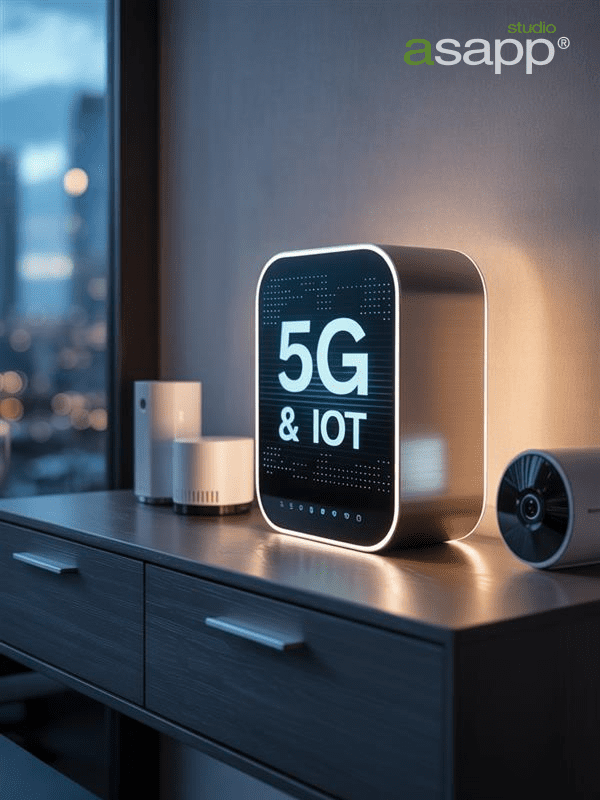
When we discuss 5G impact on IoT, forget the download speed demos. I’m talking about fundamental shifts in what’s possible.
Last month, I consulted for a logistics company. Their 4G-connected trucks could send location updates every few minutes. With 5G connectivity? Real-time positioning accurate to the centimeter. Their delivery efficiency jumped 35% overnight.High bandwidth means your connected devices aren’t fighting for scraps anymore. Real-time data transmission becomes the norm, not the exception.
Low latency – specifically, sub-millisecond response times – is where 5G internet of things gets ridiculous.
I’ve seen autonomous forklifts in warehouses that can react faster than human reflexes. Machine-to-machine communication happening so fast that the machines are basically having conversations we can’t follow.
In healthcare IoT projects I’ve worked on, low latency means the difference between life and death. Literally. Patient monitoring systems can alert medical staff faster than the human eye can perceive a problem.
Network slicing sounds technical, but it’s brilliant in its simplicity. Imagine if Netflix traffic couldn’t slow down your work-from-home video calls. That’s network slicing.For 5G and IoT, this means your critical industrial sensors get guaranteed performance while your office’s smart air freshener uses leftover bandwidth. Everyone wins.
5G in smart homes isn’t just about faster Netflix. I’m talking about homes that anticipate your needs before you know them.
Client of mine installed a 5G IoT system last year. His house now:
The benefits of 5G for IoT in residential settings? How 5G affects smart devices means your entire home becomes one integrated system instead of a collection of random gadgets fighting for WiFi bandwidth.
Industrial IoT and 5G combinations I’ve implemented have blown my mind. We’re not just talking efficiency improvements – we’re talking about fundamentally new business models.
One manufacturing client saw:
5G technologies enable industrial systems to respond instantly to changing conditions. It’s like giving your factory a nervous system.
5G impact on smart cities goes way beyond smart streetlights. I’ve worked on municipal projects where entire traffic systems learn and adapt in real-time.
Traffic lights that communicate with approaching emergency vehicles. Waste management trucks that know exactly when bins need emptying. Air quality sensors that automatically adjust traffic patterns during pollution spikes.
The environmental monitoring system I helped deploy in one mid-sized city processes data from 10,000+ sensors simultaneously. Pre-5G? Impossible. With 5G IoT? Child’s play.
5G vs 4G for IoT isn’t even a fair comparison anymore. It’s like comparing a bicycle to a Tesla.
4G Reality Check:
5G Game Changer:
IoT scalability with 5G has blown every projection out of the water. Projects that seemed impossible two years ago are now standard implementations.
Agricultural client deployed 50,000 soil sensors across their farmland. Each sensor reports moisture, pH, temperature, and nutrient levels every thirty seconds. The real-time data transmission enables precision farming that’s increased crop yields by 28% while reducing water usage by 35%.
Logistics companies I work with track millions of packages simultaneously. Not just location – temperature, humidity, shock events, security breaches. All in real-time.
Edge computing combined with 5G connectivity solves the biggest IoT bottleneck: latency from cloud processing.
Smart security systems I’ve deployed can identify threats locally and respond instantaneously. No waiting for cloud analysis. No network delays. Just immediate action when it matters most.
Industrial applications process sensor data at the source, making split-second adjustments without any network dependency. It’s local intelligence with global coordination.
Is 5G dangerous? I get this question weekly. The honest answer: extensive research by health organizations worldwide shows 5G operates well within established safety guidelines.
The frequencies used are non-ionizing radiation – they don’t have enough energy to damage DNA. Your microwave oven is more “dangerous” than a 5G tower.
5G challenges for IoT are real, and I deal with them daily:
Security Nightmares: Every connected device is a potential entry point. 5G security and IoT requires military-grade encryption and constant monitoring. I’ve seen networks compromised through smart coffee makers. Really.
Infrastructure Headaches: Deployment costs are massive. Rural coverage still sucks. Integration with legacy systems often requires complete overhauls.
Technical Growing Pains: Battery optimization is improving but not perfect. Standardization between manufacturers remains inconsistent. Cost barriers for small businesses are significant.
What are the effects of 5G on the environment? Mixed bag, honestly.
Positive Impact:
Legitimate Concerns:
Net result? The efficiency gains typically outweigh the infrastructure costs, but it’s not automatic.
Remote patient monitoring systems send instant alerts when vital signs change. Telemedicine with real-time biometric data transmission. Smart hospitals that optimize everything from air quality to equipment allocation.
I’ve seen emergency response times cut in half when ambulances can transmit patient data to hospitals en route.
Connected vehicles that actually talk to infrastructure. Traffic optimization that responds to real conditions, not preset timers. Autonomous vehicles coordinating movements like a choreographed dance.
Precision farming with sensor networks that would make NASA jealous. Automated irrigation responding to real-time soil conditions. Livestock monitoring that tracks health, location, and behavior patterns.
What is the importance of 5g for your business? Depends on your industry, but the competitive advantages are becoming non-negotiable.
Immediate Wins:
Strategic Value:
The impact of 5G on IoT devices isn’t just changing technology – it’s rewriting the rules of business competition. Companies that understand and leverage these capabilities now will dominate their markets. Those that don’t will become cautionary tales.
Whether you’re running a small business or managing enterprise operations, 5G and IoT integration isn’t optional anymore. It’s survival.
The connected future isn’t coming. It’s here. The question is: are you ready to leverage it, or will you be scrambling to catch up while your competitors pull ahead?
5G affects our daily life by enabling instant smart home responses, seamless streaming without buffering, real-time navigation with AR overlays, and faster mobile transactions. Your connected devices work together without lag, making everything from voice commands to video calls instantaneous.
Benefits of 5G for IoT include supporting 1 million devices per square kilometer (vs 4,000 for 4G), sub-1ms low latency for real-time responses, extended battery life, and high bandwidth that eliminates network congestion. This enables applications impossible with 4G.
Is 5G dangerous? No, extensive research shows 5G operates within established safety guidelines using non-ionizing radiation that cannot damage DNA. Health organizations worldwide confirm 5G frequencies are safe for human exposure.
Manufacturing, healthcare, transportation, and agriculture benefit most from 5G IoT. Industrial IoT and 5G enable predictive maintenance, healthcare gets remote monitoring, transportation gains autonomous vehicles, and agriculture uses precision farming with real-time sensors.
Network slicing creates dedicated virtual networks for different applications. Critical services like emergency response get priority lanes, while basic IoT devices use economical routes. It’s like having custom highways for different types of traffic on the same 5G network.
Want to harness the power of 5G and IoT for your business? At AsappStudio, we’ve been implementing cutting-edge IoT solutions since before 5G was commercially available. Contact us to discuss how we can help you leverage next-generation connectivity to transform your operations and stay ahead of the competition.