
Picture this: Your factory floor equipment starts predicting its own maintenance needs. Quality issues get caught before defective products roll off the line. Production lines adjust themselves in real-time without waiting for cloud approval. That’s not science fiction anymore—that’s edge computing transforming smart manufacturing right now.At Asapp Studio, we’ve seen firsthand how businesses struggle with manufacturing bottlenecks. Traditional cloud-dependent systems create delays that cost millions. But edge computing? It’s flipping the script entirely.
Let’s cut to the chase. Traditional manufacturing systems send data to distant cloud servers, wait for processing, then get responses back. It’s like texting your neighbor through someone in another country. Edge computing brings the brain power directly to your factory floor.
Here’s what makes it game-changing:
Real-time data processing happens instantly. No more waiting for cloud round-trips that take precious milliseconds—or worse, seconds. Your industrial IoT devices make split-second decisions right where the action happens.
Latency reduction transforms operations. When your robotic arm needs to adjust grip pressure based on material density, every microsecond matters. Edge computing delivers zero-latency processing that keeps production flowing smoothly.Data sovereignty keeps sensitive information local. Your proprietary manufacturing processes, quality metrics, and operational data never leave your premises. That’s a massive win for cybersecurity in manufacturing.
Remember the last time a critical machine broke down unexpectedly? Traditional systems rely on scheduled maintenance or reactive repairs. Edge AI changes everything.
Smart sensors continuously monitor vibration patterns, temperature fluctuations, and acoustic signatures. Machine learning at the edge processes this data instantly, catching anomalies before they become failures. Ford’s Michigan plant reduced unplanned downtime by 25% using edge-powered predictive maintenance.
This isn’t just about avoiding breakdowns—it’s about optimizing maintenance schedules. Instead of replacing parts on arbitrary timelines, you replace them precisely when needed. That saves both money and production time.
Traditional quality control samples products at intervals. Edge-powered AI vision systems inspect every single item in real-time. High-resolution cameras capture microscopic defects while edge analytics instantly classify and flag issues.
BMW’s smart factories use edge computing for paint quality inspection. The system identifies color variations, surface imperfections, and coating thickness issues faster than human inspectors ever could. Defect detection improved by 40% while reducing waste significantly.
Real-time quality assurance means defective products never make it to customers. Your brand reputation stays intact while production costs drop.
Imagine production lines that continuously optimize themselves. Edge computing enables autonomous production by processing sensor data, adjusting parameters, and coordinating equipment without human intervention.
Siemens’ Amberg Electronics Works showcases this beautifully. Their factory floor automation system uses edge computing to coordinate 950 programmable logic controllers. Production efficiency increased 20% while human error virtually disappeared.
Manufacturing execution systems (MES) integrated with edge computing create truly smart factories. These systems balance production schedules, optimize resource allocation, and maintain quality standards autonomously.
Manufacturing consumes massive energy. Edge computing optimizes energy consumption by monitoring usage patterns and adjusting operations in real-time. Smart sensors track power consumption across equipment while edge algorithms optimize scheduling.
Schneider Electric’s smart factory reduced energy consumption by 30% using edge-powered optimization. The system automatically adjusts lighting, HVAC, and equipment operation based on production schedules and occupancy patterns.
Energy optimization through edge computing doesn’t just save money—it supports sustainability goals that matter to modern consumers.
Traditional supply chains rely on periodic updates and batch processing. Edge computing enables real-time data processing throughout the supply chain. RFID tags, GPS trackers, and IoT sensors provide continuous visibility.
Our IoT development services help manufacturers implement edge-powered supply chain solutions. Real-time tracking prevents stockouts while optimizing inventory levels.
Distributed manufacturing becomes possible when edge systems coordinate multiple facilities seamlessly. Production can shift between locations based on capacity, demand, or material availability.
Industry 4.0 promised smart factories. Edge computing delivers them. The combination creates manufacturing environments that adapt, learn, and optimize continuously.
Cloud-edge integration provides the best of both worlds. Edge systems handle time-critical operations while cloud platforms manage long-term analytics and strategic planning. This hybrid approach maximizes both performance and insights.
Operational efficiency improves dramatically. Manufacturers report 15-30% productivity gains after implementing comprehensive edge computing solutions. These aren’t just incremental improvements—they’re transformational changes.
Modern sensor networks generate massive data volumes. Edge computing processes this information locally, sending only relevant insights to central systems. This reduces bandwidth requirements while improving response times.
Multi-access edge computing enables seamless device coordination. Your robotic systems, conveyor belts, and quality control stations work together like a synchronized orchestra.
AI-powered robotics reaches new capabilities with edge computing. Robots make complex decisions without cloud connectivity, enabling more sophisticated automation. Vision systems, path planning, and manipulation tasks all benefit from local processing power.
Edge computing doesn’t require starting from scratch. Modern solutions integrate with existing programmable logic controllers (PLCs), SCADA systems, and enterprise software. This reduces implementation complexity while maximizing return on investment.
Our custom software development services help manufacturers integrate edge computing with their existing infrastructure. We’ve seen successful implementations that pay for themselves within 18 months.
Cybersecurity in manufacturing becomes more complex with distributed edge systems. However, it also becomes more robust. Local processing reduces attack surfaces while keeping sensitive data on-premises.
Edge security strategies include:
Let’s talk numbers. Edge computing implementations typically cost $500K-$2M for mid-sized manufacturers. However, the returns are substantial:
These improvements often generate positive ROI within 12-24 months. For manufacturers operating on thin margins, these gains are transformational.
Manufacturing trends point toward even greater edge adoption. Key developments include:
5G integration will enhance edge capabilities. Ultra-low latency and massive device connectivity will enable new automation possibilities.
Edge AI acceleration through specialized chips will bring more sophisticated analytics to the factory floor.
Digital twin integration will connect physical assets with virtual models running at the edge for enhanced simulation and optimization.
Ready to transform your manufacturing operations? Start with these practical steps:
Our team at Asapp Studio specializes in helping manufacturers navigate this transformation. We’ve guided dozens of companies through successful edge computing implementations.
Edge computing isn’t just another tech trend—it’s the foundation of competitive manufacturing. Companies implementing these solutions today will dominate their markets tomorrow.
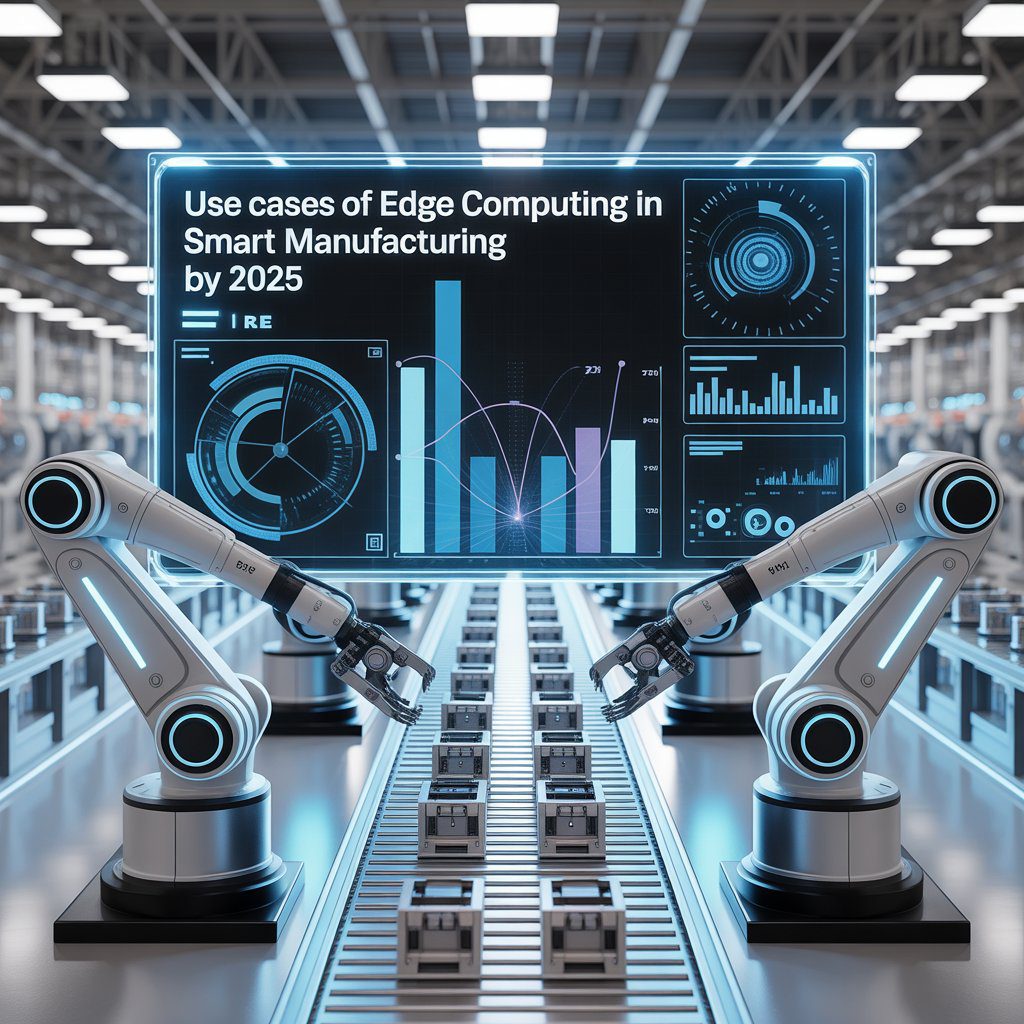
The use cases of edge computing in smart manufacturing we’ve explored represent just the beginning. As technology evolves, new possibilities will emerge. The question isn’t whether to adopt edge computing—it’s how quickly you can get started.
Your competitors are already exploring these technologies. Don’t let them get ahead. The future of manufacturing is happening at the edge, and it’s happening now.
Want to explore how edge computing can transform your manufacturing operations? Contact our team for a consultation. We’ll help you identify opportunities and create an implementation roadmap that delivers real results.
Q: What is edge computing in manufacturing?
A: Edge computing processes data locally on factory floors rather than sending it to distant cloud servers, enabling real-time decision-making and reducing latency.
Q: How does edge computing improve manufacturing efficiency?
A: Edge computing enables predictive maintenance, real-time quality control, autonomous production optimization, and instant defect detection, typically improving efficiency by 15-30%.
Q: What’s the difference between edge computing and cloud computing in manufacturing?
A: Edge computing processes data locally for instant responses, while cloud computing handles data in remote servers with higher latency but greater storage and processing power.
Q: How much does edge computing cost for manufacturing?
A: Implementation typically costs $500K-$2M for mid-sized manufacturers, with ROI achieved in 12-24 months through reduced downtime and improved efficiency.
Q: Is edge computing secure for manufacturing data?
A: Yes, edge computing enhances security by keeping sensitive manufacturing data on-premises while reducing attack surfaces through local processing and encrypted communications.