
Ever bought a couch online that looked nothing like the pictures? Or ordered shoes that pinched your toes the second you tried them on?
Yeah, me too. We’ve all been there.
But here’s the thing—2025 hit different. Shopping online doesn’t feel like a gamble anymore. You’re not squinting at product photos wondering if that lamp will actually fit on your nightstand. You’re seeing it right there, sitting on your actual nightstand, before you even think about pulling out your credit card.
I’m talking about Augmented Reality (AR) and Virtual Reality (VR), and trust me, this isn’t some tech bro hype. At Asapp Studio, we’ve been building these experiences for clients, and watching people’s faces light up when they first try them? That never gets old.
Your customers aren’t just clicking buttons anymore. They’re walking through stores that don’t exist. They’re trying on glasses without touching a frame. They’re rearranging furniture in rooms they haven’t even moved into yet.
And get this—AR shopping technology is expected to grow like crazy by 2031. Retailers who aren’t paying attention? They’re about to get lapped.
This isn’t the future. It’s Thursday afternoon, and your competition is probably already doing it.
Look, traditional online shopping was convenient. Order from bed. No pants required. Beautiful.
But it also sucked in one massive way—you never really knew what you were getting until the box showed up at your door.
That’s where Augmented Reality Shopping and Virtual Reality Retail stepped in and flipped the script completely.
Picture this scenario: You’re eyeing a coffee table on Amazon. Old way? You’d measure your space with a tape measure, compare dimensions, read 47 reviews, still feel uncertain, order it anyway, and pray.
New way? You tap Amazon AR View. That coffee table materializes in your living room through your phone screen. You walk around it. Check if your dog can still zoom past it. See if it clashes with your weird green rug. You know instantly if it works.
That’s the power of AR and VR technology in retail. It took the guessing game out back and shot it.
Virtual Reality Retail goes even harder. You’re not just looking at products—you’re transported somewhere else entirely. Imagine browsing an entire furniture store without dealing with that one salesperson who follows you around asking if you need help every thirty seconds. You’re in this fully interactive Virtual Showroom, picking things up, spinning them around, making decisions on your terms.
Here’s what we’ve noticed building eCommerce development projects: when customers can mess around with products virtually, conversion rates shoot up. Returns drop hard. People actually enjoy shopping again.
The numbers back this up. Retail virtual reality testing showed that shoppers who use AR features are 65% more confident hitting that buy button. That confidence shows up directly in your revenue.
Alright, let’s crack this open without making your eyes glaze over.
AR slaps digital stuff onto what you’re looking at in real life. Sounds basic, but the tech making it happen is pretty wild.
Google’s ARCore and Apple’s ARKit let developers build AR shopping apps that track your environment, understand how light hits surfaces, and drop virtual objects exactly where they should be.
Take Amazon’s augmented reality setup. When you fire up their AR view, your phone’s sensors start mapping your room instantly. The app calculates distances, figures out perspective, and drops that virtual couch right where it would actually sit. You can walk circles around it, duck down to check the legs, switch colors in half a second.
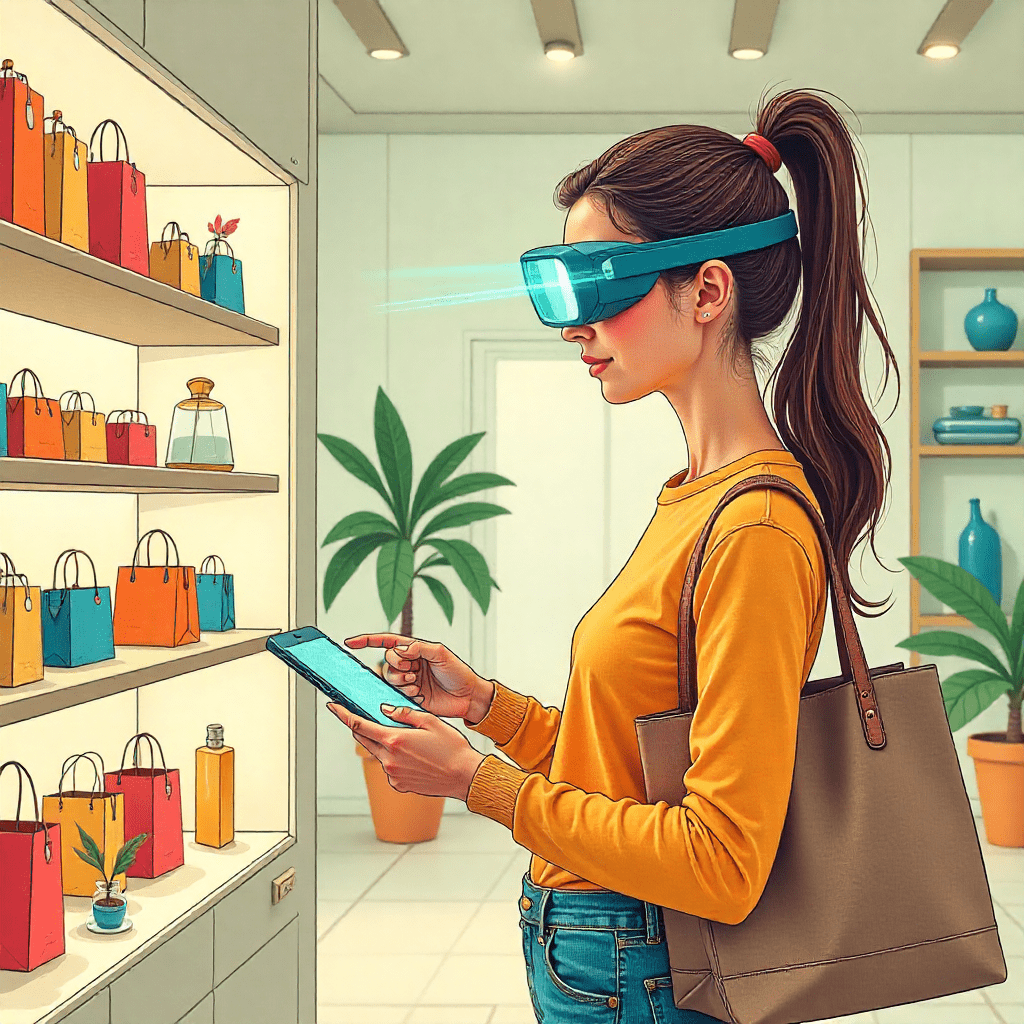
Brands are crushing it with Virtual Try-Ons right now. Makeup companies let you test every shade of lipstick without opening a single tube. Glasses brands help you find frames that don’t make your face look weird. Clothing stores show you how that jacket fits before you panic-order four sizes.
Best part? This works on the phone already in your pocket. No weird equipment. No expensive headset. Just a regular AR shopping app.
VR shopping online works differently. Instead of bringing products to your living room, it yanks you into the store.
Throw on a VR headset, and boom—you’re standing in a store that exists purely in code and creativity.
The VR shopping experience goes way past just “being there.” It’s about creating attractive online retailing stores through the cool AR technology that actually gets how humans shop. We wander around. We compare stuff side by side. We pick things up and turn them over. Good VR environments let you do all that digitally.
Nike built virtual store tours where you can explore their flagship locations from your bedroom. High-end fashion brands create VR-only boutiques with exclusive collections. Car companies build virtual showrooms where you sit in every model, adjust the seat, and check out every detail without a test drive appointment.
Even small shops are jumping in. VR platforms got cheap enough that you don’t need Silicon Valley money to create something memorable for customers.
Forget theory. Let’s talk about who’s winning right now and what they’re doing.
Amazon didn’t mess around with AR—they made it something regular people actually use. Their Amazon VR app and AR features now work with thousands of products. How to use Amazon augmented reality? It’s stupid simple. Browse something, tap the AR button, point your phone, done—the item appears where you’re pointing.
What makes Amazon smart here is integration. They didn’t make you download some separate app you’d forget exists. AR view lives right inside the main Amazon app where millions already shop. That reduced friction changes everything about adoption.
IKEA nailed AR in retail examples with their IKEA Place app. Buying furniture online used to feel like playing roulette with your credit card. Their app shows exact dimensions, real colors, actual styles—all in your actual room.
The app uses ARCore technology to scale items accurately. That sectional you’re obsessing over? Place it virtually and realize it’s way too massive for your apartment—before the delivery guys show up and ruin your Saturday.
This kind of customer engagement in retail cuts returns, makes people happier, and builds loyalty that lasts.
Sephora’s Virtual Artist shows what good interactive product display looks like. Try makeup virtually, get recommendations based on your features, save looks you want to recreate later. The tech analyzes your face shape and skin tone to show realistic results.
This immersive shopping experience solved a huge problem in beauty: buying online without swatching everything first. Their AR feature drove massive upticks in online sales while also bringing people into physical stores to buy what they’d tested virtually.
Pretty clever, right?
Three big things pushed AR and VR from “neat concept” to “you need this yesterday”:
Early AR and VR attempts were rough. Laggy, clunky, unconvincing. Not anymore.
Smartphone processing power exploded. 5G networks deliver data instantly. Cloud computing handles the heavy lifting. Result? Smooth, realistic experiences that don’t make people want to throw their phones.
At Asapp Studio, we build AR shopping apps that load fast and run smoothly even on older devices. That accessibility matters more than fancy features.
Your customers grew up with Snapchat filters and Instagram effects. AR feels normal to them, not like science fiction. This comfort level makes adoption seamless.
Meanwhile, VR headsets like Meta Quest became affordable enough for regular people. Virtual reality and the future converged faster than anyone expected. People already own VR devices for games, so VR shopping feels like a natural extension.
COVID shut down physical stores. Millions of people who never shopped online suddenly had no choice.
AR and VR filled that gap, making online shopping feel less isolating and more engaging than traditional websites.
Even after stores reopened, the habits stuck. People realized they could shop more efficiently from home with the right tools. That behavior change became permanent, creating massive demand for better online shopping innovations.
Let’s get specific about what customers actually care about:
The biggest reason people hesitate buying online? “Will this actually work for me?”
AR eliminates that question. See the product in your space, on your body, in your environment before spending a dime. This confidence alone justifies everything.
Virtual showrooms let you browse entire catalogs in minutes. No traffic. No parking nightmares. No waiting for help. You control everything.
This efficiency matters especially for busy professionals and parents who don’t have hours to wander stores.
When customers know exactly what they’re getting, returns drop dramatically. That’s good for your profits and the environment.
Fewer returns mean less shipping, packaging, and carbon emissions. Everybody wins.
AR and VR enable customization at massive scale. Show different configurations instantly. Create recommendations based on actual measurements or personal style. This personalization was impossible before.
Why are virtual worlds such as Second Life related to eCommerce? Because shopping is social.
VR platforms let friends shop together remotely, sharing opinions and making decisions as a group. This recreates the social parts of mall trips without anyone leaving their couch.
Considering implementing this? Here’s what you need to understand:
ARCore and ARKit dominate mobile AR. ARCore works on Android, ARKit handles iOS. Both offer solid tracking, environment understanding, and realistic lighting. Supporting both means reaching everyone.
WebAR changed the game in 2025. No app downloads needed—AR runs directly in browsers. This cuts friction dramatically. We’ve seen conversion rates double when customers don’t need a separate app.
Building VR shopping experiences needs different tools. Unity and Unreal Engine lead for creating 3D environments. These platforms offer realistic physics, lighting, and interactions that make virtual stores feel real.
WebVR and WebXR standards bring VR to browsers. This democratizes access, letting users experience virtual showrooms without special apps or even headsets—though headsets improve things significantly.
Heavy computation happens in the cloud, not on phones. This keeps experiences smooth and enables sophisticated features like real-time rendering, AI recommendations, and multiplayer shopping.
As a development agency focused on cutting-edge stuff, we’ve seen cloud architecture make or break implementations.
AR and VR need to connect with existing systems—inventory, payments, CRM. Good APIs make this seamless. Poor integration creates frustrating gaps where the magic suddenly disappears.
VR in business extends way past retail. Companies use it for training, remote collaboration, product development. These applications matter because they normalize VR.
When someone uses VR for work meetings or training, they’re comfortable with the interface when they hit your virtual showroom. Cross-industry adoption accelerates VR shopping acceptance.
The future of online shopping keeps getting wilder. Here’s what’s coming:
Imagine a virtual store where an AI assistant knows your style, size, and budget. It guides you to stuff you’ll love, offers styling advice, answers questions instantly. This combo of VR and AI creates unprecedented personalization.
Current VR shopping lets you see products. Next-gen haptic gloves and suits will let you feel them. Touch fabrics. Feel weight and texture. This sensory depth dissolves barriers between physical and virtual shopping.
Virtual shopping increasingly supports cryptocurrency. Blockchain enables secure, instant transactions without traditional fees. This matters especially for international customers dealing with currency headaches.
At Asapp Studio, our blockchain programming services help retailers integrate these payment options into AR and VR environments.
Virtual spaces where friends shop together, influencers host live events, and brands create experiences are exploding. Less “browse catalog,” more “attend fashion show and buy instantly.”
Standalone augmented reality e-commerce apps are merging into super-apps. Your AR shopping might live alongside banking, social media, entertainment—all in one place.
Looking further ahead, how will virtual reality change the world of commerce? The shifts could be massive:
Physical Stores Transform: Stores won’t vanish, but they’ll evolve. Instead of displaying everything, locations become showrooms where VR stations let customers explore entire catalogs. Sales people become experience guides.
Location Stops Mattering: A boutique in Paris can have customers from Tokyo, New York, Lagos simultaneously. Geography becomes irrelevant when shopping happens virtually.
Sustainability Wins: Virtual shopping reduces need for massive warehouses, display inventory, physical marketing. Products ship only after decisions, cutting waste. This benefits businesses and the planet.
Entertainment Meets Shopping: The line blurs completely. Brands create games, stories, events where purchasing happens naturally within engagement rather than as separate transactions.
New business models emerge. Subscription services for virtual showroom access. VR-only products or early releases. Virtual personal shopping consultations commanding premium fees. Possibilities multiply as adoption grows.
Ready to do this? Here’s the approach that works:
Don’t virtualize everything at once. Find your highest-return opportunity. Customers struggle with size? Start with AR placement. High clothing returns? Begin with virtual try-ons.
Building AR and VR needs specialized expertise. You need developers who understand 3D modeling, real-time rendering, immersive UX. The wrong partner creates frustrating experiences that hurt your brand.
At Asapp Studio, we’ve built custom software and mobile apps with AR and VR for retailers across industries. The key is balancing cutting-edge with usability.
Most customers hit your AR features through phones, not VR headsets. Make sure mobile experiences are polished, fast, intuitive. VR showrooms can come later.
Your team isn’t your customer. Watch real users interact with features. Where do they struggle? What makes them smile? Iterate based on actual behavior, not assumptions.
Monitor meaningful numbers: conversion rates, return rates, engagement time, satisfaction scores. AR and VR should drive business results, not just create cool demos.
The immediate future—next year or two—will see:
Standards Merge: Competing VR platforms will converge, making it easier to build once and deploy everywhere. This cuts costs and speeds adoption.
Browser Experiences Win: App downloads create friction. WebAR and WebXR will dominate, letting customers access AR and VR instantly without app stores.
AI Gets Deeper: Machine learning will power better recommendations, virtual assistants, automated 3D models. This makes implementation faster and cheaper.
5G Enables More: As 5G coverage expands, experiences can include higher-resolution models, detailed environments, seamless interactions without lag.
Virtual reality in 2050 might seem crazy to predict, but current trends suggest shopping could be unrecognizable.
Contact lenses with AR overlays might replace phones. Walk through physical stores and see reviews, prices, recommendations overlaid on products instantly. Or skip stores entirely—your home becomes a shopping interface where any surface displays products.
VR could advance to full sensory immersion. Not just sight and sound, but smell, taste, touch. Try food virtually before ordering. Smell perfumes. Feel fabrics. The boundary between physical and virtual might dissolve completely.
How will virtual reality change the world? By making distance, availability, physical reality optional. When experience can be synthesized and transmitted anywhere instantly, shopping becomes limited only by imagination, not logistics.
But we’re not waiting for 2050. The transformation is happening right now, and businesses adapting quickly will define what comes next.
All signs point to VR becoming central. Three reasons make this inevitable:
Customer Preference: When given options, customers choose immersive experiences over traditional shopping. Data is consistent across demographics and categories.
Economic Sense: VR and AR cut costs for retailers—less inventory, fewer returns, lower real estate needs—while improving satisfaction. That combo guarantees continued investment.
Technology Gets Better: Every year, AR and VR become more accessible, affordable, powerful. This improvement doesn’t reverse. As capabilities grow and costs drop, adoption accelerates.
The question isn’t whether VR and AR will transform shopping. They’re doing it now. The question is how quickly you adapt and whether you lead or follow.
Implementing AR and VR isn’t all smooth. Real challenges exist:
Different devices, operating systems, platforms create complexity. An AR experience perfect on the latest iPhone might struggle on older Androids. You need strategies delivering quality across varied hardware.
High-quality 3D models take time and expertise. For retailers with thousands of products, this represents serious investment. Automated scanning and AI-generated models help, but quality control remains crucial.
Despite growing familiarity, some customers don’t know AR and VR shopping exists or how to use it. Clear onboarding, simple interfaces, visible prompts bridge this gap.
AR apps access cameras and sensors. VR platforms track movements. Customers want assurance their data stays protected. Transparent privacy policies and robust security are non-negotiable.
AR and VR need bandwidth. Customers with slow connections get frustrated. Optimizing for various speeds and offering graceful degradation keeps everyone included.
Beyond immediate sales, AR and VR create deeper connections with brands. When customers interact with products immersively, they form stronger memories and associations.
This enhanced customer engagement in retail translates to loyalty. Customers return to retailers offering experiences they enjoy, even if prices run slightly higher. Experience becomes part of value proposition, differentiating you from competitors stuck in 2D.
Brands mastering immersive shopping position themselves as innovative leaders. This perception matters, especially to younger consumers prioritizing experience over pure functionality.
Retailers implementing AR and VR now capture advantages:
Stand Out: While competitors debate whether this matters, early adopters already offer it. This differentiation attracts curious customers.
Learning Lead: Understanding what works takes experimentation. Starting now means iterating while competitors plan.
Data Insights: Immersive shopping generates unique behavioral data. How customers interact in 3D, what they examine closely, where attention focuses—this intelligence informs everything.
Media Buzz: Innovative experiences generate press coverage and social media attention. The marketing value of being “first” or “most innovative” compounds ROI.
We’ve covered shopping, but VR’s impact extends further. Virtual trade shows connect buyers and sellers globally without travel. Virtual real estate tours sell homes before construction finishes. Virtual test drives sell cars without dealerships.
This broader transformation reinforces VR shopping adoption. As people use VR for various life aspects, resistance specifically to VR shopping evaporates. The technology becomes normal rather than novel.
The future of online shopping isn’t coming—it’s here. AR and VR are transforming how customers discover, evaluate, purchase products right now in 2025.
Retailers embracing these technologies create competitive advantages that compound over time. Those waiting risk becoming irrelevant as customer expectations evolve past traditional eCommerce.
At Asapp Studio, we’re passionate about helping businesses navigate this. Whether you need an AR shopping app, custom eCommerce development, or strategic guidance implementing immersive tech, we bring expertise turning vision into reality.
The shopping experience revolution rewards boldness. Retailers winning in 2025 and beyond stopped debating whether AR and VR matter and started building experiences customers love.
Your customers are ready for immersive shopping. Technology is mature. Business case is proven. Only question left: Will you lead this revolution, or watch competitors do it first?
Q1: How does AR technology improve online shopping experiences?
AR lets customers visualize products in their actual environment before buying, reducing uncertainty and returns while increasing purchase confidence through interactive 3D displays in real settings.
Q2: What devices do I need for VR shopping experiences?
Most VR shopping works with affordable headsets like Meta Quest or even smartphones with Google Cardboard. Many experiences now run in web browsers without special equipment at all required.
Q3: Are AR and VR shopping features expensive to implement?
Costs vary based on complexity. Basic AR features can be implemented affordably using existing platforms, while custom VR showrooms require larger investments but deliver significant ROI through conversions.
Q4: How do Virtual Try-Ons work in AR shopping apps?
Virtual Try-Ons use your device’s camera and AR technology to overlay products like glasses, makeup, or clothing onto your image, showing real-time how items look on you before you purchase.
Q5: Will VR replace physical retail stores completely?
No, VR complements rather than replaces physical stores. Stores will evolve into experiential spaces and showrooms, with VR extending reach and convenience while maintaining human connection advantages.