
I’m going to tell you something that most app development agencies won’t.
That number you keep seeing — the one that says “apps cost between $10,000 and $500,000” — is not a price range. It’s a cop-out. It’s the industry’s way of saying “we don’t want to commit to anything until you’re already on a call with our sales team.”
This post is different. I’m going to walk you through what app development costs in 2026 actually look like — broken down by app type, platform, feature set, and U.S. state. No hedging. No “it depends” without an actual explanation of what it depends on.
If you run a small business in Phoenix, a funded startup in Austin, a healthcare company in Boston, or a retail brand in Miami — you’ll leave this page with a real sense of what you’re looking at budget-wise and why.
We build apps at Asapp Studio. We’re based out of Temecula, California, and we’ve shipped projects for clients across the country — MVPs, enterprise systems, blockchain platforms, AI-powered tools, eCommerce apps, the works. What I’m sharing here reflects what we actually see in real project quotes, not industry surveys from 2022 with a new year pasted on top.
Let’s get into it.
Here’s the honest problem with how app development pricing gets discussed online.
Most articles take something genuinely complex — a buying decision with dozens of real variables — and flatten it into a fake “average” that doesn’t apply to anyone’s actual situation. The average cost to develop an app in 2026 is meaningless because there’s no such thing as an average app.
A notification app that reminds your employees to take breaks is an app. A telemedicine platform with HIPAA compliance, EHR integration, insurance billing, and video calling is also an app. These two things should not share a price range. But they do in most guides.
What you actually need to know is: what kind of app are you building, what does that category realistically cost, and what are the specific things that will push your number higher or lower. That’s what this covers.
Before breaking things down by type, here’s the honest lay of the land. Every app project falls somewhere in one of these three buckets.
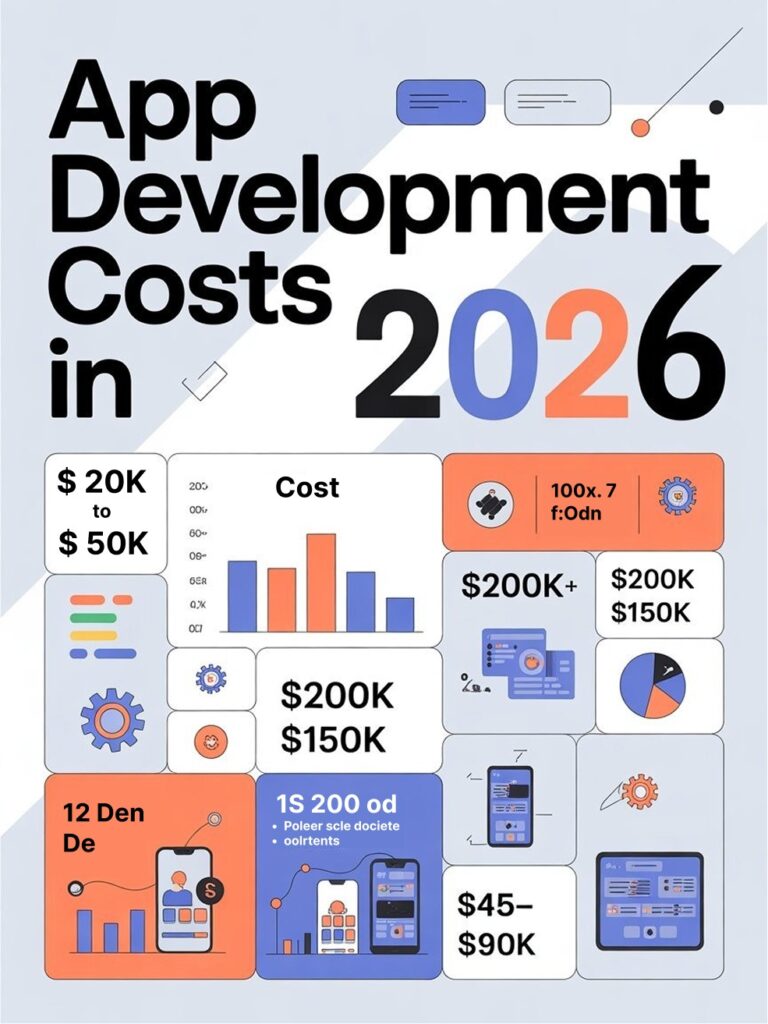
Tier 1 — Simple / MVP Apps: $10,000 – $40,000
Two to four months of work. Usually one platform (iOS or Android, not both). Limited features — user login, maybe a feed or list, some basic interactions. This tier is mostly for testing an idea before you spend real money, or for internal tools that don’t need to win a design award.
Don’t let anyone convince you to spend $80,000 on an MVP. If your MVP costs $80,000, you’re building a product, not a minimum viable product.
Tier 2 — Mid-Complexity Apps: $40,000 – $150,000
This is where most legitimate business apps land. Four to nine months. Both iOS and Android, or a solid cross-platform build. User accounts, payment processing, third-party integrations, an admin panel, maybe some mapping or messaging. eCommerce apps, food delivery MVPs, fitness apps, booking platforms — they all live here.
Tier 3 — Complex / Enterprise Apps: $150,000 – $500,000+
Nine months to two-plus years. Multiple user roles. Advanced integrations with existing enterprise systems. Compliance requirements (HIPAA, PCI-DSS, SOC 2). AI or blockchain features. Heavy backend infrastructure. This is the territory of healthcare platforms, fintech apps, industrial IoT systems, and custom enterprise software replacing legacy tools.
If a vendor quotes you Tier 3 pricing for a Tier 1 project, run. If they quote you Tier 1 pricing for a Tier 3 project, also run — just faster.
iOS app development cost runs about 10–15% higher than Android for equivalent functionality. Apple’s guidelines are tighter, the review process is slower, and Xcode has a learning curve that junior developers struggle with. The Apple app developer account cost is $99/year — practically irrelevant on any real project budget, but worth knowing.
Android app development cost is slightly cheaper at entry level, but Android fragmentation — hundreds of device types, screen sizes, and OS versions — makes comprehensive testing more expensive than it looks on paper.
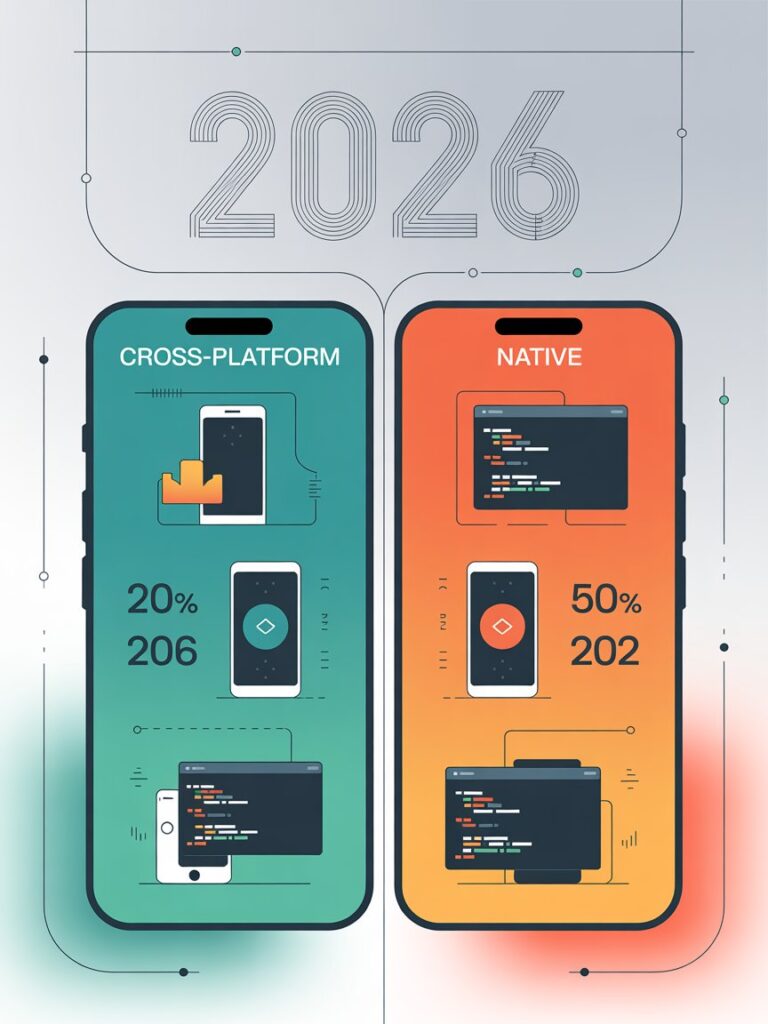
Then there’s cross-platform. Flutter app development cost in 2026 is the option most U.S. businesses should default to unless you have a specific technical reason not to. One codebase, both platforms, roughly 30–40% cheaper than two native builds. The performance concerns people had about Flutter three or four years ago mostly don’t apply to standard business apps anymore.
Flutter app development cost 2026 for a mid-complexity app: $35,000 to $120,000. Equivalent dual-native: $60,000 to $200,000+. That gap is real money.
Our Flutter App Development Company and React Native App Development Company teams have both. We’ll tell you which makes sense before we start, not after.
Every feature adds developer time. Here’s what things actually cost to build in 2026:
A food delivery app in Dallas needs at minimum: user accounts, payments, real-time GPS, push notifications, a restaurant management panel, and a driver interface. That’s already $30,000–$60,000 in features before you’ve touched design or backend infrastructure.
This is why “simple apps” that clients describe over the phone often turn out to be Tier 2 projects once someone actually maps out the feature list.
Bad UX kills apps. Not slowly — fast. Users delete apps that confuse them. They one-star apps that look dated. They abandon checkout flows that have one too many steps.
Budget 15–25% of your total project for design. If your app is competing in a market where users already have polished alternatives (fitness, food, eCommerce, finance), you need to be at the high end of that range. If you’re building an internal business tool that only your own employees will use, 15% is fine.
Our UI/UX Services team works alongside development from day one — not as a separate phase that gets handed off. That matters more than it sounds.
App development price in USA from a U.S.-based agency: $100–$250/hour. Eastern Europe: $45–$90/hour. South Asia: $20–$55/hour. Latin America: $35–$75/hour. App development cost in the UK: 20–30% less than U.S. rates, still well above offshore.
None of these automatically means better or worse quality. A $200/hour U.S. team with a disorganized project manager can deliver a worse result than a $40/hour offshore team with a rigorous process. But timezone misalignment, communication friction, and unfamiliarity with U.S. market expectations are real risks with fully offshore teams.
Asapp Studio is California-based with delivery teams that keep our rates competitive for American clients without the communication headaches that come with a 10-hour time difference and no overlap.
Mobile app development costs in 2026 for a real, ship-ready product: $50,000–$250,000 for most U.S. business use cases. That figure assumes both platforms (or a solid cross-platform build), a backend, a basic admin panel, and enough QA to not get destroyed in App Store reviews on day one.
If your app is consumer-facing and entering a competitive market — you’re not going to succeed with a $20,000 build. Your users are comparing you to apps that cost $500,000 to build. The bar is there whether you set it or not.
Our Mobile App Development team handles full-cycle work. Dedicated iOS and Android teams for platform-specific projects, cross-platform when it makes sense.
People confuse web apps with websites. They’re not the same thing.
Web app development cost — for something that actually does work (user authentication, data processing, dashboards, API integrations, real-time functionality) — runs $30,000 to $200,000+ depending on complexity. A SaaS tool with multiple user roles and subscription billing is not the same project as a brochure site with a contact form.
Website and app development costs are often lumped together when a client needs both a marketing site and a web application. Doing them with one vendor saves 15–20% versus running two separate projects with two separate teams.
Web application development costs go up significantly when you add: real-time data (think live dashboards or collaborative editing), complex role-based permissions, compliance requirements, or integrations with enterprise systems like Salesforce, SAP, or legacy databases.
Our Web Development team builds actual applications — not just good-looking static sites.
eCommerce app development cost in 2026: $45,000–$200,000. That spread exists because “eCommerce app” covers a lot of ground.
A single-brand store with a product catalog, cart, checkout, and order tracking is fundamentally different from a two-sided marketplace where independent sellers list products, get paid out, and manage their own inventory. Both are eCommerce apps. One is a Tier 2 project. The other is Tier 3.
Shopify-based builds are cheaper and faster — but you’re renting the platform, not owning it, and custom functionality gets expensive through third-party plugins that all take a cut. Custom-built commerce gives you complete ownership and a better long-term unit economics story.
Our Ecommerce Development team builds both. We’ll tell you which actually fits your business.
The most common “I want to build the next DoorDash” inquiry we get. Let’s talk about what it actually involves.
A food delivery platform has three separate apps: customer app, restaurant app, driver app. It needs real-time GPS, live order status, payment processing, ratings, notifications, menu management, surge logic, a dispatch system, and an admin panel that ties it all together. Every one of those is a billable feature.
Food delivery app development cost in 2026: $65,000 for a focused single-city MVP with stripped-down features, up to $280,000 for a fully-built platform ready to scale. The startups that succeed in this space don’t try to out-DoorDash DoorDash in week one. They pick one city — say, Boise, Idaho or Knoxville, Tennessee — nail the product there, then expand. The MVP approach isn’t settling; it’s strategy.
Healthcare apps have two cost conversations happening at once: what it costs to build the features, and what it costs to build them in a way that won’t get you sued or fined.
HIPAA compliance adds 20–30% to your development budget when it’s done properly. That means encrypted data storage, proper audit trails, Business Associate Agreements with every third-party vendor you touch, and development practices that treat Protected Health Information seriously at every layer of the stack.
Healthcare app development cost in 2026: $85,000 for a basic patient-provider communication tool, $600,000+ for a full telemedicine platform with EHR integration, multi-state licensing support, and insurance billing.
States matter a lot here. California has additional state-level privacy protections on top of federal HIPAA. New York’s insurance billing environment is one of the most complex in the country. Texas has specific telehealth regulations that changed in recent years. Massachusetts is a biotech hub — clients there tend to know their compliance requirements better than most, and they expect their development partners to as well.
Our IoT Development work extends into connected healthcare — remote monitoring, wearable device integrations, hospital equipment management.
Fitness apps are one of the most saturated markets in the App Store and Play Store. That’s a cost implication, not just a market observation — it means your app needs to be genuinely good to get traction, which means you can’t build it for $15,000 and expect to compete.
Fitness app development cost in 2026: $45,000–$130,000 for a focused product covering workout tracking, nutrition logging, and maybe wearable sync. Add live coaching, video subscriptions, or community features and you’re at $100,000–$220,000.
The hidden cost most fitness app founders discover too late: video infrastructure. Hosting, encoding, CDN delivery — it costs real money every month and scales with your user count. Plan for it in your operational budget before you commit to a video-first content strategy.
Three years ago, building AI features meant training your own models — expensive, slow, unpredictable. In 2026, you can integrate large language model APIs (OpenAI, Anthropic, Google Gemini) for a fraction of that cost. The economics shifted dramatically.
AI app development cost for an app with integrated AI — smart recommendations, a conversational assistant, document processing, predictive analytics — runs $30,000–$130,000 depending on how central AI is to the experience. If AI is the whole product, budget $80,000–$200,000 and up.
Adding AI features to an existing app: $15,000–$65,000 for most use cases.
Custom model training or fine-tuning — teaching a model on your proprietary data — starts at $50,000 for the AI work alone and that’s before the surrounding application is built.
Our Artificial Intelligence team builds practical AI integrations — the kind that solve actual business problems, not proof-of-concept demos that impress at pitch meetings and disappear six months later.
Blockchain app development cost in 2026 reflects a market that has matured past the hype cycle. Supply chain transparency, real estate title management, financial settlement, healthcare data provenance — these are real enterprise use cases, and the companies pursuing them are serious buyers.
Smart contract integration on an established chain (Ethereum, Solana, Polygon): $25,000–$75,000. A full decentralized application with custom tokenomics, wallet integration, a marketplace, and governance features: $100,000–$450,000+. An NFT marketplace or DeFi protocol at scale: $200,000–$600,000.
Our Blockchain Development team has shipped production systems in fintech, real estate, and supply chain.
IoT app development cost for the software layer — the application that communicates with devices, displays sensor data, sends alerts, and allows remote management — runs $35,000–$160,000. That does not include hardware engineering, firmware development, or hardware certification, which are separate projects.
Industrial IoT demand is highest in manufacturing-heavy states: Ohio, Michigan, Indiana, Texas. Smart building and facility management IoT is growing in major commercial real estate markets. If you’re in one of those verticals, the app is often the more straightforward part of the engagement.
Custom app development cost is the category that tends to have the widest range and the most misunderstood pricing.
How much does custom software development cost? At enterprise scale, honestly, often over $1 million once you factor in data migration, integrations with existing systems, change management, and multi-year support contracts. Mid-market businesses building custom tools to replace a patchwork of spreadsheets and manual processes: $80,000–$250,000 typically, with ROI that usually materializes within 12–18 months.
Development cost for customised computer software includes more than the initial build. Budget 15–20% of your initial build cost annually for ongoing maintenance — security patches, OS compatibility updates, feature additions, and the inevitable things that break when a third-party API changes its format.
Our Software Development Services team handles custom builds from discovery through multi-year support.
The state you’re in shapes two things: what you pay for local development talent, and what your app needs to do to comply with local regulations. Both affect total cost.
California
The highest local developer market in the country — $150–$250/hour for senior talent in SF or LA. CCPA applies to every consumer app handling California user data. Healthcare apps carry both federal HIPAA and California’s additional state-level privacy requirements. ADA digital accessibility compliance is increasingly enforced. Budget at least 15% above national baseline for compliance work on any regulated-industry app.
New York
Strong fintech market shaped significantly by NYDFS (New York Department of Financial Services) regulations — any financial app operating in New York needs to understand those requirements before writing a line of code. The insurance billing landscape for healthcare apps is among the most complex in the country.
Texas
Austin’s startup ecosystem is genuinely world-class now. Lower regulatory overhead than the coasts for most app categories. Food delivery, logistics, energy tech, and property tech are dominant. Texas-based founders no longer automatically look to San Francisco for their development partners — the local ecosystem is strong enough to comparison shop seriously.
Florida
Miami has become a legitimate tech hub over the past four years. The Latin American market proximity makes Spanish/English bilingual support a competitive advantage worth the 5–10% extra budget for localization. Real estate, hospitality, healthcare, and fintech are the dominant verticals.
Illinois
Chicago’s B2B and enterprise software market is significant and underappreciated nationally. Logistics, manufacturing, and financial services are the core app categories. Chicago clients have typically been burned by poorly-managed offshore projects and value U.S.-proximate communication structures.
Washington
Seattle’s local developer market is inflated by Amazon and Microsoft competing for talent. Strong demand for cloud-native enterprise applications and logistics tech. High expectations for technical quality — ship sloppy work here and you’ll hear about it fast.
Georgia
Atlanta punches well above its weight in fintech — more Fortune 500 financial services headquarters than almost anywhere else in the country. The local tech scene has matured significantly. Rates below coastal averages with a real talent base.
Colorado
Denver and Boulder have strong health tech and fitness app markets — not coincidentally, both are industries where compliance matters. HIPAA-fluent development culture. Moderate rates. The outdoor industry generates a surprisingly active app market here too.
Massachusetts
Boston’s biotech and healthcare density creates a development culture that’s deeply compliance-aware. Boston clients are typically among the most informed buyers in the country — they’ve done their regulatory homework before they call you. High local rates, high expectations.
North Carolina
Charlotte’s banking and fintech presence is substantial. The Research Triangle (Raleigh-Durham) has a growing life sciences and biotech app market. Rates are notably below coastal averages with a strong university-fed talent pipeline.
Ohio
Columbus, Cleveland, and Cincinnati represent a manufacturing and logistics IoT market that’s bigger than most coastal observers realize. Custom enterprise software and operational tools are common project types. Mid-range rates.
Arizona
Phoenix and Scottsdale are growing fast. Real estate tech and financial services dominate. The influx of California-based companies relocating here over the past five years has raised the local app market’s sophistication level.
Everyone asks about the cost to build an app. Fewer people ask what it costs to keep it running. That’s backwards, because operating costs never stop.
How much does it cost to run an app per month depends heavily on traffic, but here’s a realistic breakdown for a production app with a real user base:
A typical mid-size production app with a few thousand active users runs $4,000–$12,000/month in operating costs. Plan for this before you launch, not after.
How much does it cost to launch an app in the Play Store? One-time $25 developer registration fee. Google’s review process is generally faster, though they’ve tightened guidelines considerably in recent years.
How much does it cost to make an app on the App Store? The Apple app developer account cost is $99/year. Apple’s review is significantly more involved — rejections happen, and fixing rejection issues requires developer time. Build at least one revision cycle into your launch timeline.
Both stores take 15–30% of in-app purchase revenue. That’s not a development cost, but it affects your monetization math and is worth factoring into your business model before you commit to in-app purchase as your primary revenue stream.
No-code platforms — Bubble, Adalo, Glide, AppMaster — let you build something functional for $0 to a few hundred dollars a month in platform fees. That’s true. It’s also incomplete.
Free app development costs in 2026 through no-code tools make sense for exactly one scenario: you have a simple idea, you’re not sure if anyone will use it, and you want to find out without spending $60,000. Great. Use Bubble. Test it.
The moment you need to scale beyond a few hundred users, add custom logic that the platform can’t handle, operate in a regulated industry, or hand the codebase to a real development team for phase two — no-code becomes a liability, not an asset. The technical debt is real. The migration cost is real.
No-code is a prototyping budget line. Don’t try to run a real business on it.
Where a typical $100,000 project budget actually goes:
Discovery and technical planning — $8,000–$12,000 (8–12%) This is where requirements get documented, the tech stack gets chosen, and ambiguities get resolved. Cutting this phase to save money is the single fastest way to spend $40,000 on rework six months later.
UI/UX Design — $15,000–$20,000 (15–20%) Wireframes, user flows, visual design, prototype testing. Don’t shortchange this. Bad UX is the number one non-technical reason apps fail.
Frontend Development — $25,000–$30,000 (25–30%) Everything the user sees and touches. Animations, interactions, screen logic.
Backend Development — $25,000–$35,000 (25–35%) Database architecture, server logic, API design, third-party integrations. This is where the long-term scalability of your app lives.
QA and Testing — $10,000–$15,000 (10–15%) Functional testing, device testing, performance testing, security testing. A bug found in QA costs roughly 10x less to fix than a bug found by a user who then leaves a one-star review.
Project Management — $5,000–$10,000 (5–10%) Coordination, sprint planning, client communication, timeline management.
App Store Submission — $2,000–$3,000 (2–3%) Final QA before submission, metadata preparation, screenshot design, rejection response if needed.
Understanding mobile app development pricing models helps you compare vendors properly.
Fixed-price: You pay one number for a defined scope. Safe for projects where requirements are locked down. Any change after sign-off costs extra and requires a change order negotiation. Good for focused MVPs with tight specs.
Time and materials: You pay for actual hours worked. More flexibility to evolve the product. Requires real trust in your vendor’s time-tracking honesty. Better for complex projects where the requirements will shift as you learn more.
Dedicated team: A team works exclusively on your product, billed monthly. Best for long-running product development — you get a team that knows your codebase deeply and a predictable monthly cost. Typically the most efficient structure for anything over six months.
Most experienced clients in 2026 use a hybrid: fixed-price discovery phase (so both sides know what they’re actually building before committing to a full budget), followed by time-and-materials or dedicated team for execution.
| App Type | Cost Range | Timeline |
| Simple utility / MVP | $10,000 – $35,000 | 2–3 months |
| Mid-complexity startup app | $30,000 – $75,000 | 3–5 months |
| eCommerce app | $45,000 – $200,000 | 4–8 months |
| Food delivery app | $65,000 – $280,000 | 5–10 months |
| Fitness app | $45,000 – $130,000 | 4–7 months |
| Healthcare / HIPAA-compliant | $85,000 – $600,000 | 6–18 months |
| AI-powered app | $50,000 – $200,000 | 5–12 months |
| Blockchain app | $80,000 – $450,000 | 6–18 months |
| IoT app | $50,000 – $180,000 | 5–12 months |
| Custom enterprise app | $150,000 – $600,000+ | 9–24 months |
| Flutter cross-platform | $35,000 – $120,000 | 3–8 months |
AI tooling cut some development time. Code generation tools accelerated the boring parts — boilerplate code, standard CRUD operations, basic API connections. Whether that savings gets passed to clients depends entirely on the vendor.
AI features raised the bar for product quality. The flip side of accessible AI: users now expect personalization, smart search, and conversational interfaces as table stakes. Apps that don’t feel intelligent feel dated. That complexity costs money.
Security became non-negotiable. U.S. data breach costs averaged over $9 million per incident in 2025. Regulators across most states are tightening requirements. Any vendor not raising security as a first-class concern in the discovery phase is not a serious vendor.
Cross-platform is the default now. The debate about whether Flutter or React Native was “good enough” is mostly settled. They are, for most business apps. Native remains the right call for specific technical edge cases.
Maintenance finally got taken seriously. The industry spent years building apps and treating launch as the finish line. Clients who built apps three or four years ago and then watched them slowly break as OS versions changed and APIs deprecated have learned the lesson. Budget 15–20% of build cost annually for ongoing maintenance.
The smartest thing you can do with app development budget 2026 isn’t to negotiate the lowest rate. It’s to allocate correctly.
Build an honest MVP first. The most expensive mistake in app development is building a fully-featured product before validating that anyone wants it. Not one feature more than the minimum version that tests your core assumption.
Pick cross-platform unless you have a real reason not to. Cross Platform App Development through Flutter or React Native saves 30–40% versus two native builds. That money is better spent on design quality or a second phase of features.
Do discovery properly. A real discovery phase — 2–4 weeks, $8,000–$18,000 — surfaces the ambiguities that become $30,000 change orders if you find them mid-development.
Check references. Not testimonials on a vendor’s website. Actual references. Talk to people who shipped products with that team. Ask what went wrong and how it was handled.
Our Case Studies and Portfolio show real shipped projects — names, industries, and outcomes.
We’re a mobile app development company based in Temecula, California. We’ve shipped projects across healthcare, logistics, retail, fintech, education, and real estate for clients from California to New York and everywhere in between.
Our full service range: iOS development, Android development, Flutter, React Native, cross-platform, blockchain, AI, IoT, eCommerce, web development, UI/UX, software development, and QA.
We’ll give you a real estimate for your real project — not a padded number to cover our risk, not a low-ball to get you in the door. Start the conversation here.
App development costs in 2026 are not one number. They’re the sum of a hundred small decisions — some made consciously, most made by default.
The businesses that build apps that actually work — that get used, that generate revenue, that justify the investment — are not the ones who spent the most. They’re the ones who understood the cost structure before they started, scoped honestly, picked the right partner, and didn’t try to cut corners on the things that matter.
You’ve now got enough context to have a real conversation with a development vendor. Use it.
Q1: What is the average app development cost in 2026?
Most U.S. business apps in 2026 cost between $40,000 and $200,000. Simple MVPs start at $10,000; complex healthcare or enterprise platforms exceed $500,000.
Q2: How much does iOS app development cost compared to Android?
iOS typically costs 10–15% more than Android for the same feature set. Both range from $30,000 to $200,000+ based on complexity, features, and design requirements.
Q3: How much does it cost to run an app per month?
A mid-size production app runs $4,000–$12,000/month covering cloud hosting, third-party APIs, monitoring, security tools, and an ongoing developer support retainer.
Q4: Is Flutter cheaper than native app development in 2026?
Yes — Flutter saves 30–40% compared to building separate native iOS and Android apps, with one codebase handling both platforms without meaningful performance trade-offs for most apps.
Q5: How much does it cost to launch an app on the App Store?
Apple’s developer account is $99/year; Google Play is a one-time $25 fee. Budget additional developer time for Apple’s stricter review process and at least one revision cycle.