
I got a call from a guy named Marcus back in January. He runs operations for a healthcare software company out of Nashville, Tennessee. Not a giant enterprise — maybe 40 developers, a few hundred business clients, handles patient scheduling data for a network of clinics across the Southeast.
He wasn’t calling to chat. His company had just spent $340,000 cleaning up after an API breach that nobody caught for six weeks. Six weeks. Patient data sitting exposed through an endpoint his team forgot existed. The endpoint was from a third-party scheduling integration they’d deprecated eight months earlier. Someone just never killed the access.
His exact words: “We had every other security thing covered. Firewalls, MFA, encryption. Nobody thought to check the old API routes.”
Marcus’s story isn’t dramatic by 2026 standards. It’s actually pretty ordinary. And that’s the whole problem.
This piece covers the Top 5 API Security Trends in 2026 — not as a vendor pitch or padded listicle, but as an honest look at what’s actually changing and why it matters to companies of every size across the US.
Here’s what most security blogs skip past: the reason api security trends 2026 look the way they do isn’t purely technical. It’s also economic and legal.
From a numbers standpoint, the api security total addressable market has grown faster than almost any other security category in recent years. Enterprise spending on API protection tools has accelerated sharply as companies across California, New York, Texas, Florida, and other high-density tech states built cloud-native infrastructure — which runs almost entirely on APIs. More APIs, more surface area, more spend to protect it.
From a legal standpoint, state regulators are no longer treating api security as optional. California’s CPRA, New York DFS cybersecurity rules, and the wave of state-level data protection laws moving through legislatures right now all have implications for how companies manage API access and data exposure. Businesses that treated api security as a “we’ll get to it” item are now getting it forced on them through compliance requirements.
And from an attacker’s standpoint, APIs are the obvious target. The owasp api security top 10 2026 framework isn’t being updated because the threats are getting exotic — it’s being updated because the same basic top api security risks keep showing up in breach after breach. Broken auth, excessive data exposure, missing rate limits, shadow endpoints. The fundamentals. Attackers exploit them because defenders keep leaving them open.
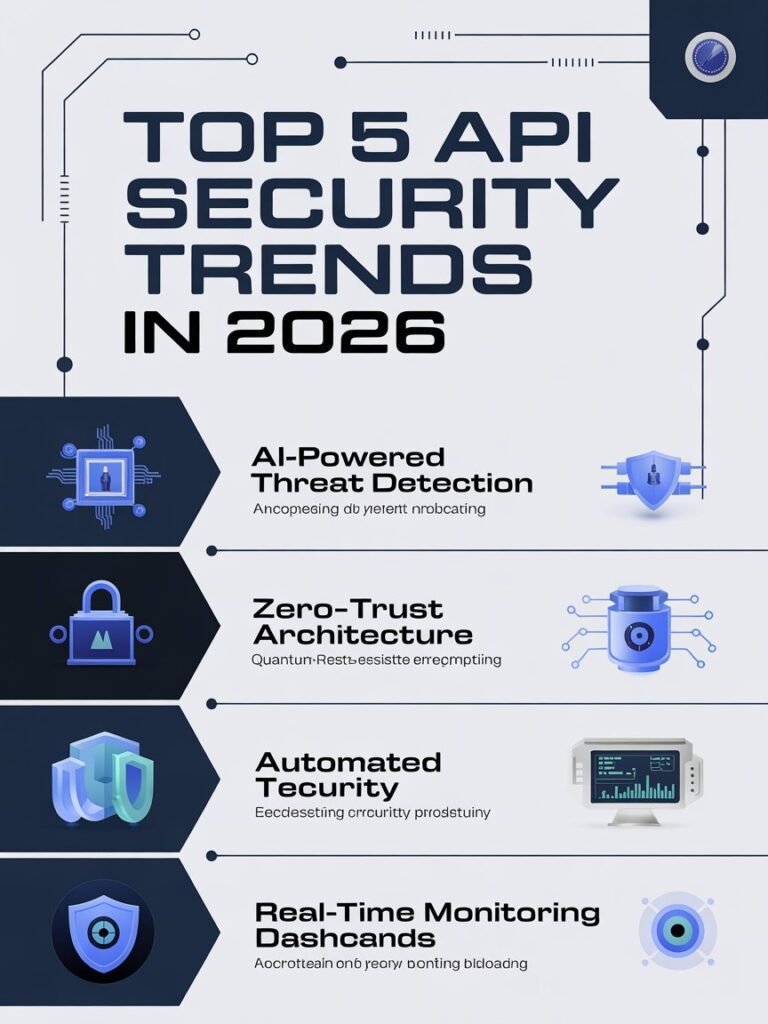
That’s the backdrop. Here are the five trends actually shaping api security in 2026.
For a while, “AI-powered security” was mostly marketing. Vendors slapped machine learning branding on rule-based tools doing the exact same thing they’d always done. If you were a developer or a security lead, you learned to tune out that kind of pitch.
2026 is different — and the difference is observable, not just claimed.
What changed is training data. Top api security vendors have accumulated years of real API traffic across enormous client bases. That data is making anomaly detection models genuinely useful. Not perfect, but useful in a way that matters. A platform watching millions of API calls per day across hundreds of clients builds real pattern recognition: what legitimate API behavior looks like across different industries, different app types, different user demographics. It can flag a scraping pattern in a retail API in Texas or a credential-stuffing attempt against a mobile payment gateway in Illinois without needing a pre-written rule to catch it.
This matters because traditional api security testing tool setups were always reactive. You could only catch what you already knew to look for. These newer ML-based systems surface unknown-unknown attacks — things nobody wrote a signature for because nobody had seen them before.
There’s also a practical integration story. Modern api test automation framework platforms now include adversarial simulation driven by ML. Instead of running a fixed checklist of known vulnerability tests, these tools generate novel attack scenarios based on your specific API structure. They’re asking: “Given how this endpoint is built, what’s the weirdest thing an attacker might try?” That’s a fundamentally different question than “does this endpoint have SQL injection protection?”
For a Chicago company running a mobile payment system through a fleet of APIs, this matters enormously. Millions of transactions. Constant probing from automated bots. A human team physically cannot review that at the required speed. An ML system watching for behavioral deviation — a single token pulling data volumes it’s never pulled before, auth requests cycling in patterns that match no real user flow — catches things that would otherwise bleed on for weeks. Like what happened to Marcus.
If you’re working with a software development team on new product builds, asking “where does ML-based API behavioral monitoring fit in your security stack?” is a fair architecture-stage question in 2026. Not a stretch. Standard.
The owasp api security top 10 2026 update isn’t revolutionary. It’s corrective. And that’s exactly what makes it important.
Broken Object Level Authorization. Broken Authentication. Unrestricted Resource Consumption. Server-Side Request Forgery. These aren’t new categories. They’ve been on previous versions of the OWASP list. But the updated 2026 framework reflects how these issues are manifesting in real attacks today, with specificity earlier versions lacked.
Take Broken Authentication. The 2026 guidance gets specific about token misuse in ways earlier versions glossed over. The question isn’t just “do you have authentication?” It’s about how to use api token management in a way that actually limits blast radius when a token gets stolen. Proper scoping, short expiration windows, rotation policies, monitoring for tokens used from unexpected locations or making unusual call sequences. Developers who built their auth flows three or four years ago and haven’t revisited them are carrying real debt here.
Unrestricted Resource Consumption shows up constantly in the api security stats 2026 data. When people think about how to hack api endpoints, they often picture sophisticated exploits. A lot of real attacks are boring: hammer an unprotected endpoint with high-request volume, either to extract data slowly or degrade service. Without rate limiting, request quotas, and consumption monitoring, your API is handing attackers a frictionless path.
SSRF — Server-Side Request Forgery — has become more prevalent as microservices architectures spread across US tech companies. When your API can be tricked into making server-side requests to internal services not meant to be externally reachable, an attacker doesn’t need to crack your perimeter. They walk through it by manipulating your own API into fetching internal resources on their behalf. Companies running complex microservices stacks in Washington, Colorado, and California are particularly exposed here.
The category that blindsides teams most often is Improper Inventory Management. Enterprises in New York, Texas, and California run systems with more APIs than any one person has a complete picture of. Version 1 of a product gets superseded by Version 2, but Version 1’s endpoints aren’t properly shut down — still live, still accessible, just unmonitored. The same way tools inspired by apis like project honeypot helped expose unknown HTTP activity, the 2026 security conversation demands full API inventory visibility as a baseline.
For teams running quality assurance pipelines, the practical ask is direct: does your QA coverage include owasp api security top 10 2026 validation, or only functional testing? If it’s just functional, you’re shipping with known-category security gaps.
Zero Trust has been a buzzword long enough that it’s started to lose meaning. Most people associate it with network segmentation and identity management — which are real — but for 2026, the conversation has moved to applying Zero Trust principles at the individual API transaction level.
Every API call gets contextually evaluated, not just authenticated.
Old model: token valid? Pass the request. New model: token valid AND does this token have scoped permission for this specific resource AND does this request pattern match previous behavior for this token AND is the calling context — device, location, time, request volume — consistent with what we’ve seen before? If something doesn’t fit, you hold it, verify it, or reject it.
This is a meaningful change because most api security vulnerabilities in 2026 aren’t “attacker broke encryption.” They’re “attacker got hold of a valid token through phishing, credential stuffing, or a leaked secret in a repo, and then used that valid token to quietly pull data for weeks.” Zero Trust at the API level closes that window. A valid token used anomalously still gets flagged.
For healthcare companies — concentrated across Massachusetts, Minnesota, Pennsylvania, and the Mid-Atlantic — this is pressing specifically because of HIPAA’s interpretation in a world of cloud-based patient data access. Patient records flowing through APIs to mobile apps, portal integrations, and third-party analytics tools represent enormous liability if a compromised token can freely roam through all connected endpoints.
For mobile payment systems and fintech APIs, a single token misconfiguration can expose transaction histories for thousands of users. Contextual Zero Trust validation isn’t overkill there. It’s basic due diligence.
The practical challenge in adopting Zero Trust at the API layer is legacy architecture. If your API gateway does simple token validation and routing, adding contextual policy enforcement requires either upgrading your gateway or adding a purpose-built API security layer in front of it. Neither is trivial, but both are achievable with a clear plan.
Teams building new platforms with mobile app development partners should ask for Zero Trust-compatible API designs from the start. Retrofitting it later always costs more.
The phrase “shift left” has been floating around developer circles for years. In 2026, it’s finally real in the API security testing space, and the reason is partly practical, partly regulatory.
The practical side: catching an api security vulnerability during development costs a fraction of catching it in production. Time to fix, cost to fix, reputational exposure — all dramatically lower when you find the problem before it ships.
The regulatory side: California, New York, and Virginia are pushing interpretations of data security obligations that imply ongoing, process-integrated security testing — not just pre-launch pen tests. If your security posture relies on an annual third-party pen test to find API vulnerabilities, explaining that posture after a breach is going to be uncomfortable.
Shift-left security testing for APIs looks like this concretely: your CI/CD pipeline includes automated API security scanning as a standard step. Every commit touching an API definition, a controller, or an auth flow triggers a scan. The scan runs a targeted assessment against that endpoint — checking for OWASP-listed vulnerability categories, testing rate limit enforcement, validating authentication flows, probing data exposure boundaries.
Api test automation framework tools built for this use case have matured significantly. They consume your OpenAPI spec or discover endpoints through traffic analysis, then generate attack scenarios and run them automatically. No human writes the test cases. The framework generates them based on how your API is structured.
Trend micro deep security api integrations and similar enterprise-grade platforms have expanded their API-specific capabilities in response to exactly this demand. Enterprise clients in regulated industries across the US are requiring security tooling that fits DevSecOps workflows — not tools that sit outside them.
For companies building web development or ecommerce development platforms handling payment data or customer records, the direct question to ask your development partner is: where in the build pipeline does API security scanning happen? If the answer is “we do a review before launch,” that’s a gap, not a process.
The latest cyber security news keeps including breaches where the vulnerability was something a shift-left scan would have caught before a single customer record was ever exposed.
Out of everything on this list, shadow API management causes the most damage the most quietly. It’s also the one least covered by traditional security tooling.
Shadow APIs are endpoints your security team doesn’t know about. Usually not hidden maliciously — they accumulated naturally. A deprecated product version whose endpoints nobody formally shut down. An internal admin tool a developer exposed through the main API gateway for convenience. A third-party integration that went live under deadline pressure without a security review. A microservice spun up for a one-time data migration that never got taken down.
Marcus, the Nashville guy from the start of this piece? Shadow API. A deprecated scheduling integration endpoint that sat live and unmonitored for eight months after the integration itself was replaced. Someone found it, probed it, and pulled patient data through it for six weeks before anyone noticed.
The global trends in api security 2025-2026 are unambiguous: shadow APIs are among the most actively exploited api security vulnerabilities right now. Attackers specifically look for them because the security logic is obvious — teams monitor what they know about. If an endpoint isn’t in the inventory, it’s not in the monitoring stack. No monitoring means no alerts when something starts going wrong.
The 2026 api security trends report data from multiple top api security companies shows API discovery — continuously cataloguing every active endpoint through traffic analysis, code scanning, and cloud infrastructure inspection — has become one of the fastest-growing investment categories in enterprise security budgets across California, Texas, New York, and Florida.
What solid API discovery looks like: automated, continuous, infrastructure-aware. Not a manual spreadsheet exercise done once a year. Your discovery tooling should watch your cloud infrastructure in real time, flag new endpoints the moment they appear, surface endpoints that have gone quiet, and alert on endpoints receiving traffic that doesn’t match their documented purpose.
Tools inspired by the detection philosophy behind apis like project honeypot extend this further — deploying intentional decoy endpoints alongside your real infrastructure to catch unauthorized probing before it reaches actual data. If something starts poking at your honeypot endpoints, you know what to look for in your real API logs.
For companies running IoT development or blockchain development platforms, the shadow API surface is particularly complex. Every device in a connected network and every node in a decentralized system has its own API interface. Full inventory visibility across that kind of distributed architecture requires purpose-built tooling — not manual reviews and spreadsheets.
Emerging cyber threats report data from 2025 into 2026 points squarely at this gap as a primary attack vector. Companies getting ahead of it are treating API discovery as infrastructure monitoring, not a periodic audit.
Read across these five areas and the through-line is visibility.
AI threat detection gives you visibility into behavioral anomalies. The owasp api security top 10 2026 gives your team a visibility framework for known vulnerability categories. Zero Trust at the API layer gives you visibility into whether authenticated requests are behaving legitimately. Shift-left testing gives you visibility into vulnerabilities before they reach production. API discovery gives you visibility into your actual attack surface.
Every single one of these api security trends 2026 is addressing some version of the same root problem that hit Marcus: not knowing what you have, not knowing what it’s doing, not knowing when something’s wrong.
The api security stats 2026 from breach post-mortems tell the same story repeatedly. Companies that got hit weren’t necessarily cutting corners on budget. They had endpoint detection, firewalls, encryption. What they lacked was complete visibility into their API layer. And attackers found the gaps they couldn’t see.
For businesses across every US state — healthcare in Minnesota, payments in New York, logistics in Georgia, SaaS in Colorado — the api trends 2026 aren’t abstract future considerations. They’re decisions being made right now that will show up either in security posture or in breach costs over the next 12 to 24 months.
The api security trend that matters most for 2026 isn’t about any single product category. It’s about closing the visibility gap before someone else finds it for you.
At Asapp Studio, security isn’t a separate workstream bolted onto development — it’s built into how we build. Our teams across mobile app development, web development, software development, and artificial intelligence integration carry API security considerations into architecture decisions, not just pre-launch review checklists.
Our quality assurance team includes API-specific security validation as part of the QA process. Our IT support team helps clients understand and monitor their API exposure on an ongoing basis — not just at initial deployment.
We’ve worked with clients in healthcare, fintech, e-commerce, and enterprise software on exactly these problems. If you want an honest conversation about where your current API setup stands and what’s actually worth prioritizing first, reach out to our team. We’re based in Temecula, California and work with clients across the United States.
The api security trends 2026 picture isn’t complicated, even when the technical specifics can be. Know your API surface completely. Test security continuously in your build process. Apply contextual validation to every API call. Keep your authentication flows tight and your tokens well-managed. Build monitoring that catches behavioral anomalies before they become six-week bleeds.
The global trends in api security 2026 point at organizations treating these as operational basics — not advanced initiatives. The difference between companies that are ahead on this and companies that aren’t mostly comes down to whether they’ve prioritized visibility across their API inventory, build pipeline, and runtime monitoring stack.
The latest cyber security news will keep moving. The recent trends in cyber security will keep shifting toward API-specific attacks because the opportunity there keeps growing. What stays constant is the fundamentals: know what you’re running, test how it behaves under attack, monitor what uses it, and kill what you don’t need.
Marcus spent $340,000 learning that. You don’t have to.
For more on building secure, modern software, explore what we do at Asapp Studio across our full services lineup and read more on our blog.
Q1. What are the Top 5 API Security Trends in 2026?
AI behavioral threat detection, OWASP API Security Top 10 2026, Zero Trust at the API transaction level, shift-left pipeline security testing, and shadow API discovery and management.
Q2. What is the OWASP API Security Top 10 2026?
Updated framework listing the most critical api security risks — broken auth, SSRF, improper inventory, unrestricted resource consumption — guiding real developer security priorities for 2026.
Q3. What are the biggest api security vulnerabilities in 2026?
Shadow APIs, broken authentication, SSRF, excessive data exposure, and absent rate limits are the most exploited api security vulnerabilities found in real-world US company breaches this year.
Q4. How does Zero Trust improve API security in 2026?
Zero Trust validates each API call contextually — scoping, behavior history, device trust — so a stolen valid token can’t silently pull data by blending in with legitimate traffic undetected.
Q5. Why does shadow API discovery matter for api security in 2026?
Untracked endpoints sit entirely outside monitoring stacks. Attackers find and exploit them because nobody’s watching. Discovery removes that blind spot before it becomes a breach.