
Let me tell you something most development agencies will not say out loud.
There is no universally “correct” answer to the Cross-Platform vs. Native 2026 debate. Anyone who tells you otherwise is either selling you something or has not shipped enough apps to know better.
I have seen Flutter apps outperform rushed native builds. I have also seen React Native apps fall apart under load while a tightly written Swift app handled the same task without breaking a sweat. Both scenarios are real. Both happen on actual client projects with actual budgets and actual deadlines.
So instead of giving you the standard “it depends” answer and calling it a blog post, let’s get into what it actually depends on — and why those variables matter more in 2026 than they did even two years ago.
If you last researched this topic in 2021 or 2022, throw most of that out.
React Native went through a complete architectural overhaul. The old JavaScript bridge that caused performance headaches in production? Gone. The New Architecture — JSI, Fabric, TurboModules — is stable and shipping. Apps that would have stuttered on the old React Native now run smooth.
Flutter swapped out its Skia rendering engine for Impeller. The practical result is more consistent frame rates, especially on iOS. Flutter 3.x and into the 4.x cycle has become the default recommendation at a lot of serious mobile studios across the US.
Swift is still the gold standard for iOS. Apple keeps pouring resources into it. SwiftUI has matured to the point where building complex, polished iOS interfaces no longer requires falling back to UIKit for half the screens.
Kotlin on Android has become similarly strong. Jetpack Compose — Kotlin’s declarative UI framework — is now the recommended way to build Android UI. It changed how Android development feels. Faster to write, easier to read, dramatically less boilerplate.
The point is: mobile app development trends 2026 are not about one framework winning and another dying. It is about a landscape that is more capable across the board than it has ever been. That actually raises the stakes on choosing the right approach, because you can no longer blame the tools when something goes wrong.
Native means building one app for one platform, in that platform’s preferred language and toolchain.
For iOS, that is Swift — optionally with SwiftUI for the UI layer, or UIKit if you are working with an older codebase. For Android, that is Kotlin — with Jetpack Compose as the current standard for new UI work.
When you go native, you get a few things no cross-platform framework can fully replicate.
Direct API access. Every new iOS or Android feature Apple or Google ships — new sensors, new gestures, new OS-level capabilities — is available to you immediately. You are not waiting for Flutter or React Native’s ecosystem to wrap it.
Platform behavior baked in. iOS navigation patterns, haptic feedback timing, the feel of a UITableView with its characteristic scroll momentum — these things are in the platform DNA. When you write in Swift, you inherit them naturally.
No abstraction ceiling. Cross-platform frameworks have limits. When you push hard enough on performance — real-time video processing, complex on-device ML, demanding graphics rendering — native is where you end up regardless. The abstraction layer always has a ceiling.
Where does native fall short? The development cost comparison is significant. Building a quality iOS app in Swift and a quality Android app in Kotlin means running two separate engineering workstreams. Two code reviews. Two test suites. Two sets of release pipelines. For a startup burning runway in San Francisco or a small product team in Chicago, that cost is real.
Our iOS App Development and Android App Development teams at Asapp Studio have shipped native apps for clients across healthcare, fintech, and logistics. The pattern is consistent — native is the right call when performance, hardware access, or platform-native UX is genuinely non-negotiable for the product to work.
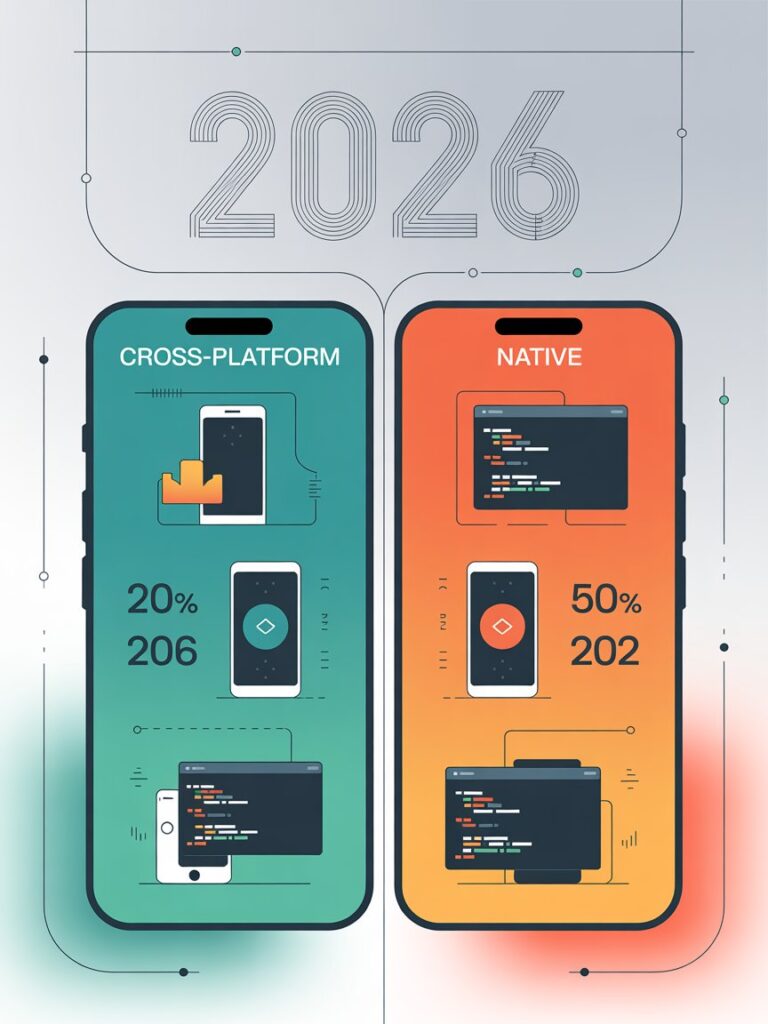
Cross-platform mobile development is a broad term. In 2026, when someone says cross-platform, they almost always mean Flutter or React Native. Not Ionic. Not Cordova. Those are a different category.
Flutter and React Native are not the same as old hybrid apps. They do not run in a WebView. They are not glorified websites inside a wrapper. They produce compiled binaries that ship to the App Store and Google Play just like native apps do.
React Native runs JavaScript on the device and communicates with native components through what used to be a bridge — and is now a much tighter JSI interface. Your UI is composed of actual native iOS and Android components. The logic runs in JavaScript. The rendering is native.
Flutter is different. It does not use native UI components at all. It draws every pixel itself using its own GPU-accelerated rendering engine. What this means in practice: a Flutter app looks identical on iOS and Android — for better or worse. It is not rendering UIButtons or Android Views. It is drawing its own buttons, its own text, its own everything.
Both approaches work. They just have different personalities.
Cross platform app development makes the strongest case when your product needs to be on both iOS and Android from day one, your team is unified rather than split into platform-specific silos, and your app’s core value is in data, workflow, or content rather than pushing hardware to its limits.
At Asapp Studio, we have dedicated React Native App Development and Flutter App Development teams. Both can deliver production-quality apps that real users on both platforms enjoy using.
Forget the abstract debate. Here are the six areas where the choice between native vs cross platform mobile app development creates real differences in real projects.
For the majority of apps, the performance difference is not something your users will ever notice.
A well-built Flutter app and a well-built Swift app will both render at 60fps, respond instantly to taps, and scroll smoothly. A poorly built version of either will stutter and frustrate users. The quality of engineering matters more than the framework.
Where native still has a genuine edge: the performance ceiling. Building a competitive mobile game with real-time physics and particle systems? Go native. Building a computer vision app doing frame-by-frame analysis on the camera feed? Go native. Doing complex audio processing in real time? Go native.
Building a delivery tracking app, a patient intake form, a B2B dashboard, or an eCommerce storefront? You are nowhere near the performance ceiling of Flutter or React Native. The argument that cross platform vs native performance represents a dramatic gap has been outdated for two years. The real question in 2026 is: how close to the ceiling does your specific app need to get?
Building two native apps is not twice as expensive as building one. It is typically 1.6x to 2x — because some work is shared (backend, APIs, design) but most of the actual coding is duplicated.
Here is a rough picture for a mid-complexity app built by a US-based or US-quality agency:
| Development Path | Estimated Range | Timeline |
| iOS only (Swift) | $45,000 – $120,000 | 3–5 months |
| Android only (Kotlin) | $40,000 – $110,000 | 3–5 months |
| Both platforms native | $75,000 – $220,000 | 5–9 months |
| React Native (both platforms) | $50,000 – $140,000 | 3–6 months |
| Flutter (both platforms) | $45,000 – $130,000 | 3–5 months |
The cross-platform savings are real — typically 30 to 45 percent for a full two-platform build. But they are not free money. You pay for them in slightly less platform-native behavior and occasionally in slower first-access to new OS features.
For a startup in Austin or Denver with $100,000 to build their MVP, the math strongly favors cross-platform. For a Series B company in New York with an established user base and experience standards, native may be worth every additional dollar.
iPhone users are trained, often subconsciously, to expect iOS interactions. The spring physics on scroll. The way the keyboard dismisses. How alerts look. The status bar behavior. When these micro-interactions are wrong — even slightly — users feel it without knowing why. They just describe the app as “feeling off.”
Android users have their own expectations — different, but just as ingrained. Material Design ripple effects on taps. Back gesture behavior. Navigation patterns.
Native apps are right by default. You inherit these behaviors from the platform.
Cross-platform apps are right when you explicitly write them to be right. Flutter requires intentional work to respect platform conventions because it draws its own UI. React Native uses actual native components, so many conventions come automatically, but edge cases still need attention.
The user experience differences in mobile apps built native vs. cross-platform are not about big dramatic failures. They are about the 50 small moments per session that either feel natural or slightly awkward. Over a thousand sessions, awkward adds up to lower retention.
Apple ships a major iOS update every September. Google ships Android major updates on a similar cadence. Both introduce new APIs, deprecate old ones, change security requirements, and sometimes break existing behavior. Maintaining your app means keeping up with all of this.
With two native apps, you are maintaining two codebases. A bug fix needs to be written, tested, and deployed twice. Keeping up with new OS requirements means two separate engineering efforts. Teams with iOS and Android native apps frequently fall into a pattern where one platform lags the other on updates.
With a cross-platform app, you fix the bug once. You update the framework package once. You deploy to both stores in parallel. The app maintenance challenges are roughly halved — not zero, but genuinely reduced.
The one exception: when a cross-platform framework is slow to support a new OS API, you wait. If Apple announces a compelling new feature and you want it in your app by launch day, a native Swift app can have it faster than a Flutter app waiting for the Flutter team to expose that API.
Before deciding on iOS vs Android development focus, check your data.
In the US, iOS market share runs around 55 to 57 percent as of 2026. But it is not evenly distributed. Urban, tech-forward markets — San Francisco, New York, Boston, Seattle — skew heavily toward iOS. Rural markets and lower-income demographics skew toward Android. The 18 to 34 demographic in the US is nearly 65 percent iPhone.
If your target users are professionals in Chicago or students in Los Angeles, you probably need iOS first. If you are building for a broad national audience including users across the Midwest and Southeast, Android coverage is critical.
Most serious B2C products in the US need both platforms. Which circles back to the cost question — and why cross-platform is such a practical choice for reaching the full US market without doubling the engineering budget.
For developers making the decision, here is the practical reality of cross platform mobile programming in each framework.
Flutter (Dart): Dart is not a language most developers come in knowing. There is a ramp-up period. But Dart is clean, strongly typed, and genuinely enjoyable to write once you are past the first two weeks. Flutter’s widget tree is logical, and hot reload makes the development cycle fast. The biggest developer complaint is usually build times on older machines.
React Native (JavaScript/TypeScript): If your team writes React for web, the mental model transfers quickly. Components, props, state, hooks — it is all familiar. Pain points are around native modules, dependency management, and debugging issues that cross the JS/native boundary. TypeScript is essentially mandatory for any serious React Native project.
Cross platform swift is worth addressing here — Apple has made Swift open-source and available on Linux, and there are efforts to use Swift on the server and even on Android. But cross platform swift has not emerged as a serious cross-platform mobile development path the way Flutter or React Native has. When most developers reference cross platform swift, they mean using Swift across multiple Apple platforms (macOS, iOS, watchOS, tvOS) rather than true cross-platform mobile development targeting both iOS and Android.
If cross-platform is the right call for your project, you still need to pick between the two primary options.
Backed by Meta. Used in production by Instagram, Shopify, and Microsoft Teams at massive scale. The JavaScript ecosystem is its greatest asset — npm has packages for nearly everything. Hiring React Native developers is easier than hiring Flutter developers because the JavaScript talent pool is much deeper.
React Native’s New Architecture is production-stable in 2026. The old bridge that caused performance complaints in 2019 and 2020 is gone. If you have an older React Native app still on the legacy architecture, migration is worthwhile.
Best suited for content-heavy apps, eCommerce, social platforms, enterprise tools where your team already knows React.
Backed by Google. Used in production by Google Pay, eBay Motors, and the BMW app. Dart’s strong typing and Flutter’s widget system create a codebase that scales cleanly — large Flutter codebases tend to be easier to navigate than large React Native codebases at the same level of complexity.
Flutter’s Impeller rendering engine delivers consistently smooth animations across devices. The testing tooling is exceptional. Compile-time type checking catches bugs before they reach production.
Best suited for brand-forward consumer apps, fintech, B2B dashboards, any project where UI consistency across iOS and Android is a design requirement.
For new projects with no prior framework investment, Flutter is our default recommendation at Asapp Studio. Performance, developer experience, and long-term maintainability all score well. React Native is the recommendation when existing JavaScript expertise or deep npm ecosystem dependencies are significant factors.
The phrase cross platform native apps sounds contradictory. It is not.
Cross-platform refers to the fact that one codebase runs on multiple platforms. Native refers to the performance and distribution characteristics — compiled binaries, native or near-native rendering, published through official app stores, able to access device hardware.
Flutter apps are cross-platform native apps. React Native apps are cross-platform native apps. Neither is a website. Neither runs in a browser. Both produce real mobile applications that pass App Store and Google Play review, run at native speeds, and access device capabilities.
The opposite of cross-platform native is hybrid — which refers to Ionic or Capacitor apps that wrap web content in a native shell. Those are a different category and generally not recommended for consumer-facing products in 2026.
Hybrid app frameworks like Ionic and Capacitor are frequently confused with React Native and Flutter, and the confusion matters.
A hybrid app runs web code inside a native container. The UI is HTML, CSS, and JavaScript rendered in a WebView. These apps can reach both platforms from one codebase, but they carry the overhead of web rendering and often lack the polish of genuinely native interfaces.
React Native is not a hybrid app. Flutter is not a hybrid app. Both produce real, compiled mobile applications.
Hybrid frameworks still have use cases — internal tools, simple utilities, rapid throwaway prototypes. But for anything customer-facing or performance-sensitive, they are the wrong tool in 2026.
Here is what the market looks like in practice across the country.
Early-stage startups across California, Texas, and Florida are choosing Flutter or React Native at a very high rate. Budget and speed to market drive this. A founder in Miami or Austin can launch on both platforms for roughly what native iOS alone would cost.
Healthcare apps — especially in states with strict HIPAA compliance standards like New York, California, and Illinois — often lean native, particularly where the app interfaces with medical devices, processes sensitive biometric data, or needs precise certainty about OS-level security behavior.
Retail and eCommerce apps are overwhelmingly cross-platform. Flutter and React Native handle product catalogs, cart flows, and checkout without issues. There is no performance or UX reason to pay double for native in this category.
Enterprise productivity apps for companies in Washington, Virginia, and the Northeast tend toward React Native because of existing JavaScript/TypeScript investment and easier integration with enterprise tooling ecosystems.
Gaming and AR applications — native wins, full stop, regardless of state or budget.
Our Mobile App Development services cover all of these categories. Our broader Software Development team works with businesses at every stage, from first MVP to enterprise-scale products.
Stop overthinking it. Run through these five questions.
Does your app need to do something computationally intense — real-time graphics, AR, heavy on-device ML, advanced audio processing? Yes → Native. No → Keep reading.
Do you have the budget and team bandwidth for two separate codebases long-term? Yes → Native is viable. No → Cross-platform.
Is shipping to both iOS and Android within the same 6-month window a real business requirement? Yes → Cross-platform. No → Could go either way.
Does your team have deep expertise in one framework already? React team → React Native. Flutter/Dart experience → Flutter. iOS background → Swift native. Android background → Kotlin native.
How tightly does your app need to track new iOS or Android features the day Apple or Google ships them? Very tightly → Native gives you first-mover access. Moderate → Cross-platform handles this fine.
Run through these five questions honestly and the answer usually becomes clear. If you want a second opinion on your specific situation, our team at Asapp Studio will give you a straight answer.
Here is where we land after all of it.
Native is the right answer when performance ceiling, platform-native UX, or first-mover access to new OS capabilities is a genuine product requirement — not a preference, an actual requirement. The cost premium is real and it is worth paying when those factors are genuinely required.
Cross-platform is the right answer for most apps most teams will build. Flutter in particular has closed the quality gap with native to the point where the distinction is largely academic for the majority of use cases. The cost savings are meaningful. The maintenance story is better. The team unity of a single codebase is an underrated practical advantage that compounds over time.
The answer is not the same for everyone. A healthcare startup in Boston building a device-integrated patient monitoring app needs a different approach than a retail brand in Los Angeles launching a loyalty and shopping app. Cross platform app development vs native is a decision that needs to be made with real product requirements on the table.
At Asapp Studio, we have built apps in Swift, Kotlin, Flutter, and React Native. We do not have a financial preference — we have a quality preference. We build in the stack that is right for what you are building, and we will tell you honestly if you are heading toward the wrong choice.
Explore our Cross Platform App Development, Flutter App Development, React Native App Development, iOS App Development, and Android App Development services — or reach out directly and tell us what you are trying to build.
Q1: What is the main difference between cross-platform and native mobile app Development?
Native targets one platform — iOS via Swift, Android via Kotlin. Cross-platform uses one codebase for both. Native gives deeper platform access; cross-platform saves time and budget significantly.
Q2: Is Flutter better than React Native for new projects in 2026?
Flutter offers stronger UI consistency and performance. React Native suits JavaScript teams well. Flutter is the default pick for new projects unless your team has deep existing React expertise.
Q3: How much cheaper is cross-platform app development compared to native?
Cross-platform typically costs 30 to 45 percent less than two separate native builds. A dual-platform cross-platform app in the US ranges from roughly $45,000 to $140,000 depending on complexity.
Q4: Do cross-platform apps perform as well as native apps in 2026?
For most apps, yes. Flutter and React Native’s New Architecture deliver near-native performance. Only extreme computational needs — games, AR, real-time processing — genuinely require fully native development.
Q5: Which approach is better for US startups with a limited budget?
Cross-platform wins for budget-constrained startups. One codebase reaches both iOS and Android simultaneously, cutting cost and timeline while still delivering a quality product users will enjoy.