
Picture a retail company in Dallas. They’re on a platform that has been running for six years. Their Black Friday traffic doubles every year, and every year their checkout slows to a crawl. Their marketing team wants to run personalized homepage banners by customer location, but engineering says that’s a two-month project. They want to add Buy Now Pay Later — another quarter of work.
The platform does everything. And that’s the problem. When one thing needs to change, everything else is in the way.
That’s the exact situation composable commerce architecture was built for.
Composable commerce is a way of building your commerce stack where you stop trying to find one platform that handles everything and instead pick the best individual tool for each job. One tool for search. One for checkout. One for pricing. One for content. Each does its job well. Each talks to the others through APIs. None of them cares what the others are built on.
Gartner gave this a formal name — packaged business capabilities, or PBCs. The idea is that individual, interoperable commerce services can be assembled the way you’d assemble a team of specialists rather than hiring one person and expecting them to be great at everything.
By 2026, this has gone from a trend to a standard. Retailers across the U.S. — from New York department stores to California DTC brands to Texas industrial distributors — are running composable stacks in production. It’s not experimental anymore. It’s how serious commerce gets built.
Ask a developer what composable commerce is, and they’ll say microservices and APIs. Ask a CFO, and they’ll say vendor independence and cost control. Ask a VP of Digital, and they’ll say speed — specifically, how fast their team can ship new customer experiences without filing a ticket and waiting six weeks.
They’re all right. But from a proper enterprise architecture perspective, the composable commerce definition is this: a strategy for building and operating commerce platforms where individual business capabilities — each with its own data, its own logic, its own API — can be deployed, replaced, or upgraded without touching anything else.
That last part matters more than most people realize. In a traditional setup, changing your promotions engine could break your cart. Upgrading your search could cascade into checkout failures. In a well-built composable architecture, none of that is possible because the services don’t share a codebase. They share nothing except API contracts.
The composable architecture meaning in enterprise IT circles is the same principle applied across all software: stop building systems where everything depends on everything else. Build them so each piece can live, breathe, and be replaced independently.
For a retailer running stores in Georgia, an e-commerce site for California customers, and a B2B wholesale portal for Texas buyers — what does composable commerce mean practically? It means all three channels can run from the same backend PBCs through the same APIs while each one has its own frontend, its own pricing logic, and its own customer experience — all managed independently.
Here’s the thing about composable architecture meaning that gets lost in vendor marketing: it’s not a product you buy. It’s a way of thinking about software.
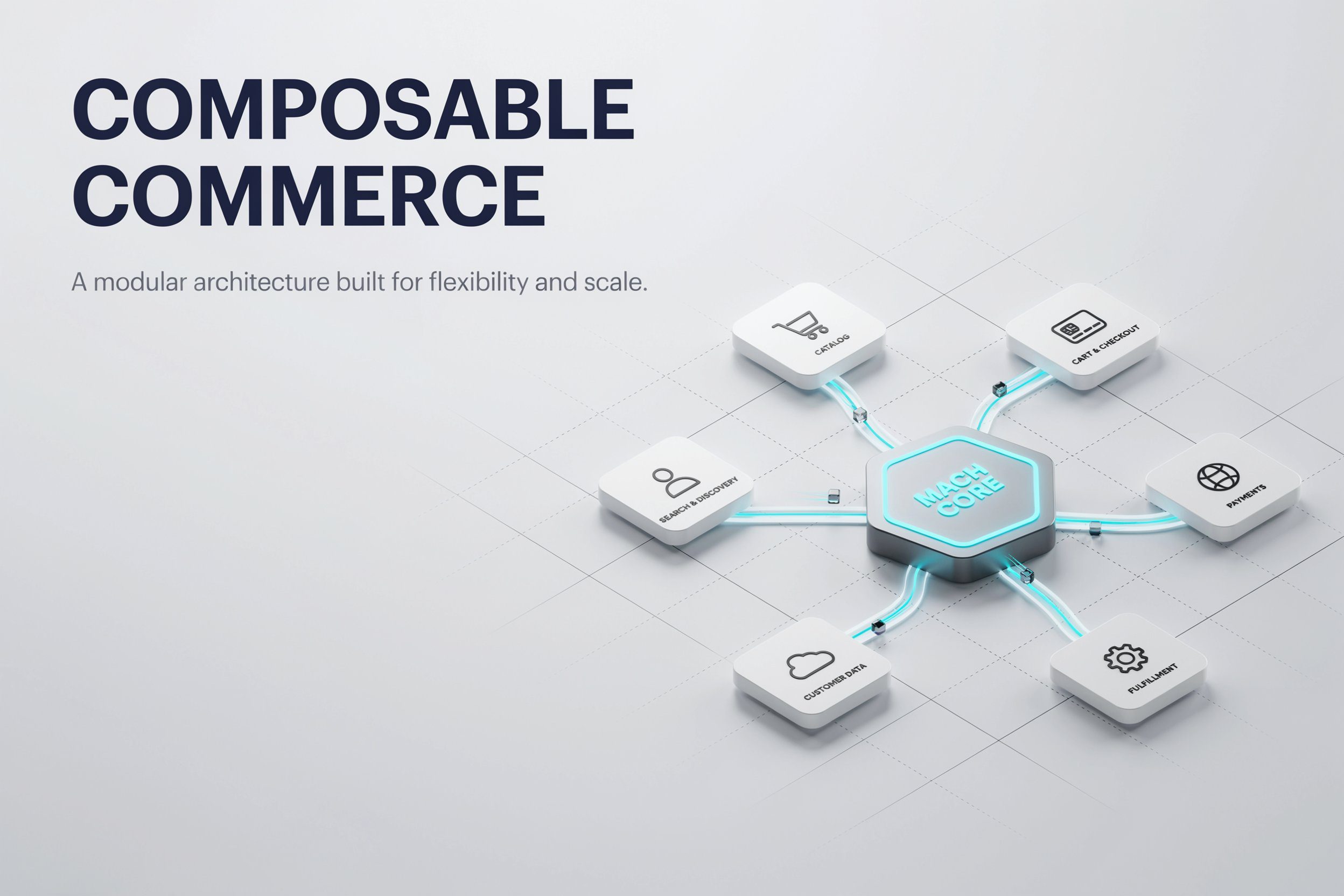
What is a composable architecture? It’s a system design philosophy where software is assembled from loosely coupled services, each accessible through clean APIs, each independently functional. No service directly depends on another’s internal workings. They communicate through agreed-upon contracts.
What does composable architecture mean in day-to-day commerce work? Your search index doesn’t know what payment processor you use. Your CMS doesn’t know anything about your pricing tiers. Your loyalty program can be ripped out and replaced without your checkout noticing. Every piece is self-contained and replaceable.
This sounds obvious when you say it out loud. But the majority of commerce platforms — especially the ones U.S. businesses have been running for the past decade — were built the opposite way. Everything is shared. Everything is coupled. Everything is fragile together.
What is composable commerce if not the correction to that? It’s building software the way software should always have been built, applied specifically to the commerce problem.
You will hear MACH architecture constantly when researching composable commerce. Here’s what the acronym actually means and why it matters:
M — Microservices. Every function is a small, independently deployable service. Cart, checkout, search, pricing — each is its own thing, deployed on its own schedule, scaled independently.
A — API-first. Every capability is accessible through a well-defined API. There are no back doors, no shared databases, no direct function calls between services. Everything goes through the API layer.
C — Cloud-native. Infrastructure runs on the cloud and takes full advantage of it — auto-scaling, managed databases, serverless compute, global distribution. Not just cloud-hosted. Cloud-native.
H — Headless. The customer-facing storefront is completely decoupled from the backend commerce logic. The frontend is its own application that talks to the backend through APIs, nothing more.
The MACH Alliance — an industry body of vendors, agencies, and integrators — exists to maintain these standards and certify that its members actually build this way.
MACH architecture e-commerce has been the technical backbone of composable commerce builds since roughly 2020. By 2026, MACH principles aren’t a differentiator anymore. They’re the floor. A vendor that isn’t API-first and cloud-native isn’t keeping up.
Understanding MACH architecture lets you ask the right questions when evaluating platforms: Is this service truly API-first design? Does it scale independently as a microservice? Can I replace it without the rest of my stack caring?
These two terms get used interchangeably. They shouldn’t be.
Here’s the core MACH architecture vs composable commerce differences in plain terms:
MACH architecture is a set of technical engineering standards. It describes how individual software services should be built — as microservices, with API-first design, on cloud-native infrastructure, with a headless frontend.
Composable commerce is a business and platform strategy. It describes how a commerce platform should be assembled — by selecting best-of-breed PBCs and connecting them rather than buying a bundled solution.
A composable commerce stack is almost always built from MACH-compliant components. But composable commerce is the bigger idea — it’s about the assembly strategy, not just the engineering standards of the components.
| MACH Architecture | Composable Commerce | |
| What it governs | How individual services are built | How a full commerce platform is assembled |
| Who owns the standard | MACH Alliance | No governing body |
| Scope | Engineering principles | Business and architectural strategy |
| 2026 Status | Industry baseline expectation | Mainstream enterprise standard |
The practical takeaway for composable commerce vs MACH architecture decision-making: use MACH standards to evaluate the quality of individual components. Use composable architecture thinking to decide which components to pick and how they’ll work together.
Most teams reading this are on a monolith right now and feeling it.
A monolithic platform is one big codebase. Product catalog, checkout, promotions, search, customer accounts — all tangled together, all sharing the same deployment cycle. When you update promotions, you deploy everything. When a checkout has a bug, it touches everything. When the vendor releases an upgrade you don’t want, you either take the whole thing or you fall behind on security patches.
Composable vs monolithic commerce isn’t a close comparison in 2026:
The monolith:
The composable approach:
The honest part: composable commerce is more complex to set up. Nobody is pretending otherwise. But for any business that has hit the ceiling of what a monolith can do, it’s the right move — and the longer you wait, the bigger the migration becomes.
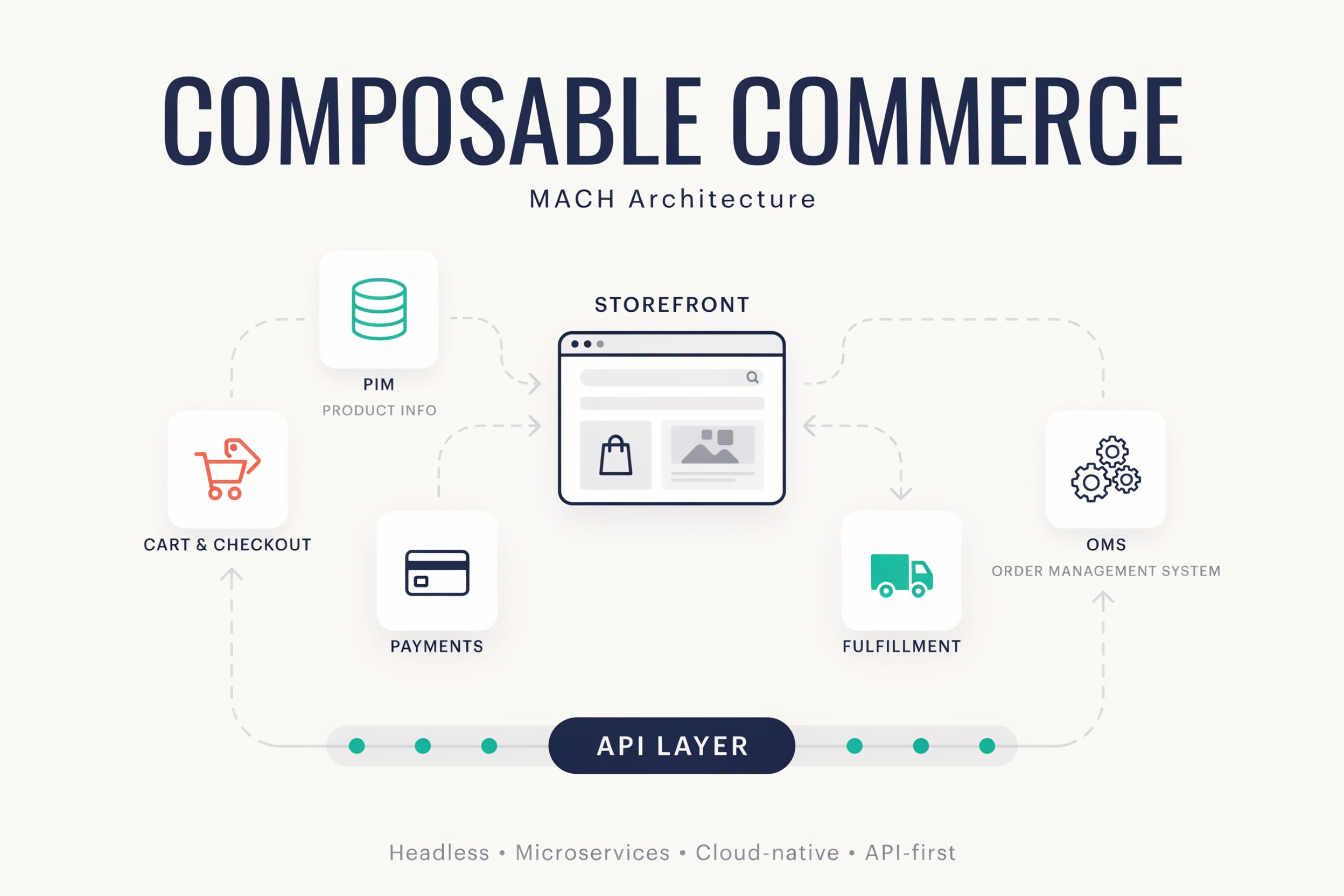
A composable commerce architecture diagram isn’t trying to show every vendor and integration. It’s showing the layers and how they talk to each other. Here’s how a production composable e-commerce platform is actually structured:
┌─────────────────────────────────────────────────────────────────┐
│ CHANNEL / STOREFRONT LAYER │
│ Web | Mobile App | In-store Kiosk | Voice | Social │
│ Jamstack / React / Next.js — headless storefront │
└──────────────────────────┬──────────────────────────────────────┘
│ API Requests
┌──────────────────────────▼──────────────────────────────────────┐
│ ORCHESTRATION / API GATEWAY │
│ Routes requests → manages auth → assembles responses │
│ Handles caching, rate limiting, cross-service error handling │
└──────────────────────────┬──────────────────────────────────────┘
│
┌──────────────────────────▼──────────────────────────────────────┐
│ PACKAGED BUSINESS CAPABILITIES (PBCs) │
│ │
│ [ Catalog / PIM ] [ Search ] [ Pricing ] [ Promotions ] │
│ [ Cart ] [ Checkout ] [ Payments ] [ Tax ] [ Shipping ] │
│ [ OMS / Fulfillment ] [ Inventory ] [ Returns ] │
│ [ CMS / Content ] [ Customer CDP ] [ Personalization ] │
│ [ Reviews ] [ Loyalty ] [ Retail Media ] │
└──────────────────────────┬──────────────────────────────────────┘
│ Events + APIs
┌──────────────────────────▼──────────────────────────────────────┐
│ CLOUD-NATIVE INFRASTRUCTURE │
│ AWS / Azure / GCP — containers, serverless, event streams │
└─────────────────────────────────────────────────────────────────┘
This composable commerce diagram makes the core architecture principle visible: layers communicate through APIs only. No service reaches directly into another service’s database. No shared monolithic business logic. Every PBC owns its own data and exposes it through an API. That’s the whole model.
The orchestration layer is what holds this together in production. It routes incoming requests from any channel to the correct PBC, assembles composite API responses, manages event flows, and handles failure gracefully when a downstream service is slow or unavailable.
Knowing the types of e-commerce architecture helps you understand where composable fits in the overall landscape:
Traditional Monolithic: Single codebase, single vendor, tightly coupled everything. Easy to launch, painful to scale. Most U.S. businesses built on legacy Magento, older Salesforce Commerce Cloud setups, or homegrown platforms fall here.
Headless Commerce Architecture: Frontend is decoupled from the backend commerce engine. The storefront communicates through APIs. Often the first step businesses take on the road to composable. You get frontend flexibility without full PBC separation.
MACH Architecture E-Commerce: Headless plus microservices, API-first design, and cloud-native infrastructure. This is the technical standard that the majority of serious composable builds are engineered to in 2026.
Composable Commerce Architecture: Best-of-breed PBCs assembled through APIs, with the freedom to select, replace, and upgrade individual services from different vendors. The most mature form of modern commerce architecture available today.
Microservices Commerce Architecture: The engineering implementation pattern underneath composable commerce — every function is a discrete, independently deployable service.
Most U.S. businesses in 2026 are somewhere on the journey between monolithic and fully composable. Very few jump all the way from a monolith to fully composable in one project. The typical path is headless first, then progressive PBC migration over 12–24 months.
What are the components of commerce in a real, production composable setup? Here’s the actual breakdown:
Headless Storefront — Digital Storefront Your customer-facing frontend, built on Jamstack or React-based frameworks like Next.js. Completely separate from your backend logic. Deployed to CDN edges globally, which means customers in California and Florida get the same sub-second load time. Fast load times affect Core Web Vitals, which affects your Google ranking.
Composable Architecture CMS Content lives in a dedicated headless CMS — Contentful, Sanity, or Storybook are the most common in the U.S. market. Your marketing team manages campaign content, landing pages, and seasonal banners through the CMS. None of that requires an engineering ticket. Content changes don’t touch commerce code.
Product Catalog (PIM) A product information management system — Akeneo is the market leader — manages catalog data, product attributes, digital assets, and taxonomy. It feeds product data to every channel through APIs.
Search and Discovery A standalone search PBC — Algolia or Constructor.io for most U.S. enterprise builds — handles site search and product discovery. The quality of your search directly affects conversion rates. This is one of the most impactful PBCs to get right.
Cart, Checkout, and Payments Separate, purpose-built services. A commerce engine like Commercetools or Elastic Path handles cart and checkout logic. Payment orchestration connects Stripe, Braintree, Klarna, Affirm, Apple Pay — whatever your actual customer base uses. Adding a new payment method is an API integration, not a platform change.
Order Management System (OMS) Handles fulfillment routing, split shipments across multiple locations, returns processing, and real-time inventory visibility. For U.S. businesses with warehouses in multiple states, the OMS is the service that keeps operations coherent. Fluent Commerce and Kibo are the most common choices.
Customer Data Platform and Personalization A CDP collects and unifies first-party customer data across every touchpoint. A personalization PBC uses that data to serve different content, product recommendations, and pricing to different customer segments — in real time, automatically, without manual merchandising work.
Commerce Orchestration The orchestration layer ties everything together. It routes incoming API requests to the correct PBC, assembles composite responses when a single page view needs data from five different services, manages event flows, and handles failures without cascading them across the whole stack.
The benefits of composable commerce architecture are showing up in real revenue numbers now, not just architecture diagrams. Here’s what U.S. businesses are actually reporting:
Shipping Features Faster When your checkout service is decoupled from your search service, your checkout team and your search team deploy on their own schedules. They don’t block each other. They don’t break each other. Commerce teams that have made this transition report releasing new features 40–60% faster than they did on a monolith. That’s not a theoretical number — it’s what teams in California, New York, and Texas are experiencing.
Scale Where It Matters Each PBC scales on its own. On Cyber Monday, your search and checkout scale up. Your CMS and loyalty engine stay at baseline. Cloud-native commerce means you pay for actual load, not for a monolith running at full capacity around the clock. For U.S. retailers with heavy seasonal traffic patterns, this is a significant operational cost improvement.
Real Vendor Independence This is the benefit U.S. enterprise buyers cite first, every time. If a vendor raises prices after an acquisition, stops innovating, or sunsets a feature you depend on — you replace just that PBC. The rest of your stack doesn’t know or care. Vendor lock-in avoidance is not an abstract benefit. It’s leverage you exercise in contract negotiations and platform strategy.
Omnichannel Without Rebuilding A single composable backend serves web, mobile, in-store kiosks, voice commerce, and social storefronts through the same APIs. You’re not maintaining parallel stacks for each channel. Adding a new channel is a frontend build, not a backend architecture project.
Personalization That Actually Works Clean Architecture makes personalization practical in a way it never was on a monolith. Serving different content and pricing to B2B buyers in Illinois vs B2C customers in Florida — that’s a configuration change, not an engineering project. Benefits of a composable architecture for e-commerce are most tangible right here: real personalization without real complexity.
Benefits of Composable Architecture for Enterprise Retail For large U.S. retailers specifically, the modular e-commerce architecture means teams stop blocking each other. Marketing runs campaigns independently. Merchandising updates catalog attributes without a deployment. Operations reconfigures fulfillment routing without touching the storefront. Every team moves at their own pace inside their own PBC.
Long-Term Cost Structure Year one of a composable build costs more than renewing a monolith license. Year two and three tell a different story. Independent service upgrades instead of full platform migrations. Vendor competition keeps pricing honest. Engineering time shifts from maintaining workarounds to building real features.
The challenges associated with implementing headless commerce solutions are real. Here’s the honest version.
Initial Build Complexity There is no single “install this” for a composable stack. You’re selecting, integrating, and configuring eight to twelve independent services. That takes planning. The composable commerce architecture diagram you design before the first line of code is written matters more than most teams expect. Get the architecture wrong at the start, and you’re rearchitecting mid-build — which is expensive and demoralizing.
Year-One Cost Best-of-breed vendors each have their own pricing. An enterprise composable stack — dedicated search, CMS, OMS, checkout engine, personalization tool, CDP — adds up. Year-one costs can exceed what an all-in-one platform renewal would have cost. The ROI comes in years two and three. That’s real, but it needs honest financial planning upfront.
Integration Burden APIs are the connective tissue of a composable stack. Connecting ten services reliably requires strong integration engineering — error handling, retry logic, event ordering, data consistency across services. None of that is automatic. It’s engineering work, and it needs to be scoped honestly.
Organizational Change This one surprises teams. Your content team now works in a headless CMS. Your merchandising team works in a PIM. Your promotions team works in a dedicated engine. People who were used to one platform are now using several. That’s a change management project, not just a technology migration.
Distributed Debugging When something breaks in a monolith, you check one place. When something breaks across ten services, you need distributed tracing to find where in the chain it started. That requires proper observability tooling — and the discipline to instrument everything from the beginning.
Working with experienced agencies specializing in composable commerce architecture reduces every one of these risks. The difference between a smooth composable migration and a painful one comes down to the experience level of the team designing the architecture.
The most significant development in composable commerce architecture in 2026 is that AI is no longer a feature sitting on top of the stack. It’s embedded inside it as a set of first-class PBCs.
AI headless commerce composable architecture in practice looks like this:
AI-Powered Search PBCs — Tools like Constructor.io and Algolia’s AI layer understand buyer intent, not just keyword matching. They process behavioral signals in real time and adapt results continuously. For a high-volume retailer in Texas processing thousands of daily searches, the revenue impact is measurable within weeks of deployment.
AI Pricing Optimization — A dedicated pricing microservice pulls in demand signals, competitor data, inventory levels, and customer segment information to generate dynamic prices. It runs independently. Your catalog doesn’t know about it. Your checkout doesn’t care how the price was set. It just gets the right number through an API.
AI Personalization — Connected to the CDP, a personalization PBC uses machine learning to serve different content, product recommendations, and promotions to different customers. Automatically. In real time. Without a merchandising team manually configuring every segment.
AI Content in Headless CMS — Merchants describe a product or campaign brief. AI drafts copy. The CMS publishes it across every channel simultaneously. Marketing teams in California and New York are compressing content production from days to hours.
JTL Integration — For merchants running JTL-Wawi as their ERP and fulfillment backend, composable architecture allows JTL to slot in as a dedicated OMS PBC. AI layers on top handle demand forecasting and stock replenishment as independent services inside the orchestration layer.
At Asapp Studio, we build AI-integrated commerce architectures where machine learning services are deployed as independent, API-callable PBCs — not retrofitted inside a vendor’s platform feature set.
Here’s a grounded look at the top platforms for composable commerce architecture in the U.S. market in 2026:
Core Commerce Engines
Commercetools — The name that comes up first in almost every enterprise composable conversation in the U.S. Commercetools composable commerce architecture modularity is its defining characteristic — genuinely modular, API-first from day one. The commercetools composable commerce modular architecture is mature, battle-tested, and running at scale for some of the largest retailers in the country. If you’re evaluating enterprise composable platforms, Commercetools is the benchmark.
Elastic Path — Purpose-built for complexity. Strong in multi-store enterprise setups and B2B scenarios with account-specific pricing and catalog requirements. Significant U.S. customer base in manufacturing and distribution.
Fabric — U.S.-headquartered, built specifically on composable principles. Gaining traction among mid-market U.S. retailers who want a modern alternative to legacy platforms without building a full composable stack from scratch.
Composable Architecture CMS
Contentful — Enterprise standard for headless content in the U.S. market. Clean API, strong content modeling, enterprise-grade support.
Sanity — Developer-preferred, real-time collaborative editing, portable text that works across any channel. Strong with agile commerce teams.
Storyblok — Visual editor on top of composable architecture CMS. The option that marketing-heavy teams choose because content editors can work without engineering involvement.
Search
Algolia — Dominant in U.S. e-commerce for API-first commerce search. Well-documented, straightforward to integrate, fast.
Constructor.io — AI-native product discovery. Built specifically for commerce. Strong performance data across U.S. enterprise retail clients.
OMS and Fulfillment
Fluent Commerce — Cloud-native OMS for distributed inventory across multiple U.S. fulfillment locations. Strong for complex omnichannel fulfillment scenarios.
Kibo Commerce — Unified OMS and personalization. U.S.-focused with solid mid-market adoption.
The best vendors for composable commerce architecture 2026 are not always the biggest names. The ones producing the best outcomes for U.S. businesses share a few traits: they have real composable deployments in production (not just pilot programs), they don’t try to steer you toward a preferred vendor regardless of fit, and they can show you a composable architecture case study from your industry — not a generic retail example.
Best vendors for composable commerce architecture in the U.S. market right now are those who built their practices around MACH principles before composable became mainstream. They had to solve the hard integration problems years ago. Their teams know where things break before they break.
When you’re evaluating vendors offering composable commerce architecture, ask for customer references in your specific segment — B2B distribution, DTC fashion, enterprise grocery, whatever your context is. A vendor who has only built composable stacks for Bay Area DTC startups is going to approach a Chicago B2B industrial distributor migration very differently. That experience gap shows up in production.
Best partners for headless commerce built with composable architecture are the ones who start with your business workflows, not with the platforms they’re certified on. The architecture should serve the business. The business shouldn’t be bent to fit the architecture.
Agencies specializing in composable commerce architecture play a different role than platform vendors. They design the full stack — selecting the right PBCs for your business, designing the orchestration layer, handling the integration engineering, and managing the organizational change that comes with a real composable migration.
The agency relationship in a composable build is closer to hiring a systems architect than buying software. You need people who can read your current environment, understand your team’s capabilities, evaluate the vendor landscape, and design something that actually fits — not a reference architecture they’ve sold to five other clients.
At Asapp Studio, our composable commerce work starts with a discovery phase that maps everything in your current environment before any vendor decision gets made. We’ve built e-commerce development services specifically for businesses that need custom composable architectures rather than off-the-shelf implementations.
Our web development and software development teams work together on composable projects because this work genuinely lives at the intersection of both. A headless storefront build is web development. The API integration layer is software engineering. They need to be designed together.
Composable commerce architecture for B2B is a different problem than B2C, and it deserves its own section.
B2B buyers don’t browse the way consumers do. They come in with a purchase order number, a negotiated contract price, approval authority limits, and a specific ship-to location. They’re not impulse buying. They’re running a procurement workflow.
Legacy platforms tried to handle this with bolt-on customizations — an account pricing module here, an approval workflow plugin there. Over time, that customization stack becomes unmaintainable. Every platform upgrade breaks three things. The engineering team is afraid to touch it.
Composable architecture solves this because each B2B requirement becomes its own PBC with its own logic:
Account-specific pricing and catalogs — A dedicated pricing PBC handles negotiated contract prices, tiered volume discounts, and account-specific catalog visibility. Buyer in Ohio sees different prices than buyer in California because their contract says so. That’s a pricing PBC configuration, not a platform customization.
Approval workflows — A separate workflow PBC manages purchase order approval routing, budget authorization, and multi-level sign-off chains. It doesn’t know or care what the checkout PBC is doing until the approval comes through.
ERP and Procurement Integration — Punchout catalog integrations with SAP Ariba, Coupa, and Oracle Procurement live as standalone integration PBCs. When the procurement system sends a purchase order, the OMS picks it up through the orchestration layer. Clean, decoupled, maintainable.
Net payment terms — Payment orchestration handles Net-30/60/90 as a PBC configuration, not a platform feature request.
In states like Illinois, Ohio, Texas, and Michigan — where industrial B2B commerce is a major economic driver — composable commerce architecture for B2B adoption has accelerated sharply since 2024. These businesses have been running on aging SAP Commerce and Oracle ATG deployments that were never designed for modern API-first integration. Composable gives them the architecture they needed twenty years ago, available now.
Composable commerce migration is not a big-bang project. Every team that has tried to migrate everything at once has regretted it. Here’s how successful U.S. migrations actually happen:
Phase 1 — Discovery and Current State Mapping (Weeks 1–6) Document everything your current platform does. Every integration. Every customization. Every team workflow that depends on a specific platform behavior. Identify the three or four capabilities causing the most friction — usually search, promotions, or checkout customization. Those are your migration priorities.
Build your composable commerce architecture diagram before signing a single vendor contract. The architecture decisions made here define everything else.
Phase 2 — Platform and Vendor Evaluation (Weeks 7–12) Evaluate vendors offering composable commerce architecture against your specific requirements. Not feature checklists — actual requirements. Test their APIs. Read their documentation. Talk to their reference customers in your industry. Understand total cost of ownership over three years, not just year-one licensing.
Phase 3 — Foundation Build (Weeks 13–20) Stand up your orchestration layer, headless storefront, and core commerce engine first. Everything else connects to this foundation. Use your web development and software development teams to build API integration layers that are clean, documented, and testable from day one.
Phase 4 — Phased PBC Migration (Weeks 21–40) Migrate one capability at a time. Start with the highest-pain service — often search or promotions. Deploy it. Run both systems briefly in parallel. Validate with real traffic. Move to the next PBC. This approach keeps your existing commerce operations running while you replace components underneath.
Phase 5 — AI Layer and Optimization (Week 40+) Once the core composable stack is stable and in production, bring in AI capabilities — personalization, dynamic pricing, AI-powered search, predictive inventory. These connect to the orchestration layer as independent PBCs. Your AI development services integrate at this layer, not on top of an existing monolith.
Composable commerce AWS deployments are the default infrastructure choice for U.S. enterprise and mid-market businesses in 2026. AWS’s service catalog maps almost exactly to what a composable commerce stack needs at the infrastructure layer.
API Gateway — Manages and routes API traffic across all PBCs. Handles authentication, rate limiting, and request transformation at the orchestration layer.
AWS Lambda — Serverless computer runs event-driven commerce logic: price recalculation, inventory event processing, order routing decisions. You pay per execution. No idle compute costs for infrequently triggered workflows.
Amazon DynamoDB — Handles cart sessions and real-time inventory signals where millisecond read latency matters. No relational overhead.
Amazon OpenSearch — Powers product search in composable stacks that prefer AWS-native services over third-party search PBCs, or complements Algolia for analytics workloads.
CloudFront + Amplify — Hosts and globally distributes the headless storefront. Content served from edge nodes close to customers in every U.S. state — California, Texas, Florida, New York — for load times that are consistent regardless of geography.
EventBridge — Event streaming between PBCs. An order placed triggers an EventBridge event that simultaneously reaches the OMS, inventory service, loyalty engine, email PBC, and analytics pipeline. Each service processes it independently.
ECS / EKS — Container orchestration for microservices-based PBCs. Services auto-scale based on their individual load signals. Your search containers scale on Black Friday. Your CMS containers don’t.
For businesses evaluating composable e-commerce solutions MACH architecture, the AWS native service mesh simplifies integration engineering significantly. Asapp Studio’s software development services include cloud-native architecture on AWS — from initial composable stack design through production deployment.
Not every U.S. business needs enterprise SaaS vendor contracts across every PBC. The composable commerce open source ecosystem is mature enough in 2026 to run production deployments for a range of business sizes.
Medusa.js — The most widely deployed composable commerce open source commerce engine in the U.S. Node.js-based, genuinely API-first, clean architecture. Used by high-growth DTC brands that want full architectural ownership without SaaS licensing costs. Active development community, growing U.S. adoption in California and New York tech circles.
Vendure — TypeScript and GraphQL-native headless commerce framework. Strong developer experience. Chosen by technical teams building highly customized composable stacks where a SaaS vendor’s opinionated data model creates friction.
Saleor — Python-based with GraphQL API. International user base with growing U.S. traction. Good fit for teams with existing Python infrastructure who want an open source commerce engine.
Vue Storefront — Open source headless storefront layer compatible with multiple backend commerce engines — Commercetools, Medusa, Magento, Shopify Plus, and others. Popular for teams that want a polished, performant frontend without building from scratch.
Open source PBCs paired with managed cloud services — Algolia for search, Stripe for payments, Sanity for CMS — give you a production-capable composable stack with lower recurring costs and complete architecture control. The total SaaS spend is dramatically lower than a full enterprise stack, and you own the architecture outright.
The composable commerce market in the U.S. is not uniform. Adoption patterns vary by region, industry, and the kind of commerce problem each market is trying to solve. Here’s where composable commerce is taking serious hold in 2026:
California (Bay Area, Los Angeles, San Diego) California was the first mover and is still the most mature composable market in the country. DTC brands, health and wellness companies, fashion retailers, and consumer electronics brands here have been running composable stacks in production since 2022–2023. Headless storefronts on Jamstack are the default for new builds in the Bay Area. The engineering talent pool makes managing composable stack complexity more feasible here than almost anywhere else in the U.S.
New York (New York City and Tri-State) Enterprise retail, luxury fashion, media, and CPG companies in New York have picked up composable migration speed significantly since 2024. B2B wholesale — CPG distributors, specialty retailers, multi-brand conglomerates — is a major driver. The complexity of their multi-channel, multi-buyer-segment operations has outgrown what any monolith can handle cleanly.
Texas (Dallas, Austin, Houston) Texas is arguably the fastest-growing composable market in the U.S. right now. Mid-market retailers, logistics businesses, industrial B2B distributors, and energy-sector suppliers are migrating away from aging Magento and SAP Commerce setups. Austin’s tech scene has grown to the point where there’s real in-market engineering talent to support composable builds that require serious integration work.
Illinois (Chicago Metro) Manufacturing and industrial B2B commerce drives composable adoption in Illinois. Chicago-based enterprises run some of the most complex B2B commerce workflows in the country — account hierarchy management, contract pricing, ERP-integrated order processing, multi-warehouse fulfillment. Composable is the only architecture that can handle that complexity without becoming unmaintainable.
Washington (Seattle) Proximity to Amazon’s infrastructure makes composable commerce AWS the obvious choice for Seattle-area commerce builds. Grocery, retail, and consumer goods companies in the Pacific Northwest have strong internal engineering teams capable of managing composable stack operations long-term.
Florida (Miami, Tampa, Orlando) Tourism, hospitality, DTC brands, and retailers serving both U.S. and Latin American markets drive composable adoption in Florida. Multi-currency, multilingual storefronts serving distinct customer bases — B2C domestic alongside international — are a native composable commerce problem that no monolith handles cleanly.
Georgia (Atlanta) Atlanta’s logistics infrastructure — Hartsfield-Jackson airport, major distribution networks — makes it a natural hub for OMS-focused composable builds. Supply chain-integrated commerce where the OMS talks directly to warehouse management systems and carrier APIs is the dominant composable use case here.
Ohio (Columbus, Cleveland) Ohio’s industrial economy drives B2B composable adoption. Healthcare supply chain, manufacturing, and distribution businesses here are replacing legacy SAP Commerce and Oracle ATG deployments with composable stacks that connect ERP systems, procurement platforms, and customer-facing commerce through clean API layers.
Where does composable commerce architecture in 2026 go from here? A few directions are already clear from what’s happening in production environments today:
AI as Native Commerce Infrastructure By mid-2026, AI is not a layer you add to a composable stack after the fact. It’s designed from the start. Search, pricing, demand forecasting, personalization, and content generation all run as AI-enabled PBCs. The future of composable commerce 2026 is a stack where machine learning is embedded in the logic of every layer — not sitting on top of a platform feature set.
Retail Media as a Composable Capability U.S. retailers are building their own retail media networks. Sponsored product placement, audience segmentation, ad serving logic — these are being built as composable PBCs plugged into existing stacks. Composable architecture makes retail media a capability that mid-market retailers can operate, not just Walmart and Amazon.
Edge Commerce Headless storefronts deployed on global CDN edges, serverless commerce functions running close to end users, sub-second load times across all U.S. states — this is the production reality for composable commerce companies that architect for edge delivery. The correlation between faster storefronts and higher conversion rates is well-established. Edge-optimized composable stacks are delivered on it.
The Market Moves Faster Than Most Teams Expect The composable commerce market is expanding through 2027 and beyond — enterprise exits from legacy platforms, a maturing open source ecosystem, and mid-market-focused composable platforms that don’t require a Fortune 500 budget to deploy.
The businesses that moved early in California, Texas, and New York have already proven the model at scale. The mid-market is following. The competitive advantage window for early movers is narrowing. Composable architecture is becoming the standard, not the differentiator.
Whether you’re a DTC brand in California doing your first headless migration, a B2B distributor in Texas finally escaping a decade-old SAP Commerce deployment, or a mid-market retailer in New York planning a full platform rebuild — having the right architecture design and engineering team matters more than the platform choice.
At Asapp Studio, we work across the full composable stack — from architecture design and vendor evaluation through production deployment and long-term stack optimization.
Learn more about our e-commerce development services, AI integration work, custom software development, custom ERP development, custom CRM development, and web development services. Or contact us directly to talk through your composable commerce project.
Q1: What defines a composable commerce architecture?
A modular e-commerce setup where independent, API-first services handle each commerce function — assembled into a custom stack instead of one bundled platform that does everything.
Q2: How is composable commerce different from MACH architecture?
MACH defines technical standards for building individual services. Composable commerce is the broader strategy of assembling best-of-breed services into a working commerce platform.
Q3: What are the core benefits of composable architecture for e-commerce?
Faster feature releases, independent scaling per service, no vendor lock-in, real omnichannel support, AI personalization capability, and lower total cost in years two and three.
Q4: Which platforms lead composable commerce in the U.S. market in 2026?
Commercetools, Elastic Path, Fabric, and open source options like Medusa.js lead the U.S. market with genuinely modular, API-first commerce capabilities.
Q5: How long does composable commerce migration take for mid-market businesses?
A phased migration typically runs 6–12 months, depending on the complexity of the existing.