

There’s a developer named Jordan. Works at a mid-size product company out of Charlotte, North Carolina. His team ships features every two weeks. Sometimes every week. They’ve got twelve engineers, a project manager who’s perpetually in four Zoom calls at once, and a QA team that — honestly — is just one overworked person named Priya.
Priya’s good at her job. Really good. But she’s one human. And the software is getting bigger every sprint.
One Tuesday morning, a payment bug made it past her. Not because she was careless. Because there were three hundred test cases and eight hours and the math simply doesn’t work.
That bug cost the company $40,000 in chargebacks and about six months of customer trust rebuilding.
Jordan called around. Asked a few consultants. I did some research. Eventually he found his way to proper automated software testing — and his team hasn’t had a production incident like that one since.
That’s not a sales story. That’s what happens when teams in places like Charlotte, and Phoenix, and Columbus start treating software test automation as infrastructure instead of an afterthought.
This guide covers everything. What automated testing actually is. How it works in real pipelines. What tools people actually use. Where it falls short. And when it makes sense to bring in outside automated software testing services versus building it yourself.
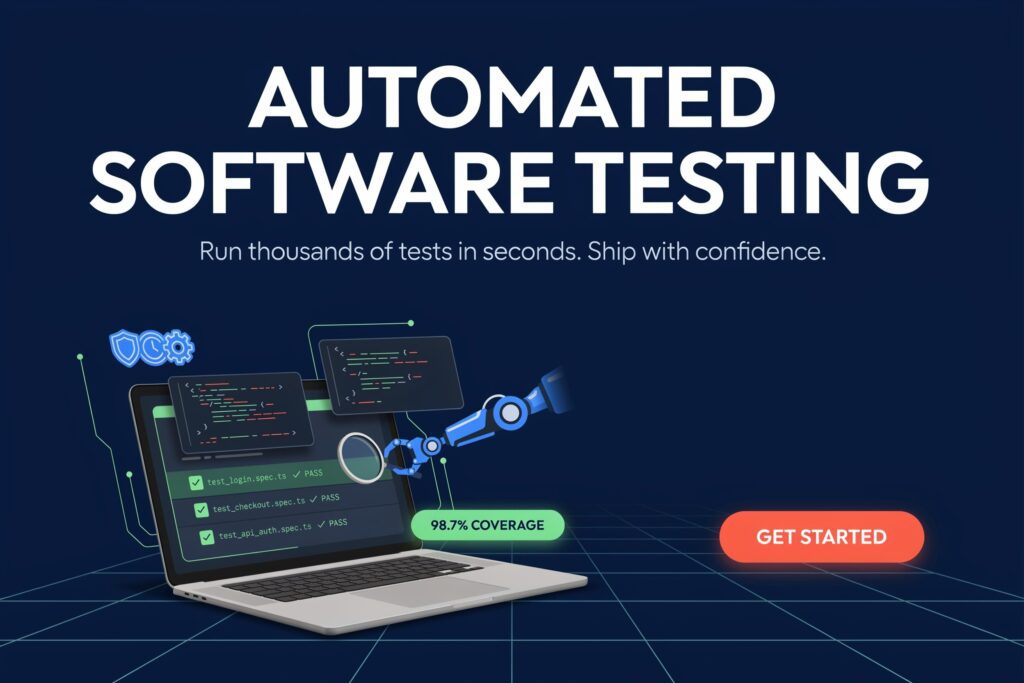
Simplest version: it’s using code to test your code.
Instead of Priya clicking through a login screen to verify it still works after a deployment, a script does it. In three seconds. Every single time. Across Chrome, Firefox, Safari, and Edge if you want. On a schedule. In the middle of the night.
That’s what is automated software testing at its core. But the actual practice runs a lot deeper than that one image.
Automation in software testing touches unit tests that verify individual functions. Integration tests that verify how components talk to each other. End-to-end tests that walk through complete user flows like a real person would. API tests that confirm your backend returns what it’s supposed to. Performance tests that simulate five thousand users hitting your system at once to see what breaks first.
It’s a whole discipline. Not one tool. Not one script. A discipline.
And it lives inside the software development lifecycle from the beginning — or at least, it should.
Let’s skip the abstract benefits and get to the stuff that actually matters to teams.
You can’t test manually at modern release speed. Teams practicing DevOps testing and Agile testing in places like Austin, Texas and Seattle, Washington are pushing code to production daily. Sometimes multiple times a day. A human QA tester checking 200 scenarios before each push isn’t just slow — it’s physically impossible. Continuous testing built into your CI/CD pipeline is the only thing that scales.
Bugs found late are expensive. There’s a rule of thumb in the industry: a bug found in production costs roughly fifteen times more to fix than one caught during testing. That ratio gets worse the longer it sits. Automated QA testing finds things early. Where the fixes are cheap and the damage is contained.
Regression is the silent killer. This is the part nobody warns new engineering managers about. Your software works great today. You add a feature next week. And suddenly something that worked perfectly for two years quietly stops working. Nobody catches it for three days. Automated regression testing exists specifically to prevent this. It re-runs your existing test coverage against every new build. Automatically.
Manual testers burn out. Priya was a great QA engineer. Running the same repetitive test cases week after week is a waste of her skills. Automation vs manual software testing isn’t about replacing people — it’s about freeing them up to do the work that actually requires a human brain. Exploratory testing. Edge cases. Usability. The stuff scripts can’t judge.
Software quality is a business issue, not just a technical one. Leadership teams from New York to San Diego are starting to understand this. Software reliability isn’t IT’s problem. It’s a customer retention problem. A revenue problem. A reputation problem. Investing in quality assurance automation is investing in the business.
Walk through the actual steps. No fluff.
Not everything should be automated. Say that again slowly. Not. Everything.
Tests that make strong candidates for automation:
Tests that are usually better done manually:
The honest answer to which software tests can be automated is: the ones stable enough that a script won’t break every time the UI changes, and important enough to run frequently.
This decision shapes everything downstream. The test automation framework you pick determines how your tests are written, how they’re maintained, how fast they run, and how readable they are six months later.
Here’s what teams across the U.S. are actually using:
Selenium testing — the old standard. Browser automation that’s been around since 2004. Huge ecosystem. Works with Java, Python, JavaScript, and more. Most enterprises in cities like Chicago and Dallas have Selenium baked into their pipelines. It’s not the flashiest anymore but it’s dependable.
Cypress testing — built for modern JavaScript-heavy web apps. Runs inside the browser instead of controlling it from outside. Tests are faster to write and easier to debug. Massive adoption among startups and product companies in San Francisco and New York over the last few years.
Playwright testing — Microsoft’s entry. Cross-browser by default, supports multiple languages, handles async interactions cleanly. Growing fast. Especially popular with teams that got frustrated with Selenium’s setup overhead.
JUnit testing — the Java world’s standard unit testing library. If your backend is Java, JUnit is almost certainly already in your stack. Same category: TestNG.
pytest for Python teams. Clean syntax. Excellent for automated software testing with Python. The plugin ecosystem is enormous.
Automated test scripts are, at the end of the day, just code. They tell the testing tool: navigate here, do this, expect this result.
A Cypress test for a login flow might look like: visit the login page, type a username, type a password, click submit, assert that the dashboard loads. Simple to describe. Simple to read later. A good software test automation engineer writes tests that are as readable as documentation.
The test scripts feed into your test cases — the defined scenarios you’ve decided matter. Managing those test cases, knowing which ones cover which features, tracking test coverage — that’s test management. It’s its own discipline and it matters more than people initially expect.
This is the step that transforms automated testing from a theoretical improvement into a real one.
CI/CD testing means every pull request, every merge, every deployment triggers your test suite automatically. No manual invocation. No forgetting. The pipeline runs, the tests run, the results appear. If something fails, the pipeline stops and alerts the team. If everything passes, the code moves forward.
For DevOps testing and Agile testing teams, this integration is the backbone of fast, safe delivery. It’s how engineering teams in Denver and Boston and Atlanta ship constantly without constant fear.
Test maintenance is the part of automated testing nobody glamorizes — but it’s where automation programs either survive or die.
Your application changes. Buttons get moved. Pages get redesigned. APIs get versioned. When that happens, tests break. Not because the feature is broken — because the test script is pointing at something that no longer exists in the same way.
Teams that neglect test maintenance end up with huge numbers of failing or flaky tests. And once your team stops trusting the test results, the whole automation program loses its value. Keeping tests green and current is real, ongoing work.
Every release, re-run everything that was working before. Confirm it still works. Catch anything the new code broke without meaning to.
This is the type of testing that most directly prevents the “we deployed a fix and broke three other things” problem. Automated regression testing software runs these checks automatically on every build. Teams in Minneapolis and Portland and Houston use it as a non-negotiable part of their release gate.
Does the software do what it’s supposed to do? Automated functional testing validates features against requirements. Can a user complete the signup flow? Does the search return correct results? Does the coupon code apply correctly? Automated functional testing software covers the scenarios your product manager cares about most.
Automated performance testing answers the question: what happens when a lot of people use this at once?
Load testing simulates hundreds or thousands of simultaneous users. It finds the breaking points before real users do. For any team running e-commerce, SaaS, or consumer apps — especially heading into high-traffic periods — skipping performance testing is a gamble that rarely ends well. Teams in Atlanta, Phoenix, and Los Angeles with seasonal traffic spikes know this the hard way.
Modern software is largely APIs talking to APIs. Automated API testing validates those interfaces — correct responses, proper error handling, authentication behavior, response times. It’s fast to run and catches integration problems early. Essential for microservices-based architectures.
Automated UI testing software drives a real browser like a user would. Click this. Type this. Navigate here. Verify this element appears. It’s slower than API or unit testing but it catches bugs that only show up in the actual user interface — the things users will hit first.
Full user journeys. A user arrives at your app, creates an account, completes an action, receives a confirmation. The whole flow, automated. End-to-end testing is the slowest type to run but the most realistic. It catches integration failures that unit and API tests won’t see.
The foundation. Unit testing tests individual functions in isolation. Fast. Cheap. Run thousands of them in seconds. The first layer of defense. Every serious software test automation engineer starts here.
The question “what are the best automated software testing tools” or “best automated testing software” comes up constantly. Real answer: no single tool does everything. Most mature teams run a stack.
Here’s what that typically looks like in practice:
For web UI testing: Selenium, Cypress, or Playwright. Most teams pick one based on their frontend stack and team preference.
For unit and integration testing: JUnit or TestNG for Java. pytest for Python. Jest or Mocha for JavaScript/Node.
For API testing: Postman with Newman for automation. REST-assured for Java teams. HTTPx or requests-based pytest suites for Python.
For performance and load testing: Apache JMeter, Gatling, or k6. JMeter is the most widely deployed across enterprise teams in the U.S.
For mobile app testing: Appium for cross-platform mobile automation across iOS and Android.
For security: OWASP ZAP or Burp Suite for automated penetration testing software integrated into the pipeline.
This is what a software automated testing tools comparison actually produces when you look at what real teams run. Not one winner. A purposeful combination built around your stack, your team, and what you’re shipping.
Automated Software Testing for Web and Mobile Apps
Automated testing for web applications has to account for browser diversity, JavaScript rendering, responsive layouts, and dynamic content. A test that passes in Chrome needs to pass in Firefox. A flow that works on a desktop needs to work on a phone screen.
Cross-browser automated testing with Playwright or Selenium is the standard approach. For teams building web applications with Asapp Studio, we integrate browser automation testing as part of the delivery.
Automated testing for mobile apps is a different beast. Appium is the go-to for native and hybrid mobile apps, supporting both iOS and Android. Combined with cloud device farms that run tests on real physical devices in parallel, it’s the closest thing to comprehensive coverage short of putting the app in front of every possible phone.
For teams building apps with React Native or Flutter, the testing approach differs from native. Cross-platform apps need cross-platform test strategies — not just ported desktop test scripts.
Different rules apply here. Completely different.
Automated software testing in healthcare operates under regulatory pressure that most software industries don’t face. HIPAA compliance. EHR integration accuracy. HL7/FHIR protocol validation. In environments where a software error isn’t just a bad user experience but a potential clinical risk, the standards for test coverage and documentation are substantially higher.
Healthcare software test automation requires validation documentation that passes the audit. Test scripts that are traceable to requirements. Coverage reports that stand up to regulatory review. It’s not just about catching bugs — it’s about proving to regulators that you caught bugs.
Teams building healthcare software in Texas, Illinois, and Massachusetts are navigating this every day. The automated software testing as a service model has grown in healthcare specifically because the specialized expertise required — both technical and regulatory — is hard to build in-house.
Our team at Asapp Studio has worked through healthcare software projects where the testing requirements were as complex as the software itself. It’s a different conversation than a standard SaaS project, and it deserves to be treated that way.
This debate gets oversimplified constantly. Let’s be direct about it.
Automation wins for:
Manual testing wins for:
Software testing manuals and automation aren’t competing philosophies. They’re complementary tools. The software testing manual vs automation argument is usually made by people who haven’t shipped software under real pressure. Teams that have — in New York, in Austin, in Chicago — know they need both. The question is how to divide the work intelligently.
Automation vs manual software testing in practice: automate everything stable and repetitive. Give manual testers back their time for judgment work. That’s the model.
Not every team builds this from scratch. Not every team should.
Automated software testing as a service — sometimes called software testing automation services or software automated testing services — gives companies access to expert testing infrastructure, tooling, and talent without hiring and managing a dedicated internal team.
This works well for:
If you’re evaluating software test automation companies or looking for an automated software testing company to partner with — not just deliver scripts — reach out to our team at Asapp Studio. We’ve worked with clients across California, Texas, Ohio, and beyond on building testing programs that actually stick.
AI in automated software testing is moving faster than most teams are tracking.
AI-powered tools now generate test cases from user stories. They predict which tests are most likely to catch new bugs — so you can run a smart subset instead of the full suite on every small change. They self-heal test scripts when the UI changes, reducing the test maintenance burden that kills most automation programs eventually.
This is what automated testing in software engineering looks like in 2025. It’s not just scripts anymore. It’s intelligent systems that get smarter about what to test and how to test it.
Pairing proper automation infrastructure with AI capabilities is where the most competitive software teams are headed. The teams that figure this out early are going to have a real advantage over the ones still running brittle, manually-maintained test suites.
A software test automation strategy that actually holds together over time is built on a few principles that sound obvious but are surprisingly often ignored:
Build the testing pyramid deliberately. Lots of cheap unit tests. Moderate integration tests. Fewer expensive end-to-end tests. Don’t invert this. Heavily end-to-end-weighted suites are slow, brittle, and expensive to maintain.
Own the test data problem early. Unstable test data is the number-one cause of flaky, unreliable tests. Fix this before you have thousands of scripts depending on messy data.
Keep execution fast. A test suite that takes four hours doesn’t enable rapid development. Parallelize. Prioritize. Cut low-value tests ruthlessly.
Make tests a team responsibility. Not just QA’s job. Not siloed away from development. The QA process works best when developers are writing unit tests, QA engineers are building integration and E2E coverage, and everyone treats a failing test as their problem to fix.
Track the right metrics. How do companies typically measure the ROI of their automated testing efforts? Time to release. Production incident rate. Cost per defect found. Deployment frequency. These numbers tell a story. Read them.
What are QA testers in the context of automation? They’re engineers. Not just manual checkers.
A modern software test automation engineer writes code, designs test architecture, makes tool decisions, and thinks about risk. They understand the product deeply enough to know what matters most to test and are clever enough to build automation that doesn’t become a burden.
The software automation testing jobs market right now is strong. Companies from coast to coast are hiring people who can both understand QA theory and build practical automation pipelines. If you’re building a team, the combination of domain knowledge and coding ability is the hire. If you’re already in this field — the job market in the U.S. will remain favorable for years.
Yes. Proportionally.
A four-person startup in Nashville doesn’t need the same infrastructure as a 500-person engineering org. But even at small scale — a handful of unit tests for your core logic, one or two end-to-end tests for the flows users depend on most, basic CI/CD integration with GitHub Actions — the time savings and the peace of mind compound fast.
Is automated testing worth it even when your team is small? The real question is: how much does a production bug cost you? Multiply that by how often you expect to ship without proper coverage. That’s the number you’re gambling with every week you skip it.
The story has an ending worth telling.
After that $40,000 payment bug, Jordan’s company brought in help. Built a proper automated software testing program. Cypress for the frontend, pytest for the API layer, the whole thing wired into their GitHub pipeline so every PR triggered a full run.
Priya stopped running repetitive scripts. She started doing exploratory testing. Finding the weird edge cases that automated tools don’t find. Documenting them. Improving the product in ways that actually require a human.
Three release cycles later, Jordan put it like this: “We’re shipping faster than before. And I’m not anxious about it anymore.”
That’s the thing people don’t say enough about automated software testing benefits. It’s not just about catching bugs. It’s about the confidence to move. The ability to ship without that knot in your stomach.
That confidence is what you’re really building.
Whether you’re starting from zero or trying to fix a broken automation program, Asapp Studio’s quality assurance team has done this before. Across industries. Across stack types. For teams in California, Texas, Illinois, and across the U.S.
Let’s talk about what your team actually needs.
Q1: What is automated software testing?
It uses tools and scripts to run tests on software automatically — no manual clicking. Validates features fast, catches bugs early, and scales with your release speed.
Q2: What is the difference between manual and automated software testing?
Manual testing uses human testers. Automated testing uses scripts. Both are needed — automation handles repetition, manual handles judgment-based exploratory work.
Q3: What are the best tools for automated software testing?
Selenium, Cypress, Playwright for web UI. pytest or JUnit for unit tests. Postman for APIs. JMeter for load. No single tool wins — teams use a combination.
Q4: Is automated software testing worth it for small businesses?
Yes. Even basic unit tests and one end-to-end flow in a simple CI/CD setup save real time, reduce bugs, and give small teams confidence to ship faster.
Q5: How does automated testing support DevOps and CI/CD?
Automated tests run on every code push inside the pipeline — catching failures before deployment, keeping releases fast without sacrificing software reliability.