
Marcus ran a mid-size subscription software company out of Austin, Texas. Nothing flashy — B2B tools for project management. About 4,000 paying customers. Monthly recurring revenue was solid. Growing, even.
Then one Tuesday morning, his support inbox blew up.
Transactions failing. Cards being declined that had worked the week before. Customers getting double-charged. Three enterprise clients in Chicago called directly, threatening to cancel. His payment processor — an off-the-shelf provider he’d plugged in three years ago — had pushed an update over the weekend. Broke his checkout flow. And the provider’s payment gateway customer service line had a 47-minute hold time.
He lost $18,000 in that single day.
That story isn’t unusual. Businesses across the United States — from Dallas retail brands to Seattle SaaS startups — have learned the hard way what happens when your payment infrastructure isn’t yours. When you’re renting the road your money travels on, someone else sets the speed limits.
That’s exactly why custom payment gateway development has become one of the most talked-about investments in fintech payment infrastructure right now. Let’s break down what it actually means, how it works, and whether building a custom payment gateway is the right move for your business.
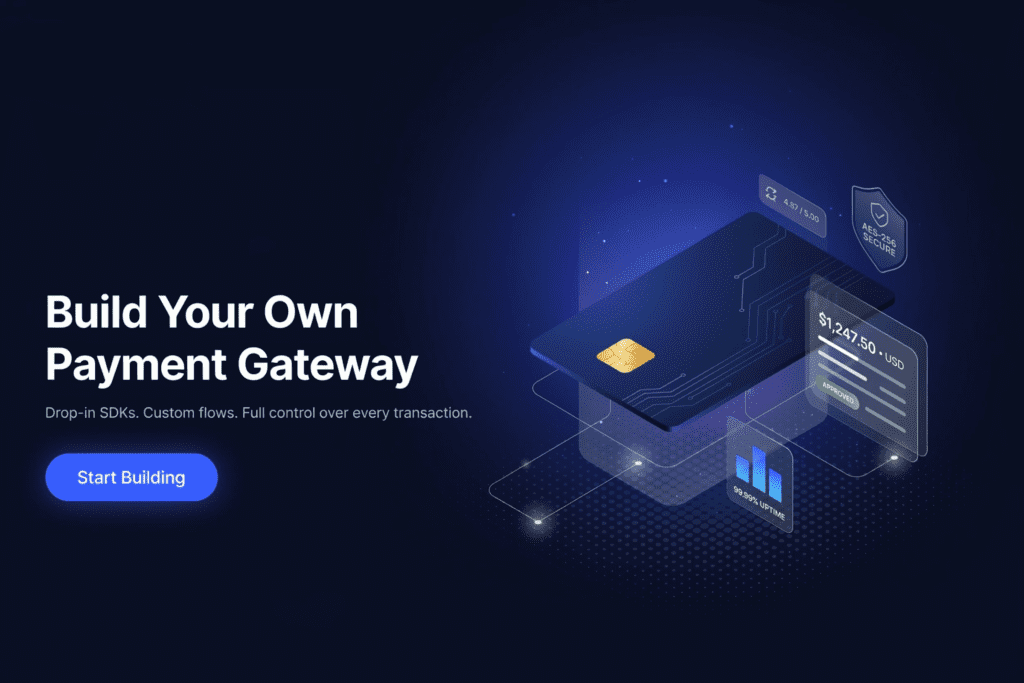
Most people hear “payment gateway” and think of a checkout button. That’s the visible tip. What’s underneath is a full transaction monitoring system — request capture, encryption, routing, bank authorization, response handling, settlement, and fraud checks — all happening in roughly two seconds.
A custom payment gateway is one your business owns, controls, and can shape around your exact technical and commercial needs. No vendor lock-in. No shared infrastructure. No off-the-shelf logic telling your checkout what it can and can’t do.
What is custom payment? Put simply: every rule, every flow, every integration is written for you. Not for a thousand other businesses who also pay the same SaaS fee.
Custom payment processing means your transaction pipeline behaves the way your business model demands — not the way a product manager in San Francisco decided the average merchant should work.
This is where numbers actually start to matter.
Standard gateways — Stripe, PayPal, Braintree — are genuinely excellent for early-stage businesses. They’re fast to deploy, developer-friendly, and handle compliance out of the box. Nobody’s saying otherwise.
But custom vs standard payment gateways error rates diverge meaningfully at scale. Standard providers apply universal fraud filters that occasionally reject legitimate transactions — a phenomenon called false positives. Depending on the vertical, false positive rates on shared gateways can run between 2% and 8%. For a company processing $5 million per month, even a 3% false positive rate means $150,000 in monthly revenue just walking out the door.
Custom payment gateway architecture lets you tune fraud prevention tools to your actual customer behavior. A returning subscriber in Miami who’s bought from you 24 times should not be blocked because their purchase pattern triggered a rule built for a retail business in New Jersey. A bespoke payment gateway knows the difference.
This is the question every technical founder and CTO in the country eventually types into Google: how to build a custom payment gateway from scratch?
It’s a fair question. And the honest answer is: it’s not simple, but it’s absolutely doable with the right team.
Here’s what the core custom payment gateway architecture looks like:
1. Payment API Layer Everything starts here. Your custom payment gateway API is the interface your front-end talks to. It captures card data (or bank data, or wallet data), tokenizes it immediately so raw card numbers never touch your servers, and passes a secure token downstream. A solid developer friendly payment API is what separates a gateway that engineers actually enjoy integrating from one they dread.
2. Transaction Routing Engine This is the part most businesses never see with off-the-shelf solutions. Your routing engine decides which acquiring bank or processor handles each transaction. Smart payment orchestration means if one processor is experiencing downtime or high decline rates, traffic automatically shifts. Your customers never notice. Your revenue doesn’t take a hit.
3. Fraud Prevention Layer Your fraud prevention tools run here — velocity checks, device fingerprinting, behavioral analysis, geolocation validation. With a custom solution, you define what “suspicious” looks like for your customer base. That’s a meaningful advantage over shared rule sets.
4. Settlement and Reconciliation After authorization comes settlement. Your system handles the actual movement of money, matched to orders, invoices, or subscription events. Clean online transaction processing with proper audit trails makes your accounting team significantly less miserable.
5. Compliance and Security Module PCI DSS compliance isn’t optional — it’s federal-level expectation in the United States. Your custom system needs to meet Payment Card Industry Data Security Standards, which govern how card data is stored, transmitted, and processed. A properly architected secure payment processing layer handles tokenization, encryption at rest, and TLS in transit. Non-negotiable.
One of the most common practical questions businesses ask: how does custom payment gateway integration actually fit into existing platforms?
Custom Payment Gateway for WooCommerce
If your e-commerce store runs on WordPress with WooCommerce, you’re not locked into Stripe or PayPal. WooCommerce has a clear extension API. A custom payment gateway for WooCommerce hooks directly into the checkout action, passes data to your own processing endpoint, and returns success/failure states back to the WooCommerce order flow. Merchants in Phoenix and Portland have been doing this for years to get lower processing fees and cleaner checkout experiences. The how to create custom payment gateway in WooCommerce process is well-documented at the developer level — your team needs PHP familiarity and a solid understanding of the WooCommerce payment gateway class.
Custom Payment Gateway for Webflow
Webflow custom payment gateway integration is a slightly different animal since Webflow’s native e-commerce has limited hooks. Most implementations use Webflow’s CMS + custom code embeds + a headless checkout approach, where your payment gateway API handles the transaction logic and Webflow handles the front-end rendering. Clean, fast, and gives Webflow merchants the control they usually have to give up.
BigCommerce Custom Payment Gateway
BigCommerce has a robust payment provider API. A BigCommerce custom payment gateway integration connects through their hosted payment page or direct API methods — the latter giving you full control over the checkout UI and transaction flow. Enterprises in Houston and Minneapolis running high-volume BigCommerce stores often go this route to reduce per-transaction fees and enable multi currency payment gateway support for international buyers.
How to Set Up Custom Payment Gateway in Shopify
Shopify is a bit more controlled. Their Payments Platform requires going through the Shopify Partner API. How to set up a custom payment gateway in Shopify typically means becoming a registered payment provider or using a Shopify Plus account with access to their payment customization APIs. For high-volume Shopify merchants, the ROI on this work is real — particularly for businesses needing recurring payments integration or very specific checkout logic.
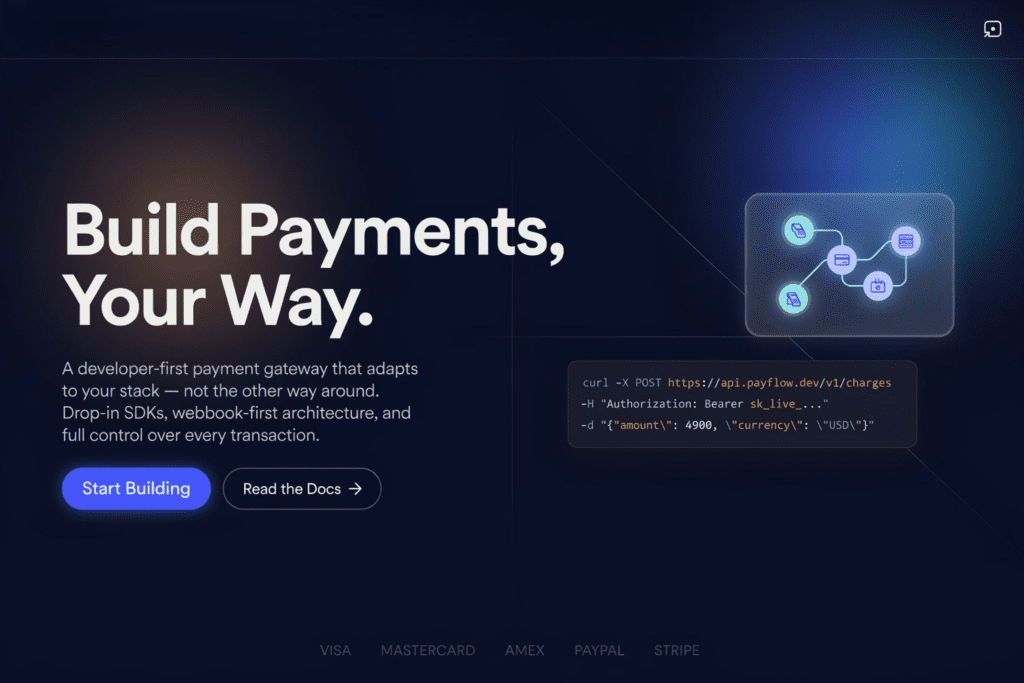
A white label payment gateway is a middle path between fully custom-built and off-the-shelf. You take a payment infrastructure that already exists — built, certified, and maintained — and put your branding on the customer-facing pieces.
For fintech startups in San Francisco, New York, or Chicago launching a white label payment gateway solution, this dramatically cuts time to market. You’re not rebuilding the acquiring relationships, the PCI infrastructure, or the bank connectivity from scratch. You’re customizing the experience and business logic on top of a proven base.
This is different from a fully bespoke payment gateway in that you don’t own the underlying infrastructure. But for many businesses — especially those offering merchant payment solutions to other businesses — it’s exactly the right tradeoff.
Let’s be direct about the cost to build custom payment gateway realities.
A basic custom gateway with standard card processing, fraud tools, and PCI compliance sits somewhere between $50,000 and $150,000 in development cost, depending on complexity, team location, and feature scope. An enterprise payment gateway with multi-acquirer routing, multi currency payment gateway support, and advanced payment orchestration can run significantly higher.
So is building a custom payment processor worth the ROI?
It depends on volume and margin. The math is straightforward:
Standard gateways charge 2.5% to 3.5% per transaction. A merchant processing $2 million per month at 3% pays $60,000 monthly in gateway fees. A custom processor — properly set up with direct acquiring relationships — might bring that to 0.5% to 1.2%. The monthly savings: $36,000 to $50,000. Development cost recovers in three to five months.
That’s before you factor in the value of reduced false positives, better checkout conversion, and the ability to handle custom logic like split payments, deferred billing, and B2B custom payment processing scenarios that off-the-shelf tools handle badly.
For businesses doing less than $500K per month, the ROI is harder to justify. For businesses north of $1 million per month in transaction volume, custom payment gateway development almost always wins on paper.
People ask this constantly. Custom payment gateway vs Stripe/PayPal — who wins?
Neither, always. It depends on where you are.
Stripe is an incredible product. Fast to integrate, excellent payment gateway API documentation, reliable uptime, strong fraud tooling. For a startup in Nashville just getting their first few hundred customers, Stripe is the right answer. Don’t fight that.
The moment you outgrow Stripe is when things get expensive and inflexible. Stripe’s pricing doesn’t really negotiate below a certain threshold. Their fraud rules can’t be fully overridden. Their payout schedules are fixed. Their dispute process has quirks that favor buyers in ways some merchant categories find punishing.
A custom payment gateway solution gives you:
At the same time, a custom gateway means you own the compliance burden, the infrastructure costs, and the maintenance. That’s real. It’s not a reason to avoid it — it’s a reason to go in with eyes open and the right development partner.
Custom Payment Gateway Teachable / Teachable Custom Payment Gateway
Online course platforms like Teachable have their own native checkout. But creators running high-volume course businesses in Los Angeles or New York often want to move payments off Teachable’s native system to avoid their transaction fees (which can be meaningful on creator businesses doing $50K+ per month). A custom payment gateway Teachable setup typically routes through a custom checkout page that redirects after Teachable enrollment logic fires, or uses Teachable’s API-based enrollment with an external checkout. The teachable custom payment gateway use case is real and more common than people think.
Custom Payment Gateway WordPress
Beyond WooCommerce, custom payment gateway WordPress implementations exist for membership sites, event ticketing, donation platforms, and course sites running on LMS plugins. The custom payment method in WordPress typically uses a custom plugin that registers a WooCommerce-compatible payment gateway class, even if the actual payment logic lives on an external API.
B2B Custom Payment Processing
B2B transactions are structurally different from retail. Purchase orders, net terms, ACH rather than cards, multi-level approval flows, high-value single transactions. A generic retail-focused gateway handles B2B awkwardly at best. B2B custom payment processing with proper invoice matching, approval workflows, and recurring payments integration for subscription contracts is an entirely different animal — and one that standard gateways weren’t designed for.
People sometimes confuse custom payment meaning with “branded checkout skin.” That’s too narrow.
True custom payment infrastructure means:
What is a custom payment service? It’s the complete stack — from the moment a buyer clicks “pay” to the moment funds settle in your bank account — operating under your control, your rules, and your brand.
For businesses wondering how to integrate custom payment gateway into their stack, here’s a realistic picture of the development lifecycle:
Discovery and Scoping (2–4 weeks) Define transaction types, volumes, currencies, platforms, compliance requirements, and integration points. Map out the payment gateway architecture that fits your business model.
Core API and Gateway Development (8–16 weeks) Build the custom payment gateway API, tokenization layer, routing engine, and fraud module. Set up sandbox environments for testing. This is the heaviest lift — where your developers earn their keep.
Platform Integrations (4–8 weeks) Wire the gateway into your front-end, whether that’s custom payment gateway for WooCommerce, a webflow custom payment gateway implementation, a Shopify integration, or a proprietary checkout. Each platform has its own quirks.
PCI DSS Certification and Security Audit (4–8 weeks) Mandatory. Every US-based business handling card data needs to pass their appropriate PCI DSS level assessment. Your custom system gets audited — penetration tested, code reviewed, infrastructure assessed.
QA and Load Testing (3–4 weeks) Our Quality Assurance team stress-tests the gateway under simulated peak load. Transaction failures under load are catastrophic. You find them in testing, not during your Black Friday spike.
Launch and Monitoring Go live in stages. Start with a percentage of traffic, monitor your transaction monitoring system dashboards, watch for anomalies, and scale up. Full cutover happens only after the system proves itself under real conditions.
Some businesses in the US — particularly fintech startups in New York, San Francisco, and Miami — are building fintech payment infrastructure from scratch. Full acquiring sponsorship, direct card network membership, the works. That’s a multi-year, multi-million-dollar journey.
Most businesses don’t need to go that far. What they need is a custom payment gateway solution that gives them control over their checkout logic, their data, and their cost structure — without rebuilding Visa from scratch.
The sweet spot is a custom-built gateway layer that sits on top of existing acquiring infrastructure. You write your own custom payment gateway API. You control your routing, your fraud rules, your checkout experience. But the actual acquiring relationship — the thing that connects to Visa, Mastercard, and the ACH network — can be through a licensed payments partner.
This is how most serious enterprise payment gateway deployments are structured. And it’s a sensible approach for businesses that need control without a decade of regulatory licensing work.
Our Software Development Services team at Asapp Studio works with businesses across the United States to architect and build exactly this kind of solution — whether you’re starting from scratch or migrating away from an off-the-shelf provider.
For the developers in the room reading this, here are the things that trip up most custom payment gateway builds:
Idempotency keys are non-negotiable. Network failures happen. A payment request might be sent twice. Your gateway must recognize duplicate requests and not double-charge. Every payment API endpoint that creates a transaction needs idempotency handling.
Webhook retry logic is underestimated. When your gateway fires a webhook to notify your platform of a completed payment, that webhook might fail. You need retry logic with exponential backoff and dead-letter queues for failed events.
Card data tokenization happens before anything else. Raw PANs (Primary Account Numbers) should never be logged, stored in databases, or passed through application layers. Tokenize at the point of capture. Every time.
Multi currency payment gateway math is tricky. Exchange rate timing, settlement currency mismatches, and FX fee disclosure to cardholders all have compliance implications. Get this right early — retrofitting currency logic is painful.
Test with real decline scenarios. Most developers test the happy path — successful authorizations. Your QA process needs to simulate insufficient funds, expired cards, AVS mismatches, and network timeouts. All of them.
Our Web Development and Software Development teams have walked this path many times. The gotchas above are almost universal.
Here’s something the conversion rate optimization community has known for years: checkout is where revenue dies.
The average e-commerce checkout abandonment rate in the United States sits above 70%. A meaningful portion of that abandonment is friction — too many steps, unfamiliar payment interfaces, lack of trust signals, payment methods that don’t match buyer preferences.
A custom checkout experience — one you fully control — lets you eliminate that friction surgically. Saved payment methods that remember your customers. One-click purchasing for repeat buyers. Native payment flows that don’t redirect to a third-party page and lose brand trust. Region-specific payment methods that matter to buyers in specific US markets.
When Asapp Studio builds a custom payment gateway solution for a client, the checkout UX is part of the conversation from day one. Not an afterthought. The payment flow is a product feature — one that directly affects your revenue. Treat it that way.
Our UI/UX Services team works directly with payment engineering to make sure the experience matches the capability underneath.
If you’re evaluating options — whether to build or to use a specialized custom payment gateway provider as a starting point — here’s what actually matters:
Ownership of data. Can you export your full transaction history? Can you run your own analytics? If the answer is “only what we give you,” that’s not truly custom.
API flexibility. Can the payment gateway API handle your specific transaction types, webhooks, and integration patterns? Or does it force you into their data model?
Fraud rule control. Can you define your own fraud prevention tools logic? Or are you stuck with their shared rule set?
PCI scope. Who holds PCI compliance? If your vendor holds it, what happens if they get breached? Shared liability is still liability.
Uptime and support. What’s the SLA? What’s the payment gateway customer service escalation path when something breaks at 2am on a Sunday?
Recurring payments. Does it natively support recurring payments integration with retry logic, dunning management, and subscription lifecycle events?
Remember Marcus from Austin? After that painful Tuesday, he called three developers. Two told him to “just switch to Braintree.” One laid out a roadmap for a proper custom payment gateway development project.
Six months later, Marcus’s company had a bespoke payment gateway running on their own infrastructure. Their false positive rate dropped from 4.2% to 0.8%. Processing costs went from 2.9% to 1.1%. And when their biggest enterprise client in Chicago asked for a custom invoicing integration with net-30 terms and ACH settlement — something their old provider flat-out refused to build — Marcus’s team deployed it in two weeks.
That’s what custom payment gateway ownership actually looks like. Not just lower fees. Control. Reliability. The ability to build what your customers need.
Businesses in Seattle, Denver, Miami, Atlanta, Houston — across the United States — are making this shift. Not because it’s trendy. Because it works.
If you’re ready to explore what a custom payment gateway solution could look like for your specific business model, our team at Asapp Studio builds exactly this. From initial architecture through launch and ongoing support. Contact us and let’s talk about your payment infrastructure.
Q1: What is a custom payment gateway and how does it differ from Stripe or PayPal?
A custom payment gateway is a payment system your business owns and controls. Unlike Stripe or PayPal, it uses your rules, your branding, your data, and your pricing agreements with acquiring banks.
Q2: How much does it cost to build a custom payment gateway in the US?
Development costs typically range from $50,000 to $200,000+ depending on complexity, feature scope, and compliance requirements like PCI DSS certification and multi-currency support.
Q3: Is a custom payment gateway worth it for small businesses?
For merchants processing under $500K monthly, standard gateways usually win. Above $1M monthly, custom gateways recover build costs quickly through lower transaction fees and fewer false declines.
Q4: How long does custom payment gateway integration take to complete?
A full build — API, fraud tools, platform integrations, PCI certification, and QA — typically takes four to eight months depending on team size and platform complexity involved.
Q5: Can a custom payment gateway support WooCommerce, Shopify, and BigCommerce?
Yes. A well-architected custom gateway API can integrate with WooCommerce, BigCommerce, Shopify Plus, Webflow, and most major platforms through their respective payment extension APIs.